


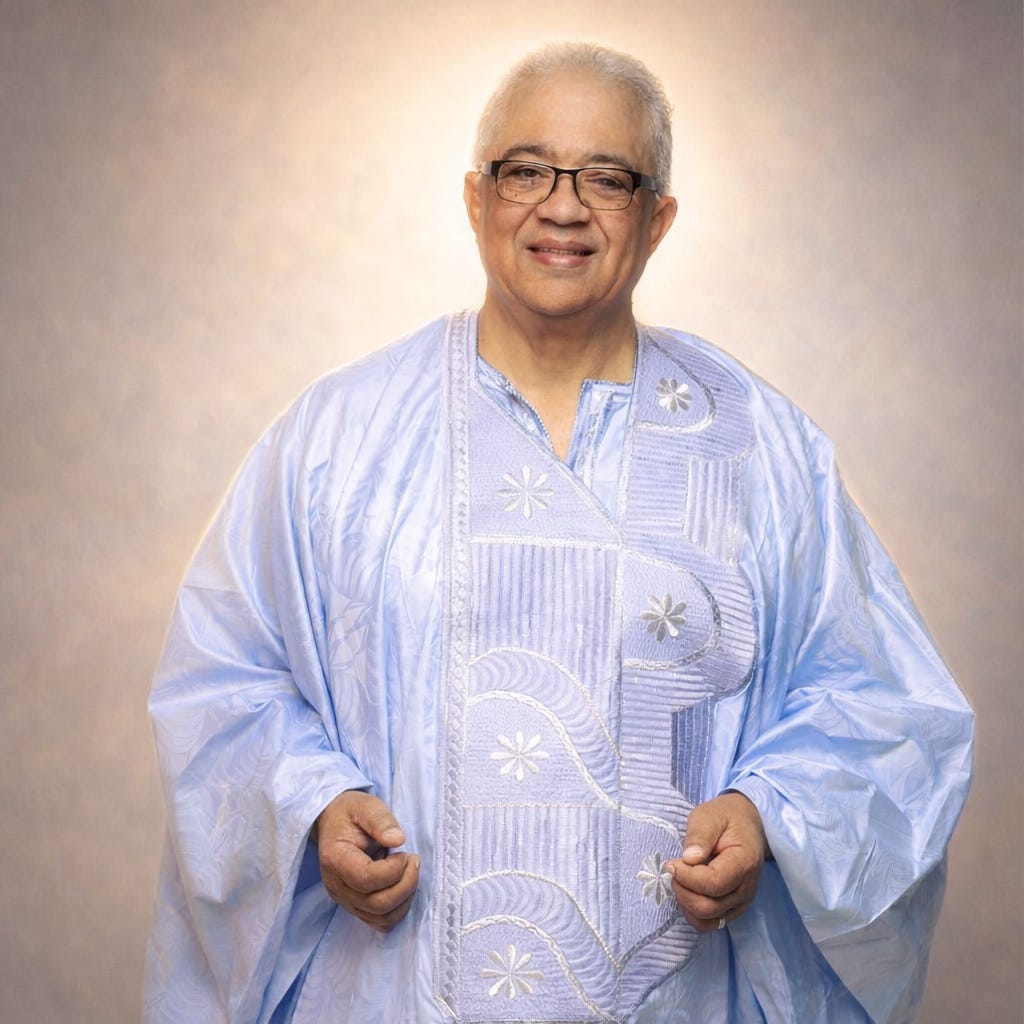
Early yesterday, I received word that Dr. Charles S. Finch III has transitioned to Ancestorhood, and with that knowing came a quiet pause—one of those moments when memory, gratitude, and lineage converge.
For me, Dr. Finch has been a personal point of Light since 1996.
That year marked an early stage in my own awakening—intellectually, spiritually, and ethically—to the deeper histories of humanity and to the responsibilities that accompany such knowledge. At a time when much of the public discourse surrounding African civilizations was marginalised, distorted, or treated as speculative, Dr. Finch stood with clarity and composure. He did not posture. He did not shout. He simply knew—and shared that knowing with generosity and rigour. His presence at one of my early initiations; his recommendation of me for a panel at the Apex Museum in Atlanta—where he himself was unable to participate; and his later participation in an event held for me shortly before my decamping from Atlanta for Iowa to resume graduate study, remain among my most cherished memories.
That same spirit of generosity extended beyond conversation and counsel. In the early years of Radical Scholar, Dr. Finch graciously agreed to serve on its Board of Advisors—an act that carried both practical and symbolic weight. His willingness to lend his name, discernment, and intellectual presence to a fledgling project affirmed not only the seriousness of the endeavour, but the necessity of creating spaces where rigorous scholarship, ethical responsibility, and expansive human history could coexist without compromise. For me, this gesture represented a quiet but meaningful vote of confidence—one rooted not in ambition, but in alignment.
Dr. Finch’s work moved with a rare steadiness between worlds. Trained as a physician and serving as both a professor and Director of International Medicine at Morehouse School of Medicine, he was equally at home discussing mitochondrial DNA, ancient Nile Valley civilizations, comparative mythology, and the long arc of human evolution. For those of us searching for coherence between science, history, and spirit, his presence quietly affirmed that such coherence was not only possible—it was necessary.
What distinguished him most, however, was not merely the breadth of his scholarship, but the moral orientation with which he carried it. He understood that reclaiming deep human history was not an exercise in nostalgia or counter-mythmaking. It was an act of repair. A rebalancing. A restoration of dignity where distortion had long prevailed.
His scholarship was perhaps most fully articulated in three early works published between 1990 and 1998—The African Background to Medical Science, Echoes of the Old Dark Land, and The Star of Deep Beginnings—each of which pressed beyond correction of historical error toward a deeper reimagining of humanity’s intellectual origins.
In January 2008, he graciously agreed to sit for an extended conversation on my former radio programme, Connecting the Dots. The episode—Human Origins and the Future of Humanity—remains one of the most meaningful dialogues I have ever facilitated.
What struck me then, and strikes me even more now in retrospect, was his presence. He was unhurried. Attentive. Open. There was no sense of hierarchy in the exchange, despite the depth of his knowledge and the esteem in which he was rightly held. He treated the conversation as a shared inquiry rather than a performance—an offering rather than a lecture.
We spoke of ancient African civilizations not as relics frozen in time, but as living repositories of insight into human potential. We spoke of origins not as a backward-looking fixation, but as a compass for where humanity might yet go. And throughout the dialogue, Dr. Finch returned—again and again—to a central theme: that humanity’s future depends on its willingness to remember itself truthfully.
That conversation has stayed with me for nearly two decades.
As my own work has unfolded—through teaching, writing, research, and the development of integrative frameworks for understanding consciousness and human development—I have often felt his influence quietly in the background. Not as something to be cited or replicated, but as a standard of integrity. A reminder that scholarship divorced from conscience is incomplete, and that knowledge carried without humility loses its power to heal.
In African cosmological traditions, Ancestors are not gone. They are repositioned. They move from visible participation to guiding presence—from voice to resonance. By that measure, Dr. Finch’s transition is not an ending, but a widening of influence.
He leaves behind not only books, lectures, and recorded conversations, but something less tangible and more enduring: permission. Permission to ask large questions without apology. Permission to integrate disciplines without fragmentation. Permission to speak of humanity as a single, evolving family while still honouring the particular histories that have shaped us.
For that, and for the Light he has provided since 1996, I offer my thanks.
May his memory continue to instruct.
May his work continue to illuminate.
May his presence among the Ancestors strengthen the long work of remembrance and repair.
For me, I welcome—and look forward to—the echoes of his work within my own, offered to those minds ready for a more expansive message.
Suggested Reflection
Sitting with Lineage and Light
(This reflection may be read silently or aloud. Allow 10–15 minutes.)
Begin by settling the body.
Let the spine rise naturally, without strain.
Allow the breath to move as it will—no correction, no effort.
When the mind has softened slightly, bring to awareness a single individual who has served as a point of Light in your life. Someone whose presence clarified rather than constrained. Someone whose way of knowing enlarged your own.
Do not rush to define why they mattered.
Simply notice how they felt in your awareness.
Now, gently reflect:
What questions did this person give you permission to ask?
What forms of courage—intellectual, moral, or spiritual—did their example quietly model?
Where, in your own life, do you find yourself carrying forward something they helped to awaken?
Allow images, phrases, or feelings to arise without forcing coherence. Trust that what matters will surface on its own.
Next, widen the frame.
Consider that this individual did not stand alone. They, too, were shaped by teachers, elders, traditions, and unseen supports. Sense the web of lineage behind them—stretching backward through time, culture, and experience.
Now, notice yourself within that same web.
Without burden or pressure, ask inwardly:
What am I being asked to steward?
What forms of clarity or integrity am I called to pass forward—whether visibly or quietly?
How might remembrance itself be an ethical act?
Rest here for a few breaths.
To close, acknowledge—silently or aloud—that lineage does not end with loss. It reconfigures. It moves from instruction to guidance, from voice to resonance.
When ready, return gently to the room, carrying with you whatever trace of Light has made itself known.
—
About the Author
Dr. Baruti KMT-Sisouvong is a consciousness scholar, executive coach, and Certified Teacher of Transcendental Meditation® based in Cambridge, Massachusetts. His work—spanning The Model for Perpetual Growth and Progress and The Seven Layers of Manifestation—explores how Pure Consciousness, neuroscience, and social-systems transformation intersect in the evolution of both the individual and society.
He is the Founder and Director of Radical Scholar Inc., a nonprofit organization dedicated to consciousness-based research and public scholarship, and President of Serat Group Inc., the parent company of Transcendental Brain, a consulting and educational platform bringing consciousness science into leadership and institutional development. He also serves as Host of the On Transcendence Podcast.
Alongside his wife, Mina, he co-directs the Cambridge and Metropolitan Boston TM Program and serves as Host and Founder of International Meditation Hour (IMH), a quarterly global gathering dedicated to the unifying power of silence.
He writes from the conviction that the most important race is not between nations or machines, but between the conditioned mind and the awakening soul.
To learn more about him, visit: https://www.barutikmtsisouvong.com/.