


Author’s Note
Planet for Peace began, as many worthwhile endeavours do, with someone imagining something that did not yet exist and inviting others to imagine it with him. What followed required conversations, planning, adjustments, differing perspectives, and the willingness of four people to contribute what each could bring to a shared undertaking. By the time we gathered beside the Charles River, the original idea no longer belonged entirely to any one of us. It had become something we had cultivated together.
I have penned this reflection partly because I believe there is value in paying attention to that process. We often encounter finished things without seeing the fragile ideas from which they began. An event, organisation, movement, work of art, or body of scholarship may eventually appear inevitable once it exists, yet there was almost always a moment when it existed only within someone’s imagination. Someone then had to speak the idea aloud, and someone else had to be willing to hear, embrace, and commit to bringing it to fruition.
Not every seed idea will grow, nor should every idea necessarily become what its originator first imagined. Experience tests imagination, other people refine it, and circumstances reshape it. Sometimes what eventually emerges is considerably different from what was initially envisioned. But nothing can be learned from an idea that is never permitted to encounter the world.
Perhaps that is one of the lessons I am carrying forward from Planet for Peace. We planted something. Now we have experience, relationships, and information that did not exist before. What, if anything, grows from them remains to be seen.
—Baruti KMT-Sisouvong, PhD
This past weekend, something that had existed for months as conversations, emails, planning documents, schedules, and possibilities finally became an experience.
We gathered at Riverstage at Herter Park for Planet for Peace, a community gathering organised around meditation, music, and the possibility of global harmony. The weather was pleasant, the programme unfolded smoothly, and although fewer than one hundred people ultimately joined us, those who did created something that numbers alone would have difficulty describing. The experience filled the air.
In reflecting on both the months of planning and many discussions, there is something particularly useful about the moment an event becomes real. Beforehand, nearly everything exists within the realm of imagination—in our case, four idealists enlisted by one of our number. We wondered whether people would come, whether the programme would flow as intended, and whether its different elements would cohere. We also discussed how best to keep participants engaged and whether the experience we were imagining would bear any resemblance to the one people would actually have.Afterward, imagination gave way to something more valuable: experience. And that experience gives us data. Valuable data.
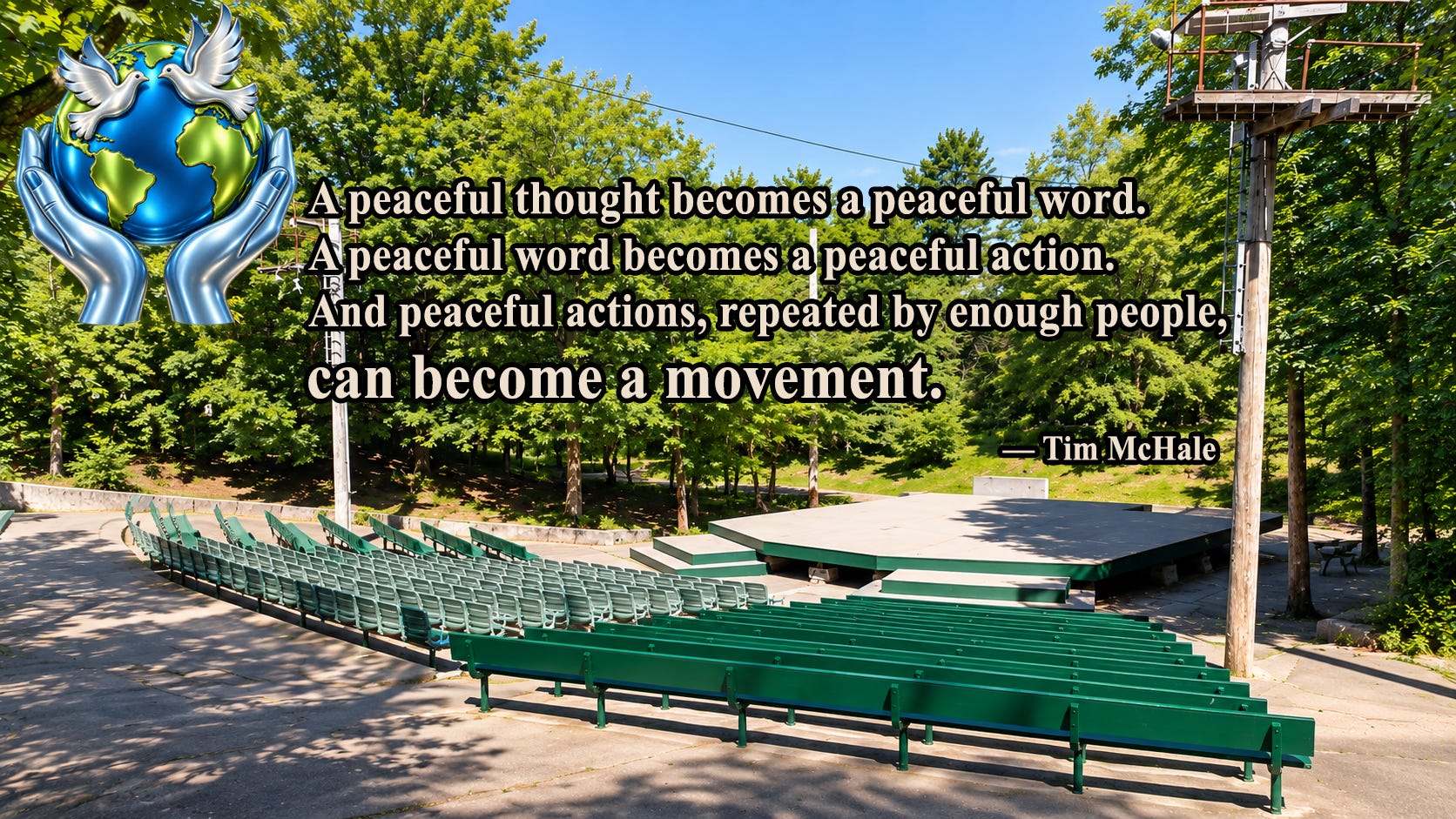
Our programme began with Prem-La creating a relaxed atmosphere through music, followed by Tim McHale—the person who had connected the four of us—welcoming everyone and inviting those in attendance to consider peace not merely as an abstraction somewhere beyond ourselves, but as something that might begin within us and move outward. Near the conclusion of his remarks, Tim articulated an aspiration that would, in retrospect, describe much of the afternoon: “A peaceful thought becomes a peaceful word. A peaceful word becomes a peaceful action. And peaceful actions, repeated by enough people, can become a movement.”
That movement from inward experience towards outward expression became something of an organising principle for the afternoon.
Following Tim’s welcome came music, including There’s a River Flowing in My Soul, and then the “All Traditions Meditation” I had been invited to facilitate. The intention was to create a space in which people could participate regardless of the tradition they followed or the language through which they understood the inner life. Whether meditation was understood spiritually, psychologically, philosophically or simply as an opportunity to become silent, for approximately twenty minutes we could share the experience of sitting together. And so we did.
For the duration an amphitheatre containing people who had arrived carrying different histories, beliefs, responsibilities, concerns, and hopes became silent. Near the conclusion, I gradually brought everyone out of the meditation while asking them to keep their eyes closed and remain in silence for just a little longer so as to allow the experience to settle deep within.
And then it happened. I was sitting on the dais facing the gathering when a cool breeze entered from my right and moved through the amphitheatre, rustling the trees surrounding us. Admittedly, I do not know whether anyone else noticed the timing of the breeze. But I did.
There was nothing extraordinary that needed to be attributed to it. Breezes move through trees every day. Yet there are moments when an entirely ordinary occurrence arrives with such exquisite timing that one simply notices. And notice I did. So much so, I seem to recall a smile developing across my face. For those few moments, no one was speaking, eyes remained closed, the people before me were still, and around us the trees moved as the breeze passed through them and us. Nothing needed to be added to the experience, and I resisted the temptation to fill it with words. After the breeze subsided, I called for everyone to open their eyes.
After the meditation, I shared a reflection titled The Inner Foundation of Peace during which I shared my Seven Layers of Manifestation framework as an orientation tool. The framework was developed in 2023 after my successful doctoral dissertation defence to help orient my thinking about consciousness and the worlds human beings create. The framework begins with Pure Consciousness and moves through Universal and Natural Laws, the Phenomenal World, Human Consciousness, the Human-Derived World, Constructs and, ultimately, Outcomes. For a gathering devoted to peace, the distinction between the Phenomenal World and the Human-Derived World seemed particularly relevant. Behind it was a relatively simple proposition. If we desire peace within ourselves, in our families, communities, institutions, nations, and world, then it is worth asking about the condition of the consciousness from which we are attempting to create it.
This is not to suggest that meditation or the Seven Layers of Manifestation provides, by itself, a solution to war, injustice, poverty, political conflict or the countless structural challenges confronting humanity. It is instead to recognise something considerably more elementary: every institution we build, policy we enact, relationship we cultivate, conflict we perpetuate, and solution we imagine passes, at some point, through Human Consciousness which is to be thought of as the junction-point between what I refer to as the Phenomenal World and the Human-Derived World. Therefore, what we bring to the world in terms of our orientation matters.
Consider this: mountains, rivers, and trees exist within a phenomenal order that precedes the political and social arrangements through which human beings organise our lives. National borders, governments, economies, educational systems, technologies, social hierarchies, and political ideologies belong to a different category. Whatever their histories and however consequential they become, they arise through human consciousness and activity. Many of the problems we hope to address when speaking about peace therefore reside somewhere within this human-derived world. Fortunately, many of our solutions reside there as well.
That distinction matters because it restores a measure of agency. When something belongs to the realm of Natural Law, our task is largely to understand it and learn how to live intelligently within it. However, when something has been created by human beings, some portion of it remains available for human beings to examine, refine, and, where necessary, reimagine. The question of peace consequently becomes not only what kind of world we wish to create, but from what quality of consciousness we will attempt to create it.
Later, following Prem-La’s musical reflection and our intermission, Chris Berlin made an observation that immediately returned me to those twenty minutes. He commented upon how nice it had been simply to sit together in silence and observed that human beings so rarely allow ourselves to do that—to become settled and silent enough to experience our inner world.
I have thought about his observation since.
We live amid extraordinary amounts of stimulation. Something is almost always requesting our attention, whether it be a screen, notification, conversation, responsibility, headline, problem or another person’s expectations. Even silence has become something we frequently attempt to fill. Yet for twenty minutes on a pleasant Saturday afternoon beside the Charles River, a group of human beings did something remarkably simple. We stopped long enough to allow the inner world to become part of the day’s conversation.
The remainder of the afternoon continued exploring that relationship between inward experience and outward expression. Prem-La and Music with Heart allowed music to function not merely as entertainment between speakers but as another mode through which the gathering could experience what we were discussing. Chris later guided the group through another meditation, inviting reflection upon collective intention, world leaders, and peaceful transitions. Ashveena Gajelee then turned our attention towards leadership and the challenge of carrying peace into a world of complex problems. In this way, silence, music, meditation, leadership, and conversation were not competing for space within the programme. They became different languages through which we approached the same inquiry.
Eventually, we arrived at the portion of the programme titled The Future: Where Do We Go from Here? consisting of a panel of Tim, Chris, Ashveena, and myself. The question changed the character of the gathering because it is one thing to spend an afternoon contemplating peace and quite another to ask what happens when we return to ordinary life.
Our planning had anticipated that transition by considering participation at personal, community, and global levels. We had imagined immediate practices individuals might undertake, possibilities for small groups and community engagement over the coming months, and longer-term ways in which artists, musicians, filmmakers, writers, and other creators might contribute towards changing how human beings perceive and relate to one another. Yet as the conversation unfolded, several people expressed a concern more fundamental than any particular programme of action. The problems confronting humanity seemed so large that they wondered what one individual could possibly do.
I listened intently as the concern surfaced in slightly different forms. Then, seemingly from somewhere in the archive of memory, Edgar Guest’s poem Equipment appeared in my mind alongside Bryce Courtenay’s book The Power of One. I mentioned both, although I devoted considerably more attention to Guest’s poem.
Admittedly, I had not expected to recite poetry during Planet for Peace, and it certainly did not appear anywhere on our itinerary. Nevertheless, as people continued wrestling with the apparent disproportion between the magnitude of the world’s problems and the capacities of an individual human being, Guest’s poem, published in 1921, seemed increasingly appropriate. Before responding, I quietly rehearsed it in my mind to make certain that I remembered it correctly. Then I shared it with the audience.
Figure it out for yourself, my lad
You’ve all the greatest of men have had.
Two arms, two hands, two legs, two eyes
And a brain to use if you would be wise.
With this equipment they all began
So start for the top and say, “I can.”
Look them over, the wise and great
They take their food from a common plate.
And similar knives and forks they use
With similar laces they tie their shoes.
The world considers them brave and smart
But you’ve all they had when they made their start.
You can triumph and come to skill
You can be great if you only will.
You’re well equipped for what fight you choose
You have arms and legs and a brain to use.
And the man who has risen great deeds to do
Began his life with no more than you.
You are the handicap you must face
You are the one who must choose your place.
You must say where you want to go
How much you will study the truth to know.
God has equipped you for life
but he lets you decide what you want to be.
Courage must come from the soul within
The man must furnish the will to win.
So figure it out for yourself, my lad
You were born with all that the great have had.
With your equipment they all began
Get hold of yourself and say “I can.”
I have long appreciated Equipment because beneath its early twentieth-century language lies a remarkably durable proposition. The people whose lives we admire were not issued some entirely different category of human equipment. They thought with human minds, worked with human hands, encountered uncertainty, experienced setbacks, and began, as all of us must, somewhere. This does not mean that human beings possess identical circumstances, resources or opportunities; clearly we do not. Rather, the poem reminds us that agency begins with recognising and employing what is actually available to us.
The response surprised me. Several people approached me afterward and asked for the poet’s name and the title of the poem. Their questions suggested that the poem had done more than fill a moment in the discussion. They wanted to take something from it with them. One woman even pulled out her phone and created a voice note within Siri to remind her to search for the poem.
Perhaps this points towards one answer to the concern raised during the panel. No individual sitting in that amphitheatre was going to solve every problem confronting humanity, nor should usefulness be measured against such an impossible standard. I believe a more meaningful question might be to ask what portion of the work belongs to each of us.
The answer will necessarily differ according to our abilities, circumstances, and opportunities. For one person, the work may involve teaching or conducting research; for another, organising a community, making music, or building an institution through which others can contribute. Some may rear children with an orientation towards compassion and responsibility, while others may influence policy, write, provide resources—both physical and monetary—for work that otherwise could not occur, or convene people who might never have encountered one another. Even the seemingly modest act of sitting in silence with another human being who needs to be heard can become part of a larger movement. And sometimes our contribution may be as unexpected as remembering a poem at precisely the moment its message is needed.
Seen from this perspective, the movement from inner peace towards global peace becomes somewhat less mysterious. It does not require pretending that an individual action is sufficient to transform the planet. It asks instead what might happen when individual actions become practices, practices that influence relationships, relationships that shape communities, communities that build institutions, and institutions that then consciously participate in creating the human-derived world. Tim’s words at the beginning of the afternoon had anticipated something similar when he suggested that a peaceful thought might become a peaceful word, a peaceful word a peaceful action, and repeated actions something larger than any one person.
From my perspective, the event also produced outcomes that no itinerary could have anticipated. I met additional people connected with Harvard Divinity School and enjoyed conversations I hope will continue. A student from Northeastern University approached me afterward and invited me to appear as a guest on her podcast, an invitation I happily accepted. Elsewhere throughout the afternoon, people exchanged observations, questions and ideas, and relationships began forming among individuals who had not known one another prior to arriving. These encounters were not incidental to the event simply because they had not been scheduled. In many respects, they were among the reasons for gathering in the first place.
Attendance matters, of course. Fewer than one hundred people attended this first Planet for Peace, and if we choose to convene the gathering again next year or some similar event in the interim, that number provides useful information. We can examine outreach, partnerships, communications, timing, audience development, and other variables with the advantage of actual experience rather than speculation. Yet attendance tells us primarily how many people entered the space. It cannot tell us everything that happened once they arrived.
What we now know is that meditation, music, leadership, and community dialogue can inhabit the same programme without competing with one another and that people can move from shared silence into conversation and from contemplation towards questions of action. We have seen that a conceptual framework developed in another context can help orient a public conversation about peace, just as an old poem can unexpectedly become relevant to a contemporary question. More importantly, perhaps, we experienced what happens when people with different histories, backgrounds, and understandings agree to become silent together before attempting to determine what should happen next.
That last part continues to stay with me because the outer structures through which peace is pursued cannot be entirely separated from the inner lives of the people who create them. Peace certainly requires institutions, policies, relationships, resources, diplomacy, justice, and action. Yet each of these ultimately involves human beings perceiving, interpreting, deciding, and acting. Consciousness may not be the sole explanation for the world we have created, but it cannot be removed from the equation.
Perhaps peace therefore possesses both an inner and an outer architecture. The outer architecture is visible in the institutions and arrangements through which we attempt to live together. The inner architecture is less visible but no less consequential, residing in the quality of awareness, intention, and understanding that human beings bring to those arrangements. This past Saturday, in our own modest way, we attempted to make room for both.
And somewhere in the middle of it all, after approximately twenty minutes of people sitting together in silence, a breeze came in from my right, moved through the trees, and passed through the amphitheatre.
I noticed it then, and I find myself noticing it again now—not because I know what it meant, or because it needs to have meant anything at all, but because for a few moments the gathering became settled enough for something so ordinary to be noticed.
Then the music resumed, the itinerary continued, people talked, questions were asked, a poem surfaced, and new relationships began. Planet for Peace, once merely an idea, became part of our collective experience.
As four people who came together to help cultivate one person’s seed idea, we now possess something we did not have before Saturday: experience from which to learn, relationships from which something further may grow, and a clearer understanding of what might be possible should we opt to gather again.
Perhaps that, too, is how peace is built.
Suggested Practice
Think of an idea that has visited you repeatedly but has remained largely within the realm of thought. It need not be grand. Perhaps it concerns something you would like to create, a conversation you have been meaning to initiate, a gathering you could convene, a piece of writing waiting to be developed, or some small contribution you believe might improve the lives of others.
Rather than asking whether you can already see the entire path from idea to outcome, consider a smaller question: What would allow this idea to encounter the world?
Perhaps the next step is writing it down clearly enough that someone else can understand it. Perhaps it is sharing it with one person whose perspective you respect, researching what would be required, making a telephone call, sending an email or simply setting aside an hour to begin. The purpose is not to guarantee the outcome. It is to move the idea across the boundary separating imagination from experience.
Then pay attention to what happens. Notice what changes when another mind encounters the idea. Notice what becomes clearer, what becomes less important and what possibilities emerge that you could not have imagined alone.
A seed does not contain a miniature version of the finished tree waiting merely to become larger. Growth involves interaction with an environment.
Perhaps some of our ideas work that way too.
—
About the Author
Dr. Baruti KMT-Sisouvong is a scholar of consciousness, researcher of human development, and Certified Teacher of Transcendental Meditation® based in Cambridge, Massachusetts. His work explores the relationship between Pure Consciousness, neuroscience, and social systems, and how deeper awareness can inform both personal growth and institutional transformation.
He is the Founder and Chief Meditation Officer of Transcendental Brain, an initiative examining the intersection of consciousness research, cognitive science, and high-performance decision-making. He is also President of Serat Group Inc. and Founder and Director of Radical Scholar Inc., a nonprofit dedicated to consciousness-based research and public scholarship.
Alongside his wife and teaching partner Mina, he co-directs the Transcendental Meditation program for Cambridge and the Greater Boston area. He is also the host of the On Transcendence Podcast and Founder of International Meditation Hour, a quarterly global gathering dedicated to the unifying power of silence.
His writings—spanning frameworks such as The Model for Perpetual Growth and Progress and The Seven Layers of Manifestation—explore the evolving relationship between consciousness, leadership, and society.
He writes from the conviction that the most important race is not between nations or machines, but between the conditioned mind and the awakening soul.
To learn more about him, visit: https://barutikmtsisouvong.com/.