


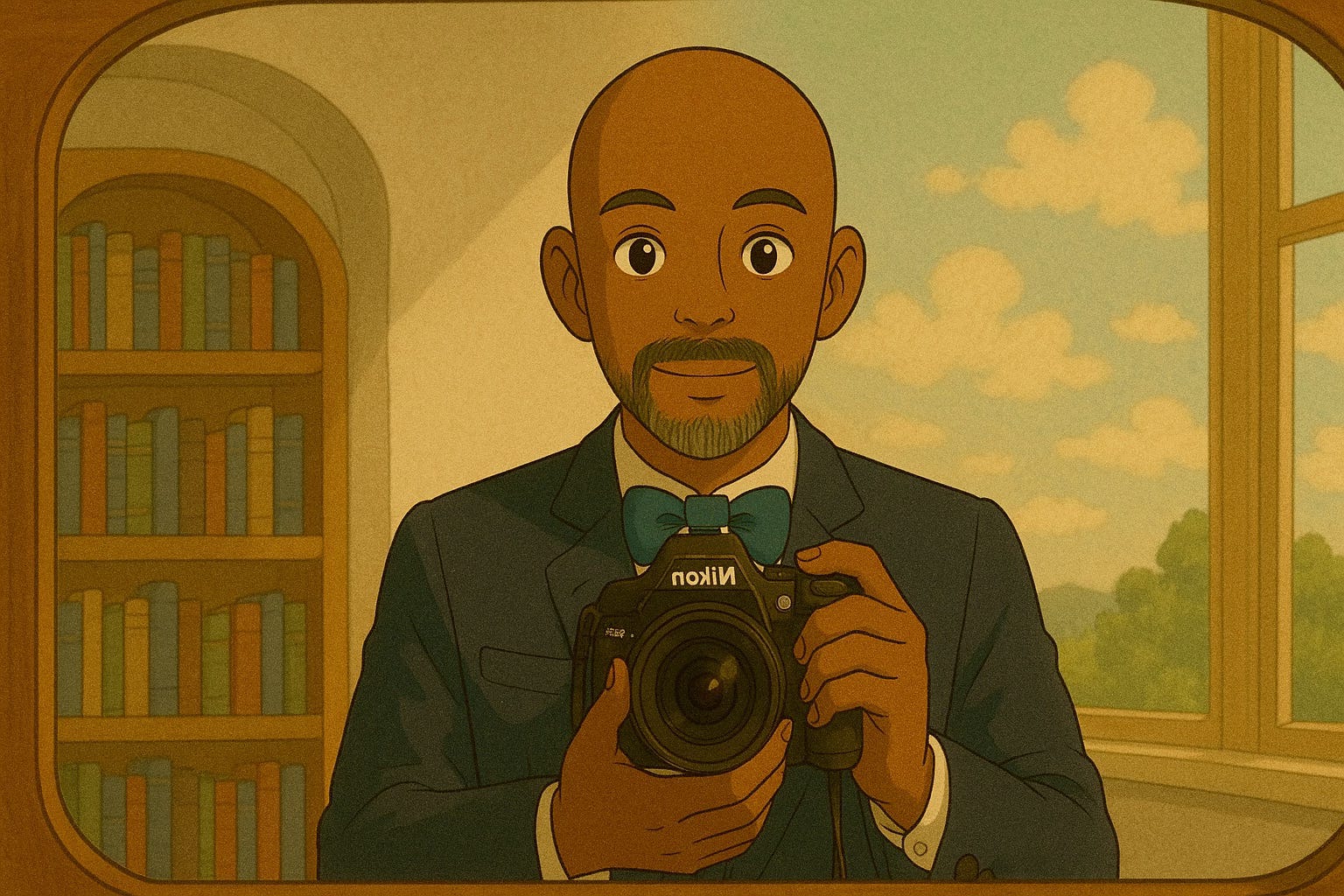
There is a moment, quiet but unmistakable, when one recognises that the work on the page is not the only work being done. The imagery surrounding that work—the symbols, the silhouettes, the faces that stand in as representatives of an idea—carries its own pedagogy. It teaches beneath the surface. It instructs indirectly. And it either reinforces or disrupts what the world has been taught to imagine.
This truth surfaced for me again recently as I reviewed a set of images for an essay on mastery and the long arc of becoming. The concepts were powerful. The visuals were elegant. Yet I felt a familiar tug—the subtle recognition that something was missing, something deeper than aesthetics.
Representation.
Not representation as token gesture.
Not representation as modern fashion.
But representation as historical correction.
As spiritual reclamation.
As truth-telling.
And the truth is this:
Far too few depictions of African-descended people exist in the very fields to which we have contributed in lasting, yet often unacknowledged ways—philosophy, mysticism, contemplative practice, consciousness studies, metaphysics, and the pursuit of inner mastery.
Even when I am the one generating the artwork, the imagery defaults toward absence unless I consciously intervene. Here, I point to the work of the brilliant Dr. Joy Buolamwini and others as examples of said absence.
Absence is its own kind of violence.
The Panel at Harvard, and What Followed
I was reminded of a Consciousness Hacking panel I participated in at Harvard Divinity School in 2017. It was a thoughtful dialogue on consciousness, practice, and spiritual understanding. Recently, I stumbled across two comments beneath the recording. The first supportive; the second, well let me just say it was *interesting*. The first reads:
“I’ve worked with energy or ‘spiritual’ healers for a long time - they have really, really helped me with my OCD, panic attacks, benzo withdrawal symptoms, and kundalini syndrome.
“P.S. the black professor is an important presence. Right now the Consciousness Hacking movement has kind of gotten painted with a ‘West Coast white person’ brush, and this guy and other black and Asian people who are doing this work disrupts that damaging narrative.”
The reply exactly as it appears:
Meditation and Eastern philosophies on conciousness come from origins in India and Asia because it originates with Vedic Texts.
The fact that you have to make this lecture into something racial shows your lack of understanding and development.
Conciousness doesn’t care about race we are all the same. When you stop labeling people by the color of their skin is when racism will stop. You cannot expect racism to stop while you continue to judge others based on color of skin vs quality of their character.
It was the familiar refrain:
the desire for the aesthetic of unity without the work of justice;
the invocation of spirituality as a bypass;
the insistence that naming reality is the cause of its harm.
The irony, of course, is that consciousness studies—especially in the West—have long been filtered through exclusively white imagery, white scholarship, white institutional authority. To simply appear as a Black scholar in a conversation on consciousness is itself a disruption, a deviation from what some believe to be the “neutral norm.”
The alleged neutrality was never neutral.
And so, when I choose imagery for my work—when I depict a Black man walking the arc of becoming, or sitting in contemplative stillness, or engaging the symbolic tools of mastery—I am not indulging a preference.
I am correcting a distortion.
The Quiet Erasure Beneath the Spiritual Discourse
Many of the world’s contemplative traditions emerged in regions where the populations were—and still are—Black and brown:
The Vedic tradition
The Upanishads
Indigenous African cosmologies
Kemetic philosophical systems
Ethiopian Christian mysticism
Sufi praxis across North and East Africa
Gnostic and desert mystic traditions
Dogon Cosmology
Yoruba and Ifá metaphysics
Afro-Caribbean initiatic systems
And yet, when these traditions are discussed in the modern West—particularly within academia, wellness spaces, or pop-spirituality—the imagery is often whitewashed, the lineage obscured, and the living descendants sidelined.
This is not an accident.
This is the machinery of representation doing what it has always done:
displacing the origin to centre the inheritor.
Thus, contrary to the comment beneath the HDS panel video, consciousness has never been divorced from race—not in its transmission, not in its appropriation, and certainly not in the politics of who is authorised to speak about it.
Representation matters because erasure is never neutral.
Why I Choose to Appear in the Frame
When I depict a Black man—a silhouette, a seeker, a craftsman, a meditator, a scholar—it is because:
1. I exist.
And too often, people like me are made invisible in the very traditions we sustain.
2. My presence challenges the inherited expectations of who is seen as a vessel of consciousness, mastery, or philosophical depth.
Representation is not decoration.
It is interrogation.
3. The work of consciousness cannot bypass the work of justice.
The two meet at the point where truth disrupts comfort. Such becomes evident to all who deeply study and contemplate my Seven Layers of Manifestation (SLM) framework.
4. Imagery shapes the imagination.
If a generation grows up seeing Black excellence depicted consistently in the sacred, intellectual, contemplative, and initiatic realms, their imagination expands accordingly. Think President Barack Hussein Obama being elected the 44th President of the United States and all that his presence and subsequent images represent for the minds of Black and brown folks—young and old—within the fields of politics and social systems; both those in the hear and now as well as those yet to be born.
5. Silence is a form of consent.
By refusing to disappear into generic or universal imagery, I categorically reject the unspoken demand that Black brilliance make itself smaller, softer, or more palatable.
6. Visibility is ancestral.
Every image is a small act of restoration for those whose wisdom was erased, appropriated, or overwritten.
This is why what I call my “Option A”—placing a Black figure at the centre of the visual narrative—is more than appropriate. It is essential.
The Arc of Becoming: A Black Lens
When I first conceived the idea for The Arc of Becoming, I envisioned a solitary figure ascending a gently curving path at dawn—a metaphor for mastery, discipline, and the long work of self-cultivation.
But the more I reflected, the more I understood:
The figure needed to be Black.
Not for me alone, but for the integrity of the story.
Because the arc of becoming is a universal human journey.
But the journey of becoming visible—in spaces where invisibility was once enforced—is uniquely ours.
A Black man walking toward the morning light, passing the symbols of scholarship, meditation, lineage, philosophical and spiritual dialogue, and discovery—book, compass, candle, sacred geometry, microphone—is not merely an illustration.
It is an intervention.
A declaration.
A restoration.
It is a refusal to let the framing of consciousness work continue without us.
Why This Matters Now
As conversations about AI, AGI, meditation, neuroscience, and consciousness accelerate, the danger of repeating historical patterns remains real:
breakthroughs credited to those with platforms rather than those with lineage,
innovations detached from their philosophical roots,
the wisdom of global Black and brown traditions abstracted into universalised, deracialised frameworks,
expertise dismissed when embodied by people of colour,
and imagery that quietly reinforces who “belongs” in the landscape of higher thought.
This is why I am deliberate.
This is why I am precise.
This is why imagery matters.
The work of consciousness is the work of seeing clearly.
That includes seeing history clearly.
Seeing representation clearly.
Seeing ourselves clearly.
And choosing imagery that reflects the fullness of that clarity.
Closing Reflection
If you have ever struggled to place yourself inside a lineage that rarely depicted you…
If you have ever felt unseen in traditions your ancestors helped shape…
If you have ever recognised that absence speaks as loudly as presence…
Then you already understand why representation is not cosmetic.
It is sacred.
It is philosophical.
It is part of the long arc of becoming.
And that arc, in my work, must always include the image of a Black seeker walking toward the light—with mastery behind him, possibility before him, and ancestral brilliance guiding every step. In short, “As within, so without.”
So, I will never apologise for centering Black and brown people in my work. After all, as part of the Global Majority, why should I?
Suggested Practice
Seeing the Frame: A Reflection on Visibility, Lineage, and Becoming
Meditation Time: 15 minutes
Purpose: To help you recognise the subtle ways visibility, lineage, and representation shape your inner and outer life—and to align more consciously with the truth of your own becoming.
1. Settle Into Stillness
Close your eyes and take a few gentle breaths.
Allow the mind to quiet.
Let the body soften.
Let yourself feel the presence of all those who came before you—those whose brilliance was lived even when it was not depicted.
2. What Has Been Invisible?
As you sit in silence, ask quietly:
· Where in my life have I been present, yet unseen?
· What parts of my journey have remained unacknowledged—even by me?
· Where has the world’s framing limited my own imagination of who I could become?
Do not force answers.
Let them surface like ripples in clear water.
3. What Must Now Become Visible?
Gently inquire:
· What aspect of myself is asking to be brought into the light?
· What craft, identity, lineage, or truth deserves representation in my work, my choices, or my public presence?
· What image of myself is finally ready to stand in the frame?
Let one insight rise naturally.
4. Set an Intention of Visibility
Place attention on the heart and silently affirm:
“I honour what was unseen. I bring forward what must now be visible. My becoming is an act of restoration.”
Sit with this for a few breaths.
Open your eyes when ready.
—
About the Author
Dr. Baruti KMT-Sisouvong is a consciousness scholar, executive coach, and Certified Teacher of Transcendental Meditation® based in Cambridge, Massachusetts. His work—spanning The Model for Perpetual Growth and Progress and The Seven Layers of Manifestation—explores how Pure Consciousness, neuroscience, and social-systems transformation intersect in the evolution of both the individual and society.
He is the Founder and Director of Radical Scholar Inc., a nonprofit organization dedicated to consciousness-based research and public scholarship, and President of Serat Group Inc., the parent company of Transcendental Brain, a consulting and educational platform bringing consciousness science into leadership and institutional development. He also serves as Host of the On Transcendence Podcast.
Alongside his wife, Mina, he co-directs the Cambridge and Metropolitan Boston TM Program and serves as Host and Founder of International Meditation Hour (IMH), a quarterly global gathering dedicated to the unifying power of silence.
He writes from the conviction that the most important race is not between nations or machines, but between the conditioned mind and the awakening soul.
To learn more about him, visit: https://www.barutikmtsisouvong.com/.