


Author’s Note
This essay emerged from a recent conversation with Abbot John Kolwaite of the Cambridge Zen Center during International Meditation Hour.
What struck me most was not the discussion of Zen, meditation, or contemplative practice itself, but rather a simple question posed decades ago by John’s teacher: “Are you angry right now?”
The question points toward a distinction that many contemplative traditions have explored for centuries—the difference between reality and the stories we create about reality.
My hope is not to suggest that our stories are unimportant. Stories help us make meaning of our experiences and connect us to one another. Rather, my hope is to invite reflection on the possibility that clarity often emerges when we learn to distinguish between what is happening and the narrative we have constructed around it.
Perhaps wisdom begins not with acquiring more information, but with seeing more clearly what is already present.
—Baruti KMT-Sisouvong, PhD
A few days ago, I had the privilege of sitting down with Abbot John Kolwaite of the Cambridge Zen Center for a conversation as part of International Meditation Hour.
As is often the case, the discussion wandered through a variety of topics—meditation, family, education, leadership, service, and the human journey itself. Yet among the many observations shared during our time together, one story remained with me long after the conversation ended.
Years ago, while attending a question-and-answer session with Zen Master Seung Sahn, a younger John raised his hand and posed a question.
What should I do with all this anger?
The question emerged from a difficult period in his life. He was young. He had become a father. Responsibilities had arrived quickly. The future seemed uncertain. Like many of us at one point or another, he found himself carrying frustration, confusion, and a growing sense that life was not unfolding according to the script he had imagined.
Zen Master Seung Sahn listened carefully.
Then he asked a question of his own.
“Are you angry right now?”
John paused.
“No.”
“Good. Next question.”
At first, he was bewildered.
The answer seemed dismissive. Incomplete. Perhaps even evasive.
Yet over time he realized that hidden within the brief exchange was a life-long teaching: The anger he carried was not present in that moment.
The floor was not attacking him. The air was not hostile. The room was not creating suffering.
Rather, much of what he was experiencing existed within the story he was carrying about his circumstances.
The realization struck me because, in one form or another, it is a lesson most of us spend our lives learning.
Human beings are storytellers.
We create narratives about who we are, what has happened to us, what others think of us, what the future will bring, and what the world ought to be. Such reminds me of a quote from Eckhart Tolle:
It is not the experience that causes us problems, it is our thinking about the experience that causes problems.
This capacity is one of our greatest gifts. It allows us to imagine possibilities, preserve wisdom, transmit culture, and make meaning from experience. Yet it can also become a source of immense suffering.
A single event occurs. Be it a conversation, setback, criticism, or a moment of disappointment.
The event itself may last only moments. Yet the story we construct around it can continue for days, months, or even years.
The mind revisits the event, expands, interprets, defends, and rehearses it incessantly. And from a neuroscience perspective, the brain does what it is designed to do—strengthen the neuronal connections associated with the initial experience as a result of internal repetition or rehearsal.
Eventually, the story becomes more real to us than the event itself.
In this way, we often suffer less from reality than from our interpretation of reality.
This does not mean our challenges are imaginary. Nor does it mean injustice, hardship, grief, or pain should be ignored. Rather, it points toward a distinction that contemplative traditions across cultures have long emphasized.
There is what is happening. And there is the story we are telling ourselves about what is happening.
The two are not always the same.
Indeed, much of contemplative practice appears designed to help us recognize the difference.
Whether through meditation, prayer, contemplation, self-inquiry, or silent reflection, practitioners are repeatedly invited to return to direct experience.
To observe, witness, notice, and ultimately to see.
Again and again, attention is drawn away from the narrative and back toward the present moment. Not because the story is unimportant, but because we can become trapped within it. And once trapped, clarity becomes increasingly difficult.
During our conversation, I made mention of a refrain many who have heard me speak previously have heard—that we tend to make our best decisions when we have clarity yet our worst decisions when we lack clarity.
The statement seems obvious, yet we rarely pause to consider what clarity actually means.
Many people assume clarity comes from acquiring more information. More data, analysis, or expertise.
Certainly, these have value. Yet some of the most important decisions in life emerge not from knowing more, but from seeing more clearly.
A person may possess all the facts and still make a poor decision if they are overwhelmed by fear.
Another may possess less information yet choose wisely because they are calm, grounded, and able to perceive the situation accurately.
Clarity is not merely intellectual. It is perceptual.
It concerns the quality of awareness itself.
This may help explain why contemplative traditions place such emphasis on stillness.
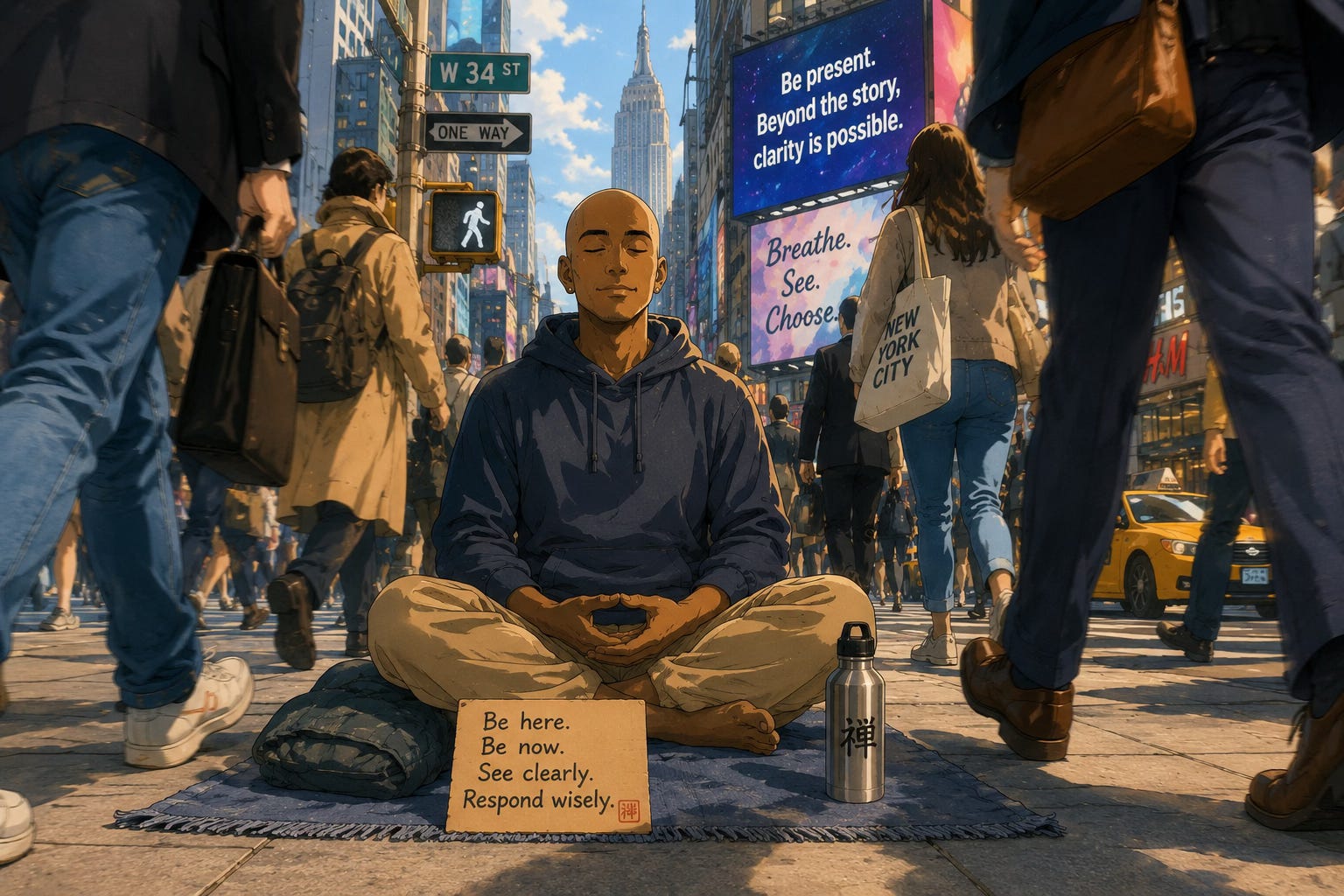
The goal is not withdrawal from life, escape from responsibility, nor indifference. Instead, it is stillness. Because stillness provides an opportunity to observe the stories we carry before they completely possess us.
In that space, something remarkable becomes possible.
We begin to notice that not every thought requires our allegiance. Nor does every emotion require immediate action. And most certainly that not every narrative reflects reality.
With clarity and presence of mind, one shifts from being rooted in a stimulus and reaction frame of mind to one of stimulus and response. Reactions come from our primitive brain whereas response comes from the prefrontal cortex or CEO.
The distance may be small.
A single breath, brief pause, or a moment of reflection. Yet within that space between the two resides freedom. And within that freedom resides choice.
Perhaps this is what Abbot John discovered years ago through the simple question posed by his teacher.
“Are you angry right now?”
Not yesterday, tomorrow, or in the story. Right now?
The question was not really about anger. It was about seeing. And seeing clearly may be among the greatest gifts contemplative practice has to offer.
For when clarity emerges, something else often follows—compassion.
We begin to recognize our own stories. Then we begin to recognize the stories carried by others. Be they fears, assumptions, wounds, hopes, confusion, longing, or any of the myriad self and socially imposed burdens carried by far too many of us.
And from that recognition, the world appears a little less divided, hostile, and populated by strangers.
Instead, it becomes a place of certainty, where humility emerges, understanding grows, and response becomes possible.
The story does not disappear. In truth, stories are part of what makes us human. But we gradually learn that the story is not the same thing as reality.
Between the story and the world lies a space. Within that space resides clarity. And from clarity, wiser choices become possible.
Perhaps this is why contemplative traditions place such emphasis on practice. Not because they promise perfection, but because they help us cultivate the capacity to pause—to observe before reacting, to listen before judging, and to see before acting.
In many respects, the pause is where transformation occurs.
Without it, life becomes a continual cycle of stimulus and reaction. Circumstances arise, emotions emerge, and behaviour follows almost automatically.
Yet with practice, something else becomes possible.
Between stimulus and reaction, a space begins to appear. Within that space resides awareness. Within said awareness resides clarity. And from clarity emerges the capacity to respond rather than merely react.
The pause may be brief. It could be a single breath or moment of reflection. Yet within that moment resides freedom. And within that freedom resides choice.
So, let us endeavour to cultivate that space within. For when life inevitably presents its challenges, disappointments, and uncertainties, we may discover that what we need most is not more information, but greater clarity.
From my experience, all it requires is a willingness to engage the inner process and the outer results will follow.
Care to join me?
Suggested Practice
At some point during the coming week, notice a moment when you feel frustrated, disappointed, anxious, or irritated.
Before reacting, pause.
Take a slow breath.
Then ask yourself:
What is actually happening right now?
Follow with a second question:
What story am I telling myself about what is happening?
Do not attempt to suppress your thoughts or emotions. Simply observe them.
Notice where reality ends and interpretation begins.
You may discover that the space between the two is smaller than you imagined. Yet within that space resides an opportunity—to respond rather than react, to choose rather than habitually repeat, and perhaps to see with greater clarity.
Repeat this practice whenever circumstances invite it.
Over time, the pause itself may become one of your most valuable teachers.
Further Reflection
This essay was inspired by a recent conversation with Abbot John Kolwaite, Abbot of the Cambridge Zen Center, during International Meditation Hour. Access via link below:
Becoming What We Are | A Conversation with Abbot John Kolwaite
—
About the Author
Dr. Baruti KMT-Sisouvong is a scholar of consciousness, researcher of human development, and Certified Teacher of Transcendental Meditation® based in Cambridge, Massachusetts. His work explores the relationship between Pure Consciousness, neuroscience, and social systems, and how deeper awareness can inform both personal growth and institutional transformation.
He is the Founder and Chief Meditation Officer of Transcendental Brain, an initiative examining the intersection of consciousness research, cognitive science, and high-performance decision-making. He is also President of Serat Group Inc. and Founder and Director of Radical Scholar Inc., a nonprofit dedicated to consciousness-based research and public scholarship.
Alongside his wife and teaching partner Mina, he co-directs the Transcendental Meditation program for Cambridge and the Greater Boston area. He is also the host of the On Transcendence Podcast and Founder of International Meditation Hour, a quarterly global gathering dedicated to the unifying power of silence.
His writings—spanning frameworks such as The Model for Perpetual Growth and Progress and The Seven Layers of Manifestation—explore the evolving relationship between consciousness, leadership, and society.
He writes from the conviction that the most important race is not between nations or machines, but between the conditioned mind and the awakening soul.
To learn more about him, visit: https://barutikmtsisouvong.com/.