


Author’s Note
I wrote this reflection not to highlight an unusual teaching moment, but to honour the quiet courage I encounter so often in those who come to learn Transcendental Meditation®. This particular session has stayed with me after several months—not because of anything extraordinary I did, but because of what it revealed about the human will to seek stillness even in the midst of pain. In sharing it, my hope is simple: that it reminds us of the dignity inherent in every person’s inward journey, and of the silent, sacred work that unfolds when two people sit together in pursuit of inner peace.
Earlier this year, something occurred in the teaching room—a moment not entirely unique, but one that nonetheless settled into the soul differently. It was an experience over which I have ruminated from time to time since that sunny afternoon.
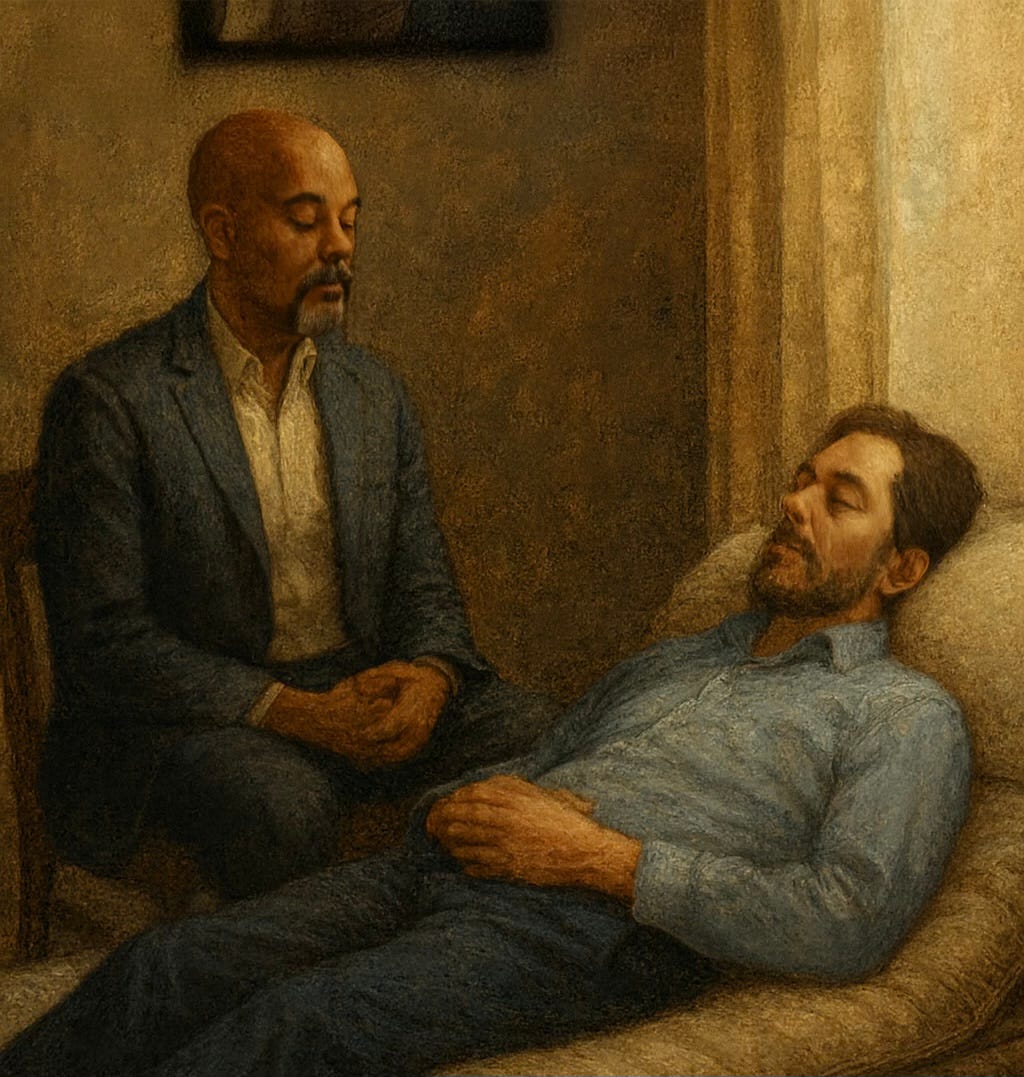
The man reclined near me—eyes thoughtful, posture as relaxed as best he could be—was learning to meditate for the first time. He carried with him the visible weight of a neurological condition: Cervical Dystonia at times also referred to as Spasmodic Torticollis. His head tilted down and to the left, neck tensed against itself as if the body and will were trying to renegotiate an understanding that had long since grown complicated.
Teaching him Transcendental Meditation® was unlike any of my previous sessions—and yet, it was exactly like every session: intimate, human, and steeped in the possibility of transformation.
He came not in search of a miracle, but of a moment. A breath. Relief from a ceaseless rhythm of tension, fatigue, and pain. And as he reclined on an inflatable mattress next to me—awkwardly adjusting his position, labouring for comfort—I was reminded, yet again, of the extraordinary range of souls who find their way to this practice. From business magnates, startup founders, executives cloaked in busynesss, Stay At-Home Moms, Stay At-Home Dads, students awakening to consciousness, to individuals like this man, whose pain is etched in the body itself. Mina and I have had the privilege of guiding them all.
It would be easy to say that meditation is a neutral practice—an equalizer that treats all who receive it the same. But the truth is, while the technique may be universal in its potential, the path each person walks into and out of the stillness is unique to the person.
What struck me that day was not just the man’s courage or openness—it was the deep spiritual truth he quietly revealed, perhaps even unbeknownst to him: that the body, even in its struggle, can become a portal to something greater. He taught me something before I could teach him. In choosing to learn TM, he declared in the act of moving forward, in no uncertain terms, that peace is worth pursuing—even if one must reach for it through discomfort.
During instruction, he followed my instructions with a kind of focused vulnerability; his breath at times syncing with the flicker of effort and surrender. The mantra, softly received, seemed to find space within him where his body could not. For those few minutes, I saw stillness enter him—not to erase the pain, but to cradle it differently.
As we completed the session, his eyes held something I recognized instantly: the quiet awe of first contact with that which does not move, does not ache, does not tense. The field of Pure Consciousness. The Self beyond the self.
Moments like these deepen my understanding of why I do this work. They remind me that TM is not merely about stress relief or performance optimization—it is about the restoration of dignity. About reclaiming a sense of wholeness that life, illness, or society may have tried to diminish.
In a world often obsessed with external achievement, here was a man for whom success, on that particular day, looked like reclining quietly and turning his attention inward. And what a triumph that is.
I have often said, and believe more deeply with each passing year, that the greatest act of service we can offer our fellow humans is to give them back to themselves. To create the conditions in which they may remember what it is to be whole, to be held, to simply be. TM does that—not through force, but through familiarity. It reintroduces us to the natural rhythms of our being—those rhythms that govern our human consciousness and that reverberate into the Human-Derived World, through our Constructs, both Good and Not-So-Good, and our Outcomes. And sometimes, that reintroduction happens in the midst of physical pain, grief, even uncertainty.
That’s the beauty of this path and technique: it welcomes everyone. There is no caste, no condition, no credential required. Only the willingness to sit/recline, to think the mantra as instructed, be gentle with one’s self, and to let go.
As Mina and I reflect on the diverse individuals who have passed and will continue to pass through our doors—from the affluent to the afflicted, from the seekers to the skeptics—we are reminded that our teaching space is sacred not because of us, but because of what flows through it. It is a place where consciousness meets compassion. Where science meets soul. Where people come not to be fixed, but to be found.
And sometimes, in the silence of a meditation room, the most overlooked truths emerge: that love is action, that healing takes many forms, and that each of us, no matter our story, deserves to feel what it means to be whole—even if only for twenty minutes twice a day.
To the gentleman I taught that day: thank you. Thank you for trusting me with your time, your condition, your quiet hope. Thank you to your partner who arranged everything and came with you to complete the interview form, make certain that you were settled and comfortable as possible, as well as for ensuring they understood my instructions to you afterward as they would be assisting you in becoming comfortable to meditate easily at home. You both reinforced my years-long understanding that all human bodies are temples—even those marked by discomfort. You illustrated that presence is always possible. And you further confirmed for me that this work—this sacred work of inner restoration—is worth doing, again and again and again.
Suggested Practice: Meeting Yourself with Compassion
Meditation Time: 20 minutes
Theme: Stillness Within Struggle
Reflection Prompt:
After your next meditation, take a few moments to gently observe:
Where in my life do I strain against myself? And what happens when I allow stillness to cradle that strain rather than resist it?
Practice:
Sit or recline in a position that genuinely supports your body.
Let the mantra be effortless—especially if the body is not.
After meditation, place a hand on the centre of the chest and breathe slowly, acknowledging any tension, discomfort, or emotion that surfaced.
Offer yourself this quiet affirmation:
“Even here, I am whole.”
To learn more about Transcendental Meditation, visit: https://www.tm.org.
—
About the Author
Dr. Baruti KMT-Sisouvong is a consciousness scholar, executive coach, and Certified Teacher of Transcendental Meditation® based in Cambridge, Massachusetts. His work—spanning The Model for Perpetual Growth and Progress and The Seven Layers of Manifestation—explores how Pure Consciousness, neuroscience, and social-systems transformation intersect in the evolution of both the individual and society.
He is the Founder and Director of Radical Scholar Inc., a nonprofit organization dedicated to consciousness-based research and public scholarship, and President of Serat Group Inc., the parent company of Transcendental Brain, a consulting and educational platform bringing consciousness science into leadership and institutional development. He also serves as Host of the On Transcendence Podcast.
Alongside his wife, Mina, he co-directs the Cambridge and Metropolitan Boston TM Program and serves as Host and Founder of International Meditation Hour (IMH), a quarterly global gathering dedicated to the unifying power of silence.
He writes from the conviction that the most important race is not between nations or machines, but between the conditioned mind and the awakening soul.
To learn more about him, visit: https://www.barutikmtsisouvong.com/.