


Author’s Note
This essay was born of an exchange years ago with a professor who claimed that Sanskrit was the primordial language of humankind. His assertion carried the familiar implication that the peoples of Africa possessed neither language nor knowledge worthy of the term “civilization.”
Having studied the work of Drs. Cheikh Anta Diop, Théophile Obenga, Asa G. Hilliard III, Charles S. Finch III, and many others who rigorously recovered Africa’s intellectual history, I recognized such claims as not only historically false but as artifacts of a colonial worldview that systematically denied African civilizations their rightful place in the story of human knowledge. The civilizations of Kemet, Kush, Nubia, Ife, Mali, and many more had long articulated sophisticated cosmologies of consciousness—each naming, transmitting, and living this knowledge through its own sacred traditions.
This essay is thus an offering: a reweaving of memory, scholarship, and reflection that affirms what Africa’s ancient seers and philosophers already knew—that consciousness is the first language, and from its silence, all worlds were thought, spoken, and worked into being.
—Baruti KMT-Sisouvong, PhD
There is a subtle, enduring question that humankind has never set down: what lies at the foundation of existence? To some, the answer has been stone, fire, water, or atom. To others, it has been awareness itself—the felt presence in which everything appears. Across time and place, the whisper has returned in many guises, but always with the same insistence: consciousness is not an effect but the cause, not derivative but primary.
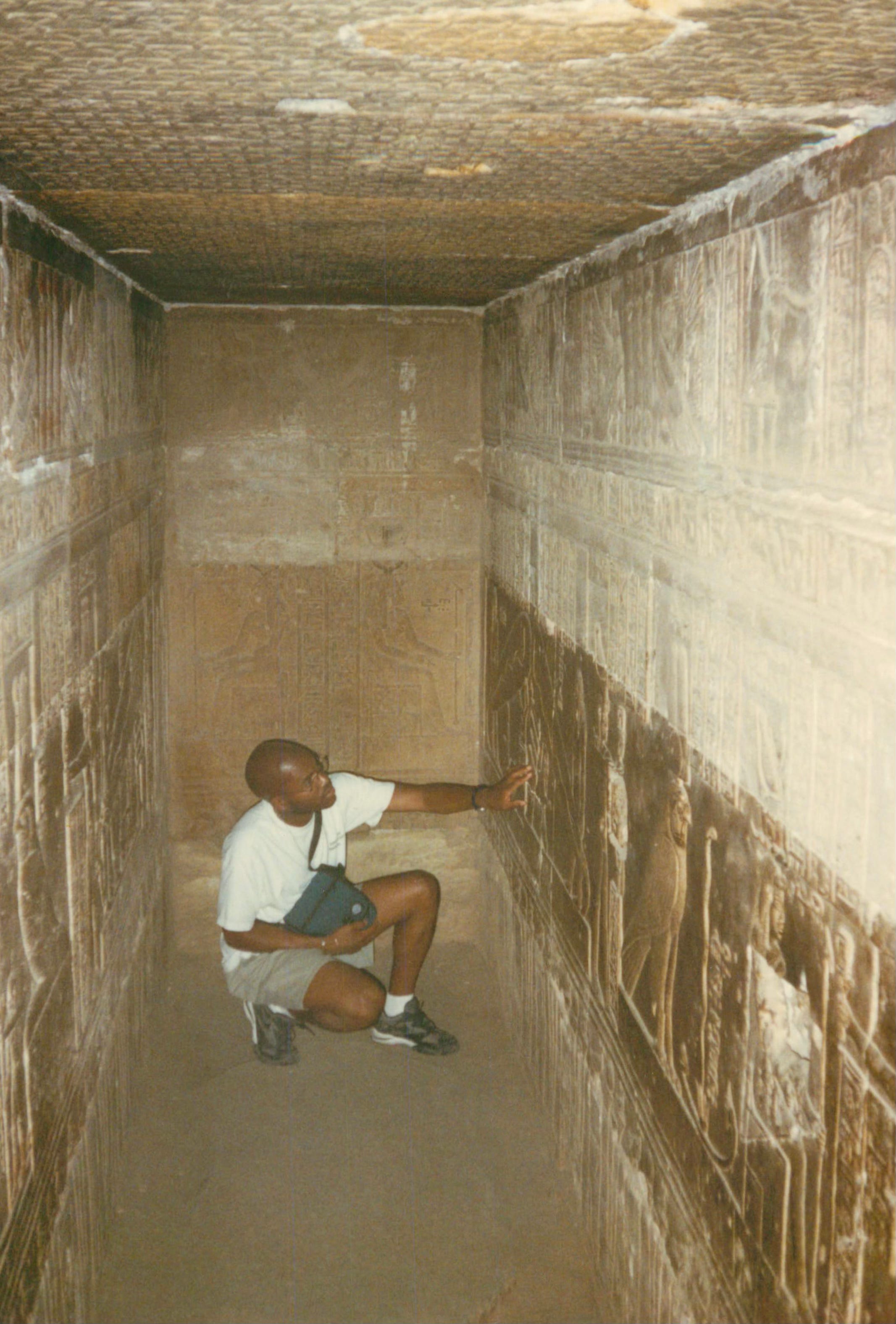
I first began to sense this as more than abstract philosophy during my time in Egypt. Walking among the stones of Ancient Kemet, studying inscriptions that stretched back thousands of years, I discovered that creation myths there did not begin with physical matter. They began with Nun—the boundless waters of potential, unformed and infinite. Out of this stillness rose Atum, the self-created one, whose very thought brought the cosmos into being. Later, in the Memphite Theology, Ptah shaped the world by heart and tongue—mind and speech. Creation was not the accident of matter, but the utterance of consciousness.
Later in studying the work of Marcel Griaule and Germaine Dieterlen as conducted in Mali, we note the Dogon of Mali preserved a similar memory. Their great cosmic principle, Amma, imagined the universe before unfolding it. Thought came first, then form. In Yoruba Ifa, the concept of asé—the vital force—speaks to the same truth: all that moves and breathes does so because consciousness animates it. Orunmila, the spirit of wisdom, does not discover the world but dreams it into shape. Before anything is seen, it is known. Here, I am reminded of the Sanskrit word namarupa which translates as name and form—suggesting that thought precedes form.
These African voices harmonize with a chorus that arises in other lands. In the forests and ashrams of India, rishis declared: “Sarvam khalvidam Brahma”—all this is Brahman. The universe itself is consciousness, not a god apart but the very fabric in which we live and move. Śaṅkara, centuries later, walked barefoot across India to remind people that Atman, the self within, is not different from Brahman, the infinite field without. Diversity is appearance; consciousness is essence.
Buddhist philosophers of the Yogācāra school gave it another voice: citta-mātra—“mind-only.” What we call external world is but projection, consciousness knowing itself through appearances.
The Greeks, too, listened to this whisper. Parmenides taught that reality is one, unchanging, eternal—a field of being rather than a flux of matter. Plato described the Forms, eternal patterns of intelligibility, as more real than shadows cast on the cave wall. Plotinus, in late antiquity, spoke of The One—a radiant unity beyond thought yet present in every act of awareness.
If one traces the conversation about consciousness through history, it becomes clear that it never truly stopped. It only changed location.
When the Conversation Moved Elsewhere
In Europe, the centuries following the collapse of the Western Roman Empire in the fifth century are often referred to as the “Dark Ages” (approx. 500–1000 CE). The phrase itself is imperfect—there were monasteries, scholars, and quiet preservation of knowledge—but it does capture something of the intellectual contraction that followed the political fragmentation of the continent. Large urban centres declined. Trade networks shrank. Libraries were lost. In many regions, the infrastructure required for sustained philosophical and scientific inquiry weakened.
Yet the human search for understanding did not disappear.
It moved elsewhere.
Across North Africa and the Middle East, the conversation about mind, reality, and consciousness continued with remarkable vitality. Under the Abbasid Caliphate (750–1258 CE), the translation movement centred in Baghdad’s Bayt al-Hikma—the House of Wisdom—preserved and expanded the philosophical inheritance of antiquity. Greek texts that had faded from parts of Europe were translated into Arabic and examined with renewed philosophical rigor.
Thinkers such as Al-Kindī (801–873), Al-Fārābī (872–950), and Ibn Sīnā—known in the West as Avicenna (980–1037)—engaged deeply with questions about the nature of mind and existence. Avicenna offered one of the most striking reflections on consciousness ever proposed: the thought experiment of the “Floating Man.” Imagine a person brought into existence fully formed yet suspended in empty space, deprived of all sensory input. Even without sight, sound, or touch, Avicenna argued, that person would still affirm their own existence. Consciousness, therefore, cannot be reduced solely to sensory experience—it possesses an immediate awareness of itself.
At the same time, centres of learning flourished across Africa. In Timbuktu, institutions such as Sankoré and Djinguereber sustained vibrant scholarly traditions from the thirteenth through sixteenth centuries. Thousands of manuscripts circulated through West Africa, exploring theology, astronomy, mathematics, law, and philosophy—testimony to intellectual worlds far richer than the simplified narratives often presented in European histories. Many of these manuscripts still survive today, material witnesses to a scholarly tradition that the modern world is only beginning to rediscover.
Seen from a wider vantage, the so-called Dark Ages were not a universal darkness. They were a geographical shift in the centres of learning.
The human conversation about consciousness never ceased; it simply changed languages, landscapes, and institutions—carried forward by scholars, mystics, and philosophers across Africa and the Islamic world until Europe, centuries later, would be reacquainted with many of these preserved texts during the Renaissance.
The thread, though stretched across continents, remained unbroken.
Centuries later, mystics carried the flame. Ibn Arabi (1165-1240), the Sufi of Andalusia, taught the wahdat al-wujud, the unity of being. The universe, he said, is nothing but the self-disclosure of the Divine within consciousness. In Europe, Giordano Bruno dared to imagine an infinite cosmos alive with mind. He would be burned at the stake for declaring that consciousness filled the stars.
Even in the so-called Age of Reason, the whisper did not fade. Descartes, with his cogito ergo sum—‘I think, therefore I am’—placed consciousness as the one certainty. George Berkeley went further: to be is to be perceived. Matter, he argued, has no independent existence apart from mind. Spinoza framed reality as a single substance that speaks as thought and extension both—consciousness and matter inseparable yet grounded in awareness.
German Idealists picked up the thread: Fichte, Schelling, Hegel—all saw Spirit unfolding in time. Schopenhauer gave it a darker cast: the world is will and representation, consciousness shaping reality even as it strains against its own desire. Across the Atlantic, William James spoke of “radical empiricism,” a psychology that included consciousness not as accident but as fabric.
By the twentieth century, science itself began to brush against the ancient truth. Erwin Schrödinger, father of quantum mechanics, confessed that Vedanta was right: consciousness is singular, the multiplicity of minds an illusion. David Bohm described the implicate order, where matter and mind are enfolded aspects of one whole. Max Planck, theoretical physicist and recipient of the 1918 Nobel Prize in Physics and for whom the Planck Scale is named, opined:
I regard consciousness as fundamental. I regard matter as derivative from consciousness. We cannot get behind consciousness. Everything that we talk about, everything that we regard as existing, postulates consciousness.
Aldous Huxley called it the Perennial Philosophy. Alan Watts translated it for the Western ear: what you are, at root, is awareness itself. Sri Aurobindo in India wrote of consciousness evolving through layers, destined toward a supramental flowering.
And now, in our time, the whisper becomes a debate. Donald Hoffman suggests that space and time are but a user interface, with consciousness as the underlying reality. Bernardo Kastrup defends analytic idealism with rigorous logic, insisting that mind is fundamental. Rupert Spira, speaking softly in the Advaitic lineage, points out that all we ever know—every sight, sound, or thought—appears only in consciousness.
Another Voice Added to the Chorus
As I have come to understand it, from the accepted beginnings of the universe to the present moment—and across all that humans have brought forth within the phenomenal world into which we are born—everything arises from consciousness. Through human consciousness, we imagine, shape, and bring into form what I refer to as the Human-Derived World. Yet whether phenomenal or human-derived, all things are born within, brought forth, and sustained by mind. In this sense, everything—without exception—began as an idea within consciousness and may rightly be understood as an echo of it. Yes, even we humans.
Long before I encountered Vedic Science in any formal sense, it seems nature itself had been preparing me for it. My early studies began with Three Magic Words, a deceptively simple yet foundational text that first oriented my thinking toward mind as causative rather than derivative. That orientation deepened through later encounters with several traditional African Wisdom systems, Rosicrucian philosophy, Freemasonry, Western esoteric traditions, which—like the writings of Emerson, Thoreau, and other Transcendentalists and mystics such as William James and Evelyn Underhill—appeared to arrive independently at the same recognition: that consciousness is primary, and that nature, mind, and meaning arise from a deeper unity.
What distinguished my own path, however, was coming of age within the modern scientific era and discovering in Vedic Science a disciplined, empirical, and academically rigorous vehicle through which these insights could be studied, tested, and communicated. It offered a means to weave my early training in history, sociology, and education into a structured framework—one capable not only of contemplation, but of advancing the lived reality of Pure Consciousness for as many constituents as possible. That foundation continues to guide my scholarship and practice.
In one instance, I remember the evening Dr. Asa G. Hilliard, III brought a manuscript from Timbuktu to class. To hold it in my hands was already to feel history breathing. To learn that it had been authored by a woman was to feel another story fracture—the harmful myth that literacy, scholarship, and intellectual authority were gifts bestowed gradually by Europe upon the rest of the world. That small book, cool beneath my fingers, carried a different memory.
Across this arc, what unfolds is not a collection of disconnected traditions, but a layered movement—from pure awareness, to law, to form, to human imagination, and finally to the worlds we collectively bring into being.
From KMT (Kemet) to Cambridge, from Dogon to Delhi, from Athens to Amsterdam, the current is one and the same. The question is never truly whether consciousness is primary—it is fundamentally a question of whether we are prepared to see it. And whether we are willing to recognise that no single culture, teacher, or institution owns what has always belonged to humankind and beyond.
A Pause for Reflection
As you read these words, stop for a moment. Notice the page or screen before you. Notice the thoughts arising as you try to follow the thread of history. Notice the subtle awareness in which even these words appear.
Can you find a single experience outside this awareness?
Is there any colour, sound, or thought that is not first embraced by consciousness itself?
The same whisper that stirred in ancient seers is here, right now, as the awareness reading these lines—You.
Suggested Practice: Living from the Field
Journal Prompts
Recall a moment when you felt presence more real than circumstance—perhaps in nature, prayer, or silence. What does that memory reveal about the role of consciousness in your life?
Where in daily life do you identify with the “waves”—the fleeting roles and thoughts—instead of the “ocean” of awareness itself?
How might your relationships or work shift if you carried the recognition that everything arises and subsides within the same field of consciousness?
Practical Exercise
Choose one ordinary act today—walking, eating, or speaking with another. Instead of focusing only on the content, notice the space of awareness in which it unfolds. See how the quality of the act changes when you include the field itself in your attention.
Closing Note
The story of consciousness is not confined to temples, scriptures, or treatises. It lives wherever awareness awakens to itself. In my own journey—among the hieroglyphs of Egypt, the practices of meditation, and the dialogue of philosophy—the lesson has been constant: the truest foundation is not matter, but mind. Consciousness is all there is. And to remember this, even for a breath, is to touch the same current that carried humanity’s wisest voices across ages.
—
About the Author
Dr. Baruti KMT-Sisouvong is a scholar of consciousness, researcher of human development, and Certified Teacher of Transcendental Meditation® based in Cambridge, Massachusetts. His work explores the relationship between Pure Consciousness, neuroscience, and social systems, and how deeper awareness can inform both personal growth and institutional transformation.
He is the Founder and Chief Meditation Officer of Transcendental Brain, an initiative examining the intersection of consciousness research, cognitive science, and high-performance decision-making. He is also President of Serat Group Inc. and Founder and Director of Radical Scholar Inc., a nonprofit dedicated to consciousness-based research and public scholarship.
Alongside his wife and teaching partner Mina, he co-directs the Transcendental Meditation program for Cambridge and the Greater Boston area. He is also the host of the On Transcendence Podcast and Founder of International Meditation Hour, a quarterly global gathering dedicated to the unifying power of silence.
His writings—spanning frameworks such as The Model for Perpetual Growth and Progress and The Seven Layers of Manifestation—explore the evolving relationship between consciousness, leadership, and society.
He writes from the conviction that the most important race is not between nations or machines, but between the conditioned mind and the awakening soul.
To learn more about him, visit: https://www.barutikmtsisouvong.com/.