


Author’s Note
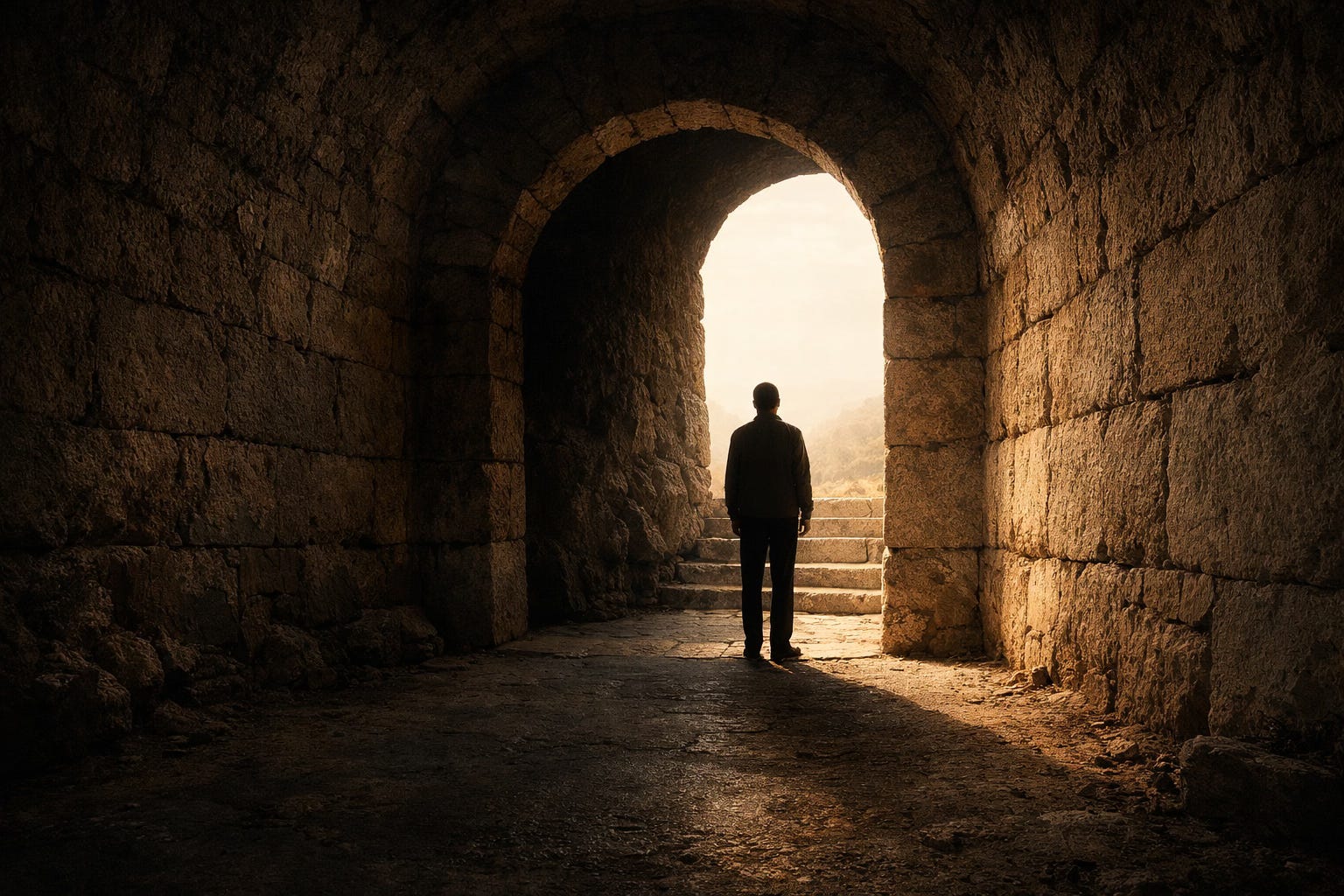
This essay emerges from a line of inquiry that has been unfolding for many years—long before the frameworks referenced here had names. As a graduate student, I found myself repeatedly drawn to a particular moment across philosophical, mythic, and modern narratives: not the instant of awakening, but what follows it. The pause. The turn. The decision to re-enter the world with altered perception and renewed responsibility.
At the time, these questions surfaced through engagements with figures such as Plato, Camus, and contemporary mythologies, alongside early explorations of consciousness articulated within Vedic Science. What I could sense then—but not yet fully articulate—was that awakening is never complete in isolation. Insight matures only through integration, and integration reveals itself through return.
From Shadow to Stone reflects the continuity of that inquiry, now clarified through the lenses of the Seven Layers of Manifestation and the Model for Perpetual Growth and Progress. What once appeared as intuition has since stabilised into structure; what once felt personal now reveals ethical and societal dimensions. The themes, however, remain the same: an understanding of and direct experience with Pure Consciousness develops gradually, responsibility follows clarity, and the most meaningful work often begins after the light has been seen.
This essay is offered not as a conclusion, but as a waypoint—one expression of an ongoing commitment to understand how awakening becomes lived, repeated, and refined over time.
There is a persistent misunderstanding in contemporary readings of awakening narratives: the belief that insight arrives fully formed, instantly reorganising the individual who encounters it. This assumption flattens what the great philosophical and mythic traditions took pains to describe as developmental, gradual, and often demanding.
Plato’s Allegory of the Cave, Camus’ Sisyphus, and Campbell’s Hero’s Journey all resist the notion of sudden transformation. Instead, they point toward a subtler truth: awakening is not a moment but a maturation; not an escape from the world but a reorientation within it.
Viewed through the lenses of the Seven Layers of Manifestation (SLM) and the Model for Perpetual Growth and Progress (MPGP), these narratives converge into a coherent developmental arc—one that moves from perception to integration, and ultimately to ethical return.
The Cave Revisited: Awakening as Reorientation, Not Revelation
Plato does not depict the freed prisoner as triumphant upon leaving the cave. On the contrary, the ascent is painful, disorienting, and resisted at every step. The eyes ache. Familiar certainties dissolve. What once felt solid now appears illusory, and what appears real is at first unbearable.
Through the SLM framework, the cave represents a condition of consciousness organised around the surface layers (V, VI, and VII): sensory immediacy, inherited narratives, social reinforcement, and unexamined consensus. The shadows are not false so much as partial—representations mistaken for totality.
The ascent does not catapult the individual directly into higher-order awareness. Instead, it initiates a gradual recalibration across layers: perception loosens, cognition reframes, meaning reorganises. Each layer must stabilise before the next can meaningfully unfold.
The MPGP clarifies why this must be so. Insight, when unintegrated, destabilises identity. Growth that skips stages invites fragmentation rather than coherence. The individual must live with new perception long enough for it to become embodied understanding. Only then can responsibility emerge.
The popular impulse to imagine awakening as instantaneous misses Plato’s central lesson: illumination without adaptation is not enlightenment—it is overload.
The Long Pause Outside the Cave
What is often omitted in retellings of Plato’s allegory is the time required outside the cave. The freed individual does not immediately turn back to liberate others. There is a necessary interval of contemplation, observation, and internal reorganisation—in short, a pause consisting of what I was once told must be traversed by all who choose this work: a period of solitary refinement.
This pause is critical.
What this pause ultimately reveals is that awakening is inseparable from choice. Long before I had the language of layered manifestation or staged growth, I was drawn to a recurring moment across myth and modern narrative alike: not the instant of revelation, but the decision that follows it. Whether in the descent of Sisyphus after the stone has fallen, or in the figure who turns back toward danger rather than fleeing it, consciousness matures not through escape but through deliberate re-engagement. The pause is where perception becomes volitional—where one decides not merely to see differently, but to live differently. It is here, in this interval between insight and action, that responsibility quietly takes root. One does not return because clarity guarantees success, but because integrity no longer permits withdrawal.
In SLM terms, this is the period during which deeper, foundational-layer insights (Layers I, II, and III) must be metabolised into stable patterns of perception and conduct. In MPGP terms, it marks the transition from awareness to responsibility—a shift from personal insight to ethical obligation.
Joseph Campbell names this phase initiation. The hero, having crossed the threshold, must endure trials that refine perception and clarify purpose. The boon is not knowledge alone, but wisdom tempered by humility.
The return to the cave is therefore not impulsive. It is chosen.
The Return: Responsibility Without Illusion
When the awakened individual re-enters the cave, they do so without expectation of applause. Plato is explicit: they are ridiculed, misunderstood, even threatened. Truth does not persuade by force of clarity alone; it must contend with fear, habit, and identity.
This return aligns precisely with the higher tiers of MPGP, where growth becomes relational and societal rather than personal. The individual accepts the burden of repetition—of speaking again and again into misunderstanding—not because success is guaranteed, but because integrity demands it.
Here, awakening reveals its ethical dimension. To see clearly is not enough. One must act clearly, even when outcomes are uncertain.
Sisyphus Reconsidered: Inner Refinement Through Repetition
Camus’ Sisyphus is often misunderstood as a figure of despair. Yet Camus insists that Sisyphus is not defeated by the task but transformed by his relationship to it. The rock rolls down, the labour resumes—but something within Sisyphus has shifted.
From the outside, the work is futile. From within, it is formative.
Through MPGP, Sisyphus exemplifies inner refinement under constraint. Progress is no longer measured by external completion but by the quality of consciousness brought to the task. Each ascent becomes an opportunity for presence, agency, and choice.
Through SLM, Sisyphus’s condition illustrates how transcendence does not require escape from the material world. Consciousness may expand even when circumstances remain unchanged. What alters is not the task, but the relationship to it.
In this light, Sisyphus mirrors the returned cave-dweller: both accept repetition not as punishment, but as service. Both understand that truth must be lived repeatedly, not merely discovered once.
Bridging the Models: Awakening as Lived Commitment
The Seven Layers of Manifestation framework and the Model for Perpetual Growth and Progress converge on a shared insight: awakening is incomplete without integration, and integration is incomplete without return.
SLM clarifies where awareness unfolds. MPGP clarifies how growth stabilises over time.
Together, they reveal that consciousness evolves not through dramatic rupture, but through sustained alignment between insight, action, and purpose.
The cave remains. The hill remains. Society remains complex and resistant even. What changes is the individual’s inner posture—steadier, clearer, less dependent on outcome, more committed to truth.
This is not resignation. It is mature participation.
Suggested Practice: From Cave to Hill
This guided reflection may be undertaken after meditation or in a quiet, undistracted moment.
1. The Cave
Recall a belief, role, or narrative you once accepted without question. Observe it gently, without judgment. What shadows once appeared solid?
2. The Ascent
Notice moments in your life when discomfort preceded insight. Where did clarity arrive gradually rather than all at once?
3. The Pause Outside
Reflect on insights you have gained but not yet fully embodied. What integration is still unfolding?
4. The Return
Where are you being called to bring clarity back into familiar spaces—family, work, community—without attachment to recognition?
5. The Hill
Identify a recurring task or responsibility in your life. Experiment with approaching it not as burden, but as practice. What changes when presence replaces resistance?
Sit with these reflections briefly. There is nothing to solve. The work continues—not because it is easy, but because it is meaningful.
Transition Complete: From shadow to stone, from insight to service, from awakening to lived commitment.
—
About the Author
Dr. Baruti KMT-Sisouvong is a consciousness scholar, executive coach, and Certified Teacher of Transcendental Meditation® based in Cambridge, Massachusetts. His work—spanning The Model for Perpetual Growth and Progress and The Seven Layers of Manifestation—explores how Pure Consciousness, neuroscience, and social-systems transformation intersect in the evolution of both the individual and society.
He is the Founder and Director of Radical Scholar Inc., a nonprofit organization dedicated to consciousness-based research and public scholarship, and President of Serat Group Inc., the parent company of Transcendental Brain, a consulting and educational platform bringing consciousness science into leadership and institutional development. He also serves as Host of the On Transcendence Podcast.
Alongside his wife, Mina, he co-directs the Cambridge and Metropolitan Boston TM Program and serves as Host and Founder of International Meditation Hour (IMH), a quarterly global gathering dedicated to the unifying power of silence.
He writes from the conviction that the most important race is not between nations or machines, but between the conditioned mind and the awakening soul.
To learn more about him, visit: https://www.barutikmtsisouvong.com/.