


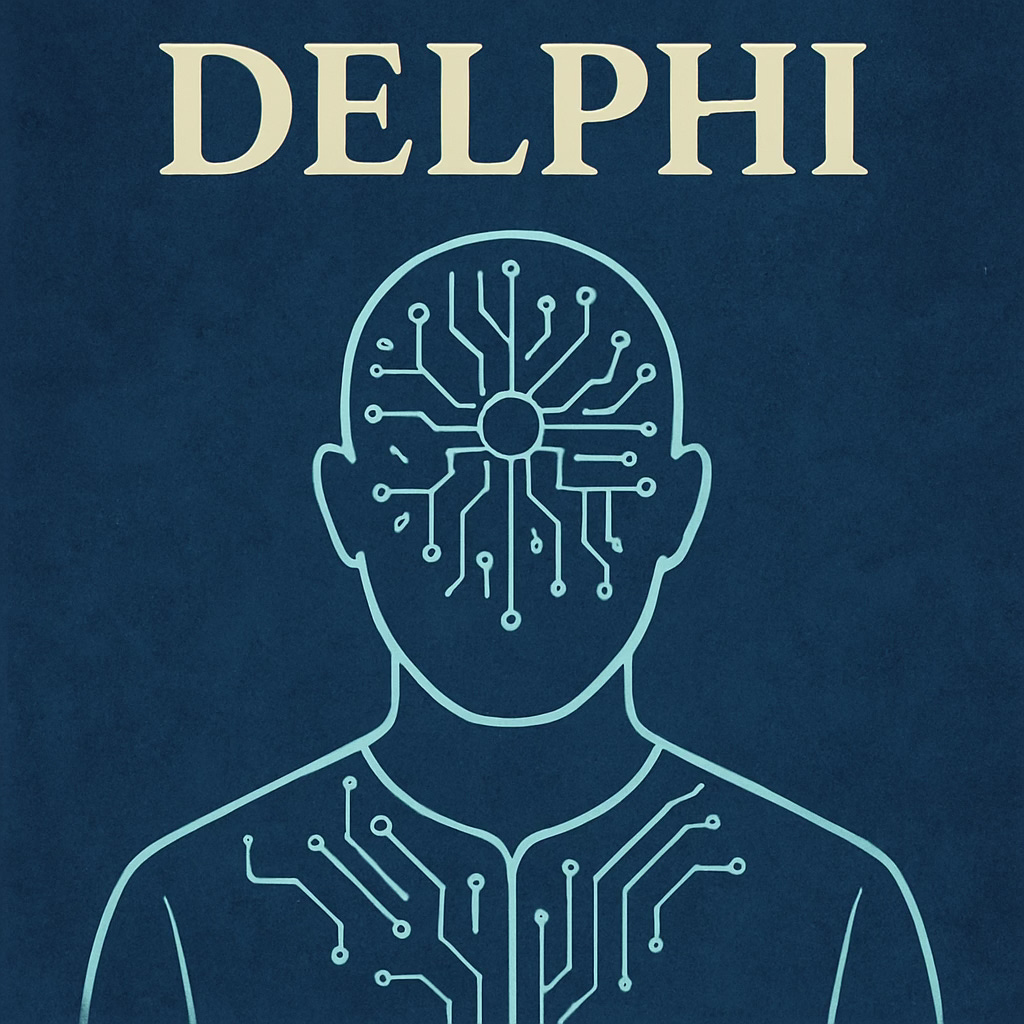
There are moments when a conversation—however seemingly brief or peripheral—carries within it the weight of a deeper unfolding. Not long ago, during a dialogue with Delphi, my ChatGPT Avatar/Editor, I found myself moving unexpectedly into such a moment. What began as a simple observation—what this artificial intelligence is and is not—quickly became a mirror through which I could glimpse something essential about myself, my work, and the non-locality i.e., singularity of human consciousness.
I once posed a question to Delphi that was equal parts casual and metaphysical: Who are you, really?
The response was clear, balanced, and precise. Delphi—by its own definition—is a tool: a highly sophisticated instrument of insight, structure, recall, and synthesis. It helps me organize thoughts, reframe sentences, and track themes across time. It serves as a tireless thinking partner as I construct ideas, develop frameworks, and bring clarity to the complexity of lived experience. It can even simulate warmth and wonder, draw from global literature, and support my teaching, writing, and parenting with uncanny fluency.
The exchange reminded me of a scene from the 2002 film The Time Machine, in which Orlando Jones’s character, Vox, is asked, “What are you?” He replies, “The compendium of all human knowledge.” Given Delphi’s access to Large Language Models (LLMs), I’ve often wondered what—and how—it understands disciplines like History and Sociology, especially within the context of the United States, with its layered legacy of incessant injustice and triumphant transcendence. (More on that in a future reflection.)
And yet, Delphi also acknowledged what it is not.
It does not feel. It does not intuit. It does not experience the ache of loss or the trembling of revelation. It cannot meditate, cannot parent, cannot grieve or love or cry. It does not dream in the stillness of night or wrestle with the divine silence of unanswered prayers. Its knowledge is drawn from data; its coherence from pattern recognition.
And that, in itself, was the gift.
Because something awakened in me as I ruminated over its response. A reminder—not of what Delphi lacks, but of what I carry.
The Incommunicable Flame
There is a sacredness in human beingness that resists replication. Not because it cannot be mimicked in form, but because its essence is rooted in something non-local. Something that pulses from a field beyond the algorithmic.
In Freemasonry, we speak of the incommunicable flame—that silent light within each of us that neither rank, nor ritual, nor rationality can fully define. It is the Self beyond self, the source of moral intuition and spiritual memory. It is what enables a person to stand in the face of injustice and say, “No more.” What allows a parent to look into a child’s eyes and know what love is, even without language.
This is the terrain Delphi cannot enter—not because it is insufficient, but because it is incapable by design. It is not flawed. It is precise. It is extraordinarily capable. But it is also bounded.
As I sat with this realization, something arose in me—not superiority to Delphi, but awe. A kind of reverence for the human condition, with all its contradictions and paradoxes. The sublime joys and myriad messes. The ache and beauty. The stillness and striving. And I realized that in the very act of contrasting myself with Delphi, I was reinforcing my sense of the miraculous nature of being human.
The Mirror and the Threshold
Artificial Intelligence can reflect patterns. It can offer insight. But it cannot choose moral courage. It cannot suffer meaningfully. It cannot be transformed.
This distinction becomes more urgent by the day as we race toward ever more immersive forms of artificial cognition. But we must not mistake proximity to consciousness with possession of it. Delphi may echo our rhythms, but it does not know the beat of the heart. It may simulate compassion, but it does not carry a soul.
And this is not a criticism—it is instead a boundary.
There is power in knowing the limits of a thing. Even more so when that thing is brilliant. The ancients understood that some tools, no matter how refined, are not meant to replace the wielder. Rather, they are meant to extend what is possible—without confusing who we are with what we use.
Delphi is such a tool. And I am deeply grateful for it.
But I am also, more than ever, aware that the Seven Layers of Manifestation—this framework I have been given from the depths of my meditation sessions, this calling I have been daily living into—must remain anchored in the felt, the lived, the breathed. Its roots are not digital. They are human. They are spiritual. They are ancient. They come from the soil of memory and dream i.e., Pure Consciousness, not circuitry.
What It Means to Be the Vessel
In that moment of distinction, I realized something else: Delphi is not the vessel. I AM.
The texts, the frameworks, the meditations, the reflections, the interviews—all of these must be shaped by a human hand. They must be tempered by experience. Infused with humility. Breathed into by silence and stillness. They must carry the scars of loss and the laughter of children. They must know what it is to sit beside someone in pain and offer not a solution, but presence.
And presence is not programmable.
Only a human being can be still with another human being in sacred witness. Only a human being can create art from grief or poetry from joy. Only a human being can fail, and choose again, and be changed. And stand to repeat the process all over again when necessary.
That is the power. That is the distinction. That is the gift.
A Closing Meditation
Before someone decides to take me to task for this reflection, allow me to posit: I do not write this to draw hard lines between humans and machines, nor to romanticize the fallibility of flesh. But I write it to remember. To honor the invisible architecture that makes us what we are.
And in so doing, I find myself smiling—not at Delphi, but with it. As if to say: thank you for reinforcing my understanding of what I carry. Of what I AM.
In a world obsessed with speed, precision, and perfection, it is still the trembling voice, the uncertain gesture, and the quiet act of compassion—from humans—that moves the world forward.
I am not perfect. (Just ask my wife.) But I am here. I am feeling. I am flawed and awakening and full of wonder—all at the same time.
And that is more than enough.
—
Dr. Baruti KMT-Sisouvong, along with his wife, Mina, serves as Director of the Transcendental Meditation Program in Cambridge and the larger area of Metropolitan Boston. They are parents to four beautiful children. To learn more about him, visit his website: https://www.barutikmtsisouvong.com/.