


Author’s Note
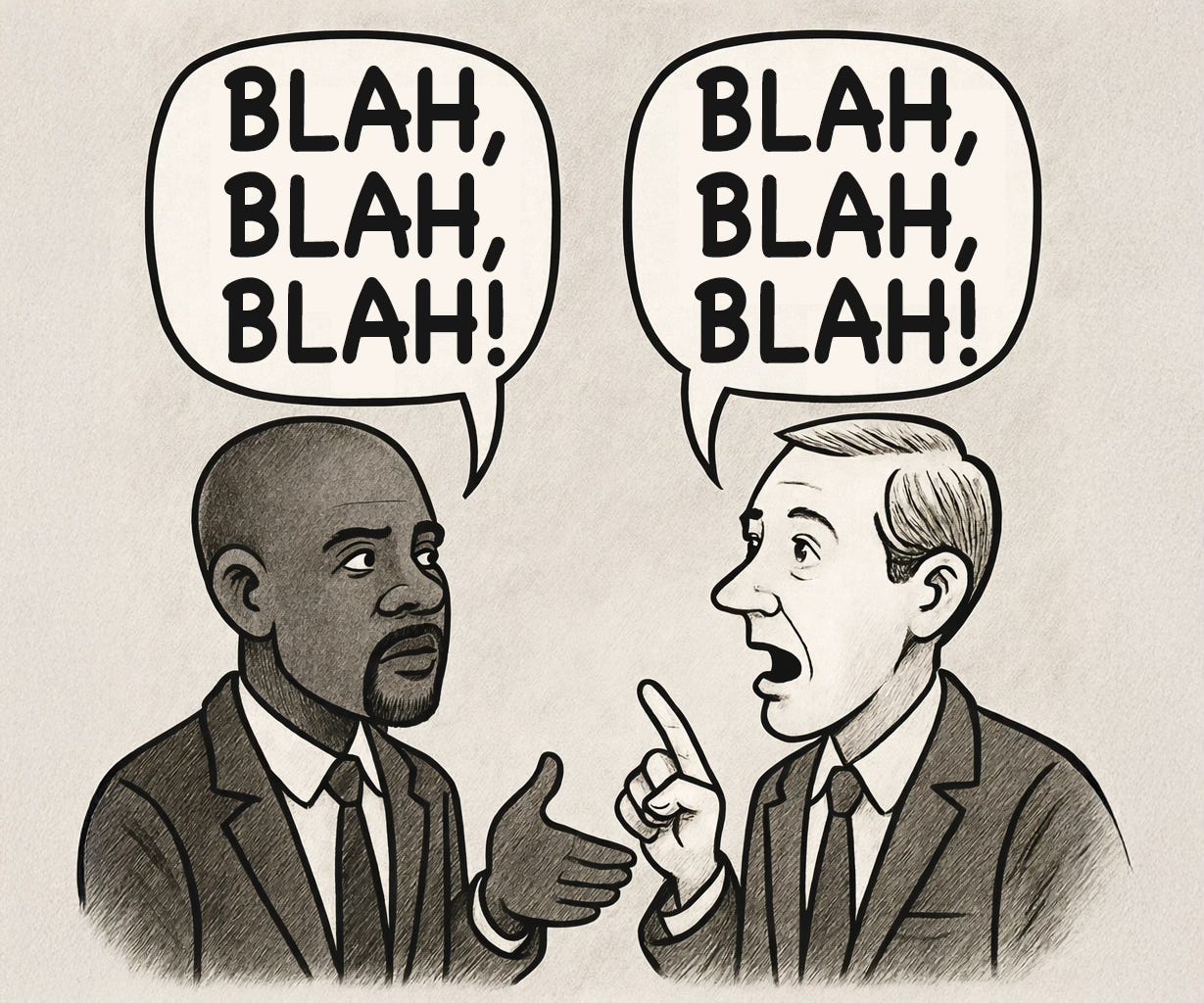
This reflection grew out of a memory of reading Leonard Steinhorn’s commentary in the Atlanta Journal-Constitution more than two decades ago. His challenge—that we ask not why African Americans have struggled, but how they (we) have achieved so much given the odds—has on occasion echoed in my mind ever since. That question of resilience, paired with an image of two men talking past one another beneath word bubbles filled with “Blah, Blah, Blah,” is as timely now as it was then.
In this essay, I consider what resilience in the African American—i.e., Black—experience can teach us about navigating the weighty changes brought by artificial intelligence and artificial general intelligence. To do so, I draw upon two frameworks I have developed: the Seven Layers of Manifestation (SLM), which enables us to see simultaneously the unchanging principles governing the Phenomenal World and the shifting landscape of change within the Human-Derived World; and the Model for Perpetual Growth and Progress (MPGP) born of my Doctoral research, which offers a practical path for moving through that terrain.
The result is both historical reflection and forward-facing meditation—an invitation to shift the question from “What will we lose?” to “How will we rise, given the odds we face?”
In the late 1990s and early 2000s, Leonard Steinhorn challenged America to reconsider how it framed questions about race. Too often, he keenly observed, the question was posed in terms of deficit—often bordering on pathologization: Why haven’t African Americans succeeded in greater numbers? His counter was sharp and necessary: How have African Americans achieved so much, given the odds they face?
I recall an accompanying cartoon, akin to the one created for this essay albeit more flattering than the original: a Black man and a white man in dialogue, each with a speech bubble filled only with the words “Blah, Blah, Blah.” The message was unmistakable. Much of the national conversation on race amounted to sound without listening—talking past one another rather than hearing. Yet within that noise, Steinhorn’s reframing offered clarity: resilience, not failure, was the real story.
Today, as humanity stands at the threshold of artificial intelligence and artificial general intelligence (AI/AGI), I find myself returning to that reframing. What can African American History teach us about resilience in the face of disruption? And what tools might we use—not only to survive what lies ahead, but to transform both ourselves and society through it?
The Long Arc of Resilience and Becoming
From the first shiploads of enslaved Africans, resilience was not optional—it was survival. Songs in the fields encoded hope, faith, and escape routes. Families and communities rebuilt themselves under crushing constraints. Black churches, schools, and civic associations became vessels of strength. Out of oppression emerged artistic brilliance, scientific innovation, and enduring cultural contributions that reshaped the American landscape. Resilience is in our Social DNA.
One early example of such resilience appears in the life and work of Prince Hall, founder of Prince Hall Freemasonry in the Commonwealth of Massachusetts. As I discuss in my dissertation, Hall’s 1797 oration stands as a powerful testament to the cultivation of inner resources amid social hostility. In an effort to counter both mental and physical assaults—and to fortify the Masons present, as well as their families, for life within an increasingly unwelcome society—Hall offered the following charge:
Although you are deprived of the means of education, yet you are not deprived of the means of meditation; by which I mean thinking, hearing, and weighing matters, men, and things in your own mind, and making that judgment of them as you think reasonable to satisfy your minds and give an answer to those who may ask you a question
(Brooks & Saillant, 2002, p. 204).
More than a century later, the Civil Rights Movement embodied resilience on a collective scale: organized nonviolence in the face of brutality, hope sustained by a vision larger than the moment. Every historical epoch—from Reconstruction to the Harlem Renaissance, from Jim Crow to Black Lives Matter—reveals resilience as both offense and defense: the capacity to endure and the creative power to advance.
This resilience was not merely reactive. It was generative. Against odds meant to silence, Black people spoke. Against systems meant to erase, we created foundational technologies and received patents for ideas that continue to fuel global society. Because, in the end, Nature itself is creative. And given that we, too, exist within the same universe as everyone else, are we not also part of Nature and are thus creative? Available evidence offers a resounding yes! Again, resilience is in our Social DNA.
Facing a New Disruption
Today, we stand before another form of systemic disruption: the rise of AI and AGI. Unlike past technologies, these systems do not simply extend human hands or accelerate physical labour; they increasingly mimic human cognition, decision-making, and creativity.
The questions most often asked about these emerging technologies are deficit-oriented: What will humanity lose? Which jobs will vanish? What dangers will arise? Important questions, yes—but incomplete. The better question—the one I am calling for here, the Steinhorn question—is this: How will humanity rise, given the odds before us?
Here, I believe, African American resilience offers a blueprint. For centuries, Black communities have modeled how to face overwhelming odds, adapt creatively, innovate culturally, and retain humanity amid dehumanizing structures. In the language of resilience, history is already a manual for the present. And contemporary models and frameworks may assist individuals and societies alike in charting a path through our collective future.
The Seven Layers of Manifestation (SLM): Seeing the Landscape
As I have written elsewhere, when our questions remain centered primarily on lack and limitation, what we witness is not merely a failure of intellect, but the predictable collapse of Layers 4–7 following a prolonged cultural amnesia regarding Layers 1–3.
These first three layers—Pure Consciousness, Universal and Natural Laws, and the Phenomenal World—form the ontological foundation of existence itself. They are neither optional nor symbolic. They are the underlying structures that enable coherence, intelligence, creativity, and meaning in human life.
When a society denies or forgets them, the remaining anthropological layers—Human Consciousness, the Human-Derived World, Social Constructs, and Outcomes—inevitably fracture. Recognizing AI/AGI as creations within the Human-Derived World, the Seven Layers of Manifestation offer a means of interpreting this dual story of historical resilience and technological disruption.
Pure (Non-Local) Consciousness represents the undercurrent: deeper truths of resilience, creativity, and unseen potential.
Universal and Natural Laws are the observable processes humans attempt to emulate—often imperfectly—through our own systems and designs.
The Phenomenal World is the world into which we are born and, if wise, seek to work with rather than against. The laws governing becoming, sustaining, and departure were not created by humans; we are meant to cooperate with them.
Human (Local) Consciousness reflects the surface level: headlines about AI replacing jobs, or historical narratives of deficit that reinforce lack and limitation at multiple levels.
The Human-Derived World is where ideas and intentions emerge within communities—the dream of freedom, the dream of human-centred technology—and where actions give those intentions form: sit-ins and marches then; ethical frameworks and collective demands now.
Constructs encompass the systems that suppress or support resilience: Jim Crow then; algorithmic bias now. They also shape narratives of possibility—deficit talk versus resilience talk.
Outcomes (Non-Local Influence) close the loop: what the world becomes depends upon the consciousness we bring to shaping it.
Through SLM, African American resilience and humanity’s encounter with AI/AGI are revealed not as isolated phenomena, but as interrelated expressions within a larger pattern of manifestation.
The Model for Perpetual Growth and Progress (MPGP): Walking the Path
If the Seven Layers of Manifestation serve as the lens, the Model for Perpetual Growth and Progress is the path.
The MPGP outlines a six-tier developmental arc—each tier comprising three progressive elements—that guides a human being from basic inner coherence toward higher-purpose action and non-local influence. As the MPGP deepens within one’s epistemological base, this inner development and attendant shift in perspective become evident in all that one thinks, says, does, and produces. In this way, the individual comes to serve as a living point of reference for the movement from “impossible” to “I’m possible,” recognizing that true and lasting change must begin with a restructuring of the scaffolding underlying prior ways of thinking, acting, and generating outcomes.
Applied to larger society and our current socio-technological shift, each of the three elements comprising the six tiers of the MPGP together form a tri-aspect superstructure—one that offers a coherent way of moving through disruption:
Contemplation → Acceptance of Change: facing reality—whether slavery, segregation, or AI/AGI automation—without denial.
Necessary Action → Evolving Sense of Self: responding creatively, whether through the founding of schools or the redefinition of meaningful work in an AI-driven economy.
Execution → Commitment to Higher Purpose: building and sustaining—freedom movements then; conscious technological stewardship now.
The MPGP thus teaches that resilience is not accidental. It is cultivated through successive stages of inner recognition and outward action. It is a living cycle—perpetually renewing, perpetually guiding.
Resilience as Humanity’s Teacher
Viewed together, SLM and MPGP reveal resilience as both principle and practice:
Principle, because history demonstrates that communities can flourish even under seemingly impossible odds.
Practice, because frameworks exist to guide us forward, step by step, in both consciousness and action.
Thus, the African American story is not simply one of survival. It is a parable for humanity itself: how to navigate systemic odds, transform suffering into creativity, and build futures where futures appear denied.
As AI/AGI accelerates, the odds may feel increasingly stacked against society—job displacement, ethical dilemmas, existential risk. Yet the better question, echoing Steinhorn, remains: How will humanity achieve so much, given the odds we face?
Closing
The cartoon with its “Blah, Blah, Blah” reminds us how often dialogue devolves into empty noise. But history teaches us to ask better questions. The question of our moment—echoing through centuries of resilience—is not what will we lose?but how will we rise?
As the dawn of AI/AGI approaches, may we learn from those who have faced impossible odds and emerged with vision intact. May resilience—both ancient and newly cultivated—become the operating system by which we navigate the future.
And may we, as a result, remain willing to install new “software” in the form of more expansive ideas and principled action, oriented toward the highest and best for all. As with African Americans, the larger society is more than capable. Let us, then, envision—and act.
Suggested Practice: Guided Reflection
Take a quiet moment. Close your eyes. Breathe deeply.
Step 1 (SLM Check-In): Are you responding to AI and change from Local Consciousness (surface fear, immediate reaction), or from Non-Local Consciousness (deep trust, creative vision)?
Step 2 (MPGP Alignment): Where are you in the cycle—Contemplation, Action, or Execution?
Step 3 (Resilience Anchor): Recall a personal, communal, or historical story of resilience. What does it teach you about your role in shaping the future?
Sit with the answer. Write it down. Share it if you feel so moved.
—
About the Author
Dr. Baruti KMT-Sisouvong is a consciousness scholar, executive coach, and Certified Teacher of Transcendental Meditation® based in Cambridge, Massachusetts. His work—spanning The Model for Perpetual Growth and Progress and The Seven Layers of Manifestation—explores how Pure Consciousness, neuroscience, and social-systems transformation intersect in the evolution of both the individual and society.
He is the Founder and Director of Radical Scholar Inc., a nonprofit organization dedicated to consciousness-based research and public scholarship, and President of Serat Group Inc., the parent company of Transcendental Brain, a consulting and educational platform bringing consciousness science into leadership and institutional development. He also serves as Host of the On Transcendence Podcast.
Alongside his wife, Mina, he co-directs the Cambridge and Metropolitan Boston TM Program and serves as Host and Founder of International Meditation Hour (IMH), a quarterly global gathering dedicated to the unifying power of silence.
He writes from the conviction that the most important race is not between nations or machines, but between the conditioned mind and the awakening soul.
To learn more about him, visit: https://www.barutikmtsisouvong.com/.