


Author’s Note
This essay is offered in the spirit of clear seeing rather than accusation. It arises from lived experience, but it is not written to settle accounts or assign blame. Spiritual traditions rightly emphasize self-reflection, responsibility, and inner growth; however, these virtues lose their integrity when they are invoked in ways that obscure material causation or excuse structural harm. What follows is an enquiry into how well-intentioned spiritual frameworks can drift into bypassing when power differentials go unexamined. The aim is not to diminish spiritual understanding, but to restore its ethical coherence—so that insight deepens rather than displaces accountability.
—Baruti KMT-Sisouvong, PhD
Spiritual communities often aspire to operate at a higher level of awareness—one grounded in reflection, compassion, and responsibility rather than reactivity or blame. At their best, such communities cultivate resilience and discernment: an inner stability that remains intact amid changing conditions rather than denying them. Yet precisely because of these aspirations, they can become vulnerable to a subtle distortion: the use of spiritual language to bypass difficult truths about power, causality, and material consequence.
This essay examines that distortion not as a moral failure, but as a structural one. It asks how spiritual explanations, when untethered from power analysis, can unintentionally misattribute harm, absolve decision-makers, and quietly burden those least able to absorb the consequences.
Spiritual Bypassing in Institutional Contexts
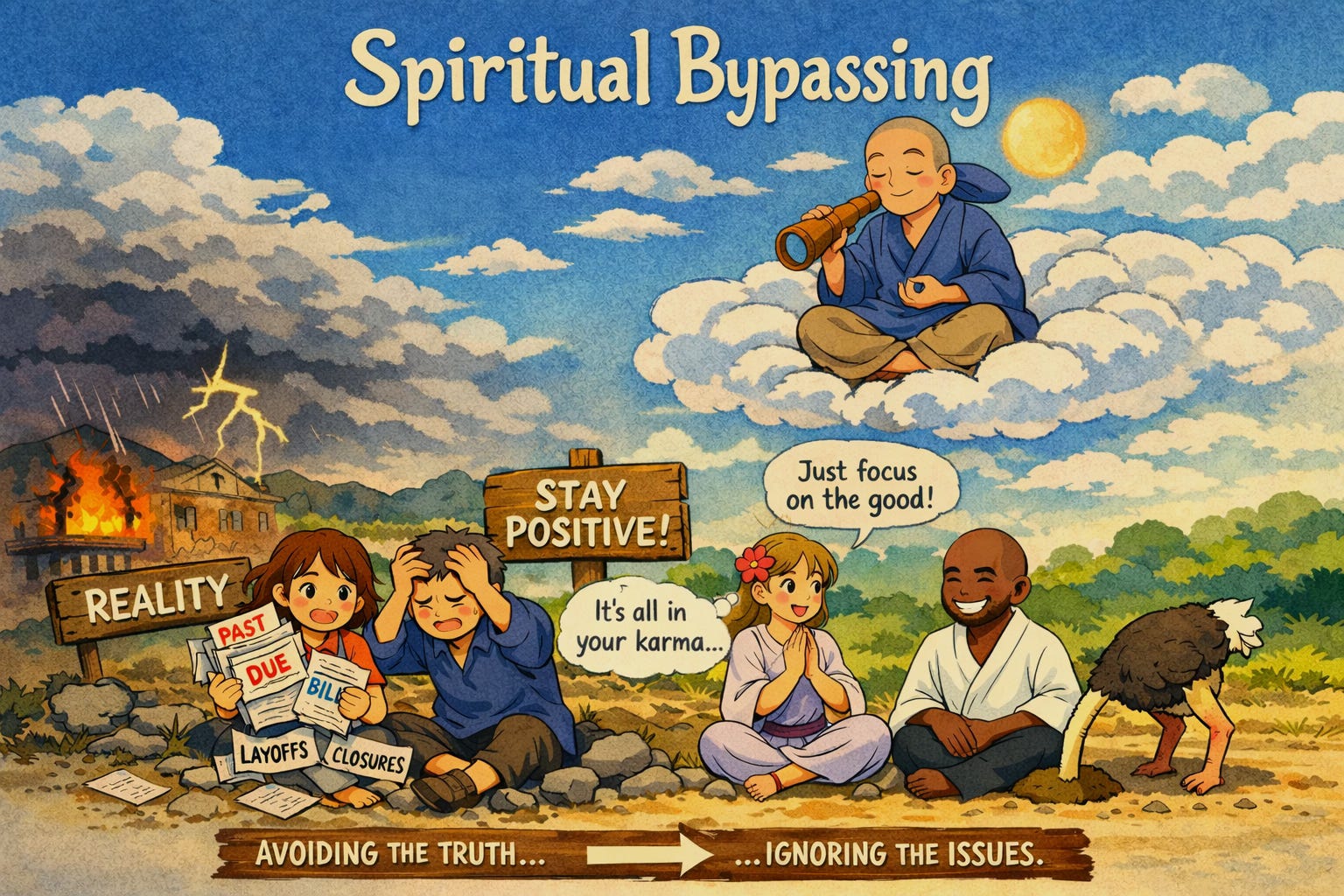
The term spiritual bypassing, coined by Buddhist psychologist and author John Welwood (1943–2019) in the 1980s, was developed to describe the use of spiritual practices or ideals to avoid confronting painful emotions, unresolved psychological issues, or necessary developmental tasks. Rather than engaging these experiences directly, individuals may adopt spiritual language or postures that position them above aspects of human life they find uncomfortable—or, at times, tremendously inconvenient.
Reflecting on the phenomenon in an interview with Tina Fossella, Welwood observed:
“When we are spiritually bypassing, we often use the goal of awakening or liberation to rationalize what I call premature transcendence: trying to rise above the raw and messy side of our humanness before we have fully faced and made peace with it. We then tend to use absolute truth to disparage or dismiss relative human needs, feelings, psychological problems, relational difficulties, and developmental deficits. I see this as an ‘occupational hazard’ of the spiritual path, in that spirituality does involve a vision of going beyond our current karmic situation.”
Although Welwood originally identified this tendency within Buddhist communities, similar patterns can be found across many spiritual and contemplative traditions. In such contexts, bypassing is rarely malicious. More often, it arises in environments where sincerity and shared values are assumed, allowing spiritual ideals to be unconsciously used as a means of disengagement rather than critical enquiry.
Within institutional settings, spiritual bypassing tends to appear not as outright denial, but as misplaced interpretation—particularly when spiritual principles are applied without reference to material conditions. Reflection replaces responsibility; explanation sublimates examination.
Karma Without Power Analysis
Appeals to karma become ethically unstable and morally untenable when severed from any analysis of power. From a sociological standpoint long established in the study of social life, causality is never assessed solely at the level of individual disposition; it is examined in relation to structure, authority, and patterned inequality. Karma, properly understood, concerns the relationship between action and consequence. Yet when consequences are shaped primarily by centralized—or upstream—decisions, policy shifts, or structural interventions, attributing downstream harm to an individual’s inner state confuses metaphysics with material causality.
Such reasoning inadvertently absolves those insulated from impact while moralizing the experience of those who are not. Karma, when invoked without attention to institutional authority, access, and insulation from financial precarity, ceases to function as a tool for insight and instead becomes a narrative that protects hierarchy under the guise of spiritual explanation.
To remain coherent, spiritual causality must be held alongside structural causality—not in competition, but in honest relation.
Causality Across the Seven Layers of Manifestation
One way to understand how spiritual bypassing takes hold—particularly in institutional settings—is through the lens of the Seven Layers of Manifestation, a framework developed in continuity with my doctoral research that traces causality as it unfolds from the most fundamental to the most expressed.
In this model, experience ascends from Pure Consciousness, through Universal and Natural Laws, into the Phenomenal World, Human Consciousness, the Human-Derived World, Social Constructs, and finally into Outcomes, including effects that ripple beyond immediate visibility. Each layer has its own integrity, its own domain of responsibility, and its own mode of causation. This mirrors a long-standing sociological understanding: that meaning and consequence emerge through layered systems of influence, and that errors arise when causality is assigned at the wrong level of analysis.
Spiritual bypassing often occurs when these layers are collapsed—when consequences generated within the Human-Derived World or maintained through institutional Constructs are retroactively explained away by appeals to higher-order principles such as karma, consciousness, or Universal and Natural Law. In such cases, causality is pulled upward in abstraction rather than traced downward in fact.
An ascending model of manifestation makes this misattribution visible. Decisions enacted at the level of systems and policies do not originate in Pure Consciousness, nor are they neutral expressions of Universal and Natural Law. They are mediated through human choice, design, and power—and their impacts register materially and psychologically before they are ever spiritualized.
To honour the full arc of manifestation is to respect where responsibility properly resides at each layer. When this discernment is lost, spiritual language ceases to illuminate reality and instead obscures it—substituting metaphysical explanation for structural accountability. Left unexamined, the downstream effects can accumulate in ways that are difficult to reverse.
When Spiritual Systems Reward the Buffered
Spiritual systems embedded in institutional frameworks can unintentionally reward those already buffered by wealth, status, or independent means. Financial insulation allows disruption to be framed as a “lesson” or “test,” while those without such buffers experience the same disruption as a threat to stability, housing, or livelihood.
Over time, this asymmetry produces a quiet moral distortion. Those least affected appear most composed and are thus perceived as spiritually mature, while those bearing the greatest consequences are encouraged—explicitly or implicitly—to look inward rather than question outward conditions. Equanimity becomes easier to perform when survival is not at stake, yet calm is mistaken for depth and vulnerability misread as personal failing.
This is not a failure of character. It is a failure of context.
Discernment Is Not Blame
Naming structural causality is not a rejection of personal reflection. Nor is it an abdication of spiritual responsibility. Discernment is not accusation; it is the ethical alignment of explanation with causation.
A mature spiritual ethic holds two truths simultaneously:
individuals are responsible for how they respond to circumstances, and
institutions are responsible for the consequences of their decisions.
When reflection is used to displace accountability—or when discernment is collapsed into blame—spiritual language loses its grounding function and becomes anesthetic rather than illuminating.
The Obligation to See Clearly
Spiritual traditions exist, in part, to reduce suffering—not to explain it away. When institutional decisions produce uneven harm, clarity is not optional; it is an ethical obligation. Seeing clearly does not require hostility, nor does it demand retribution. It requires aligning explanation with causation, compassion with consequence, and—where appropriate—direct and equitable recompense.
A spiritually mature system is not one that never disrupts lives, but one that can acknowledge disruption honestly, distribute responsibility fairly, and respond with integrity rather than abstraction.
Clear seeing requires honouring the full arc of causality—from consciousness to construct to consequence—without collapsing responsibility upward or downward for the sake of comfort.
Clear seeing, even when uncomfortable, is not divisive.
It is the foundation of trust.
For if we do not have trust, what is the alternative?
Suggested Practice: Seeing Clearly, Gently
Set aside 10–15 minutes in a quiet space.
1. Name the Situation Clearly
Without interpretation, write down what occurred. Focus on observable actions, decisions, or changes—avoid conclusions about intent or meaning.
2. Separate What Was Done To You from How You Responded
In two columns, distinguish between:
circumstances or decisions beyond your control
your internal responses, choices, or adaptations
3. Notice Where Responsibility Truly Lies
Ask: Who had decision-making authority? Who absorbed the consequences? Who was buffered, and who was exposed?
Notice what becomes clearer when responsibility is located accurately.
Let answers arise without judgment.
4. Release False Causality
Gently notice any impulse to over-attribute blame to yourself in order to preserve harmony or coherence. Silently affirm:
Clarity does not require self-punishment.
5. Close with Integration
End by identifying one insight that restores alignment—either internally (how you will care for yourself) or externally (what truth you will no longer obscure).
This practice is not about fixing or resolving.
It is about seeing without distortion.
—
About the Author
Dr. Baruti KMT-Sisouvong is a consciousness scholar, executive coach, and Certified Teacher of Transcendental Meditation® based in Cambridge, Massachusetts. His work—spanning The Model for Perpetual Growth and Progress and The Seven Layers of Manifestation—explores how Pure Consciousness, neuroscience, and social-systems transformation intersect in the evolution of both the individual and society.
He is the Founder and Director of Radical Scholar Inc., a nonprofit organization dedicated to consciousness-based research and public scholarship, and President of Serat Group Inc., the parent company of Transcendental Brain, a consulting and educational platform bringing consciousness science into leadership and institutional development. He also serves as Host of the On Transcendence Podcast.
Alongside his wife, Mina, he co-directs the Cambridge and Metropolitan Boston TM Program and serves as Host and Founder of International Meditation Hour (IMH), a quarterly global gathering dedicated to the unifying power of silence.
He writes from the conviction that the most important race is not between nations or machines, but between the conditioned mind and the awakening soul.
To learn more about him, visit: https://www.barutikmtsisouvong.com/.