


Author’s Note
Solve et coagula entered my thinking at a time when I had begun to recognise a pattern across experiences that, while living through them, had often seemed unrelated. The completion of my doctorate in 2023 marked the end of one long journey, but the years that followed brought changes in professional relationships, institutions, economic circumstances, intellectual direction, and my understanding of where the work ahead might properly belong. At the same time, On Transcendence, the Seven Layers of Manifestation, Adaptive Elegance, and Transcendental Brain began taking form. This essay emerged from the recognition that these were perhaps not two separate stories—one about things becoming less stable and another about things being created—but different movements within the same double-helix like process. I offer it not as an argument that every loss conceals a gift, but as an invitation to consider whether some forms of dissolution become intelligible only after we begin to see what is assembling in the space they leave behind.
—Baruti KMT-Sisouvong, PhD
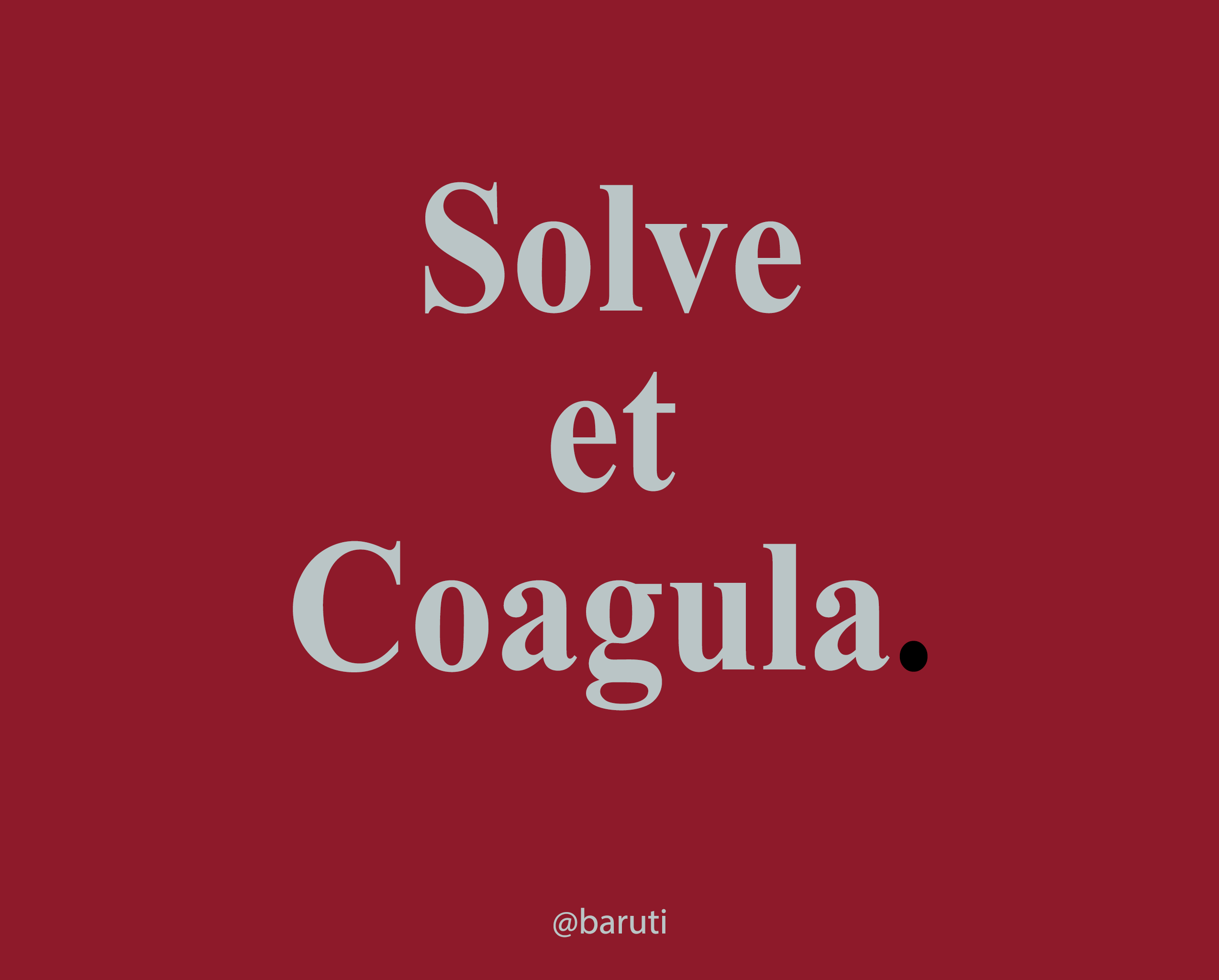
There is a Latin phrase I recently encountered as a tattoo on the forearms of an attendee to one of our recent group meditations that has been rolling around in my mind: solve et coagula. Dissolve and coagulate.
The words come from the language of alchemy, where they describe processes through which something is broken down into its constituent elements and subsequently recombined into another form. Over centuries, the phrase acquired meanings extending beyond the Alchemist’s laboratory. Dissolution and reconstitution became metaphors for transformation itself:
what exists is loosened, separated, or reduced so that something different might emerge from what remains.
I have been ruminating over my experiences and that of my family of the last three years and the serendipity of those words crossing my path at precisely the moment they were needed most, are not lost on me. Viewed from where I now stand, much of the last three years of my life seems to have followed precisely that movement. At the time, however, it did not always look or feel like transformation. Sometimes it simply looked like, if I may borrow the words of Nigerian novelist and poet Chinua Achebe, “things were falling apart.”
That observation matters because humans have developed an enormous vocabulary for beginnings. We celebrate launches, births, graduations, marriages, appointments, promotions, discoveries, and all the other moments in which something new announces its arrival. However, we are considerably less comfortable with the periods preceding them, those seasons in which familiar structures stop working, relationships change, institutions disappoint us, financial assumptions become unstable, identities become too small, and arrangements we had expected to continue reveal that they will not. From inside such periods, dissolution rarely introduces itself politely as transformation. If I am being honest, it looks like loss and feels like uncertainty. And because we cannot yet see the form that might eventually emerge, our natural impulse is often to attempt to preserve the form we already know. In the interest of full disclosure, I certainly know something about that impulse.
In September 2023, after years of research, writing, revision, and persistence, I successfully defended the dissertation that completed my doctoral work in Vedic Science. It was an achievement toward which I had been moving for years, but the degree represented more to me than another credential. I had spent much of my adult life thinking about consciousness, mystical experience, human development, culture, and the structures through which people make meaning. The doctorate represented the formal culmination of one long intellectual journey and, quite reasonably, I imagined that what followed would be a period of consolidation. Instead, what followed was dissolution.
Not catastrophe or a single dramatic rupture after which everything was suddenly different. What occurred was slower and, in some respects, more consequential. Structures that had once seemed stable began revealing their limitations, some relationships changed while others disappeared, and institutional assumptions I had previously been willing to accept became increasingly difficult to sustain. Not to mention, economic conditions shifted and ways of working that had once appeared viable became less so. And finally, questions I had been willing to leave unanswered became harder to ignore. Increasingly, I found myself confronting the difference between preserving an existing arrangement and following the direction in which my own work seemed to be moving. Admittedly, it has been a surreal experience.
For a considerable period, my instinct was to repair what appeared to be weakening. That instinct was not unreasonable. Because when something we value begins to falter, responsibility often requires that we invest more effort, communicate more clearly, make adjustments, accommodate where accommodation is appropriate, and determine whether equilibrium can be restored. I was taught early by my parents and continue to believe there is virtue in not abandoning something simply because it has become difficult. Persistence has carried me through enough of life that I would be suspicious of any philosophy that treated difficulty itself as evidence that something should be discarded.
Yet there is another possibility, and it has taken me some time to recognise it. Repair can gradually become the expenditure of enormous amounts of energy attempting to preserve a form whose usefulness has already begun to expire. Persistence, which in one context represents discipline and commitment, can in another become an inability to recognise that the conditions which once justified the investment have fundamentally changed. The difficult question is not simply whether something can be held together, but whether holding it together continues to serve the purpose for which the structure existed in the first place. Here, I am reminded of an engineering dictum I read somewhere long ago:
Become comfortable with ceasing to optimise a thing that should no longer exist.
That has been one of the more consequential lessons of the past three years. Not everything that can be preserved necessarily should be preserved. There are moments when the more useful question ceases to be, How do I prevent this from changing? and becomes instead, What might this change be making possible?
That is solve: to dissolve.
But dissolution by itself is not transformation. A building reduced to rubble has dissolved. A relationship ended has dissolved. An institution collapsed due to negligence and or financial mismanagement has dissolved. An identity abandoned has dissolved. And as I have come to understand it, there is nothing inherently generative about disintegration. For transformation to occur, something more is required. The constituent elements must enter into another relationship. What has been loosened must become available for another organisation.
That is coagula: to bring together, to re-form, to permit another configuration to emerge from what remains. In my experience, this is true for buildings, relationships, institutions, and even identities.
The curious thing is that I could not see this second movement clearly while I was occupied with trying to prevent the first. Only in retrospect have I begun to recognise that while certain structures in my life were loosening, something else was occurring at precisely the same time. I was building.
Last year in July, I began publishing On Transcendence as a place to think publicly about consciousness, human development, meditation, society, and questions that had occupied me for decades. At first, the essays were simply essays. One question led to another, an observation became the occasion for reflection, and experiences from seemingly unrelated parts of my life found their way onto the page. Yet as the body of work grew, recurring patterns became increasingly visible. Ideas that had previously existed in different intellectual compartments began speaking to one another.
Additionally, last year in October saw the birth of the International Meditation Hour which quickly garnered a loyal viewership for the quarterly gatherings to hear discussions surrounding contemplative traditions as a way to illustrate that the source of all are the same. And to allow those curious about meditation to be introduced to contemplative life and its modern benefits for society in a welcoming environment.
Also, the reorientation framework I call The Seven Layers of Manifestation emerged in the Autumn of 2023 from this process as an attempt to understand the relationship between Pure Consciousness, Universal and Natural Laws, the phenomenal world, human consciousness, the worlds human beings create, the constructs through which we organise those worlds, and the outcomes that ultimately result. The Model for Perpetual Growth and Progress, which had emerged from my doctoral research, began finding its place within a larger architecture. Questions concerning how people navigate disruption and transition developed into what I now call Adaptive Elegance. The nonprofit I founded in 2006, Radical Scholar, became another vehicle through which scholarship and public service could meet. Increasingly, these projects that had initially appeared to be separate undertakings began revealing themselves as expressions of a larger inquiry, one that eventually found an intellectual home in Transcendental Brain. Not to forget the book manuscript that has been in the works for two years titled Elegant Transitions.
The temptation when recounting such developments is to impose intentionality upon them after the fact. We prefer stories in which the protagonist knew where he was going, formulated the plan, encountered the obstacles, and eventually arrived at the destination he had envisioned from the beginning. Admittedly, it is an attractive narrative. But it would not be an accurate description of these years. I did not know in 2023 where any of this was going. Most of the time, I knew only what appeared to be the next appropriate thing to do. An essay seemed worth writing, so I wrote it. A question required further examination, so I followed it. A conceptual relationship became visible, so I developed it. A conversation opened another possibility, so I entered it. A platform was needed, so I began constructing one. And to be crystal clear, only afterward did the pattern become visible.
That recognition has caused me to reconsider what I mean when I say that something in life is “falling apart.” Sometimes, of course, that is precisely what is happening. As I see it, there is no wisdom in romanticising every loss, failure, disappointment, or disruption as though the universe secretly arranged it for our development. Some things break because they are neglected, opportunities disappear because we mishandle them, institutions deteriorate because people make poor decisions, relationships end because the conditions necessary to sustain them no longer exist, and suffering is simply suffering. And Solve et coagula should not become a philosophy for pretending otherwise.
But neither should we assume that preservation is always preferable to dissolution. A form that served one stage of development may become incapable of containing the next. The very structure that once provided stability can eventually constrain what is attempting to emerge within it. At such moments, life presents us with a peculiar choice: we can expend increasing amounts of energy maintaining the architecture of what has been, or we can permit enough of that architecture to loosen such that another possibility becomes visible.
I believe I have spent much of the last three years standing somewhere within that choice.
There have been periods in which I interpreted progress primarily as the successful restoration of what had been disrupted. If the former equilibrium could be recovered, the problem would have been solved. Increasingly, however, I have begun to wonder whether restoration was ever the appropriate task. Perhaps some disruptions are not invitations to reconstruct yesterday. Perhaps they are, instead, occasions for reorganisation.
To be crystal clear, reorganisation does not require rejecting everything that preceded it. Quite the opposite. Dissolution leaves material behind, yes. Experience, knowledge, relationships, skills, lessons, commitments, and values do not simply disappear because the structure in which they were acquired has changed. They become available for recombination. What was learned in one context can indeed, and in some cases, serve another. What was developed for one purpose can acquire another use. A relationship that genuinely belongs to one’s life may survive the institutional arrangement through which it originated. An idea constrained by one setting may become generative when moved into another.
Seen from this perspective, several experiences I once regarded primarily as obstacles now look somewhat different. Some were also clarifications. They revealed where reciprocity existed and where it did not, which structures possessed the capacity to adapt and which could survive only by demanding ever greater accommodation from those within them. They forced me to distinguish between things I continued to value because they served a meaningful purpose and things I valued largely because I had invested years of my life in them. Those are not the same thing, although from inside a long commitment they can be remarkably difficult to distinguish and sunk-cost fallacy is a real thing.
Perhaps most importantly, this period forced upon me a question I might otherwise have postponed indefinitely:
If the existing structure disappeared, what would I build in its place?
There is something liberating about that question because it redirects attention from rescue toward creation. The energy previously consumed by attempting to control what other people or institutions will become can be invested in determining what one will build oneself. As a result, one’s orientation changes. One ceases measuring every development by whether it restores the old arrangement and begins asking whether it contributes to the emerging one.
I have felt that shift increasingly over the past year. The work has become less about finding somewhere for my ideas to fit and more about constructing appropriate containers for them. I find myself less concerned with whether an existing institution has room for a particular inquiry and more interested in following the inquiry wherever it leads. The question of permission has gradually given way to the question of responsibility: if I believe something deserves to exist, what am I prepared to do to bring it into form?
A small moment this past weekend made that change unexpectedly tangible. Several months ago, I was invited to participate in an interdisciplinary conference examining complexity science, medicine, and the intelligence of healing. Upon receiving word that we were definitely on for the conference and as I then considered what I might contribute, I found myself returning to questions that have emerged across several years of work: consciousness, self-organisation, adaptation, transcendence, and the conditions under which complex systems reorganise. Eventually a presentation began to take shape around a question that now seems almost inevitable: What is the nature of the intelligence by which living systems organise?
Then came an altogether more mundane question. The conference organiser asked for my institutional affiliation.
Not long ago, I might have hesitated. This time, I did not. I wrote: Transcendental Brain.
It was a small act, barely a sentence in an email, yet I found myself recognising what it represented. Something that had existed first as an idea, then as a name, then as a collection of apparently related projects had become sufficiently coherent to serve as the intellectual home from which I could enter a scholarly conversation. No committee declared the moment. Nor did a ceremony accompany the occasion. Nothing external conferred legitimacy upon it. Yet something had changed within me because the new form had begun to hold.
As I sit here typing these lines and reflecting on the naming my affiliation experience, I am convinced that transformation often happens this way, not through trumpets or dramatic declarations but through a gradual reversal in what feels real. The old form becomes less convincing at approximately the same time that the new one becomes more substantial. Eventually, and almost without noticing when the threshold was crossed, we discover that we are no longer primarily leaving something. We are entering something. That is what solve et coagula has come to mean to me.
I once might have understood the phrase primarily as an instruction: identify what must be dismantled and construct something better in its place akin to the thinking of Buckminster Fuller. Yet I hear it differently now. It seems less like an instruction than an observation about the nature of becoming. Growth continually asks existing forms to accommodate what is emerging within them. Sometimes they can. They expand, adapt, and remain useful. Sadly, sometimes they cannot. And when they cannot, dissolution need not represent the opposite of progress. Under certain conditions, it may be one of progress’s mechanisms.
The difficulty is that we usually encounter solve before we can see coagula. We experience the loosening before we understand what the loosening has made possible. We see pieces before we see a pattern, and we experience absence before we recognise space. This may be why periods of genuine transition require something more demanding than optimism. They require orientation:
the capacity to remain sufficiently attentive amid uncertainty to distinguish between what genuinely requires repair and what must finally be released, between what deserves another investment of energy and what has already taught us everything it can, and between the destruction of something valuable and the dissolution of a form that has completed its work.
I know of no formula that can make those distinctions for us. Perhaps the closest thing I have found is a practice of attention: observing where enormous effort is required merely to keep something standing, where energy begins to return when that effort is withdrawn, and what starts assembling when the space previously occupied by maintenance becomes available for creation. Often the evidence does not arrive all at once. However, we recognise it retrospectively, when we look behind us over the road travelled and discover that pieces which once appeared scattered have begun assuming another form.
Three years after completing one journey I had spent years pursuing, I find myself standing inside another that I could not then have described. Some things have dissolved and others are still dissolving. Yet something new has become increasingly visible among what remains, and for perhaps the first time along the path I do not feel compelled to hurry the process or insist upon knowing its final shape.
After all, solve is only half the sentence.
Coagula is already underway.
Suggested Practice
Consider something in your life that you have been working particularly hard to preserve. It might be a relationship, role, professional arrangement, expectation, identity, routine, institution, or simply an idea about how some part of your life is supposed to unfold. Rather than immediately deciding whether it should be retained or released, spend some time observing the energy required to maintain it. Ask yourself what remains genuinely alive within the arrangement, what seems to require increasing force merely to continue, and whether your efforts are serving the underlying purpose or principally preserving its familiar form.
Then turn your attention toward what may already be assembling elsewhere. What questions keep returning? Where does energy seem to reappear? What have you begun creating, exploring, or imagining without having consciously identified it as a new direction? The object is not to force a coagula simply because you have recognised a solve. It is to become sufficiently attentive that, should a new configuration already be emerging, you are able to recognise it.
Sometimes the most useful question is not, “How do I put this back together?”
It is, “What is trying to take form now?”
—
About the Author
Dr. Baruti KMT-Sisouvong is a scholar of consciousness, researcher of human development, and Certified Teacher of Transcendental Meditation® based in Cambridge, Massachusetts. His work explores the relationship between Pure Consciousness, neuroscience, and social systems, and how deeper awareness can inform both personal growth and institutional transformation.
He is the Founder and Chief Meditation Officer of Transcendental Brain, an initiative examining the intersection of consciousness research, cognitive science, and high-performance decision-making. He is also President of Serat Group Inc. and Founder and Director of Radical Scholar Inc., a nonprofit dedicated to consciousness-based research and public scholarship.
Alongside his wife and teaching partner Mina, he co-directs the Transcendental Meditation program for Cambridge and the Greater Boston area. He is also the host of the On Transcendence Podcast and Founder of International Meditation Hour, a quarterly global gathering dedicated to the unifying power of silence.
His writings—spanning frameworks such as The Model for Perpetual Growth and Progress and The Seven Layers of Manifestation—explore the evolving relationship between consciousness, leadership, and society.
He writes from the conviction that the most important race is not between nations or machines, but between the conditioned mind and the awakening soul.
To learn more about him, visit: https://barutikmtsisouvong.com/.