


Author’s Note
This essay emerged from an ongoing conversation between my scholarly interests, my lived experiences, and the possibilities I perceive for our collective future. I am grateful to my friend Dave White, whose essay, Food, Clothing, Shelter, Wi-Fi, prompted me to revisit the relationship between Abraham Maslow’s examination of human motivation and the Model for Perpetual Growth and Progress that emerged during my doctoral research.
The subject has acquired a particularly personal significance over the course of the last ten months. During this period, my family and I have experienced firsthand the extent to which material uncertainty can demand considerable attention and energy. Yet, alongside those experiences, I have continued to engage in scholarly enquiry, creative endeavours, and the development of initiatives intended to contribute to the well-being of others. These seemingly divergent experiences have deepened my appreciation for the relationship between the circumstances within which we live and the capacities we continue to cultivate.
I remain convinced that the fullest expression of human potential requires attention to both dimensions of our existence. We have a collective responsibility to create conditions that support human flourishing, just as we have an individual responsibility to participate consciously in our own development. Neither responsibility diminishes the significance of the other.
Much of my work, across its various expressions, represents an attempt to understand this relationship and contribute to its practical realisation. My hope is that this essay encourages further conversation about what we might become, individually and collectively, if we were to regard the development of human consciousness and its attendant capacities as central to our understanding of progress.
—Baruti KMT-Sisouvong, PhD
A friend recently shared an essay that brought me back to a question I have been considering for many years: What would become possible if we organised our societies around the full development of human beings rather than primarily around their capacity to contribute to existing economic arrangements? The essay, Food, Clothing, Shelter, Wi-Fi, was written by Dave White, whose work with Artificial Intelligence has led him to consider not only the extraordinary capabilities of emerging technologies but also the conditions under which human beings might benefit from them. His argument is both practical and provocative. As technological systems become increasingly capable of performing work previously undertaken by people, the resulting productivity, incoming value judgement, should help secure the conditions necessary for individuals to participate meaningfully in society and pursue lives that extend beyond the immediate demands of survival.
Dave draws upon Abraham Maslow’s familiar hierarchy of needs, but proposes a significant alteration to its conventional presentation. Rather than imagining individuals climbing a pyramid toward self-actualisation, he invites readers to consider a house whose roof consists of guaranteed primary needs. Food, water, clothing, shelter, healthcare, education, connectivity, and a basic income become conditions provided by society rather than benefits contingent upon a person’s position within the labour market. Beneath that roof, individuals are free to cultivate belonging, fluency, contribution, and imagination according to their interests, abilities, and aspirations. For me, the metaphor is appealing because it changes the location of responsibility. Instead of asking only what an individual must do to ascend, it asks what society must provide so that individuals have a meaningful opportunity to develop.
His argument also raises a question that deserves attention beyond the immediate discussion of Artificial Intelligence. If we were successful in establishing these conditions, what would follow? Would the removal of certain material constraints naturally lead individuals toward the fuller expression of their capacities, or would additional forms of development remain necessary? The answer, I believe, requires us to distinguish between the conditions that make growth possible and the processes through which growth is consciously undertaken.
This distinction returned me to the work of Abraham Maslow and, more particularly, to the Model for Perpetual Growth and Progress, or MPGP, that emerged during the research culminating in my doctoral dissertation at Maharishi International University.
Maslow’s 1943 paper, A Theory of Human Motivation, proposed that human motivation could be understood partly through a hierarchy of needs, with certain needs generally assuming greater urgency when they remained insufficiently satisfied. His work has frequently been represented through a pyramid, although that familiar image was not part of his original publication. At its upper reaches, the theory considers self-actualisation, the tendency toward the realisation of one’s capacities and potentialities. Maslow subsequently explored transcendence, extending his consideration of human motivation beyond individual fulfilment in 1969 toward values and purposes that reach beyond the individual self.
It is worth distinguishing here between transcendence as discussed by Maslow and transcending as understood within Maharishi Vedic Science. Whereas Maslow’s consideration of self-transcendence concerns motivations, values, and purposes extending beyond the individual self, Maharishi Vedic Science describes transcending as the process through which the mind moves beyond the progressively subtler levels of mental activity to experience Pure Consciousness, the self-referral nature of consciousness itself. The former concerns, principally, an expansion in the orientation of human motivation; the latter concerns the direct experience of the fundamental nature of consciousness. Within the philosophical orientation of the MPGP, these considerations need not be regarded as mutually exclusive. Rather, they invite further enquiry into the relationship between the development of consciousness and the increasingly expansive purposes towards which human capacities may be directed.
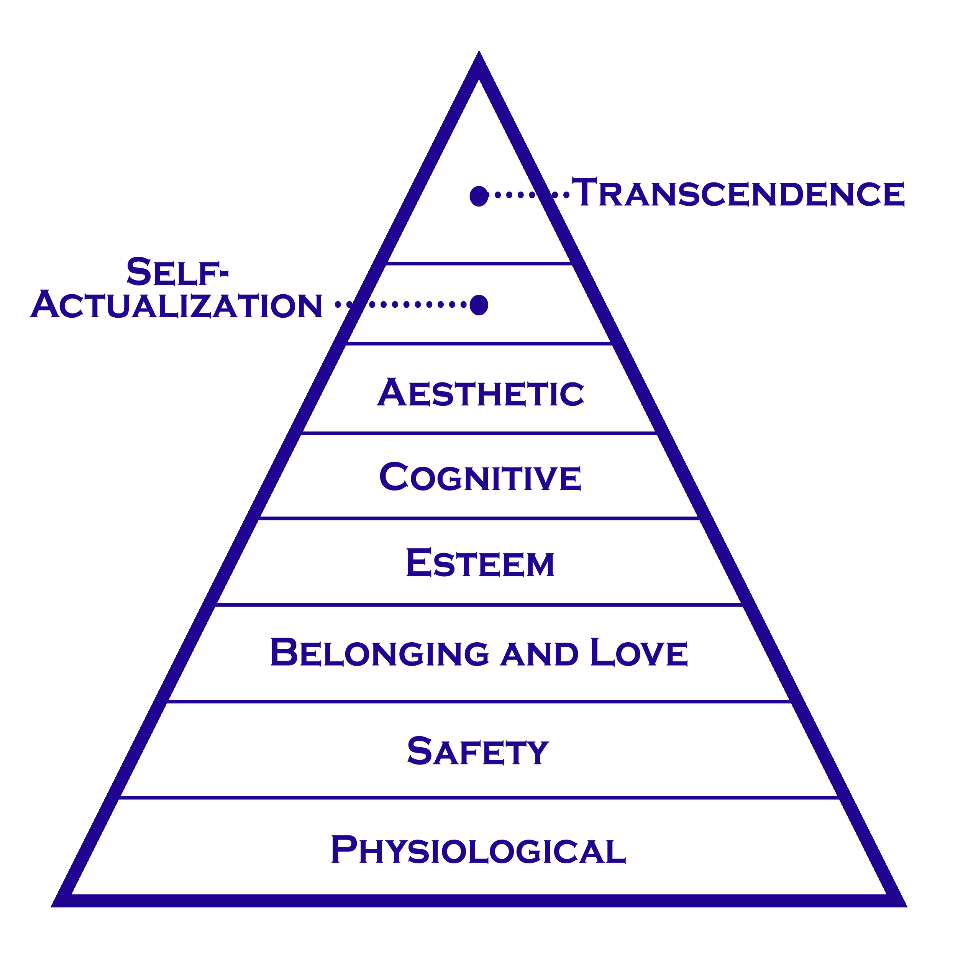
Depiction of Maslow’s Hierarchy of Needs (1943/69)
These ideas have remained influential because they speak to something recognisable within human experience. When a person is struggling to secure food, maintain housing, or protect their family from immediate danger, those concerns can understandably occupy a substantial portion of their attention and effort. This is something with which I have become intimately familiar over the last ten months. Yet human beings also demonstrate an enduring interest in learning, creating, belonging, contributing, and discovering what their lives might mean. This is something I have also experienced alongside the former. Our aspirations are not exhausted by the satisfaction of material requirements, even though the conditions under which we live can profoundly influence our ability to pursue them.
I do not believe Maslow’s hierarchy should be interpreted as an inflexible staircase through which every person must progress in precisely the same order. Human motivation is considerably more dynamic, and individuals have repeatedly demonstrated the capacity to pursue knowledge, create beauty, and serve others even while confronting considerable deprivation. Nevertheless, the model remains valuable as a reminder that human development occurs within conditions that may either support or constrain the expression of our capacities.
This is where Dave’s proposed roof becomes especially consequential. A society that provides reliable access to the resources necessary for participation in contemporary life does more than relieve immediate hardship. It may also enlarge the practical opportunities available for education, experimentation, relationships, creative work, and purposeful engagement. A person who no longer must devote every available resource to securing tomorrow’s necessities may possess greater freedom to consider what they wish to learn, what they might create, and how they could contribute to the lives of their fellow humans.
At the same time, the existence of such opportunities does not determine how they will be used. Greater freedom can provide the conditions for development, but it does not necessarily supply the knowledge, discipline, discernment, or sense of purpose through which development becomes an intentional undertaking. We may possess capacities that remain largely unrecognised, encounter opportunities without understanding their significance, or acquire knowledge without translating it into meaningful action. The challenge of human flourishing therefore involves both the organisation of our external conditions and the cultivation of our internal capacities.
During my doctoral research, I encountered this relationship through an examination of mystical experiences among Freemasons and the philosophical dimensions of a system often understood primarily through its fraternal and philanthropic activities. My interest extended beyond whether individuals reported unusual experiences. I was also concerned with how sustained engagement with ritual, symbolism, contemplation, and practical activity might contribute to personal transformation and the manner in which such transformation could become evident within one’s life.
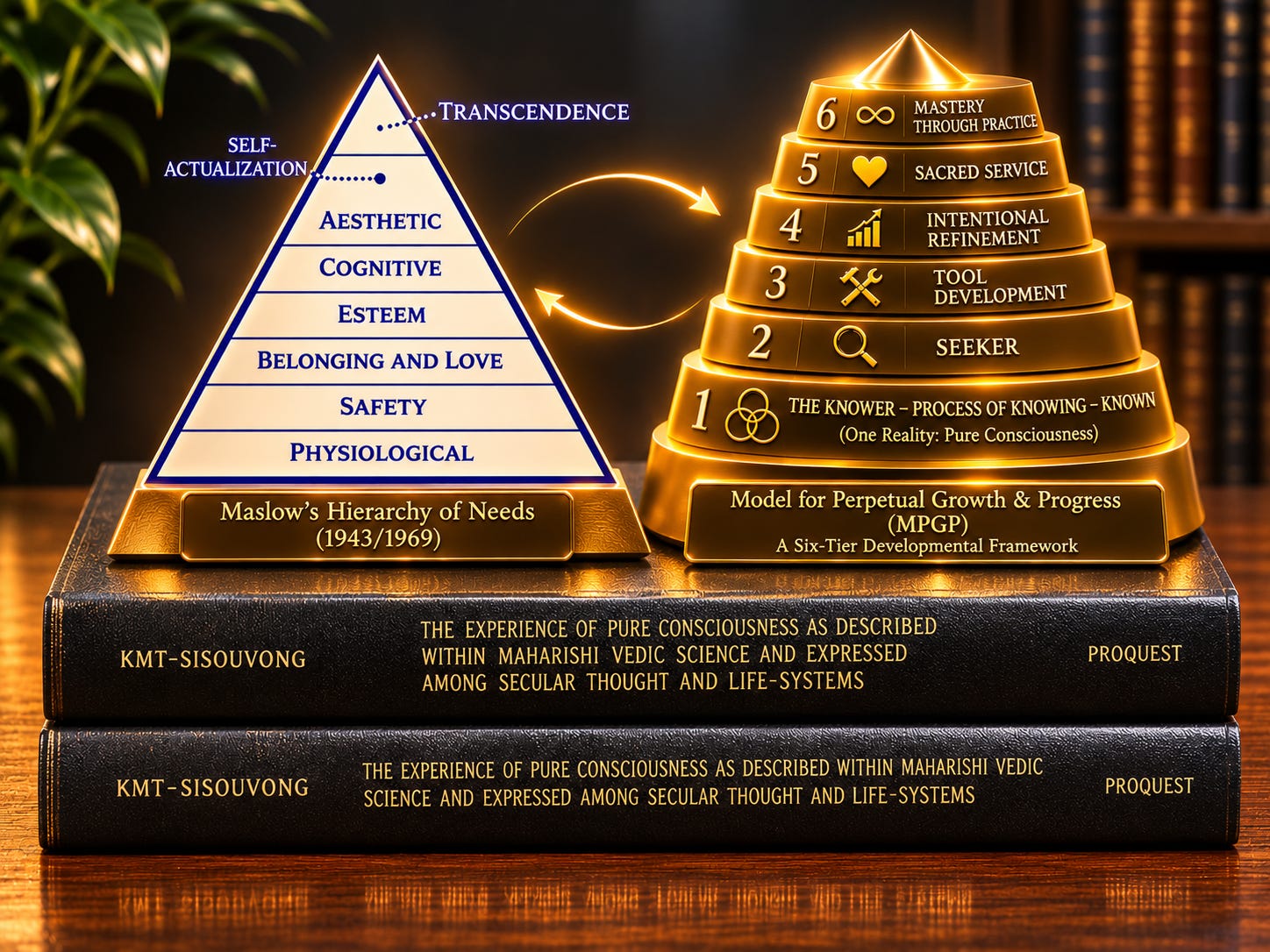
Out of that enquiry emerged the Model for Perpetual Growth and Progress (MPGP). Although developed initially within the context of Freemasonry, the model was intended to illuminate a process of development that could be considered more broadly. Its philosophical foundation rests upon the three-in-one structure of Pure Consciousness as articulated within Maharishi Vedic Science. Within this understanding, the Knower (Ṛishi), the Process of Knowing (Devatā), and the Known (Chhandas) constitute three distinguishable aspects of a single, self-referral reality, their unified wholeness being referred to as Saṃhitā. Consciousness, in this formulation, is not merely a capacity through which an individual acquires knowledge of an independently existing world; it is understood as possessing within its own nature the fundamental structure of knowledge itself. The MPGP emerged, in part, from my consideration of how this understanding might inform our examination of human development and the relationship among knowledge, experience, contemplation, and action.
One of the more interesting discoveries occurred after the model had begun to take shape. During conversations with Masonic colleagues and mentors, similarities between its progression and Maslow’s hierarchy became apparent. Those similarities had not consciously guided its initial development, but they invited a closer examination of how the model might be situated within the broader discussion of human potential. I came to regard the MPGP as operating principally within the domain Maslow associated with self-actualisation and, in its orientation toward higher purpose, with his subsequent discussion of transcendence.
The distinction is worth considering because Maslow’s model addresses the needs and motivations associated with human development, while the MPGP seeks to illuminate a process through which individuals may deliberately cultivate and express their capacities. The models are not identical, nor should one be treated as a replacement for the other. Rather, they offer different perspectives upon a shared concern: how human beings might become more fully capable of expressing the possibilities inherent within their lives.
In its original formulation, the MPGP begins with a foundational consideration of the Knower, the Process of Knowing, and the Known. It then explores the importance of becoming a Seeker of knowledge, engaging in sustained education, cultivating a deeper desire for understanding, undertaking contemplation, accepting change, and translating increasingly refined understanding into necessary action. The process culminates in execution and commitment to a higher purpose, although that culmination is not intended to represent the permanent completion of development. Each new undertaking may require the individual to return to the position of a Seeker, recognising that previous achievement does not eliminate the possibility—or necessity—of further learning.
As I have continued developing the framework beyond its original Masonic application, I have found it useful to consider its broader implications through a six-tier progression involving the Knower–Process of Knowing–Known, Seeker, Tool Development, Intentional Refinement, Sacred Service, and Mastery Through Practice. The first tier remains foundational to the entire model because it directs our attention towards consciousness and the structure of knowledge itself. The subsequent tiers explore how the individual may participate increasingly consciously in the acquisition, development, refinement, and expression of knowledge. In this respect, the broader application of the MPGP does not represent a departure from its philosophical foundation, but rather an exploration of the practical implications of that foundation for the perpetual development of human potential.
The movement from the foundational consideration of the Knower, the Process of Knowing, and the Known towards becoming a Seeker is especially important because it involves an examination of our relationship to knowledge itself. Ordinarily, we experience the knower, the process through which something becomes known, and the object of knowledge as distinguishable aspects of experience. Maharishi Vedic Science, however, locates the unified basis of this threefold structure within Pure Consciousness. This understanding invites us to consider human development not exclusively in terms of the accumulation of knowledge, but also in terms of the development of the consciousness of the individual through whom knowledge is acquired, interpreted, and expressed.
Every individual possesses experiences, abilities, and understandings acquired through the circumstances of living. Yet the possession of knowledge does not necessarily imply an awareness of its limitations, nor does it necessarily entail an understanding of the nature of the knower. We may become so familiar with what we know that we cease to examine the assumptions through which our understanding has been formed or the qualities of consciousness through which we engage with the world. The movement towards becoming a Seeker therefore involves recognising that our present knowledge, however valuable, represents neither the entirety of what may be known nor the full extent of what we might become capable of knowing. It invites an enquiry into both the object of knowledge and the nature and development of the knower.
Such recognition need not diminish confidence in our existing abilities. Rather, it can provide the foundation for a more expansive relationship with learning. A person who acknowledges the limits of present understanding becomes better positioned to encounter unfamiliar perspectives, examine previously unconsidered possibilities, and acquire knowledge that may alter the direction of subsequent action. The willingness to remain a Seeker, even after attaining considerable expertise, is therefore central to the perpetual character of the developmental process.
Knowledge alone, however, does not ensure that an individual possesses the means to act effectively upon it. The development of tools becomes necessary because intentions require methods through which they may be translated into practical outcomes. These tools may take the form of technical skills, conceptual frameworks, habits of enquiry, contemplative practices, interpersonal abilities, or technologies that extend the range of what an individual can accomplish. Their value depends not simply upon their availability but upon the degree to which they are understood, appropriately selected, and employed in pursuit of meaningful objectives.
Here, I believe, is where Dave’s discussion of Artificial Intelligence becomes especially relevant. Contemporary technologies are increasingly capable of assisting with activities that once demanded substantial amounts of human time and effort. They can support research, organise information, facilitate communication, and contribute to the development of products and services at a pace that would have been difficult to imagine but a few years ago. Yet access to powerful tools should not be confused with mastery of their use. Because the capacity to formulate worthwhile questions, evaluate the reliability of information, recognise limitations, and determine whether a proposed action serves an appropriate purpose remains essential.
Indeed, I have long held that the increasing capabilities of our tools may make the cultivation of discernment more important rather than less. When a technology can produce an answer almost instantaneously, the individual must still determine whether the question was worth asking, whether the answer is adequate, and what consequences may follow from acting upon it. The development of tools therefore invites a corresponding development of the person employing them, lest increased technical capability become disconnected from the wisdom necessary to direct it. Such a relationship leads naturally toward intentional refinement, through which acquired knowledge and developed abilities are subjected to continuing examination. Because an individual may become proficient in a particular activity while remaining unaware of habits, assumptions, or limitations that constrain further development. Refinement therefore requires a willingness to evaluate both outcomes and the processes through which those outcomes are produced. Moreover, it involves recognising where established approaches remain useful, where they have become inadequate, and where changing circumstances demand a different understanding of what effective action requires.
Admittedly, such refinement can be uncomfortable for some because it may challenge aspects of their identity that have become closely associated with previous achievements. Think of it this way: the person who has long been recognised for a particular skill may find it difficult to acknowledge that the skill requires updating. An organisation may continue employing familiar methods even as the conditions that once made those methods successful have irrevocably changed. Yet the willingness to examine and revise established practices is among the capacities through which growth remains possible. Development then becomes perpetual not because individuals continually accumulate more information, but because they remain capable of allowing new understanding to influence how they think and act.
The movement toward Sacred Service introduces another dimension of the developmental process by asking how cultivated capacities might be directed beyond exclusively personal advantage. I employ the term sacred here not to suggest that meaningful service must be associated with a particular religious or mystical tradition, but to recognise the profound value of human life and the responsibilities that accompany our capacity to influence the experiences of our fellow humans. Knowledge and skill can be employed in ways that serve narrow interests, just as they can contribute to the well-being of families, communities, institutions, and societies. The distinction concerns the purposes toward which those capacities are directed and the degree to which the individual recognises a relationship between personal development and the wider human enterprise.
Maslow’s later consideration of transcendence is especially relevant at this point. If self-actualisation concerns the fuller expression of individual potential, transcendence invites consideration of purposes and values that extend beyond the individual. This does not require the abandonment of personal aspirations, nor does it imply that service is possible only after an individual has achieved some imagined state of completion. Rather, it suggests that the meaning of personal development may become increasingly connected to the contributions made possible through that development. As one’s capacities expand, so too may the range of responsibilities one is prepared to undertake.
Mastery Through Practice brings these considerations into the continuing activities of daily life. Mastery should not be understood as the attainment of a final condition in which further development is unnecessary. Even considerable expertise remains subject to the demands of changing circumstances, new information, and unfamiliar challenges. The practitioner who has acquired substantial knowledge must continue exercising discernment, refining methods, and evaluating outcomes if that knowledge is to remain useful. Practice is therefore not simply the means through which mastery is initially achieved; it is also the process through which mastery is sustained, tested, and ultimately renewed.
This understanding returns us to the perpetual nature of the MPGP. The individual who has developed considerable proficiency in one domain may encounter another in which they are once again a beginner. A person whose experience has prepared them to guide others may nevertheless discover that a new circumstance requires an unfamiliar approach. Such experiences need not represent a retreat from previous development. They may instead demonstrate that growth remains possible precisely because knowledge and mastery are not regarded as permanent possessions immune to further examination.
When considered alongside Dave’s proposal, this developmental perspective suggests that a more complete account of human flourishing must attend to both the conditions within which people live and the processes through which they become increasingly capable of participating in those conditions. Providing reliable access to food, shelter, healthcare, education, and technological connectivity, as proposed by Dave, can expand the range of opportunities available to individuals. Yet those opportunities become most consequential when people are simultaneously supported in developing the knowledge, skills, awareness, and sense of purpose necessary to employ them meaningfully.
The relationship is reciprocal. Individuals who cultivate their capacities may become better positioned to contribute to the institutions and communities that sustain them, while societies that invest in human well-being may enable more people to undertake the work of development. Neither process should be understood as entirely independent of the other. The quality of our institutions influences the opportunities available for personal growth, and the qualities cultivated within individuals can influence the institutions they subsequently create, maintain, and transform. And as I continue to survey the social landscape of the coming world order, this reciprocity becomes particularly important as Artificial Intelligence assumes a larger role within contemporary economic and social life. If technological progress allows more work to be performed with less human labour, we must consider not only how the resulting benefits are distributed but also what forms of human development those benefits might support. A society that secures material needs without cultivating intellectual curiosity, critical judgement, creativity, and meaningful participation would leave important dimensions of human potential insufficiently developed. Conversely, a society that celebrates individual achievement while neglecting the material conditions necessary for widespread participation would continue to restrict the possibilities available to many of its members.
The challenge, therefore, is to resist treating material security and personal development as competing priorities. The capacity to become more fully human does not begin only after every material need has been satisfied, and the pursuit of self-actualisation should never be employed to excuse the neglect of those needs. Human beings develop within the circumstances available to them, sometimes displaying extraordinary creativity and commitment under conditions of considerable hardship. Yet the existence of such achievements should encourage us to consider how much more might become possible if fewer people were required to devote so much of their energy to overcoming preventable deprivation.
This is where I find Dave’s argument especially compelling. His proposed roof does not presume to determine what every person should become. Rather, it seeks to establish fundamental conditions under which more individuals may have the freedom to discover and pursue their own possibilities. The MPGP complements that proposition by considering the ongoing work through which possibilities are recognised, capacities cultivated, and knowledge translated into increasingly conscious action.
Taken together, these perspectives invite us to imagine a society that regards human development as both a collective responsibility and an individual undertaking. Such a society would not measure its achievements exclusively through productivity, wealth, or the sophistication of its technologies. It would also consider whether people possess meaningful opportunities to learn, create, contribute, and continue developing throughout their lives. The value of technological advancement would be assessed not merely by the quantity of work it enables machines to perform, but by the extent to which it enlarges the possibilities available to the human beings whose knowledge and labour have contributed to its creation.
I return, then, to the question that initially arose while considering Dave’s essay. What might become possible if we organised our societies around the fuller development of human beings? I suspect the answer extends considerably beyond the provision of material necessities, although those necessities remain indispensable. It involves recognising that human capacities are not exhausted by their present expression and that the journey toward greater knowledge, awareness, and contribution remains open throughout life.
The promise of the Model for Perpetual Growth and Progress is not that every individual will arrive at an identical destination or achieve some predetermined standard of excellence. Its promise rests in the possibility that individuals may learn to participate more consciously in their own development, recognising the underlying unity of the Knower, the Process of Knowing, and the Known within Pure Consciousness, and the significance of cultivating the consciousness through which knowledge is acquired and expressed. From this foundation, individuals may continually seek further understanding, develop appropriate tools, refine their approaches, serve purposes beyond themselves, and sustain their growth through continued practice.
If Maslow helped illuminate the needs and motivations associated with human flourishing, and Dave invites us to reconsider the social responsibilities necessary to support that flourishing, the MPGP offers a way of examining the work through which human potential may be progressively realised. Each perspective contributes something important to the larger enquiry, and their relationship reminds us that the development of human beings cannot be reduced either to the provision of resources or to the exercise of individual will.
We possess capacities whose fuller expression may remain beyond our present understanding, and the circumstances of our lives can either encourage or constrain their development. I believe recognising those capacities is an important beginning. But their realisation requires the continuing interaction of opportunity, knowledge, awareness, deliberate action, and practice. As we humans become more capable of understanding that relationship, we may also become better prepared to create conditions in which a wider swath of the human species can undertake the same journey.
Perhaps the task before us is not simply to build a more productive society, but to build one in which the fruits of productivity support the perpetual development of the people who make that society possible. In so doing, we may discover that the most consequential measure of progress is not merely how much we have learned to produce, but how much more fully we have enabled one another to become. And for me, that is a gift I desire to present to our species via all the work being undertaken with the Model for Perpetual Growth and Progress, the book manuscripts for both The Seven Layers of Manifestation and Elegant Transitions, the Adaptive Elegance measure, Radical Scholar, Transcendental Brain, and all associated endeavours beneath the umbrella of Serat Group.
Care to join me?
Suggested Practice | Examining the Architecture of Your Own Becoming
Set aside some time to consider an aspect of your life in which you sense that your present abilities, understanding, or circumstances do not yet reflect the fuller expression of your potential. This may concern your professional life, intellectual interests, relationships, creative endeavours, or the contributions you wish to make to your community.
Begin by examining the conditions within which your development is presently occurring. Which aspects of your environment support your growth, and which constrain it? Consider whether those constraints arise primarily from external circumstances, limitations in your present knowledge or abilities, or an interaction between the two. The purpose of this enquiry is not to assign blame, but to develop a more comprehensive understanding of the conditions influencing your possibilities.
Having considered these circumstances, explore the following questions through the lens of the Model for Perpetual Growth and Progress:
Knower–Process of Knowing–Known: What do I presently understand about myself as the knower, the processes through which I acquire and interpret knowledge, and that which I have come to know? How might the development of my consciousness influence the relationship among these three aspects of experience?
Seeker: What remains beyond my present understanding that I would benefit from exploring?
Tool Development: What skills, practices, relationships, or resources might enable me to translate my understanding into meaningful action?
Intentional Refinement: Which of my existing assumptions, habits, or approaches might benefit from further examination or modification?
Sacred Service: How might the development of my capacities contribute to the well-being of others?
Mastery Through Practice: What can I incorporate into my daily life to sustain, deepen, and continually renew my development?
Having reflected upon these questions, identify one meaningful action you can undertake within the coming week. Consider also whether there is something you might do to improve the conditions under which another person is pursuing their own development.
Return to this enquiry periodically, recognising that your answers may change as your understanding deepens and your circumstances evolve. The purpose is not to arrive at a final assessment of who you are, but to become an increasingly conscious participant in the continuing process of who you are becoming.
In so doing, you may discover that the architecture of human potential is something in whose construction we are all capable of participating.
—
About the Author
Dr. Baruti KMT-Sisouvong is a consciousness scholar, researcher of human development, and Certified Teacher of Transcendental Meditation® based in Cambridge, Massachusetts. His work explores the relationships among Pure Consciousness, neuroscience, human development, and social systems, with particular attention to how expanded awareness can inform individual and collective transformation.
He is Founder and Chief Meditation Officer of Transcendental Brain, President of Serat Group Inc., and Founder of Radical Scholar Inc.. Alongside his wife, Mina, he co-directs the Transcendental Meditation programme for Cambridge and Greater Boston. He also hosts the On Transcendence Podcast and founded International Meditation Hour.
Learn more at barutikmtsisouvong.com.