


Author’s Note
The ideas explored in this essay arose from reflecting upon several conversations concerning leadership, institutional culture, and the assumptions that often shape how we evaluate human potential. While social structures undoubtedly influence opportunity, I remain convinced that they do not determine the limits of our capacity. My hope is that this reflection encourages readers not only to examine the boundaries imposed by society, but also those inherited within their own imagination.
—Baruti KMT-Sisouvong, PhD
There is a particular kind of surprise that has long fascinated me.
It is not the surprise of witnessing something miraculous or wholly unexpected. Rather, it is the expression that appears when someone accomplishes what another wholly, but quietly, believed was beyond their capacity.
The achievement is evident. The surprise is genuine. And therein lies the more interesting question.
Why was the observer surprised in the first place?
Over the years, I have occasionally encountered situations in which an obstacle appeared less like an ordinary challenge and more like an unspoken examination. The standard applied seemed unusually high. The opportunity equally narrow. The expectations unmistakably restrained. Whether consciously or unconsciously, it sometimes felt as though the possibility of success itself was being tested.
Yet when the obstacle was overcome—sometimes exceeded by a considerable margin—the response was not always admiration. It was astonishment.
Not because something impossible had occurred. But because something presumed impossible had become visible. The surprise, therefore, did not necessarily reveal the limits of the individual. It revealed the limits of an orientation held by the surprised party.
It was this recurring experience that led me to a realization I have carried for many years:
My capacity for success in any chosen endeavour will almost certainly extend beyond the bounds of many people’s imagination.
I say many because I have also encountered individuals who genuinely celebrated my successes. Their encouragement was sincere, and I remain grateful for it.
What has intrigued me are those moments when success seemed to produce genuine astonishment. Such reactions have led me to wonder about the assumptions that made the achievement appear unlikely in the first place. It is almost as if the astonished party had accepted that they alone possessed some special gift from the Divine that would preclude anyone not of their group from achieving a goal in the neighbourhood of their realm of expertise. I liken their surprise as a self-imposed governor of imagination.
While these encounters have always struck me as curious, my training in both History and Sociology reminds me that they are not without precedent. Human societies have long constructed boundaries of belonging and developed subtle ways of policing who is expected to cross them.
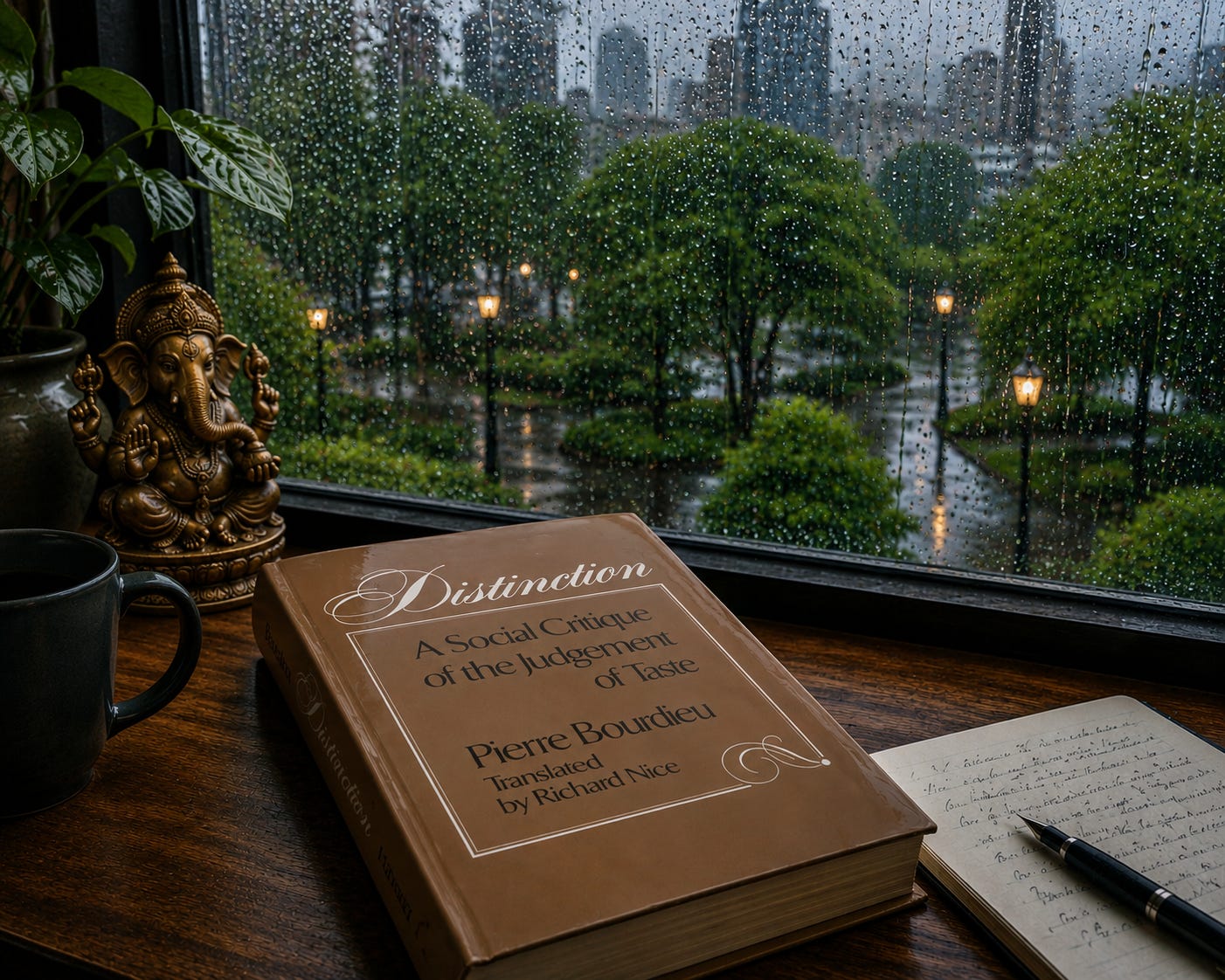
The French sociologist Pierre Bourdieu devoted much of his scholarly life to explaining how societies reproduce themselves across generations.
Through concepts such as habitus, field, and capital, he demonstrated that people inherit far more than wealth or education. They also inherit ways of seeing the world. Expectations become embodied. Social boundaries become internalized. Certain futures feel natural, while others seem improbable or even unimaginable. Most of these assumptions operate well beneath conscious awareness. And for some, they simply feel like reality.
Bourdieu’s insight remains extraordinarily valuable because it reminds us that social structures do not perpetuate themselves solely through laws or institutions. They are also reproduced through expectations.
Who belongs, leads, follows, succeeds, and in relation to myself, surprises us when they do. This is where orientation becomes especially important.
If we inherit assumptions regarding the limits of another person’s ability—whether because of race, class, gender, education, disability, or some other social construct—we may begin interpreting every encounter through those assumptions.
The test appears objective. Yet the expectations embedded within it rarely are.
The remarkable thing is not that people rise beyond such expectations. Human beings have done so throughout history. The remarkable thing is that anyone remains surprised.
History offers countless examples.
Frederick Douglass was expected to remain enslaved.
Madam C. J. Walker was expected to remain economically invisible.
George Washington Carver transformed agricultural science despite the limitations imposed upon him.
The citizens of Tulsa’s Greenwood District were never expected to build one of the most prosperous Black communities in America.
Reginald F. Lewis was not expected to build a billion-dollar enterprise through TLC Beatrice in the 1980s.
Katherine Johnson helped guide astronauts into space while working within institutions that often questioned whether she belonged there at all.
Their achievements did not create their capacities. They revealed capacities that had always been present. The surprise belonged elsewhere.
One of the most enduring consequences of inherited hierarchy is the tendency to confuse constrained opportunity with constrained ability. The distinction is meaningful. Simply stated, opportunity may be limited by circumstance, yet ability need not be.
There is another side to inherited hierarchy that receives far less attention.
It may also be argued that inherited hierarchy also damages the inheritor as it has been shown to be a fomenter of mediocrity if it persuades them that achievement requires little cultivation. Here, I am reminded of a conversation I had with my Mom during one of our calls during my undergrad years.
As I recounted to my Mom both hers and my Dad’s lack of effusive praise when we did well in school, with our household chores, or the many side jobs we held as teens in service to our neighbours—paper route, cutting grass, raking leaves, and shoveling snow—she simply responded:
“Your Dad and I did not want you guys to rest on your laurels.”
Her statement was matter of fact. And as a result, I have long appreciated her sharing the truth of what she and my Dad navigated as parents. They never wanted us to rest on our laurels and thus possess the possibility to descend into mediocrity. Based on how my siblings and I have turned out, by and large, their decision continues to pay dividends. For, I believe, capacity is innate. Yet it matters more how we cultivate a mind consistently oriented toward possibility that determines potential outcomes, thereby showcasing its fullest expression.
When opportunities finally emerge, capacities long hidden frequently become visible. And to those whose orientation assumed deficiency, such moments appear exceptional. Yet to Nature, they are simply expressions of possibilities that had always existed. This is one reason resilience deserves greater philosophical attention.
Sadly, too often we imagine resilience as though it were possessed only by extraordinary individuals. History suggests otherwise.
Resilience appears wherever human beings refuse to allow imposed boundaries to define the limits of their becoming.
Some display it publicly, others silently. Some within laboratories, others within classrooms. Some within businesses, and others within families.
Its expressions differ, yet its source appears universal.
Resilience is not the privilege of a select few. It is Nature’s endowment to humanity.
Viewed through this lens, the most interesting question is no longer whether someone overcame an obstacle. The more revealing question becomes:
What orientation made that achievement seem unlikely in the first place?
Perhaps this is one reason societies periodically experience moments of considerable transformation. Not because human capacity suddenly increases, but because inherited assumptions finally begin yielding to observable reality.
Constructs give way.
Orientation shifts.
Possibility expands.
Examining the annals of historical accounts of social progress, we note every generation inherits boundaries. Some are physical. Others are institutional. Still others exist only within the imagination.
The latter are often the most difficult to recognize because they masquerade as common sense.
Yet history repeatedly demonstrates that perhaps the greatest surprise is not that human beings continue exceeding imposed boundaries. Rather, it is that we continue mistaking society’s boundaries for Nature’s design. Nature, by contrast, distributes human potential far more generously than societies distribute opportunity.
To recognize this is not merely to challenge injustice. It is to clarify reality.
For resilience is not the domain of a select few. The capacity is innate, a gift from Nature, and resident within us all.
Suggested Practice: Examine the Surprise
Take a few moments to reflect upon a time when someone genuinely surprised you by what they accomplished.
Ask yourself:
What assumptions did I unknowingly hold about that person’s capacity?
Were those assumptions based upon direct experience or inherited expectations?
Where else might I be mistaking a social construct for a natural limitation?
Finally, turn the reflection inward.
Recall a time when you exceeded someone else’s expectations—or perhaps even your own.
Notice that the capacity did not suddenly appear.
Rather, the opportunity simply allowed something already present to become visible.
Carry that recognition into your day, remembering that Nature distributes human potential more generously than our imaginations often allow.
—
About the Author
Dr. Baruti KMT-Sisouvong is a scholar of consciousness, researcher of human development, and Certified Teacher of Transcendental Meditation® based in Cambridge, Massachusetts. His work explores the relationship between Pure Consciousness, neuroscience, and social systems, and how deeper awareness can inform both personal growth and institutional transformation.
He is the Founder and Chief Meditation Officer of Transcendental Brain, an initiative examining the intersection of consciousness research, cognitive science, and high-performance decision-making. He is also President of Serat Group Inc. and Founder and Director of Radical Scholar Inc., a nonprofit dedicated to consciousness-based research and public scholarship.
Alongside his wife and teaching partner Mina, he co-directs the Transcendental Meditation program for Cambridge and the Greater Boston area. He is also the host of the On Transcendence Podcast and Founder of International Meditation Hour, a quarterly global gathering dedicated to the unifying power of silence.
His writings—spanning frameworks such as The Model for Perpetual Growth and Progress and The Seven Layers of Manifestation—explore the evolving relationship between consciousness, leadership, and society.
He writes from the conviction that the most important race is not between nations or machines, but between the conditioned mind and the awakening soul.
To learn more about him, visit: https://barutikmtsisouvong.com/.
I chose not to finish reading this article and decided to comment on the first few sentences about surprise.
Birthdays have never really been super fun for me for some reason. Yet, in this random moment in time, I am so grateful to have been born about 34 years ago.