

The Call and the Capacity
On the Cliff of Possibility

Author’s Note
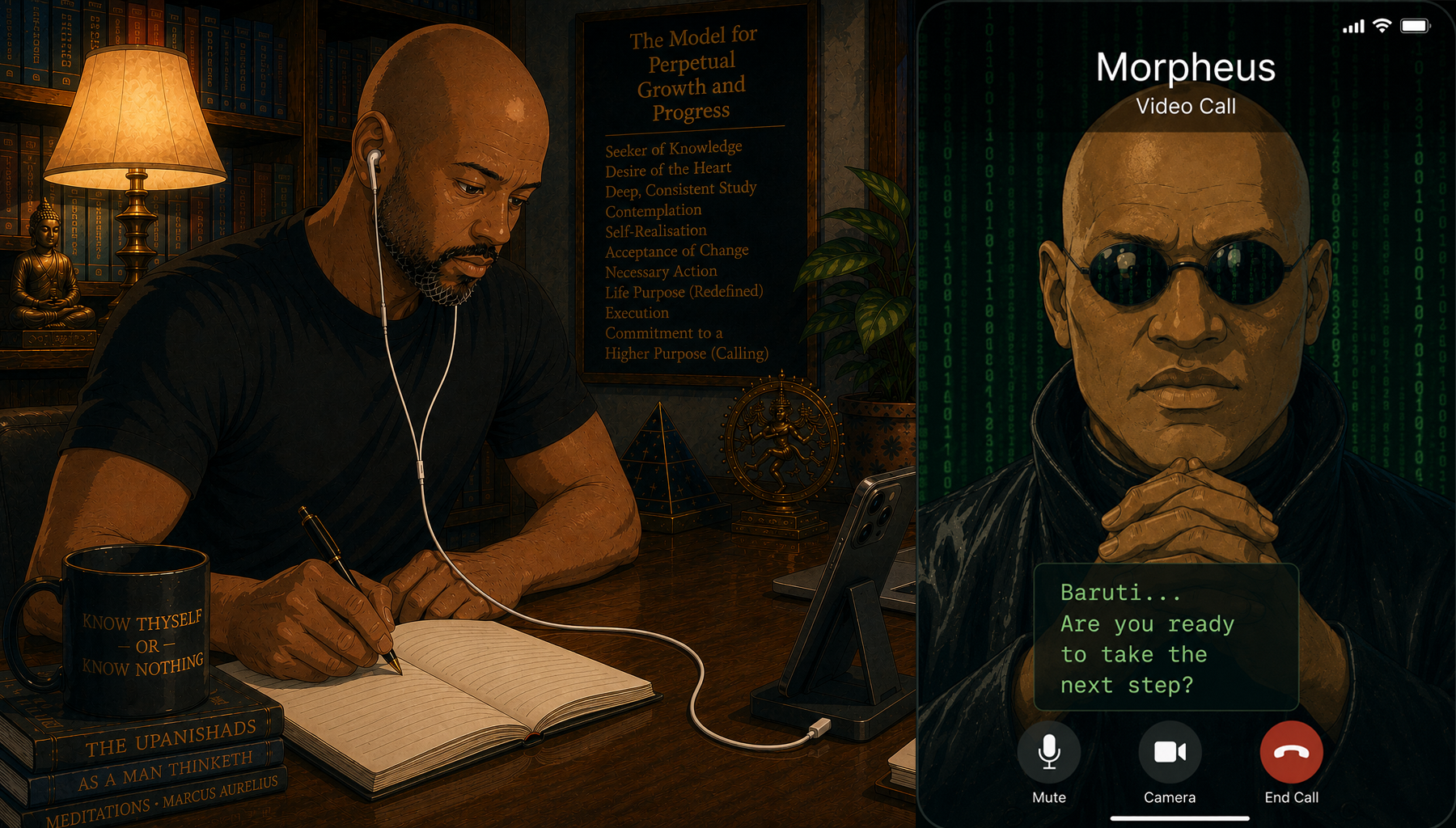
This essay emerged from an unexpected source: a dream.
While I rarely regard dreams as predictive, I have often found them to be clarifying. Occasionally, they present familiar ideas from an entirely new perspective, revealing relationships that remain unnoticed during waking life.
The dream that inspired this essay did not provide answers so much as a question: What enables a person to answer life’s deepest callings?
As I reflected upon the experience, I found myself returning to the Model for Perpetual Growth and Progress (MPGP), developed during my doctoral research. For the first time, I recognised the model not simply as a framework describing human development, but as an operational guide for cultivating the capacity required to respond to increasingly meaningful opportunities.
Whether one thinks in terms of purpose, vocation, dharma, or simply becoming a better human being, the principle remains remarkably similar.
The call may arrive unexpectedly.
Capacity, however, is cultivated intentionally.
—Baruti KMT-Sisouvong, PhD
Recently, one morning shortly before waking, I found myself facilitating a discussion unlike any I can remember.
Such dreams are not uncommon for me. More often than not, I find myself walking alongside someone in conversation or standing before a group discussing consciousness, philosophy, or the practical challenges of becoming more fully human. Yet this particular conversation possessed a quality that distinguished it from the others.
In this instance, there was no indication of where we were, how we had arrived there, or even with whom I was speaking. However, the conversation itself possessed a completeness that rendered every surrounding detail moot. It was as though we had been speaking for hours, and I had simply become aware of the discussion midway through.
The subject was life—not the ordinary rhythm of schedules, occupations, family, friends, or one’s attendant responsibilities, but the deeper current that carries each of us toward the person we are capable of becoming.
At one point the discussion turned to what I referred to as the call. Every life, I suggested, is eventually confronted by one. For some it appears early, while for others it arrives after decades of wandering. Sometimes it announces itself through opportunity, sometimes through disappointment, and sometimes through an experience so beautiful or so painful that one cannot return to living as before. Whatever form it assumes, the call asks something of us that our present life can no longer ignore.
As they listened, they were in complete agreement.
As I continued speaking, I mentioned that the call inevitably leads every person to a cliff.
Not a physical cliff, but what I called during the conversation “a cliff of possibility.”
On one side stands the person we presently are. Across the divide stands the person we sense we might become if only we possessed whatever is required to reach the other side. Looking across that expanse, one may initially feel fear or discouragement. Yet, with a belief in one’s self, one may come to recognise that cross the expanse one must.
After a long silence, the person finally asked the obvious question: “But how does anyone cross?”
The answer came immediately.
It was a single word.
Only it was not one I had ever heard before.
It sounded like calcity.
Within the dream, the meaning seemed perfectly obvious. The conversation continued without hesitation, as though both of us understood precisely what had been said. Yet the moment I awoke, the certainty vanished. I searched dictionaries, etymological references, and every resource readily available to me. The word simply did not exist in this context.
For a few moments I wondered whether I had misheard it. Then another possibility occurred to me. Perhaps the dream had not been attempting to give me a new word. Perhaps it had been attempting to communicate an idea for which my waking mind would have to search.
As the morning unfolded, another word gradually took its place.
Capacity.
Not talent, intelligence, or ambition.
Capacity.
The more I reflected upon it, the more the conversation began to reveal itself in an entirely different light.
For many years I had assumed that the greatest challenge facing most people was discovering their purpose. Like countless others, I imagined that somewhere beyond the horizon there existed a calling waiting patiently to be found. Increasingly, however, I have come to suspect that this understanding is incomplete.
Most people recognise the call long before they possess the capacity to answer it.
The aspiring physician hears the call before acquiring the knowledge required to heal. The teacher senses the desire to educate long before learning how to reach the minds sitting before the classroom. Parents quickly discover that loving a child and possessing the wisdom to raise one faithfully are not identical capacities. Scholars often glimpse questions whose answers require decades of disciplined inquiry before they can responsibly attempt a response.
Even in my own life, I can now identify moments when I believed I was prepared for opportunities that, in retrospect, would almost certainly have overwhelmed me. Looking back across those years, I no longer see delay where I once believed delay existed. I increasingly see a domain of preparation consisting of countless experiences enlarging the vessel long before I understood why the enlargement was necessary.
The cliff had never been asking me to leap. It had been asking me to grow.
That simple realisation returned me unexpectedly to work I had undertaken several years earlier while completing my doctoral research. During that period I found myself wrestling with a question that seemed deceptively simple: Why do some individuals gradually become capable of answering increasingly meaningful calls while others remain perpetually standing at the edge of possibility?
That question eventually gave rise to what I later called the Model for Perpetual Growth and Progress. Although the model first emerged within my study of mystical experiences with Freemasonry, I gradually realised that its underlying pattern extended far beyond any single tradition. It described not merely the development of Masons, but something universal about human unfoldment itself. It was conceived as a practical means by which individuals might understand their present position while identifying the next stage of their own development toward greater effectiveness, service, and ultimately, purpose.
During the morning of the experience, I came to recognise that the dream had been walking me back through that very model.
Because every meaningful journey begins with a Seeker of Knowledge. Before techniques can be learned or wisdom acquired, one must first become willing to admit that one’s present understanding is incomplete. Curiosity, more than certainty, becomes the doorway through which all genuine growth begins.
Yet seeking alone accomplishes very little. Standing before possibility long enough awakens the Desire of the Heart. Information gathered merely to satisfy curiosity seldom transforms a life. Something deeper must awaken—a longing not simply to know more, but to become more. That catalytic desire naturally leads to Deep, Consistent Study, not because discipline is externally imposed, but because the heart itself has become invested in the journey. Over time, such study produces something few anticipate. It enlarges one’s capacity for Compassion for Everyone, for the deeper one comes to understand oneself, the more readily one recognises the common humanity—and the same spark of consciousness—resident within everyone.
Eventually, the accumulation of knowledge gives way to something altogether different. One begins to contemplate not only the world, but one’s own interior landscape. Long-held assumptions gradually loosen their grip. Moments of genuine Self-Realisation begin to emerge, and with them comes an increasing Acceptance of Change. At first, such changes may appear unsettling. Later they come to be recognised as evidence that growth is occurring.
There comes a point, however, when insight alone is no longer sufficient. Understanding begins to demand expression. What once appeared optional gradually reveals itself as Necessary Action. Priorities become fundamentally reorganised. One’s Life Purpose is thus redefined, not because an entirely new life has appeared, but because the same life is now being viewed through different, more refined eyes. As that process continues, one’s very identity evolves. The person capable of answering tomorrow’s call is no longer the same individual who first stood at the edge of the cliff of possibility years before.
Only then does execution assume its proper place. Action, therefore, ceases to arise from restlessness or ambition alone and instead becomes the natural expression of an increasingly integrated life. In short, one learns to keep one’s attention fixed upon what truly matters—the prize—and gradually the work itself begins pointing beyond personal achievement toward what the model describes as a Commitment to a Higher Purpose—what I have increasingly come to think of simply as one’s calling.
What strikes me now is that the calling never truly appeared at the beginning of the journey.
It had been waiting to reveal itself at the culmination of years spent actively increasing the capacity required to sustain it.
Seen in this light, education, disciplined practice, meditation, contemplation, meaningful relationships, failure, perseverance, failure yet again, and service begin to reveal themselves not as isolated experiences but as different means by which Nature gradually enlarges the individual. Every challenge, every disappointment, every unexpected opportunity asks something slightly more of us than the one before. Not because life delights in difficulty, quite the contrary. But because greater responsibility requires greater capacity.
Perhaps that is why I believe the most meaningful opportunities often arrive just beyond our present ability. They are invitations, not verdicts. They reveal the direction of our future while simultaneously exposing the work still required within the present.
I never discovered the meaning of the word I heard in the dream from that morning.
Perhaps no such word exists. Or perhaps it need not.
However, its meaning remains unmistakably clear.
Every life eventually receives a call. Every call brings us to a cliff of possibility. And every day, whether we recognise it or not, offers yet another opportunity to cultivate the capacity required to cross.
As I sat reflecting upon the dream, I found myself thinking of Joseph Campbell’s observation that every meaningful life eventually undertakes “The Hero’s Journey.” Perhaps what Campbell described mythologically, the dream had illustrated developmentally. The call is heard, the threshold appears, and what follows is not merely an outward adventure but an inward expansion of one’s capacity to meet what life is asking.
So, when such an opportunity or cliff of possibility presents itself along your journey, resist the initial urge to decline the invitation. Instead, look around for tools, techniques, and teachers capable of assisting you in cultivating the necessary interior landscape to make the crossing possible. The capacity is not resident within only a select few. I believe we all possess a measure of developable capacity. We must both recognise such and begin developing it.
Whether one calls it Dharma, vocation, purpose, or simply answering life’s call, the work remains remarkably similar.
We cultivate the capacity, take the next step, and continue along the path as we endeavour to remain true to our commitment to being and doing better in all aspects of our lives. Not only for ourselves alone but also for the benefit of all with whom we come into contact in the spirit of service.
To borrow the wonderfully concise phrase from The Mandalorian:
“This is the way.”
Suggested Practice
Standing at the Cliff
Take ten to fifteen minutes with a notebook and consider the following questions.
What opportunity, responsibility, or possibility presently stands before you that feels just beyond your current abilities?
Rather than asking, “Am I ready?” ask instead:
“Who must I become to answer this call well?”
Next, identify one area in which your capacity might be intentionally developed.
Perhaps it is knowledge.
Perhaps discipline.
Perhaps courage.
Perhaps patience.
Perhaps compassion.
Perhaps the willingness to seek guidance from someone who has already made a similar crossing.
Finally, commit to one concrete action you can undertake this week that develops your capacity rather than merely advances your immediate goal.
Remember:
The objective is not simply to reach the other side of the cliff.
The objective is to become the kind of person capable of living there.
—
About the Author
Dr. Baruti KMT-Sisouvong is a scholar of consciousness, researcher of human development, and Certified Teacher of Transcendental Meditation® based in Cambridge, Massachusetts. His work explores the relationship between Pure Consciousness, neuroscience, and social systems, and how deeper awareness can inform both personal growth and institutional transformation.
He is the Founder and Chief Meditation Officer of Transcendental Brain, an initiative examining the intersection of consciousness research, cognitive science, and high-performance decision-making. He is also President of Serat Group Inc. and Founder and Director of Radical Scholar Inc., a nonprofit dedicated to consciousness-based research and public scholarship.
Alongside his wife and teaching partner Mina, he co-directs the Transcendental Meditation program for Cambridge and the Greater Boston area. He is also the host of the On Transcendence Podcast and Founder of International Meditation Hour, a quarterly global gathering dedicated to the unifying power of silence.
His writings—spanning frameworks such as The Model for Perpetual Growth and Progress and The Seven Layers of Manifestation—explore the evolving relationship between consciousness, leadership, and society.
He writes from the conviction that the most important race is not between nations or machines, but between the conditioned mind and the awakening soul.
To learn more about him, visit: https://barutikmtsisouvong.com/.