


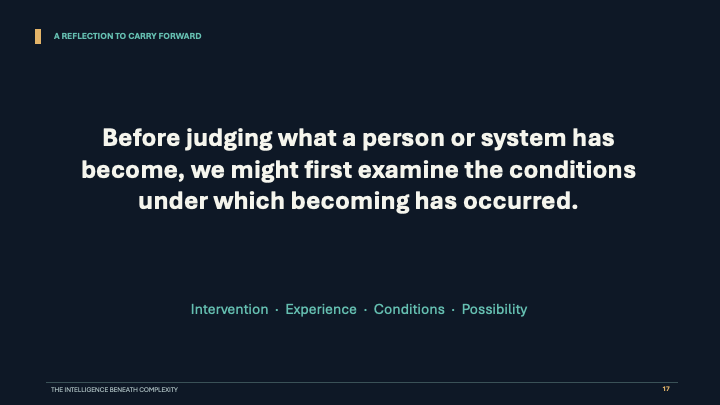
This image is adapted from my presentation at the 2026 Conference on Complex Systems (CCS 2026), as the experience served as the foundation for this essay.
Author’s Note
This essay emerged from an ordinary family experience that became the opening question of my presentation at the 2026 Conference on Complex Systems. Watching our second-youngest son, Tennyson Blake, recover from a minor injury to his hand prompted me to consider the remarkable organisation of living systems and the conditions under which healing becomes possible.
The discussion following my presentation extended that inquiry beyond biology into education, institutional functioning, sociopolitical arrangements, and the ways human beings interpret one another. In developing these reflections, I found myself returning to lessons from my time studying and traveling to Egypt with Dr Asa G. Hilliard III as part of one of his annual study tours, a recent interview with Dr Eddie Glaude, Jr, and my ongoing work on the Seven Layers of Manifestation and Adaptive Elegance.
The comparisons offered here are intended to illuminate a shared question about capacities and conditions, not to suggest that biological healing, learning, and social transformation operate through identical mechanisms. My desire is that the essay encourages us to examine more carefully the assumptions and arrangements through which we understand human potential, particularly when what we observe downstream may have been shaped by conditions established much further upstream.
—Baruti KMT-Sisouvong, PhD
Recently, our second youngest son, Tennyson Blake, sustained a minor injury to his hand during one of our walks as a family. As I observed the natural process of healing, I found myself contemplating something that is at once entirely familiar and rather extraordinary. Without any deliberate instruction from him, his body had begun the work of repair. Beneath the visible surface of the injury, an intricate coordination of biological processes was unfolding, involving cellular communication, immune responses, tissue regeneration, and the countless interactions through which a living organism maintains and restores its functioning. What struck me was not simply that his hand would heal, but that the processes responsible for healing were already underway, operating through relationships and mechanisms that neither he nor I or his other family members needed to consciously direct.
As I continued ruminating over the thought of Tennyson’s hand healing over the coming days, my mind entertained an additional thought: there is something remarkable about how easily we accept such occurrences as ordinary as a result of the processes themselves receding into the background of daily life. We expect wounds to close, bruises to fade, and damaged tissues to recover, provided the circumstances are favourable. Modern biology has illuminated much of what makes these processes possible, and the continuing development of medical knowledge has transformed our ability to support them when natural recovery is insufficient. Yet familiarity with the mechanisms need not exhaust our curiosity about the organisation they exhibit. Each participating cell responds to local signals and conditions, while the collective activity of many such cells contributes to the functioning of an organism whose complexity far exceeds that of any individual component. The healing of a child’s hand thus becomes an occasion for considering a much larger question about the relationship between the parts of a living system and the organisation of the whole.
That question accompanied me into a presentation I delivered at the 2026 Conference on Complex Systems, where I participated in a symposium entitled Complexity, Asian Medicine, and the Intelligence of Healing. I began by inviting those in attendance to consider what, precisely, is doing the healing when a living system repairs itself. The question was not intended to displace the biological explanations upon which medicine depends. Rather, it was an invitation to consider what those explanations reveal about the coordinated activity of living systems and whether our understanding of such activity might benefit from a broader appreciation of complexity, relationships, and the conditions under which particular forms of organisation become possible.
Complexity science provides a useful perspective because it encourages us to examine systems whose behaviour cannot always be understood adequately by considering their constituent parts in isolation. Within such systems, interactions among components can generate patterns, relationships, and forms of organisation that are not readily apparent from an examination of any single element. The significance of this observation is not that complex systems necessarily possess subjective awareness, nor that their observable organisation demonstrates consciousness in some universal sense. The relationship between self-organisation, intelligence, and consciousness remains an important subject of scientific and philosophical enquiry, and the distinctions among these concepts deserve to be preserved. What complexity science does provide, however, is a way of attending to the relational character of processes that might otherwise appear to be the activities of separate and independent components.
As I considered the healing process through this perspective, my attention gradually shifted from the mechanisms responsible for repair to the conditions under which those mechanisms operate. A living organism may possess considerable capacity for recovery, yet that capacity can be constrained by infection, inadequate circulation, nutritional deficiencies, or other physiological complications. The existence of a capacity does not guarantee its successful expression, and the presence of an organised response does not necessarily mean that the response is beneficial. Chronic inflammation, for example, can represent the persistence of biological activity that no longer serves the organism as it should. The distinction between organisation and healthy functioning is therefore essential, particularly when considering the relationship between self-organisation and healing.
This led me to reflect upon how frequently we direct our attention toward an outcome without adequately examining the circumstances that contribute to its emergence. For example, in medicine, effective intervention requires an understanding not only of the pathological process but also of the organism and environment within which that process occurs. The same treatment may produce different results depending upon a person’s physiological condition, medical history, and the interaction of numerous factors that influence recovery. Although these considerations are familiar within clinical practice, they also suggest a broader intellectual orientation in which the circumstances surrounding a system become part of our explanation of its behaviour.
Toward the conclusion of my presentation, I invited participants to consider what conditions might be preventing a living system from organising in ways that support healthier functioning. I had intended the question to encourage reflection upon healing, adaptation, and the possibilities that become available when we examine the relationships within which a system operates. Yet the discussion following the presentation revealed that its implications could extend considerably beyond the biological domain. As questions emerged from participants representing different disciplinary and experiential perspectives, I was reminded that the most interesting developments in an intellectual exchange often occur when an idea encounters a context for which it was not originally formulated.
One such moment arose during a question from a well-known scholar and author, whose contribution invited me to consider the relationship between consciousness, complexity, and the sociopolitical world. In responding, I found myself returning to an enquiry that has accompanied much of my work for years: How have we created the world that we inhabit? Although the question may initially appear straightforward, it becomes increasingly consequential when we begin to distinguish between the natural world within which human life unfolds and the social arrangements through which we organise our collective existence.
When born, we enter the Human-Derived World mid-sentence as it is a world already populated by institutions, expectations, cultural practices, economic relationships, political systems, and inherited categories of identity. Much of this world appears to possess a permanence that discourages us from questioning its origins. We learn to navigate its structures, to interpret our experiences through its categories, and to accommodate ourselves to its expectations, often without recognising the extent to which these arrangements are products of human activity. Yet the institutions and social distinctions that organise so much of our lives did not emerge independently of human beings. They developed through accumulated decisions, interpretations, conflicts, agreements, and practices that became established over time, sometimes acquiring an appearance of inevitability that obscures their constructed character.
During my response to the scholar, I suggested that the world we create is influenced by how we view ourselves and how we perceive those with whom we come into contact. Our understanding of another person is rarely formed in isolation from the categories, assumptions, and expectations we have inherited. We encounter individuals whose experiences may differ from our own, yet rather than approaching those differences as invitations to understanding, we sometimes interpret them through the language of otherness. In so doing, we can allow distinctions that might otherwise serve descriptive or practical purposes to become boundaries that limit our capacity to recognise a shared humanity.
The consequences of such perceptions do not remain confined to the individual mind. Our interpretations influence how we behave toward others, which relationships we cultivate, which opportunities we make available, and which arrangements we consider appropriate or legitimate. Over time, patterns of behaviour may become embedded in institutions, policies, and social expectations that influence the lives of people who had no part in their original formation. A distinction that begins as a way of describing the world can eventually become part of the structure through which the world is experienced, and a construct developed through human activity can acquire an authority that seems to exceed the people who sustain it.
This relationship between consciousness and the human-derived world occupies an important place within my Seven Layers of Manifestation framework. The model considers a progression from Pure Consciousness through Universal and Natural Laws and the Phenomenal World to Human Consciousness, the Human-Derived World, Constructs, and Outcomes. Within the portion of the framework most relevant to our sociopolitical experience, I am particularly interested in how human perception and interpretation contribute to the arrangements we establish, and how those arrangements influence the consequences we subsequently encounter. During the talk, I offered the framework as a conceptual orientation for examining these relationships, rather than as an experimentally established account of the causes of every social outcome.
The relationships themselves are more complicated than any simple progression might suggest. Once institutions and social arrangements have been established, they exert influences upon the individuals who inhabit them. A person born into a particular society encounters opportunities and constraints shaped by decisions made long before that person’s arrival, while the material resources, historical circumstances, and structures of power associated with those arrangements may persist regardless of individual intentions. Consciousness influences the human-derived world, but the human-derived world also influences the development and expression of consciousness. The relationship is reciprocal, unfolding through interactions that can reinforce established patterns or, under particular circumstances, contribute to their transformation.
This reciprocity helps explain why some of our most consequential social arrangements can appear to be natural features of existence. When a pattern has been reproduced across generations, its familiarity can become a substitute for justification, and the persistence of an institution can be mistaken for evidence that it could not have been otherwise. We may consequently devote enormous energy to managing the outcomes of an arrangement while giving comparatively little attention to the assumptions, incentives, and relationships that sustain it. To move upstream in our thinking is to question whether the conditions producing a particular outcome have been adequately examined and whether alternative arrangements might make different possibilities available. Perhaps with the release of the in-process manuscript titled The Seven Layers of Manifestation: Consciousness, Creation, and the Future of Being readers will gain ever more effective tools for navigating life in a more conscious manner.
As I was considering these ideas during the conference discussion, I recalled an interview I conducted many years ago with Dr. Coleman Barks for my programme Connecting the Dots in Atlanta. Dr. Barks shared a passage from Rumi that has remained with me. It reads:
Out beyond ideas of wrong doing and right doing,
there is a field.
I’ll meet you there.
When the soul lies down in that grass,
the world is too full to talk about.
Ideas, languages,
even the phrase ‘each other’
doesn’t make any sense.
The poem serves as an offering inviting us to imagine a field beyond the familiar divisions of wrongdoing and rightdoing, where the encounter between human beings is no longer confined by the distinctions through which they ordinarily understand one another. I have returned to that image repeatedly because it suggests the possibility of experiencing our common humanity without requiring every encounter to be mediated by the categories we have inherited.
I do not interpret Rumi’s invitation as a call to abandon moral discernment or to disregard the realities of injustice. Distinguishing harmful from beneficial actions remains essential to responsible human conduct, and there are circumstances in which the refusal to acknowledge a meaningful difference can itself become a form of harm. What I find compelling is the possibility that our categories, however useful or historically significant, need not exhaust our understanding of the people to whom they are applied. We can recognise the importance of identity, history, and social experience while remaining open to dimensions of human relationship that are not adequately captured by the labels through which we have learned to perceive one another.
The distinction becomes especially important when we consider the conditions under which people are invited to develop. An individual whose possibilities are continually interpreted through restrictive assumptions may encounter barriers that have little to do with that individual’s inherent capacities. Such barriers may be reinforced by individuals through expectations, institutional practices, access to resources, or the unequal distribution of opportunities. Although it would be a mistake to suggest that all difficulties originate in the surrounding environment, it would be equally mistaken to evaluate a person’s development without considering the circumstances within which that development has been expected to occur.
Another connection that emerged during the conference discussion concerned something I learned years ago from the late Dr Asa G. Hilliard III. His work in education introduced me to the importance of instructional validity, which encourages us to examine the adequacy of the educational conditions provided to a learner before attributing an unsuccessful outcome solely to the learner’s abilities. The concept directs attention toward the relationship between the student, the instruction, and the circumstances under which learning is expected to take place. It challenges the assumption that a disappointing result necessarily demonstrates an enduring deficiency within the person being assessed. Indeed, there are instances, unquestionably, where it is the person providing the instruction and the expectations, be they high or low, they hold of the learner that impact the outcome. In another of Dr. Hilliard’s points, I have taken to calling “Hilliardisms—short for “Hilliard’s maxims—“If they don’t love your children, they cannot teach your children.”
Returning to the matter of assessment a person’s alleged deficiencies, I am reminded of an insightful example of this tendency as discussed during an interview with Dr. Eddie Glaude, Jr on One54 Africa (13:58-17:35). Eddie was discussing the sometimes contentious comparisons drawn between African Americans whose families have lived in the United States for generations, including those who participated in the struggle for civil rights, and members of African and Caribbean immigrant communities. Such comparisons frequently emerge in conversations about educational attainment, economic mobility, and access to prestigious institutions, where differences in observable outcomes are sometimes interpreted as evidence of differences in cultural values, ambition, or personal responsibility. Eddie challenged the premise of these comparisons by drawing attention to the circumstances of the populations being examined. Those who have successfully migrated from one country to another do not necessarily represent a cross-section of the society they left behind. Their ability to migrate may reflect access to resources, educational opportunities, family networks, or other circumstances that distinguish them from people who remain in their countries of origin. Consequently, comparing the outcomes of immigrant populations with those of historically disadvantaged communities in the United States may involve comparing people whose material circumstances and opportunities were substantially different long before their outcomes became visible.
What particularly interested me was Eddie’s insistence that we examine the groups being compared before drawing conclusions about what their achievements or difficulties signify. A person who has been able to leave a resource-constrained environment may have more in common, in socioeconomic terms, with members of an established African American middle class than with individuals whose lives have unfolded under conditions of persistent deprivation. Conversely, people who remain in economically disadvantaged communities abroad may share important material circumstances with disadvantaged communities in the United States, even though their nationalities, cultural histories, and experiences differ. Because the implications extend beyond the particulars of migration. We frequently interpret disparities in achievement through the characteristics of the people involved, while giving insufficient attention to the processes through which opportunities are distributed and populations become differentiated. When the sociohistorical conditions surrounding two groups are not comparable, their outcomes cannot responsibly be treated as straightforward evidence of differences in effort, intelligence, or cultural worth. Even when similarities in socioeconomic background can be established, historical experiences, institutional arrangements, and other relevant circumstances may continue to influence the opportunities available to individuals.
This does not mean that cultural practices, individual decisions, or personal responsibility are irrelevant to human development. It means, instead, that their influence must be examined within the circumstances in which they operate, rather than invoked as explanations that render those circumstances invisible. Eddie’s argument reminded me that the categories through which we organise social comparisons can themselves become obstacles to understanding. We may believe we are evaluating differences in human capacity when, in fact, we have failed to establish whether the conditions under which those capacities were expressed were sufficiently comparable. Again, the thinking is too far downstream to be meaningful.
There is another dimension to Eddie’s observation that I find particularly consequential. When differences in outcomes are interpreted principally through ethnic or cultural categories, the resulting comparisons can contribute to divisions among communities whose experiences and material interests may overlap considerably. Competition for educational opportunities, economic resources, and institutional recognition can become understood as a conflict between groups rather than an occasion to examine the arrangements through which those opportunities are distributed. In this way, the interpretations we develop about one another can become part of the conditions that shape our subsequent relationships. What begins as an attempt to explain an outcome may contribute to the reproduction of another, particularly when the categories through which we understand our differences obscure the circumstances we share.
For me, this is where Dr. Hilliard’s point regarding instructional validity is particularly instructive. Just as we should hesitate to attribute a student’s difficulty solely to the student without examining the educational conditions provided, we should hesitate to interpret differences in collective outcomes without examining upstream considerations to include the historical, economic, and institutional arrangements within which those outcomes emerged. In both instances, the central concern is not to deny individual agency, but to avoid mistaking an outcome produced under particular conditions downstream for a definitive statement about what an individual or community is capable of becoming.
For me, the relevance of this perspective extends beyond the classroom, although the differences among educational, biological, and social systems should not be overlooked. A child’s wound does not heal according to the same mechanisms through which a student acquires knowledge, nor does an institution change through the same processes by which damaged tissue repairs itself. Nevertheless, these different domains can invite a similar form of enquiry concerning the relationship between a system’s capacities and the conditions within which those capacities are expressed. Before concluding that an individual or institution is incapable of functioning differently, we might ask whether the arrangements surrounding them an it, respectively, are supporting the forms of development we hope to observe.
I have often wondered how many of our assessments of human potential are actually assessments of performance under particular conditions. We observe what a person has accomplished within an existing set of circumstances and may be tempted to treat that outcome as a comprehensive measure of what the person is capable of becoming. Yet performance reflects more than individual capacity. It is influenced by access, expectations, relationships, resources, opportunities, and the accumulated effects of prior experiences. To recognise these influences is not to deny personal responsibility or the importance of sustained effort, but to place individual action within the wider relationships that help make particular outcomes possible.
I believe the same consideration applies to institutions. Organisations often become concerned with improving performance while preserving the very arrangements that may be constraining it. They introduce new expectations, establish additional measurements, or demand greater effort from the people within them, sometimes without sufficiently examining whether their underlying structures remain appropriate to the circumstances they face. An institution may possess talented and committed individuals yet organise their activities in ways that inhibit cooperation, discourage initiative, or prevent the development of more effective practices. Under such circumstances, the problem cannot be understood adequately by examining individual performance alone. An upstream analysis becomes essential.
This is where the language of complexity becomes particularly useful. The behaviour of an interconnected system emerges through relationships among its components, and efforts to alter one part of that system may produce consequences elsewhere. A policy intended to improve efficiency may inadvertently diminish trust, while an organisational change designed to increase accountability may discourage the very initiative upon which innovation depends. Conversely, a relatively modest alteration in relationships, incentives, or opportunities can sometimes create possibilities that were previously difficult to realise. The outcomes are not always predictable, and there is no guarantee that an intervention will produce the intended result, but the recognition of these interdependencies encourages a more careful examination of the conditions within which change is attempted.
During my response to the scholar, I also reflected upon the possibility that meaningful change can begin with an individual who recognises that the present arrangement of things is not the only arrangement imaginable. I recalled Bryce Courtenay’s The Power of One and the enduring appeal of the idea that an individual can contribute to developments extending beyond the immediate circumstances of personal action. I have long been interested in the ways that one person’s willingness to think or act differently can influence others, particularly when those interactions create opportunities for new relationships and forms of cooperation.
Such an observation must be accompanied by an appreciation of the limits of individual agency. Human beings do not possess equal freedom to act, nor do they encounter the same consequences when challenging established arrangements. Material circumstances, institutional authority, political power, and historical inequalities influence what people can undertake and what risks they must bear. It would therefore be inadequate to suggest that a person can overcome every structural barrier simply by changing a belief or adopting a more optimistic perspective. The circumstances within which individuals act are real, and their effects cannot be dismissed through appeals to personal determination.
Yet recognising the significance of structural constraints need not lead us to conclude that individual participation is inconsequential. People remain involved in relationships and networks through which information, practices, and possibilities circulate. An individual may influence a colleague, a student, a neighbour, or a community, and something of that influence may be carried into other settings. Many such contributions will remain local, while others may encounter circumstances that allow them to become part of broader patterns of change via the ripple effect. Complexity science does not promise that a particular action will generate a particular result, but it does help us appreciate why the consequences of interaction cannot always be understood solely in terms of the intentions or capacities of an isolated individual.
I find this relationship between agency and circumstance especially compelling because it avoids two conclusions that, for me, seem equally unsatisfactory. We need not imagine ourselves as possessing complete control over the world we inhabit, nor must we regard ourselves as powerless before arrangements that have developed through human activity. Our participation takes place within conditions we have inherited, yet those conditions are also influenced by the continuing decisions, relationships, and practices of the people who inhabit them. We are shaped by our circumstances while participating, however unequally, in the processes through which circumstances may change.
These reflections connect with another area of my developing work, which I have described as Adaptive Elegance. The framework concerns our capacity to navigate changing circumstances with increasing flexibility, coherence, and effectiveness. It emerged from an interest in understanding why some individuals appear able to respond constructively to transitions that others experience as deeply destabilising, and how such capacities might be examined and cultivated responsibly. The associated measurement instrument remains under development, and the framework should not be mistaken for an established clinical assessment or a validated explanation of every dimension of human adaptation.
What interests me most about Adaptive Elegance in the present context is the relationship between our capacity to adapt and the conditions to which we are adapting. Adaptation is often celebrated as an unqualified virtue, particularly in environments characterised by uncertainty and rapid change. Yet an individual may become highly skilled at accommodating circumstances that remain harmful, while an organisation may demonstrate impressive stability through practices that constrain the development of the people it serves. The ability to adjust to prevailing conditions does not, by itself, establish that those conditions are desirable or that accommodation represents the most constructive response. For this reason, I have come to regard orientation as inseparable from the question of adaptation. Because flexibility becomes more meaningful when it is accompanied by an appreciation of what deserves to be preserved, what requires reconsideration, and what possibilities ought to guide our actions. Coherence involves more than maintaining consistency in the face of change; it also concerns the relationship between our values, our understanding, and the decisions through which those commitments become expressed. Effectiveness, likewise, must be considered in relation to the purposes being pursued, because an individual or institution can become extraordinarily effective at producing outcomes whose consequences have not been adequately examined.
The cultivation of adaptive capacity therefore cannot be separated entirely from the examination of our environments. We may help individuals develop greater flexibility and resilience, but if the institutions within which they live continually reproduce unnecessary constraints, the benefits of those individual capacities may remain limited. Conversely, supportive conditions may allow people to express abilities that were previously obscured or constrained. The relationship is not a simple matter of choosing between individual development and institutional reform. Each influences the other, and a more complete understanding of human flourishing requires attention to both.
This brings me back to Tennyson and the healing of his hand. What began as an ordinary family experience became an occasion for considering the extraordinary coordination of living systems, and that consideration eventually opened into a broader enquiry about the relationships through which human beings organise their collective existence. The distance between biological healing and sociopolitical transformation is considerable, and I am not, nor would I ever suggest that the mechanisms governing one can simply be transferred to the other. Yet both invite us to consider how capacities are expressed within particular conditions and how those conditions may support, constrain, or redirect the possibilities before us.
Perhaps one of our more persistent habits is to treat the present functioning of a person, institution, or society as though it provides a complete account of what that system is capable of becoming. We observe an outcome, develop an explanation for its occurrence, and sometimes allow that explanation to harden into an expectation about the future. In so doing, we may overlook the extent to which the outcome reflects circumstances that are themselves capable of change. The conditions that have contributed to a particular pattern may be deeply established, and altering them may require sustained effort, collective action, and difficult choices, but their persistence does not necessarily establish their permanence. The possibility of change should not, therefore, be confused with a guarantee of improvement. Some injuries require intervention that natural processes alone cannot provide, and some institutional arrangements resist reform even when their limitations are widely recognised. Social transformation can generate unintended consequences, and the recognition that a system is human-derived does not mean that its difficulties can be resolved through individual intention alone. Indeed, an appreciation of complexity should make us more attentive to the limits of prediction and to the importance of examining whether our efforts are producing the effects we hope to achieve.
Nevertheless, uncertainty need not diminish our responsibility to investigate the conditions within which we live. If our institutions, expectations, and social relationships have been shaped through human thought and activity, then their continued existence invites not only accommodation but also reflection. We can examine the assumptions that inform them, the opportunities they make available, the possibilities they constrain, and the consequences they produce for those whose lives unfold within their reach. Such examination may reveal circumstances in which preservation is appropriate, others in which refinement is needed, and still others in which more substantial transformation becomes fundamentally necessary.
The longer I live and examine the social world through the lenses of History, Sociology, Consciousness, and Human Potential, I am increasingly persuaded that meaningful progress requires a willingness to move upstream in our thinking. Rather than attending exclusively to the outcomes we hope to change, we must become curious about the relationships and arrangements through which those outcomes emerge. Rather than assuming that present limitations necessarily define enduring capacities, we must examine whether different conditions might permit different forms of functioning. And rather than treating the human-derived world as something wholly separate from ourselves, we must recognise our continuing participation, conscious or otherwise, in its development and maintenance, even as we acknowledge the considerable differences in the power and opportunities available to each of us.
The question with which I concluded my conference presentation continues to resonate: What conditions might be preventing a living system from organising in ways that support healthier functioning? Following the exchange with the scholar, I find myself considering a companion enquiry concerning the conditions we are helping to create through the ways we perceive ourselves, encounter one another, and organise our shared world. The relationship between these questions seems particularly important because it reminds us that we are not merely observers of the environments within which human development occurs. We are also participants in relationships and institutions that influence what becomes possible for others.
Perhaps, then, the work before us is not simply to become more capable of navigating the world as it presently exists, but to develop a clearer understanding of how that world has been constructed and how our participation might contribute to its continued refinement. Such work requires humility about the limits of our knowledge, discernment concerning the consequences of our actions, and a willingness to reconsider arrangements that familiarity has made appear inevitable. It also requires an appreciation that meaningful transformation is seldom the achievement of an isolated individual, even when an individual’s action provides an important beginning.
When I think again about Tennyson’s hand, I am reminded that healing is not merely an event we observe after an injury has occurred. It is a process unfolding through relationships, capacities, and conditions whose interactions make recovery possible. Admittedly, the larger human questions are more complicated, but they invite a similar attentiveness to what supports development and what may prevent it.
In the final analysis, we cannot determine every outcome, nor can we remove every constraint. We can, however, become more conscious of the conditions we inherit, the arrangements we sustain, and the possibilities our actions make available to those who come after us. In that continuing relationship between what has been created and what remains possible, I believe we encounter an important dimension of our responsibility to one another.
And perhaps it is there, in the willingness to reconsider not only what we have become but also the conditions through which becoming occurs, that a more enduring form of progress begins.
Suggested Practice — Moving Upstream
Consider a situation in your life, workplace, family, or community in which an outcome has become a recurring source of frustration. Perhaps someone is struggling to learn, an organisation is failing to meet its objectives, or a relationship has settled into an unproductive pattern.
Before focusing exclusively on what appears to be going wrong, consider the conditions under which the outcome is occurring. What expectations, assumptions, relationships, resources, or institutional arrangements might be contributing to the present situation? Are you evaluating someone’s capacity based primarily upon their performance under circumstances that may themselves warrant examination?
Now consider your own participation in those conditions. Which arrangements are beyond your immediate influence, and which might be open to reconsideration through your decisions, conversations, or actions?
Rather than attempting to change everything at once, identify one constructive adjustment that could make a different outcome more possible. Allow sufficient time to observe its effects, remaining open to the possibility that your initial understanding may need refinement.
The invitation is not to assign blame or assume that every difficulty can be resolved through individual action. It is to cultivate the habit of examining the conditions that contribute to what we observe before concluding that the outcome represents the limit of what is possible.
—
About the Author
Dr. Baruti KMT-Sisouvong is a scholar of consciousness, researcher of human development, and Certified Teacher of Transcendental Meditation® based in Cambridge, Massachusetts. His work explores the relationship between Pure Consciousness, neuroscience, and social systems, and how deeper awareness can inform both personal growth and institutional transformation.
He is the Founder and Chief Meditation Officer of Transcendental Brain, an initiative examining the intersection of consciousness research, cognitive science, and high-performance decision-making. He is also President of Serat Group Inc. and Founder and Director of Radical Scholar Inc., a nonprofit dedicated to consciousness-based research and public scholarship.
Alongside his wife and teaching partner Mina, he co-directs the Transcendental Meditation program for Cambridge and the Greater Boston area. He is also the host of the On Transcendence Podcast and Founder of International Meditation Hour, a quarterly global gathering dedicated to the unifying power of silence.
His writings—spanning frameworks such as The Model for Perpetual Growth and Progress and The Seven Layers of Manifestation—explore the evolving relationship between consciousness, leadership, and society.
He writes from the conviction that the most important race is not between nations or machines, but between the conditioned mind and the awakening soul.
To learn more about him, visit: https://barutikmtsisouvong.com/.