


Author’s Note
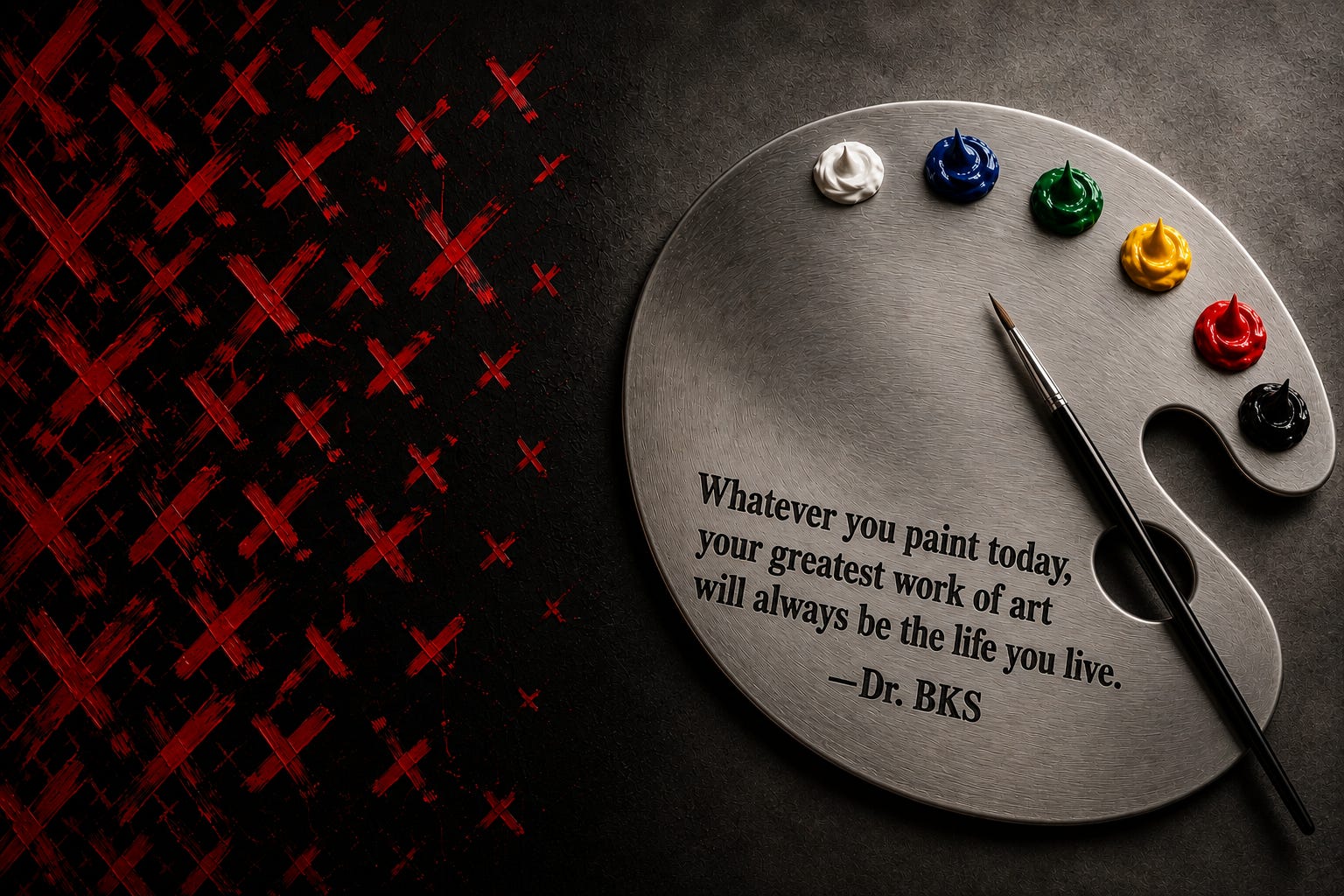
This essay began with two encounters that arrived separately but seemed to be speaking to one another: a video recounting the story of a painter who invited strangers first to identify the flaws in his work and then to correct them, and an observation from my colleague Dr. Stacey Patton that “Behavioral adjustment sometimes means accepting reality rather than continuing to negotiate with potential.” Somewhere between the cross and the brush, I began thinking about feedback—not merely our willingness to give it, but our capacity to receive it, learn from it, and recognise when another person’s response to it has itself become information.
What emerged is ultimately less an essay about criticism than about adaptation. Feedback offers us information about the distance between intention and outcome, expectation and experience, as well as potential and reality. Adaptive Elegance asks what we do once that distance becomes visible. Sometimes wisdom requires changing what we are doing. At other times it requires changing what we expect of another person, organisation, or system. In either case, the work begins with seeing clearly what is actually before us.
—Baruti KMT-Sisouvong, PhD
I came across a story recently about a painter who wanted to know what people truly thought of his work.
He had completed a painting of which he was particularly proud, but rather than relying upon his own assessment, he decided to submit it to the judgement of others. One morning, he carried the painting into a crowded public square and placed it where passers-by could see it. Beneath it, he left a simple instruction: if you find a mistake in this painting, mark it with a cross.
He then went away.
When he returned at the end of the day, he was devastated. Crosses were everywhere.
People had found fault with nearly every portion of the painting. What had begun the morning as one of his finest works now appeared to him as an inventory of his inadequacies. Every mark seemed to confirm something he had not previously known about himself. Perhaps, he thought, he was simply not as talented as he had imagined.
He then took the painting to a friend.
The friend listened and afterward proposed an experiment. Paint the same picture again, he told him. Change nothing. Tomorrow, return it to the same public square.
The painter did exactly that.
The following morning, an identical painting appeared in the same place, but the instructions beneath it had changed. This time, rather than asking people to mark what they believed was wrong, the painter invited them to correct whatever mistakes they found. Brushes and paint were provided.
He returned that evening. Yet, this time, the painting was untouched. Not one brushstroke had been changed.
The lesson offered by the story is an appealing one: people are often quite willing to tell us what is wrong while considerably fewer possess the knowledge, courage, or ability to make it right. Criticism is easy. Contribution is difficult.
I believe there is truth in that. But I found myself lingering over the story for some time afterward because I am not certain that is all it has to teach us.
After all, a person need not be a painter to notice that something in a painting appears out of proportion. A passenger need not know how to repair an aircraft engine to recognise that the sound coming from it is unusual. Someone experiencing the consequences of a poorly designed system may be exceptionally well positioned to identify its failures while having neither the expertise nor authority required to redesign it. And the person observing a recurring theme in the decision-making capacity of a loved one need not be a licensed therapist to note the need for real change in both the thinking and actions of the observed.
The absence of a solution does not necessarily invalidate an observation.
And so perhaps the more interesting question is not whether the people holding the brushes could have painted something better. Perhaps it is what happens in the space between someone making a cross and someone being willing to pick up a brush. Admittedly, I have been thinking deeply about that space lately.
There have been occasions in my own life when I have attempted to offer feedback about an event, an interaction, or a process that I believed could have unfolded differently. My intention in those moments has generally not been to establish blame. I am considerably more interested in understanding what happened, what contributed to the outcome, and what might be changed so that we do not simply reproduce the same result the next time circumstances align in similar fashion.
Yet I have noticed how easily feedback can be experienced as something else entirely—criticism.
For some, an observation about behaviour becomes a judgement of character, a question about process becomes an accusation, an attempt to examine what happened becomes an argument about who was right, and on occasion the conversation ends with some variation of: I can’t talk about this right now.
That response, by itself, is entirely reasonable.
There are moments when we genuinely do not have the emotional or cognitive bandwidth to engage a difficult subject productively. Knowing when one needs time before responding can itself be evidence of maturity. The difficulty arises when not now becomes not ever.
The immediate discomfort passes, life resumes, and the unresolved issue recedes into the background. Until it happens again. And when it does, everyone is surprised by an outcome for which the previous experience had already supplied the data.
That is where another sentence I encountered recently began speaking to the painter’s story in an unexpected way.
My colleague Dr. Stacey Patton wrote:
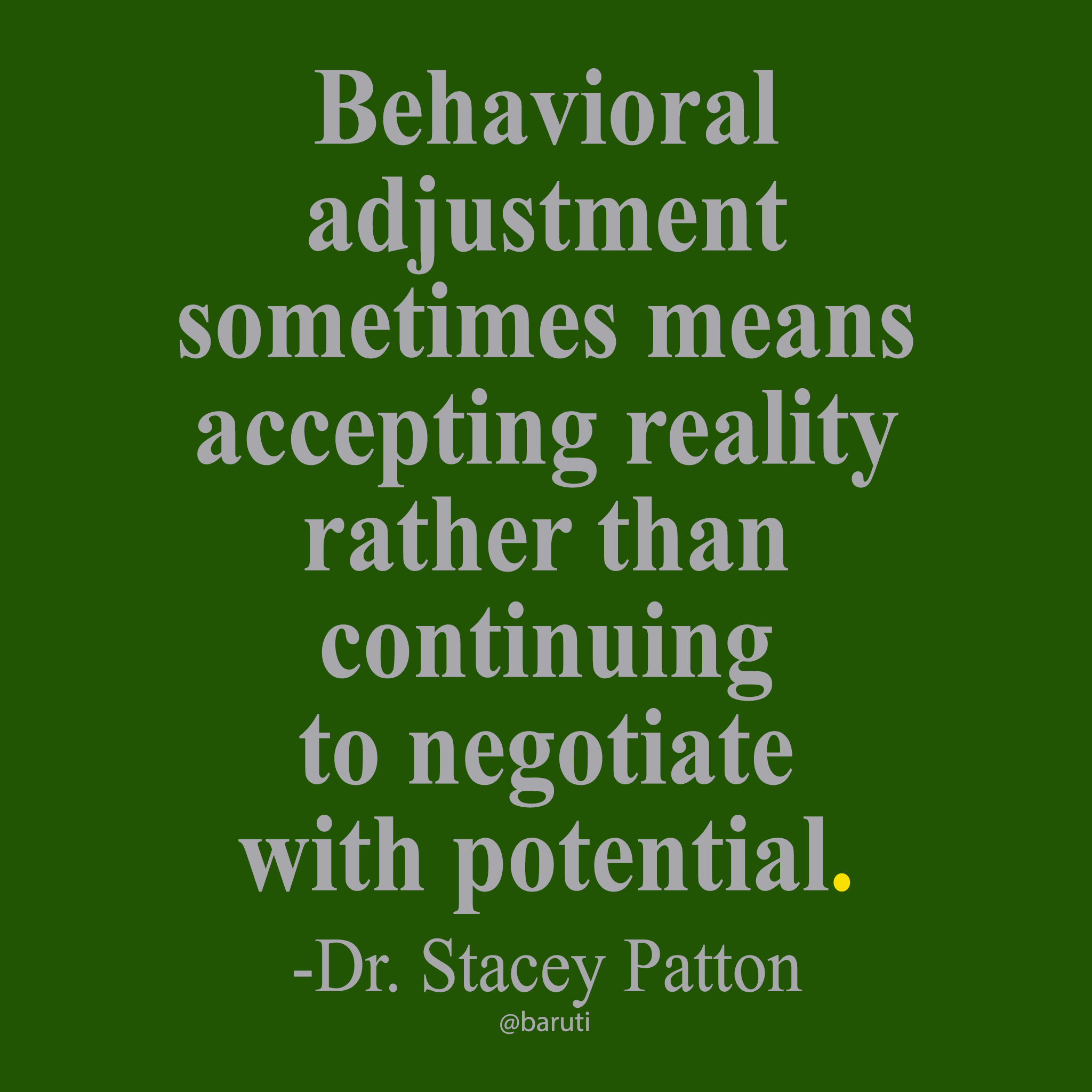
“Behavioral adjustment sometimes means accepting reality rather than continuing to negotiate with potential.”
I made a quote card from the sentence not only because I found myself returning to it long after the initial encounter, but also because the words number one of my favourite numbers—thirteen.
There is considerable wisdom packed into the distinction between reality and potential.
Potential concerns what could happen. Reality concerns what has happened and, particularly when patterns repeat, what is happening.
Human beings seem to have an extraordinary capacity to negotiate between the two. We tell ourselves that next time will be different. That perhaps the person will respond differently, the organisation will learn, the conversation we have attempted several times will finally occur, and a system repeatedly producing the same outcome somehow remains on the verge of producing another.
Sometimes that faith is warranted. Human beings grow, organisations change, relationships mature, and at times people genuinely surprise us. But potential can also become a way of avoiding information.
If reality repeatedly communicates one thing while we continue organising our behaviour around another, eventually the question is no longer whether the other person, organisation, or system will change. The question becomes whether we will.
And suddenly Dr. Patton’s observation applies in two directions.
The person receiving feedback may need to accept the reality that something about their behaviour contributed to an undesirable outcome. That acceptance need not mean accepting that they are a bad person, incompetent, thoughtless, or deficient. Behaviour is not identity. To discover that something I did was ineffective is not to discover that I am ineffective. It is simply information.
Indeed, feedback becomes much easier to receive once we can separate information about our behaviour from conclusions about our worth.
But there is another person in the exchange—the person giving the feedback may eventually need to accept reality too.
If a person or an organisation repeatedly demonstrates that they cannot or will not engage a particular conversation, there comes a point when continuing to approach them according to their potential becomes its own refusal to incorporate feedback. We may find ourselves endlessly searching for the right phrasing, the right moment, the gentler introduction, the more complete explanation—the formulation that will finally produce the engagement we have been diligently seeking.
Perhaps it will. But we must, at some point, accept that repeated behaviour is also information.
There is a peculiar irony here. We can become so committed to helping people and organisations adapt that we fail to adapt ourselves.
That does not require us to abandon goodwill. Nor does it require declaring some people and organisations incapable of change. It simply means recognising that we cannot responsibly make present decisions according to a future version of the person or organisation who has not yet appeared.
We can leave room for potential without confusing it with reality.
Perhaps that is why the painter’s story stays with me.
At first, it appears to divide the world neatly between critics and contributors. There are those willing to make crosses and those willing to wield brushes.
But human relationships are rarely so simple.
Sometimes the cross is useful, the criticism is uninformed, the person holding the brush does not actually know how to improve the painting, the painter is so wounded by seeing the cross that he cannot examine whether it identifies something worth reconsidering, and sometimes we become so preoccupied with whether someone else will pick up the brush that we fail to notice the only brush we actually control is already in our own hand.
Feedback, at its best, is not condemnation. It is information entering a system. What happens next depends upon the system’s capacity to receive it.
We can reject the information, defend against it, postpone encountering it, examine it, challenge it, incorporate it, or discover, after careful consideration, that it tells us more about the person offering it than about ourselves. But some response is required if true learning is to occur.
Perhaps this is one of the less obvious dimensions of Adaptive Elegance: the capacity to encounter the distance between what we hoped would happen and what actually happened without needing either to defend ourselves against the difference or surrender ourselves to it.
We simply look, learn what the experience has to teach, and then we adjust what is ours to adjust.
Because potential tells us what might yet become possible. Reality tells us where we must begin. And wisdom may consist, in part, of knowing the difference.
Suggested Practice: Reality, Potential, and the Brush in Your Hand
Consider a situation in your life that has remained unresolved despite repeated attempts to address it. It may involve another person, a relationship, an organisation, a professional circumstance, or even a recurring pattern within yourself.
Without assigning blame, ask yourself: What has actually happened?
Try to answer only from observable experience rather than intention, hope, explanation, or expectation. Then ask a second question: What have I been expecting could happen?
Notice the distance between those answers.
Now consider whether there is feedback contained within that distance. Perhaps reality is asking you to communicate differently, establish a boundary, reconsider an expectation, change a process, try again, or simply stop organising present decisions around a potential that has not yet materialised.
Finally, ask: What is mine to adjust?
You need not determine what another person should do or how an organisation ought to change. For the moment, concern yourself only with the brush in your hand.
Leave room for potential. But begin with reality.
—
About the Author
Dr. Baruti KMT-Sisouvong is a scholar of consciousness, researcher of human development, and Certified Teacher of Transcendental Meditation® based in Cambridge, Massachusetts. His work explores the relationship between Pure Consciousness, neuroscience, and social systems, and how deeper awareness can inform both personal growth and institutional transformation.
He is the Founder and Chief Meditation Officer of Transcendental Brain, an initiative examining the intersection of consciousness research, cognitive science, and high-performance decision-making. He is also President of Serat Group Inc. and Founder and Director of Radical Scholar Inc., a nonprofit dedicated to consciousness-based research and public scholarship.
Alongside his wife and teaching partner Mina, he co-directs the Transcendental Meditation program for Cambridge and the Greater Boston area. He is also the host of the On Transcendence Podcast and Founder of International Meditation Hour, a quarterly global gathering dedicated to the unifying power of silence.
His writings—spanning frameworks such as The Model for Perpetual Growth and Progress and The Seven Layers of Manifestation—explore the evolving relationship between consciousness, leadership, and society.
He writes from the conviction that the most important race is not between nations or machines, but between the conditioned mind and the awakening soul.
To learn more about him, visit: https://barutikmtsisouvong.com/.
This article, as well as the ability to listen to it while walking back to my parent’s home (about 2.5 miles and carrying a 5 gallon jug of water) is a blessing. I remember a time a few years ago as a 23 year old when this task would have been considered impossible for me to do on my own. Let alone, with ease and enjoyment.
The reality of the past coupled with the reality of this present moment keeps hope alive within my heart that when there is work which must be done, appropriate compensation must be an afterthought, especially if it is in service of the next generation.