


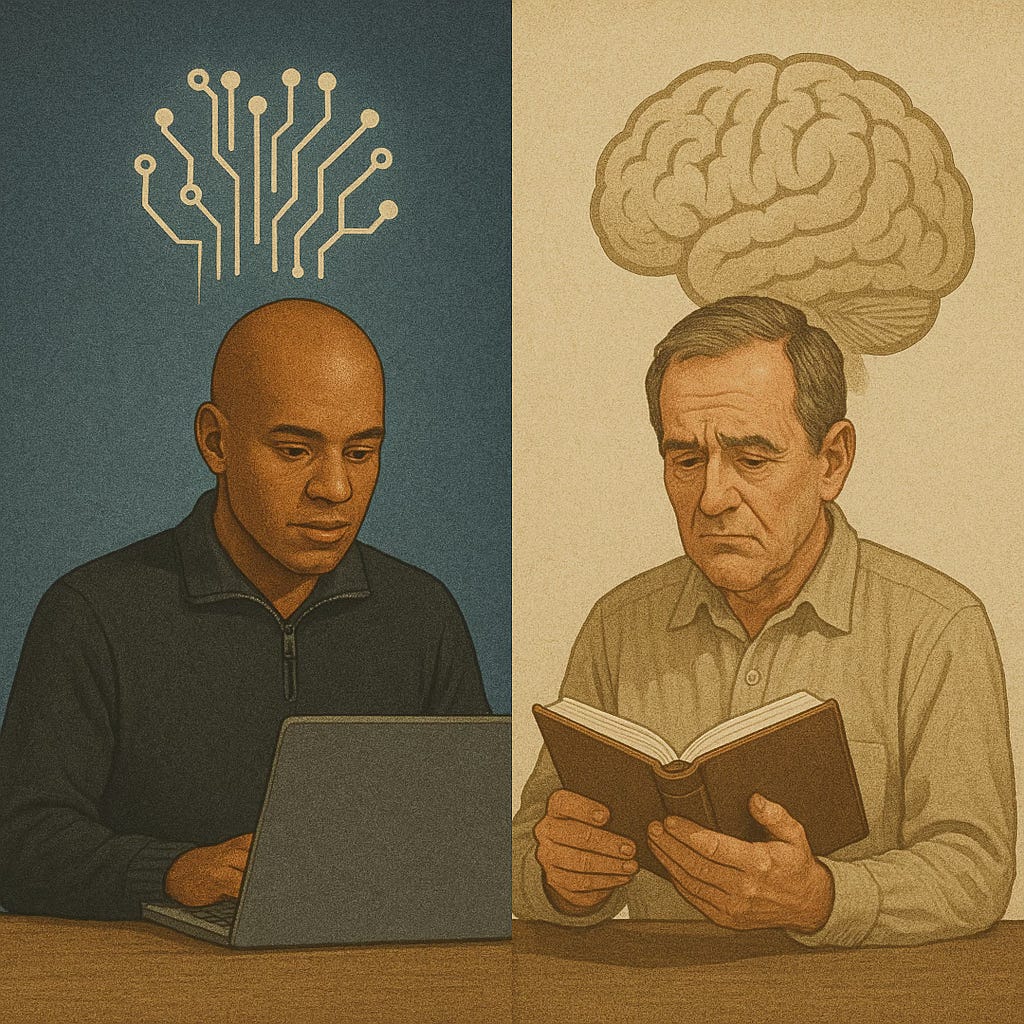
We are living through a moment of extraordinary acceleration. Tools that once required specialised training are now accessible to anyone with an internet connection. Artificial Intelligence writes, codes, edits, analyses, and synthesises with unprecedented speed. And yet, beneath this flood of capability, a quiet truth is emerging—one that may define the next generation of human work, learning, and meaning.
The truth is simple:
AI does not level the playing field.
It widens it.
The individuals who enter this new era with depth—with foundational knowledge, cultivated skill, and an internal architecture shaped by years of focused practice—will find themselves amplified. Those without such grounding will be carried only as far as the tools can take them, and no further.
This widening gap is what I call The Grokking Divide.
The Grokking Divide is the widening gap between those who use AI to amplify deep understanding and those who rely on it to compensate for the absence of it.
What Does It Mean to “Grok”?
The term comes from Robert Heinlein and his novel Stranger in a Strange Land (1961): to understand something so fully that it becomes part of you. The term appears more than four hundred fifty times in one form or another within the text—grok, groks, grokked, and grokking.
It is not memorisation.
It is not proficiency.
It is internalised mastery—deep understanding rendered intuitive, embodied, and effortlessly generative.
Before AI, grokking emerged naturally through:
years of reading and reflection,
hours of practice and apprenticeship,
trial, error, refinement… repeat
solitude,
stillness,
discipline,
and the craftsman’s devotion to the work for its own sake.
Now, as I observe the situation, the world is split between two paths:
1. Those who grok—whose minds have been shaped by depth—and therefore wield AI as a force multiplier of brilliance.
2. Those who do not grok—who therefore rely on AI as a substitute for understanding and become increasingly dependent on it.
This is the divide.
AI Is a Mirror, Not a Mind
One of the misconceptions of the current moment is that AI replaces thinking. It does not. It replaces surface-level output—the mechanical, repetitive, predictable components of work.
What it cannot replace are the human faculties that emerge only through consciousness when coupled with lived experience:
judgement,
discernment,
taste,
intuition,
pattern recognition,
philosophical orientation,
lived experience,
consciousness.
These cannot be automated because they are not mechanical.
They arise from being, not merely from doing.
This is why two people can ask AI the same question and receive responses worlds apart in value. One asks from knowledge; the other from absence. The first guides the tool; the second is guided by it.
The Craftsman in the Age of Acceleration
Cal Newport’s arguments in So Good They Can’t Ignore You (2012) and Deep Work (2016) now reads like prophecies. Long before publicly accessible AI matured, he posited that:
focus,
depth,
skill,
intention,
deliberate practice,
and the craftsman mindset
are the most valuable capacities in modern life.
From my perspective, he was right.
AI has not replaced craftsmanship.
It has replaced the illusion that one can succeed without it.
This is where the divide becomes wholly unmistakable:
AI increases the output of the shallow,
but it increases the impact of the deep.
The craftsman is not threatened.
The craftsman is accelerated.
Why Mastery Matters More Now Than Ever
The worker of the future—the thinker of the future—will not be defined by how quickly they can produce, but by how deeply they can understand. Here, I am reminded of a passage from Alvin Toffler’s book Future Shock (1970) as he quotes Psychologist Herbert Gerjuoy: “Tomorrow’s illiterate will not be the man who can’t read; he will be the man who has not learned how to learn” and Toffler’s preceding point regarding “human adaptability” and the importance of “instructing students how to learn, unlearn, and relearn” (p. 367). This capacity—how to learn, unlearn, and relearn—I believe, is a required component for the deep work and subsequent mastery as articulated by Newport.
In light of emerging AI and AGI, mastery now includes:
the ability to evaluate AI output,
the wisdom to discern nuance,
the clarity to guide complex tools toward meaningful ends,
and the internal stability to remain grounded in a world of ceaseless acceleration.
This is why meditators, scholars, artisans, scientists, philosophers, and practitioners of inward disciplines (including Transcendental Meditation®) are positioned uniquely well. They have cultivated the very faculties—attention, presence, clarity, depth—that cannot be automated.
AI strengthens the mind that is already strong.
It reveals the mind that has not yet been trained.
The Spiritual Dimension of the Grokking Divide
At its core, the divide is not technological.
It is consciousness-based.
To grok is to integrate knowledge into identity.
It is to become the work.
It is the difference between reciting principles and living them.
It is, to quote Cicero : Esse quam videri—To be, rather than to seem.
AI can assist in exploration.
But it cannot walk the inner path for you.
Meditation, reflection, craft, lineage, scholarship—these build the internal scaffolding through which true understanding takes form. Without this foundation, AI produces words. With it, AI becomes a partner in insight.
And that is the future we are stepping into:
Not man versus machine, but mastery directing machine.
Not automation diminishing humanity, but consciousness elevating it.
Closing Reflection
We are crossing a threshold.
The age of information has become the age of acceleration.
Those who cultivate depth will shape the future.
Those who depend on tools for understanding will be shaped by it.
If ever there was a moment to recommit to mastery—not performance, not productivity, not speed—it is now.
Mastery is no longer optional.
It is the anchor in the storm.
It is the cosmic differentiator.
It is the path through the noise.
It is the antidote to overwhelm.
And it is the foundation on which the next generation of human thought, creativity, and progress will be built.
This is the Grokking Divide.
And each of us must decide on which side we will stand.
As for me, I know precisely where I stand—and I intend to stand there with clarity, consistency, and craft.
I invite you to take your place there as well.
Will you join me?
Suggested Practice: Strengthening Your Grokking Mind
Meditation Time: 10–15 minutes
Purpose: To cultivate depth, discernment, and the inner clarity needed to stand on the mastery side of the Grokking Divide.
1. Enter Stillness
Sit comfortably and close your eyes.
Allow your breath to slow
and your awareness to settle beneath the surface of thought.
Let the noise of urgency dissolve.
2. Reflect on Depth vs. Output
Ask yourself quietly:
Where in my life am I merely operating tools?
Where am I cultivating genuine understanding?
What knowledge or skill calls for deeper investment, not faster execution?
Let insights arise without judgement.
3. Identify Your “Grokking Zone”
Consider one area where depth would meaningfully transform your work or life.
It may be:
a craft,
a discipline,
a topic you’ve skimmed but never mastered,
or an inner capacity worth strengthening (focus, presence, clarity).
Name it clearly.
4. Choose One Deliberate Step
Commit to a single next action that builds mastery, not convenience:
reading deeply instead of scanning
practising instead of skimming
reflecting instead of reacting
learning instead of leaning on shortcuts
One step is enough.
Mastery is built layer by layer.
5. Close With Intention
Place a hand on the heart and affirm silently:
I choose depth over haste.
I choose mastery over imitation.
I choose to grok, not merely to operate.
Open your eyes when ready, carrying the intention forward.
—
About the Author
Dr. Baruti KMT-Sisouvong is a consciousness scholar, executive coach, and Certified Teacher of Transcendental Meditation® based in Cambridge, Massachusetts. His work—spanning The Model for Perpetual Growth and Progress and The Seven Layers of Manifestation—explores how Pure Consciousness, neuroscience, and social-systems transformation intersect in the evolution of both the individual and society.
He is the Founder and Director of Radical Scholar Inc., a nonprofit organization dedicated to consciousness-based research and public scholarship, and President of Serat Group Inc., the parent company of Transcendental Brain, a consulting and educational platform bringing consciousness science into leadership and institutional development. He also serves as Host of the On Transcendence Podcast.
Alongside his wife, Mina, he co-directs the Cambridge and Metropolitan Boston TM Program and serves as Host and Founder of International Meditation Hour (IMH), a quarterly global gathering dedicated to the unifying power of silence.
He writes from the conviction that the most important race is not between nations or machines, but between the conditioned mind and the awakening soul.
To learn more about him, visit: https://www.barutikmtsisouvong.com/.