



Author’s Note
I began this essay thinking about discipline and a passage I underlined years ago while reading Walter Isaacson’s biography of Steve Jobs. What emerged instead was a reflection on formation—on the ordinary experiences through which habits of attention, persistence, interpretation, and resilience become woven into the fabric of one’s life.
Looking back, I can see that some of the experiences I least appreciated while living through them were quietly preparing me for circumstances neither my parents nor I could have anticipated. A lawn that had to be mowed again, newspaper routes that proved considerably more demanding than expected, and a difficult night during my teenage years now appear to me as parts of the same curriculum. None announced itself as such at the time. Life rarely does.
Now, as a husband and father, the reflection carries a different type of weight. I am increasingly aware that parenting is not only about preparing children for the circumstances we can foresee, but helping cultivate within themselves the habits of mind they will need for circumstances we cannot. Perhaps that is one of the subtle responsibilities passed from generation to generation: we receive certain lessons before we fully understand their value, refine them through the experience of living and contemplation, and then endeavour to pass their essence forward.
—Baruti KMT-Sisouvong, PhD
Years ago, while reading Walter Isaacson’s biography of Steve Jobs, I encountered a passage that has remained uppermost in my mind. Isaacson recounts that when Jobs turned thirty, he celebrated with a lavish but characteristically unconventional party at the St. Francis Hotel in San Francisco. The invitation included what Jobs described as an old Hindu saying:
“In the first 30 years of your life, you make your habits. For the last 30 years of your life, your habits make you.”
I underlined the passage. In the margin, I wrote simply: Key. On Habits.
I have returned to the idea many times since. There is something intuitively true about it, even if I would now add a qualification. I do not believe we become permanently fixed at thirty, nor that the habits formed during childhood and young adulthood inevitably determine everything that follows. Human beings retain a remarkable capacity for change. Consciousness allows us to observe ourselves, reconsider our orientation, abandon patterns that no longer serve us, and intentionally cultivate new ones. This, I believe, is part of what it means to be a fully functioning human being—one capable of contributing meaningfully to the larger human enterprise.
But there is another truth contained within the saying that becomes increasingly difficult to ignore as the years accumulate: long before we realise we are constructing a life, we are constructing the person who will eventually have to live it. The habits of attention we cultivate, the standards we accept, and the ways we respond to disappointment are all brushstrokes on the canvas of a life. Some are more refined than others, but each contributes to the larger picture. Those early habits influence whether we finish what we begin, whether difficulty causes us to retreat or invites us to become more capable, and whether we interpret adversity as evidence against ourselves or as material from which something stronger might be fashioned. In my experience, these things accumulate, and eventually they begin carrying us.
When I consider the habits that have carried me through adulthood, marriage, fatherhood, scholarship, teaching, disappointment, reinvention, and more than a few storms along the way, my mind does not immediately return to a university classroom or some great intellectual revelation. Instead, it returns to a lawn in Milwaukee.
The Afternoon
I was young, and one of my household responsibilities was cutting the grass. As the eldest, my chores were considerable. I was responsible for helping clean the house from top to bottom, doing the laundry each week, and, when the season required it, maintaining the lawn—cutting the grass, trimming the edges, raking where necessary, and cleaning everything afterwards.
The backyard was sizeable and not entirely level, with a slight incline that made the work just demanding enough to notice, particularly when pushing a mower repeatedly across it. And on one particular Saturday morning in spring, however, I had somewhere I very much wanted to be.
Some friends from church and I were going to basketball practice. They were coming to collect me in the church van sometime in the early afternoon, which meant everything at home needed to be finished before they arrived. So, I completed the laundry, cleaned the house, and then turned my attention to the lawn—or, more accurately, most of my attention. My body was in the yard pushing the lawnmower, but my mind was already at basketball practice.
I remember finishing and beginning to clean the clippings from the walkways, grass, and sidewalks in the front and back yards. I was nearly done. The mower would soon be returned to the garage, the bags of clippings placed near the trash bins, and I would be free to go. Somewhere during all of this, I noticed my mother watching me through the window. This was not especially unusual. My mother inspecting my work was hardly an unprecedented event, and because my thoughts were already elsewhere, I gave it little consideration. In hindsight, however, I should have known something was amiss.
As I was wrapping everything up, my mother casually asked whether I was finished. “Yep,” I replied. Even now, I recognise that this was not the ideal response. “Really?” she asked. Something in her tone did not feel right, and she then directed my attention to the lawn. There, running alongside several of the impressions left by the lawnmower wheels, were conspicuous shards of grass standing taller than everything around them. At several points during my hurried mowing, the machine had apparently drifted from the path I thought I was following. I had missed entire strips of grass in both the front and back yards, and I was mildly pissed that I had not noticed them.
Still, the solution seemed obvious enough. I would simply wheel the mower back onto the lawn, run it across those few capriciously offending areas, put everything away, and still make basketball practice. No big deal. My mother had a different interpretation of the situation. “What are you doing?” she asked. I explained that I was going to cut the sections I had missed. “How?” I told her I would run the mower over them. Her response was an immediate yet elongated “No.”
If I did that, she explained, I would disturb the orderly pattern of lines running through “my lawn.” I needed to go over the grass again properly, following the same paths, maintaining the same lines, and catching the places I had missed along the way. I could scarcely believe what I was hearing. Surely this was unnecessary. The grass was already cut—mostly—and the problem could be corrected in minutes. But she was serious, and so I began again.
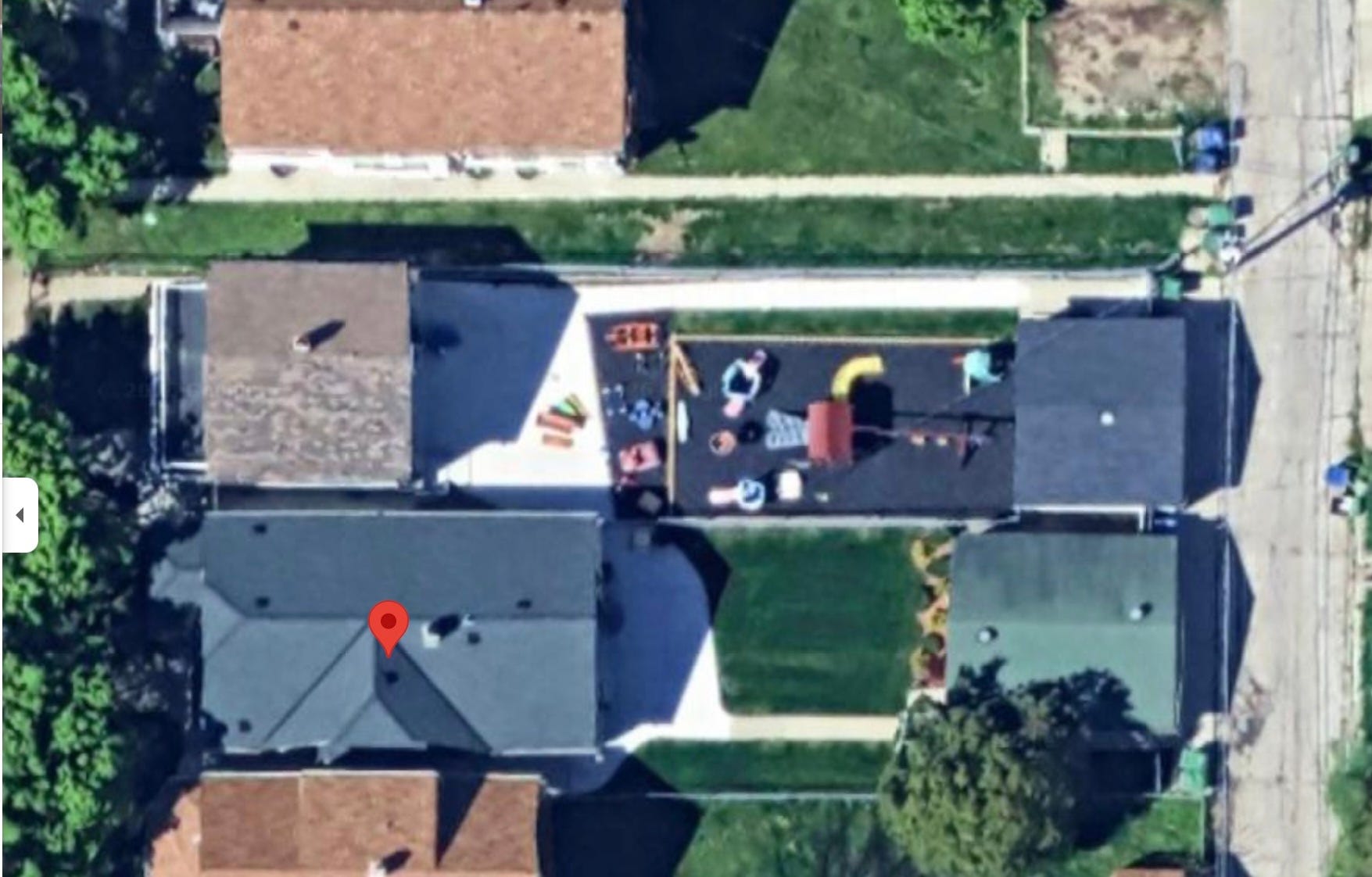
The backyard of my childhood home in Milwaukee as it appears today. My mother also owns the neighbouring property, whose backyard now serves as a play area for her daycare. The paved patio visible behind our home did not exist during the period described in this essay; at the time, that portion of the yard was grass as well. The backyard also has a slight incline that is difficult to discern from this aerial view. Together with the front lawn, it made Saturday lawn duty considerably more involved than the image might initially suggest.
By the second pass, whatever affection I might once have possessed for that lawn had long since departed. As I recall it now, I was essentially cursing the grass and making liberal use of what would later become famously associated with Samuel L. Jackson—also one of my own favourite expletives: Mother£$@%&+! Long before the wider world came to know him for it, I had already put the word to considerable use.
Sometime thereafter, the church van arrived and I heard the horn. My friends were outside waiting for me while I was still dealing with a lawn that, in my mind, I had already finished once. But there was another lesson waiting for me: I had to go to the van myself and tell them that I would not be coming to basketball practice that day. While I do not remember the exact words I used, I do remember the feeling. It was not a pleasant Saturday.
At the time, I suspect I understood the experience primarily as punishment. Years later, however, I came to understand something my mother may or may not have intended to teach me: Be where your hands are. The problem that morning was not that I did not know how to cut grass. I had successfully done it many times before. The problem was that while my hands were guiding the lawnmower, my attention was somewhere in the future. I wanted the present task to be over because something more desirable awaited me, and because I was already mentally inhabiting the next experience, I failed to attend sufficiently to the experience directly before me.
Years later, a portion of that backyard was converted into a patio. I remember being delighted when I learned of the plan. After all those years of cutting grass, here at last was progress: less lawn meant less work. Or so I thought. My celebration proved unduly premature. What had disappeared from my summer responsibilities simply reappeared in another form during the Milwaukee winter, because the new patio, naturally, had to be shovelled. Apparently, the burden had not been eliminated; it had merely changed seasons—and become considerably heavier.
As related to the lawn, and all these years later, the irony has remained with me. My eagerness to reach the future caused me to neglect the present, and my neglect of the present prevented me from reaching the future toward which I had been rushing headlong. The lesson has travelled remarkably well: when the mind arrives somewhere before the body does, something in the present is likely to be missed. Sometimes it is a strip of grass; at other times, it is considerably more consequential.
The Morning
Around the same period of my childhood, my younger brother and I had paper routes. We were Paper Boys, back when newspapers arrived on doorsteps and porches each morning and someone—often a young person from the neighbourhood—was responsible not only for delivering them but, in many cases, for collecting payment from subscribers. Not long after we began, my brother decided that the newspaper business was not for him, and in his chosen departure I saw an opportunity.
If I took over his route in addition to mine, I reasoned, I would make twice the money. The arithmetic was impeccable. My business analysis, however, was not. I had calculated the number of routes without sufficiently considering the nature of the newspapers themselves. Most days were manageable, but then came Wednesday and Sunday. Those who remember newspapers from that era will understand immediately. Wednesday and Sunday editions could be enormous, stuffed with advertisements and pages of coupons families would clip and carry to the grocer for discounts. The newspapers were huge, and now I had two routes.
I can still remember our front porch covered with stacks of papers waiting for me to deliver them. On Wednesdays and Sundays especially, those stacks consumed considerable real estate. What had appeared to be a straightforward doubling of income turned out to involve a radically different equation. Quantity and volume, I discovered, are not the same thing, and neither are revenue and effort.
I kept the combined routes for several weeks before another complication emerged: collecting money from people was not always as easy as delivering their newspapers. Some subscribers were difficult to catch; others were slow to pay. I began learning that earning money and receiving money were not necessarily the same activity. Eventually, the great newspaper enterprise came to an end, but something remained.
I had learned to ask better questions before assuming a responsibility. How much work is actually involved? What changes from day to day? What hidden demands accompany the obvious ones? What does completion really require? Those were useful lessons, but the more enduring lesson was simpler: I can do hard things.
There is a kind of knowledge that cannot be acquired merely by being told something. A child can be told that he is resilient. He can be assured that he is capable. Adults can praise his potential and remind him that he can accomplish whatever he puts his mind to. All of that may be valuable, but there is another form of confidence that develops only through evidence. You encounter something difficult and do it. Then you encounter something else difficult and do that too. Eventually, without necessarily realising it, you begin accumulating evidence about yourself. Difficulty stops automatically meaning I cannot and gradually begins to mean, I have been here before.
The boy carrying those absurdly heavy Sunday newspapers could not have known where his life would eventually take him. He could not have anticipated the intellectual, professional, financial, familial, and personal challenges that would await him decades later. But he was making deposits into an account his future self would someday need. There was another deposit, however, that came under very different circumstances.
The Night
I am reminded of a particular night when I was either sixteen or seventeen. I had returned home from a restaurant shift, showered, and gone to bed—only to fall asleep crying and awaken the same way. This cycle of weeping—falling asleep in tears, waking in tears—repeated several times through the night. At one point, I recall feeling a calm presence, either descending upon me or rising from within. It is difficult to explain, but the calm was palpable.
Through the tears, I spoke aloud: “I don’t know why I’m going through this, but I know I’m going through it for a reason—and in the end, I’ll be fine.” With those words, a subtle but meaningful relief settled over me. That calm lasted for days, perhaps longer, and in that moment a personal affirmation crystallised—one I still carry: I am turning stumbling blocks into stepping stones to better opportunity. That night was a meaningful turning point in my life.
Years later, I came across Michael Talbot’s The Holographic Universe and first encountered the notion of the universe’s holographic nature, alongside quantum entanglement theory. I felt an almost reverent wonder at the journey I had travelled. That reading, along with many others, helped shape my evolving perspective on time, and I have often wondered whether that calm presence I felt was my future self somehow sending energy and reassurance back through the corridors of time to that younger version of me, encouraging him to just keep going.
What if the calm that sixteen- or seventeen-year-old boy experienced was somehow connected to the man he would eventually become? What if, across whatever mysterious corridors time might contain, something of my future self was reaching towards him, whispering that he should keep going, that although he could not see it then, there was life on the other side of what he was experiencing and, ultimately, he would be fine?
I cannot know that, of course, nor do I need to. The possibility has value for me not because I can prove it, but because of what has happened since. I have become a better man for that and many other such experiences, and now I find myself sending the same message forward—at times directly and at others indirectly.
Again and again, and in different forms during this current chapter of my journey, I endeavour to help Chloë Rose, Emerson James Warren, Tennyson Blake, and Malcolm Aurelius understand something I learned early and have cultivated over the intervening years: difficulty is not necessarily evidence that you are moving in the wrong direction; frustration is not always a signal to stop; failure does not have to become identity; and disappointment need not determine orientation. There will be times when the path is difficult simply because worthwhile things are difficult. At other times, you have to mow the lawn again, Wednesday and Sunday newspapers are much heavier than those on the other days of the week, and sometimes you have to endure a night whose meaning will not become apparent until many years later.
This is one of the more challenging dimensions of parenthood. We naturally want to protect our children by endeavouring to spare them unnecessary suffering, disappointment, and pain, and we should. But protecting children from unnecessary suffering is different from protecting them from necessary difficulty. The latter can deprive them of precisely the experiences through which capacity develops.
My parents could not accompany me into every room I would eventually enter. They could not anticipate every disappointment, betrayal, loss, professional challenge, or unexpected turn awaiting me, but they could help furnish the mind that would eventually enter those rooms. And that may be one of the greatest gifts parents can give their children: not a perfectly cleared road, but roots, standards, habits, and expectations that cultivate the capacity to remain with something when remaining becomes uncomfortable, the willingness to look again when you think the work is finished, the confidence born from discovering that something difficult can nevertheless be done, and the insatiable habit of asking, when circumstances become painful, not merely Why is this happening to me? but also What might I make from what is happening?
This is why the saying Isaacson recounts has stayed with me: “In the first 30 years of your life, you make your habits. For the last 30 years of your life, your habits make you.” Perhaps. But after living somewhat longer, I would modify it.
During our early years, we certainly make habits, although many are also made for us. Parents, teachers, circumstances, responsibilities, cultures, and communities establish patterns before we possess sufficient perspective to understand what those patterns are doing. Then something remarkable happens. In my experience, external instruction gradually becomes internal orientation. No mother needs to be standing in the window, no customer needs to be waiting for a newspaper to be delivered, and no one needs to tell us to just keep moving. The voice has moved inside, and as a result, our habits begin making us.
Yet I do not believe the process ends there. Consciousness gives us the capacity to observe the person our habits have made and decide whether further refinement is necessary. We can strengthen some patterns, relinquish others, and consciously cultivate still others suited to the person we are becoming. The relationship therefore becomes reciprocal: we make our habits, our habits make us, and, if we remain sufficiently awake, we continue remaking both.
From where I sit penning this essay, occasionally pausing to listen to my family in the other room reading, talking, and at times disagreeing with one another, this matters particularly now. We live in a cultural moment enamoured with speed: quick fixes, instant answers, ubiquitous celebrity, overnight success, algorithms optimised to prevent the slightest interval of boredom, and an increasing difficulty remaining with a book long enough to allow an argument to unfold slowly across hundreds of pages. Much of modern life seems organised around removing friction, yet friction is often where capacity develops.
There are qualities of mind that cannot simply be downloaded, despite what The Matrix once suggested the future might hold, nor can they be purchased, hacked, or acquired through shortcuts. Attention develops through attending, patience through waiting, endurance through enduring, and discernment through making decisions—sometimes incorrectly—and living long enough to understand why. Discipline, likewise, is cultivated through the repeated experience of doing what needs to be done even when something else would be considerably more enjoyable, especially then.
This is, in part, how the brain works. What we repeatedly attend to and repeatedly do helps strengthen the neural pathways associated with those behaviours. Practice does not merely improve performance; over time, it changes the instrument through which performance occurs. The childhood instructions to “pay attention,” “finish what you started,” or “try again” therefore carry significance far beyond the immediate task. Repeated often enough, behaviour begins shaping disposition.
I now understand that many of the experiences I once regarded as chores, inconveniences, disappointments, or hardships were participating in the subtle crafting of a mind—a mind that would grow stronger and more determined over time. The lawn was teaching attention to detail, the newspapers were teaching capacity, and that difficult night all those years ago was teaching orientation and the power we possess to see things differently. None announced itself as a lesson because life rarely does. Only later, looking backwards, do we sometimes recognise the curriculum.
Perhaps that is why I remain grateful for those early experiences, even those I certainly did not appreciate while living through them. The habits they helped establish have carried me through storms my younger self could never have anticipated. Now the responsibility has changed. I am no longer merely the child being formed; I am one of the people helping form others—consciously.
Someday my children will enter rooms Mina and I cannot enter with them. They will encounter decisions we cannot make for them, disappointments we cannot prevent, opportunities we cannot anticipate, and difficulties we cannot remove. I cannot know what their equivalent of that Milwaukee lawn will be, which Wednesday or Sunday morning will place more weight upon them than they expected, or whether some future night will find one of them awake in the darkness trying to make sense of something that hurts.
But perhaps preventing those moments is not entirely the work of parenting. What we can do is help provide them with the strength of mind, habits, and discipline that will aid them when those moments inevitably arrive. And perhaps the lessons they learn will someday be carried forward to another generation, helping others discover, as I once did, that stumbling blocks can sometimes become stepping stones to better opportunity.
Perhaps, many years from now, when one of them looks backwards across the strange and winding path of a life, they too will recognise that some of the things that once seemed unnecessarily difficult were actually giving them roots—deep enough to weather storms, strong enough to support growth, and flexible enough to keep reaching towards whatever comes next.
Because long before we know what life will ask of us, we are cultivating the habits of mind with which we will answer.
Suggested Practice
Consider an ordinary responsibility from your childhood or adolescence that you disliked, resisted, or regarded at the time as little more than an inconvenience. Rather than beginning with what happened, begin with the person the experience required you to become in order to move through it.
What did the experience repeatedly ask of you—attention, patience, persistence, courage, restraint, responsibility, adaptability? Did something once imposed upon you from the outside eventually become part of your internal orientation? And where, perhaps decades later, can you recognise yourself drawing upon that early formation?
Then consider the question from the opposite direction. What are you repeatedly practising now? What habits of attention, interpretation, and action are you strengthening through repetition? If our habits eventually participate in making us, ask whether the person being formed by your present habits is the person you consciously intend to become.
For those raising or guiding children, students, or others, there is one further question worth considering: Are we merely making their lives easier, or are we also helping them develop the inner resources with which they will meet the parts of life we cannot make easy for them?
—
About the Author
Dr. Baruti KMT-Sisouvong is a scholar of consciousness, researcher of human development, and Certified Teacher of Transcendental Meditation® based in Cambridge, Massachusetts. His work explores the relationship between Pure Consciousness, neuroscience, and social systems, and how deeper awareness can inform both personal growth and institutional transformation.
He is the Founder and Chief Meditation Officer of Transcendental Brain, an initiative examining the intersection of consciousness research, cognitive science, and high-performance decision-making. He is also President of Serat Group Inc. and Founder and Director of Radical Scholar Inc., a nonprofit dedicated to consciousness-based research and public scholarship.
Alongside his wife and teaching partner Mina, he co-directs the Transcendental Meditation program for Cambridge and the Greater Boston area. He is also the host of the On Transcendence Podcast and Founder of International Meditation Hour, a quarterly global gathering dedicated to the unifying power of silence.
His writings—spanning frameworks such as The Model for Perpetual Growth and Progress and The Seven Layers of Manifestation—explore the evolving relationship between consciousness, leadership, and society.
He writes from the conviction that the most important race is not between nations or machines, but between the conditioned mind and the awakening soul.
To learn more about him, visit: https://barutikmtsisouvong.com/.