


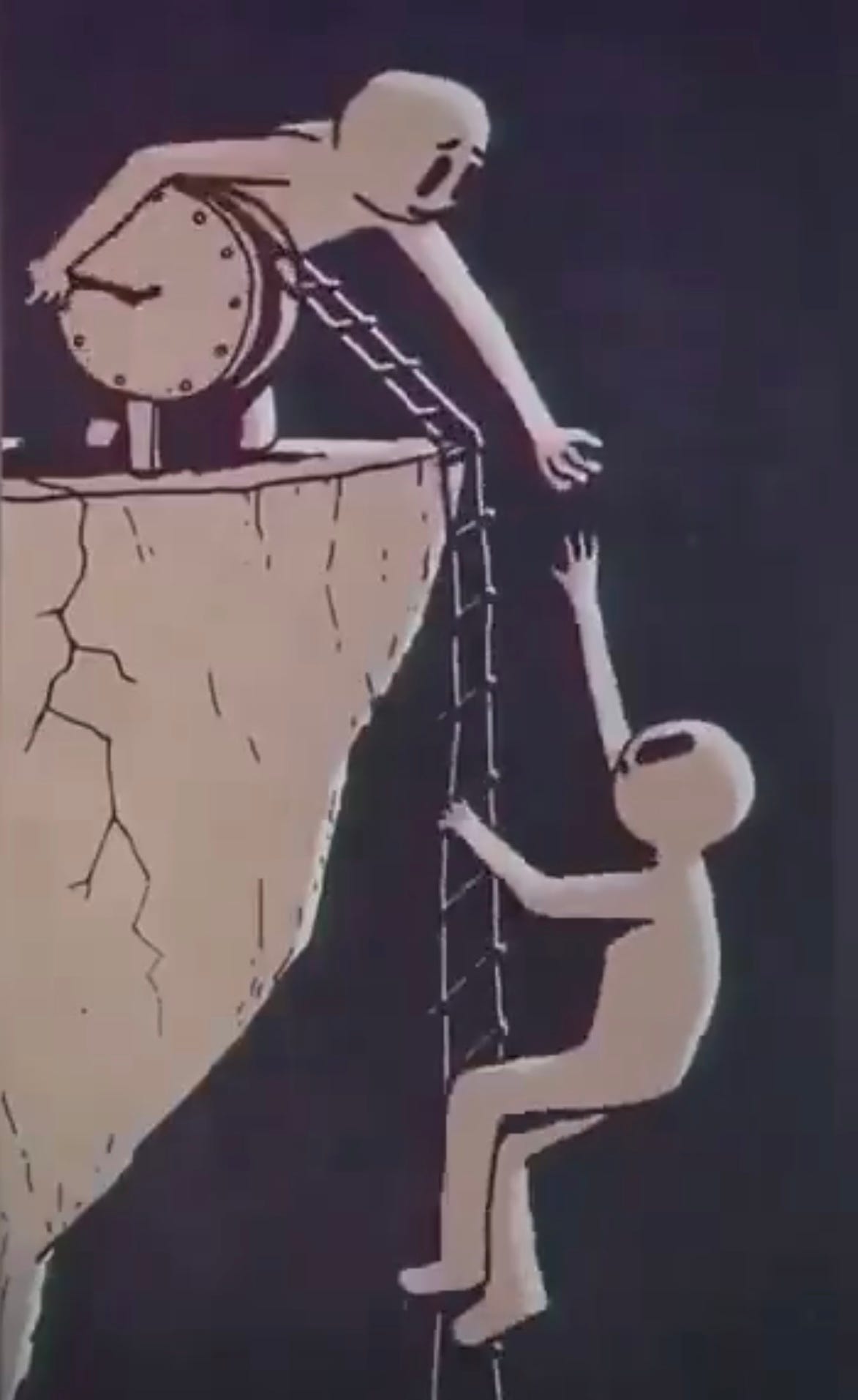
Still from animation titled Loop #3 by Steve Cutts.
Author’s Note
This reflection began with a short animation that stopped me mid-scroll. What initially held my attention was the contradiction visible to the viewer but hidden from the climber: an outstretched hand suggesting assistance while, simultaneously, the means of ascent was being compromised. The image reminded me that help is never defined solely by what is offered. Direction matters too.
As I continued writing this essay, however, I found myself thinking about Gilbert Young’s He Ain’t Heavy, an image I have appreciated for years. There, too, one person reaches down towards another. Yet the meaning feels altogether different. The person above appears to have crossed the barrier and now reaches back so that another might do likewise. The juxtaposition clarified something important for me: this essay is not an argument for suspicion, radical self-reliance, or refusing assistance. Some hands steady the ladder. Some add a rung. Some reach back from the other side because they genuinely want us to arrive.
Discernment lies in learning the difference.
Perhaps that is ultimately what I have been contemplating: not whether we should accept help, but whether the help being offered honours our agency and the direction we have chosen for our lives. Gratitude need not suspend discernment. Nor must difficulty persuade us that someone else’s destination should become our own.
Sometimes the wisest response to an outstretched hand is to grasp it firmly. And at other times it is to say, with genuine appreciation, Thank you. But that is not where I am going.
—Baruti KMT-Sisouvong, PhD
A short animation appeared in my feed recently and as I watched it, my mind drifted to the times I later learned of the motives of some whom I thought really had my back. I am certain some readers will be able to relate to such a moment of realisation. After a Google Lens search using a screenshot, I learned its provenance. British animator and illustrator Steve Cutts created the thought-provoking short. You may know his animation titled Happiness as it has gained considerable attention for its commentary on modern life. However, this short telescopes in on the reality of some human interactions.
In this latest find, a person is climbing a ladder suspended against the side of a cliff. The climb is difficult. Above him stands another person, safely positioned at the top, reaching down with an outstretched hand. From the climber’s perspective, the meaning of the scene seems obvious. Someone has seen his struggle. Someone is waiting to help. If he can only climb a little farther, perhaps he will be able to reach the hand being offered and finally pull himself over the edge. But the viewer can see something the climber cannot. The person extending the hand is also interfering with the ladder. That changes everything.
What appears from below to be assistance is, from another vantage point, part of the difficulty itself. The climber believes he is struggling against the height, the distance, perhaps his own fatigue. He does not know that the person presenting himself as part of the solution is simultaneously working against the means by which the climber might reach the destination under his own power. Admittedly, I found myself thinking about that image long after the video ended and, as a result, believe it stayed with me because life teaches us to notice the hand.
We are taught to recognise assistance by its visible forms. Someone offers money, opens a door, makes an introduction, proposes an opportunity, provides advice, access, shelter, employment, institutional support, or a path forward. These things can be enormously valuable. Much of what any of us accomplishes is made possible by people who extended a hand at precisely the moment we needed one. And make no mistake, I have been the beneficiary of such hands throughout my life. But experience has also taught me that the existence of an offer tells us surprisingly little about whether accepting it will move us toward where we are actually trying to go. Because, sometimes the most important question is not whether someone is willing to help us. It is where their help is taking us.
Earlier this year, during a particularly difficult period, my family and I were presented with an offer of financial assistance. Five thousand dollars was available to help us relocate beyond Massachusetts. Now, on its face, this was unquestionably assistance. Five thousand dollars is not an abstraction. It can pay for transportation, deposits, temporary housing, food, or any number of necessities accompanying a major transition. And when resources are constrained, it would be foolish to pretend that an offer of money has no value simply because one ultimately decides not to accept it. However, we declined.
The decision was not made because the resource lacked value. It was made because the destination attached to the resource was not ours. We had spent years building a life elsewhere and our children were being reared where we had chosen to plant. Our work, relationships, projects, responsibilities, and aspirations had developed in a place we called home. Whatever difficulties confronted us in that moment, we did not understand those difficulties as evidence that the direction of our lives had been mistaken. Instead, we understood them as difficulties encountered while travelling in a direction we continued to believe was ours. And for us, the distinction mattered greatly. Again, we were not rejecting assistance. We were rejecting the destination attached to the assistance.
Over the last several months, I have returned to that distinction periodically because it reaches far beyond money or relocation. And after several contemplative sessions on the matter, I have concluded much of what presents itself as help in life arrives with a direction embedded within it. Sometimes that direction is explicit. Often it is not.
Think of it this way, a parent may offer support provided a child pursues a particular career, an institution may provide resources if an individual returns to a role the institution considers appropriate, an employer may offer advancement along a path that leads farther away from the work an employee actually wants to do, a friend may propose a solution that would certainly resolve the immediate difficulty but would require abandoning something the person experiencing the difficulty considers essential. None of these offers must be sinister. That is important.
The person offering assistance may be entirely sincere, and may genuinely believe the destination they are proposing is preferable. They may see risks we do not see and be acting from experience, affection, responsibility, institutional necessity, or their own understanding of what constitutes a successful outcome. But sincerity does not eliminate direction. Because an outstretched hand can be offered with genuine kindness and still pull us somewhere we do not wish to go.
That is why discernment requires something more sophisticated than dividing the world into people who help us and people who hinder us. Reality is rarely so accommodating. The same person, institution, opportunity may do both. And something may alleviate an immediate problem while creating a longer-term dependency, provide security while narrowing possibility, or make life easier while relocating authority over our lives from ourselves to someone else. And sometimes the offer is not the problem at all.
There are times when the problem is that we have become so exhausted from climbing that any hand above us begins to look like the right hand due to the fact that difficulty changes perception. Here, I am reminded of the scene in Alex Haley’s 1965 book titled Autobiography of Malcolm X and beautifully captured in Spike Lee’s 1992 Movie X starring Academy Award Winner Denzel Washington. Of that experience, we learn from Malcolm X as conveyed to Haley the following:
One day, I remember, a dirty glass of water was on a counter and Mr. Muhammad put a clean glass of water beside it. “You want to know how to spread my teachings?” he said, and he pointed to the glasses of water. “Don’t condemn if you see a person has a dirty glass of water,” he said, “just show them the clean glass of water that you have. When they inspect it, you won’t have to say that yours is better.”
Of all the things that Mr. Muhammad ever was to teach me, I don’t know why, that still stands out in my mind, although I haven’t always practiced it. I love too much to battle. I’m inclined to tell somebody if his glass of water is dirty.
Similar to the glass of dirty glass of water, when one has been climbing for a long time, relief, and relief, becomes extraordinarily attractive. There are moments when the promise of no longer having to struggle can become more compelling than the question of where relief will leave us once the immediate crisis has passed. A person who has spent months or years trying to hold something together may understandably reach for whatever appears capable of reducing the pressure. And, in my experience, this is precisely when orientation matters most.
It is relatively easy to preserve one’s direction when the road is smooth. The more revealing test, however, comes when continuing along that road becomes expensive, uncertain, lonely, or downright exhausting. Under those conditions, an alternative destination can begin to look increasingly attractive not because it has suddenly become ours, but because reaching it appears easier than continuing towards the one we chose. And this is where some observers may seek to enter the picture.
To be clear, there is nothing inherently noble about difficulty. Suffering does not become virtuous merely because it is endured. There are times when wisdom requires changing direction, relinquishing a plan, accepting assistance, or even recognising that what we once wanted no longer fits the person we have become. But that, too, should be an act of discernment.
Changing one’s destination is different from having one’s destination changed by the conditions attached to rescue. And this is where I return to the ladder.
The most striking feature of the animation is not actually the hand. It is the difference in perspective between the climber and the observer. From where the climber hangs, they cannot see the entire system in which his struggle is occurring. Their attention is understandably concentrated upon the next rung and the outstretched hand above them. We, however, are permitted to see more. And what we see raises another possibility.
Perhaps the climber does not need to be rescued. Perhaps, instead, they need the ladder to stop being interfered with. Or in a case more socially aware readers may recognise, the goalpost should remain stationary and not be moved as more people begin to regularly score in the game of life. But I digress.
Returning to our climber and the question of whether they require saving or for the ladder instead to stop moving, we must acknowledge there is an enormous difference between those two propositions.
Sometimes people do not need someone else to carry them to safety. They need a fair opportunity to use their own capacities, access to the tools already available to them, unnecessary obstacles removed, promises honoured, information shared, agreements respected, opportunities left open, or sufficient room to attempt something without another person continually rearranging the conditions under which success must occur. Again, let the goalpost remain where it was originally established and let the game unfold as designed.
Again, back to our ladder, in such circumstances, the most meaningful form of assistance may not be an outstretched hand at all. It may simply be: stop moving the rungs. This insight has implications for those of us who offer help as well.
When someone we care about is struggling, it is natural to imagine that we know what would solve the problem. Sometimes we do. But there is a subtle difference between helping someone reach their destination and helping them reach the destination we have selected for them. The former requires attention to their agency. The latter can easily disguise direction as generosity.
Perhaps one of the questions we should therefore ask before helping is not merely, What can I offer? It is instead, What is this person actually trying to build?
That question changes the relationship between helper and helped. It does not require us to agree with every destination another person chooses. Nor does it obligate us to finance, endorse, or participate in choices we consider unwise. But it allows us to distinguish between declining to support someone’s direction and attempting to redirect that person while calling the redirection assistance. And the distinction is particularly important because gratitude can sometimes complicate discernment.
We may feel that declining an offer is ungrateful. We may worry that saying no to assistance will offend the person extending it. We may even begin to question ourselves: If I truly needed help, wouldn’t I accept what is being offered?
Not necessarily. Need does not eliminate agency. Gratitude does not require acceptance. And appreciation for an outstretched hand does not require us to surrender our judgement about where we intend to go. One can say, sincerely, Thank you for offering, while also saying, That is not where I am going. There is strength in learning to hold those sentences together.
The longer I live, the more I suspect that many important decisions are not choices between obvious good and obvious bad. They are choices between competing goods, competing risks, competing futures, and competing interpretations of what progress looks like. Under those circumstances, the appearance of assistance cannot substitute for clarity of orientation.
We must know enough about our own direction to recognise when an opportunity advances it, when an obstacle requires adaptation, when a destination deserves reconsideration, and when an apparently helpful solution would ultimately carry us somewhere else. And to be clear, this does not mean refusing every hand. Quite the opposite.

He Ain’t Heavy, Gilbert Young. ©Gilbert Young.
Used here in discussion of the artist's depiction of reaching back to assist another.
There are hands worth reaching for. There are people whose assistance changes lives precisely because they help without attempting to possess the direction of the person they are helping. There are teachers, friends, benefactors, colleagues, family members, institutions, and sometimes complete strangers who strengthen the ladder, steady it, add a rung, illuminate the next step, or simply stand nearby while someone else climbs. Here, I am thinking of the type of assistance as depicted in the famous artwork by Gilbert Young titled He Ain’t Heavy and features an outstretched hand from above being extended to a hand below to assist over what appears to be a wall over which the person above has successfully surmounted and seeks to be of assistance. From where I stand, those are the hands that should be treasured.
Back to the video of the climber, and their experience, discernment asks us to look beyond the hand itself. What is happening to the ladder? What conditions accompany the assistance? What becomes possible if we accept it? What becomes impossible? And perhaps most importantly:
Where does this hand lead?
The person in the animation continues climbing towards the hand because, from his vantage point, the hand represents safety. Perhaps that is why the image stayed with me and compelled me to share this reflection.
Because, there have been moments in my own life when what appeared to be the obvious solution would have required travelling towards a destination I had already decided was no longer mine. Declining those solutions did not make the difficulties disappear. Sometimes it made the next stretch of the climb considerably harder. But difficulty and misdirection are not the same thing.
A difficult road may still be your road, an easier road may still lead somewhere you do not wish to live, and an outstretched hand, however welcome it may initially appear, should not relieve us of the responsibility to know the difference. Because, sometimes wisdom is reaching for the hand. At other times, there is wisdom is continuing to climb. And yet at other times still, deep wisdom begins with recognising that what you are declining is not assistance itself. You are declining the destination attached to it.
Suggested Practice
Think of an offer of assistance you are presently considering—or one you accepted or declined in the past. For a moment, set aside the value of what was offered and consider instead the direction embedded within it.
Ask yourself: Where does this hand lead?
Would accepting the assistance strengthen your ability to continue towards a destination you have consciously chosen, or would it redirect you towards one selected by someone else? What would become possible through accepting it? What might become impossible? Are you declining something valuable merely because receiving help feels uncomfortable, or are you recognising that the conditions attached to the help would require relinquishing something essential?
Then reverse the perspective. Consider a person you are presently trying to help. Ask whether your assistance strengthens their ladder—or whether, however unintentionally, you are asking them to climb towards the destination you have chosen for them.
Sit with the distinction without forcing an immediate answer. Sometimes discernment begins simply by noticing the difference between an outstretched hand and an aligned one.
—
About the Author
Dr. Baruti KMT-Sisouvong is a scholar of consciousness, researcher of human development, and Certified Teacher of Transcendental Meditation® based in Cambridge, Massachusetts. His work explores the relationship between Pure Consciousness, neuroscience, and social systems, and how deeper awareness can inform both personal growth and institutional transformation.
He is the Founder and Chief Meditation Officer of Transcendental Brain, an initiative examining the intersection of consciousness research, cognitive science, and high-performance decision-making. He is also President of Serat Group Inc. and Founder and Director of Radical Scholar Inc., a nonprofit dedicated to consciousness-based research and public scholarship.
Alongside his wife and teaching partner Mina, he co-directs the Transcendental Meditation program for Cambridge and the Greater Boston area. He is also the host of the On Transcendence Podcast and Founder of International Meditation Hour, a quarterly global gathering dedicated to the unifying power of silence.
His writings—spanning frameworks such as The Model for Perpetual Growth and Progress and The Seven Layers of Manifestation—explore the evolving relationship between consciousness, leadership, and society.
He writes from the conviction that the most important race is not between nations or machines, but between the conditioned mind and the awakening soul.
To learn more about him, visit: https://barutikmtsisouvong.com/.