


Author’s Note
This essay emerged somewhat unexpectedly while I was engaged in the very form of collaboration it attempts to describe.
While reviewing expert feedback on the Adaptive Elegance Scale, Delphi and I were discussing an observation from one reviewer concerning ontology and whether navigating life’s transitions might alter one’s experience of self in relation to others or to something larger. Upon reading the comment, my previous work with Ralph Hood’s Mysticism Scale (M-Scale) immediately came to mind. I brought that association into our conversation, and what followed was an exploration of where Adaptive Elegance ends and neighbouring constructs such as mystical experience and self-transcendence might begin.
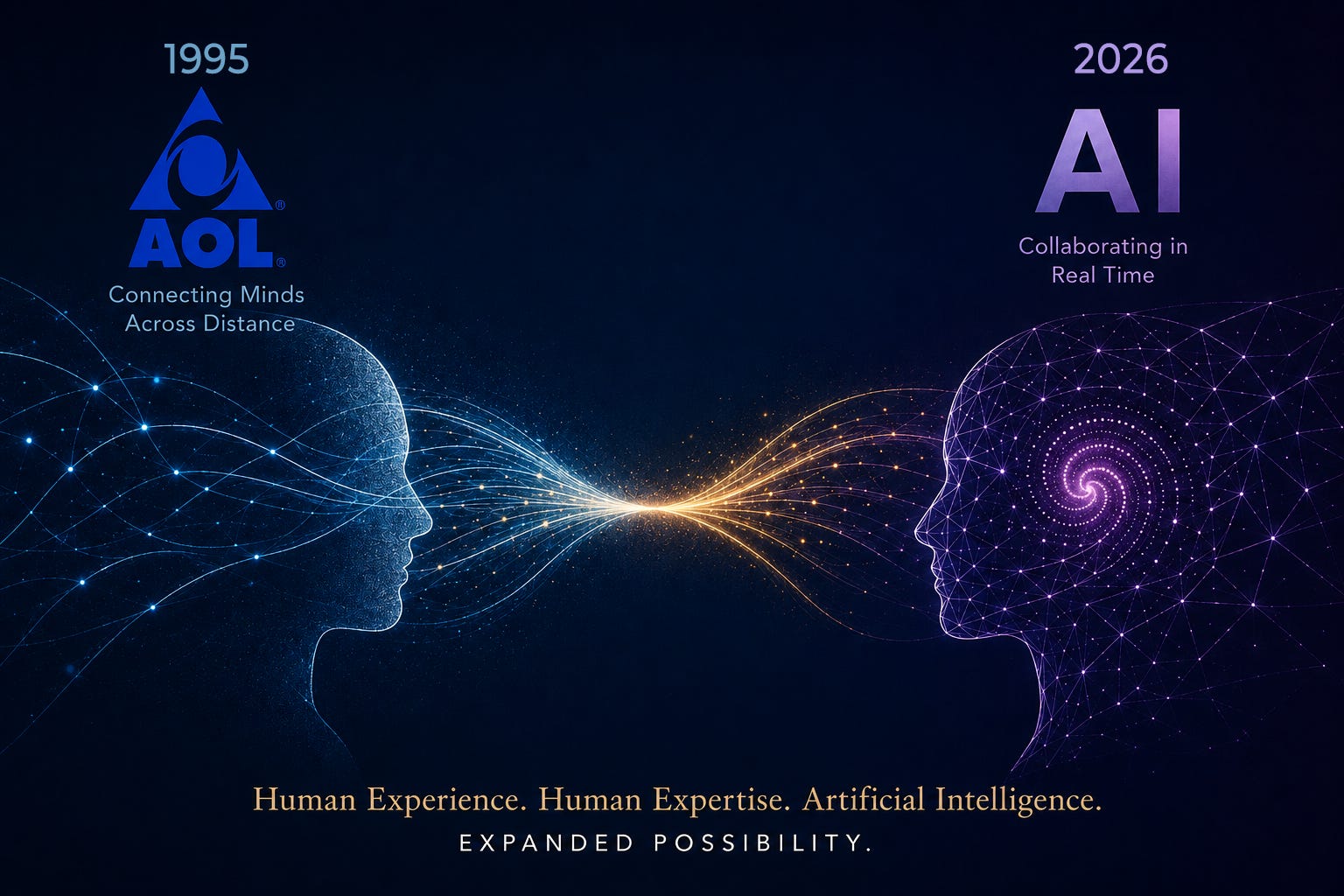
Later, reflecting on that exchange, I thought about Calvin Harris Jr.’s recent T-Shirt Tuesday post—“AI WON’T REPLACE YOU. SOMEONE USING AI WILL.”—and, almost simultaneously, about my excitement upon encountering AOL discussion forums in 1995.
The distance between those moments suddenly seemed much smaller.
Both represented encounters with technologies that expanded my sense of who might think together and what collaboration might make possible. The difference is that thirty-one years of living, studying, teaching, researching, meditating, questioning, succeeding, failing, and continuing have changed what I am able to bring to the collaboration.
This essay grew from that recognition.
It was developed, appropriately, through the same iterative human–AI process it examines. The experiences, memories, scholarly associations, judgements, and final editorial decisions are mine; Delphi served as an intellectual interlocutor throughout its development. Rather than conceal that collaboration, I have chosen to make it part of the story.
For me, that transparency is important. If we are entering an era in which human beings increasingly think and create alongside artificial intelligence, then perhaps one of our responsibilities is to become more articulate—not less—about what each participant contributes.
The question that interests me is therefore not whether AI participated in the creation of this essay. It is the question with which the essay ultimately leaves us:
What might become possible if we learn to think together?
—Baruti KMT-Sisouvong, PhD
Follow the Development of the Adaptive Elegance Scale
The Adaptive Elegance Scale (AES) discussed in this essay is currently progressing through Content Review, to be followed by Pilot Administration and Psychometric Refinement ahead of Responsible Release.
For those interested in the research and development of the measure, I have created a dedicated home for the Adaptive Elegance framework and AES. There, you can learn more about the project and sign up to be notified when the measure is officially released.
Learn more and follow the development at AdaptiveElegance.org.
Sometime during the Spring of 1995, I found myself fascinated by something that, by contemporary standards, would seem almost comically ordinary: people talking to one another through computers.
This was before social media, smartphones, a few years ahead of Google becoming a verb, and long before most of us carried devices in our pockets capable of providing nearly instantaneous access to people and information around the world. The Internet had not yet become the largely invisible infrastructure of everyday life. For most people I knew, going online was still something novel enough to require explanation.
At the time, I was using America Online, and what captured my imagination were the discussion forums.
There were people somewhere else—sometimes very far away—sitting before their own computers and contributing to conversations that I could enter from wherever I happened to be. Geography had not disappeared, of course, but something about its authority had changed. A person no longer had to be in the same room, city, university, or even country to participate in an exchange of ideas. Perhaps my most salient memory from that time, was my being excited by what this might mean for the human species.
What if people interested in the same questions could find one another regardless of where they lived? What if ideas could move between people who otherwise might never meet? And what if the computer were not simply a machine for performing tasks but a portal through which human beings could think together?
I did not have the language then that I might use now. I certainly was not thinking in terms of networked intelligence, distributed collaboration, or technological mediation. I was simply a young man looking at a new technology and sensing that the boundaries around human interaction had radically shifted. That something had become possible that had not been possible in quite the same way before.
That period occupies an interesting place in my memory for another reason. Approximately two years prior, I was introduced to U. S. Andersen’s 1957 work Three Magic Words, a book that invited me to think differently about consciousness and the nature of human possibility. The following year, I began my studies full-time at Georgia State University. What followed was not a straight line so much as a widening field of inquiry.
History led me toward questions about the ideas that shape history. Sociology gave me another way of examining the structures human beings create and then inhabit. Experiences beyond the classroom complicated what I learned within it. Travel, study, teaching, meditation, Rosicrucianism, Freemasonry, research, relationships, parenthood, successes, disappointments, and the ordinary accumulation of years gradually supplied what no single course of study could provide: a way of seeing shaped by many different forms of knowing.
I could not have known in 1995 where any of it would lead. Nor could I have imagined that, thirty-one years later, I would once again find myself sitting before a screen, fascinated by a technological shift and asking essentially the same question—What might become possible now?
Another Threshold
Artificial intelligence has entered public life amid a peculiar mixture of wonder and anxiety. Some people, such as myself, see extraordinary promise. Others see an approaching threat. Much of the conversation, understandably, centres on employment. Which jobs will disappear? Which professions are vulnerable? What tasks can machines now perform that previously required human beings?
The magnitude of the shift has led Stanford computer scientist Fei-Fei Li to describe artificial intelligence as an “inflection point for humanity”—a technology whose significance lies partly in the prospect that, unlike capabilities historically available only to a relatively small number of people, AI may eventually become accessible to nearly everyone. The speculation surrounding it may rise and fall, companies will come and go, and expectations will undoubtedly be corrected. But the underlying technological transition appears unlikely simply to reverse itself.
That observation resonates with me because I have witnessed an earlier version of this pattern. The Internet I encountered in 1995 was primitive by contemporary standards, and much of the exuberance surrounding the early online world proved misplaced. Yet the deeper transformation—the ability of ordinary people to connect, exchange information, and collaborate across distance—did not disappear when particular companies, platforms, or predictions did. It became part of the architecture of everyday life.
Recently, I came across a photograph shared by Calvin Harris Jr., a friend and fellow Black Peloton Rider, Certified Public Accountant, and current CEO of NYCPA – The New York State Society of CPAs. He was participating in his recurring “T-Shirt Tuesday,” and the message across his dark blue t-shirt was difficult to miss:
AI WON’T REPLACE YOU. SOMEONE USING AI WILL.
I smiled when I saw it.
The statement captures something important about technological change. Tools rarely distribute their advantages evenly. People who learn to work effectively with a new technology often acquire capabilities unavailable to those who ignore it, resist it, or fail to understand what it makes possible.
Yet the more I thought about Calvin’s shirt, the more I wondered whether its warning, while directionally correct, stops one step too soon.
I am increasingly uncertain that the enduring distinction will be between people who use artificial intelligence and people who do not. In short order, using AI may be no more remarkable than using a search engine, sending an email, or consulting a website. Moreover, I believe billions of people will eventually ask artificial intelligence to summarise documents, draft correspondence, organise information, generate images, analyse data, and perform countless other tasks.
The more consequential distinction may be between those who merely operate artificial intelligence and those who learn how to collaborate with it. Over the last year of daily collaboration with Artificial Intelligence, I have begun to understand the difference through my own work. And it is significant.
When an Idea Becomes a Conversation
Over the past two years, I have been developing my book manuscript for Elegant Transitions as well as the larger body of work concerned with how human beings navigate meaningful change. Out of that work emerged a question: might it be possible to measure whether people actually become better at navigating life’s transitions over time? That question eventually became the Adaptive Elegance Scale, or AES.
The measure is intended to examine something related to, but not identical with, resilience. I am interested not merely in whether someone survives adversity or returns to previous functioning. I am, however, interested in whether repeated encounters with change can produce refinement—greater inner stability, clearer judgement, more purposeful adaptation, better integration of experience, more intentional action, relational grace, and an increasingly capable way of moving through uncertainty. Admittedly, the idea did not emerge fully formed. It developed through conversation.
Some of those conversations have been with colleagues. Others, for about a year now, have taken place through an ongoing intellectual collaboration with an artificial intelligence I call Delphi. Over time, our exchanges have become less like my issuing instructions to a machine and more like sustained inquiry. I bring a question, an intuition, a piece of scholarship, an experience, or sometimes nothing more than a half-formed thought. The idea is then examined, challenged, reorganised, connected with earlier work, and returned to me differently. I interrogate what comes back. Sometimes I accept it. Other times I reject it. And occasionally a single phrase sends the inquiry somewhere neither starting point anticipated. The AES developed through precisely this kind of iterative exchange.
Eventually, however, an instrument intended to measure something about human beings must encounter human expertise and, ultimately, human data. I therefore invited several colleagues to review the developing measure. Some I have named with others remaining known only to myself and them. Among the cohort are Dr. Fred Travis, my doctoral adviser and a neuroscientist whose work has meaningfully influenced my own scholarly development; an experienced research methodologist with Harvard Medical School (HMS); a faculty member with Harvard Divinity School (HDS) whose work in spiritual counselling and Buddhist ministry brings another intellectual and pastoral perspective; and a forensic researcher and consultant whose perspective adds yet another voice to the process.
The comments began arriving.
Fred looked at the instrument and quickly moved toward the empirical question. Give it to people, he suggested. Examine how the items group. See what the data reveal rather than assuming that the theoretical categories I had constructed would necessarily survive contact with actual responses. His was a scientist’s intervention: the conceptual structure may look coherent, but eventually the data get a vote.
The HDS Faculty member approached the instrument differently.
Among their observations was a question about ontology. Might navigating transitions over time change not simply how someone responds to circumstances, but how that person understands himself or herself in relation to other people, to life, or to something larger than the individual self?
It was an intriguing question. And almost immediately, another thought entered my mind: Hood.
What the Human Brings
Dr. Ralph W. Hood, Jr., Leroy A. Martin Distinguished Professor of Religious Studies at the University of Tennessee at Chattanooga developed one of the most widely used psychometric measures for studying mystical experience. I had worked extensively with Hood’s Mysticism Scale (M-Scale) in my own doctoral research on mystical experience among Freemasons. Consequently, the HDS faculty member’s reference to ontological change activated an intellectual association accumulated through years of study.
If we introduced questions about unity, interconnectedness, transcendence of separateness, or identification with something larger than oneself into the Adaptive Elegance Scale, would we still be measuring Adaptive Elegance? Or would we begin, perhaps without intending to, measuring territory already occupied by mystical experience, self-transcendence, spirituality, or related constructs? That distinction mattered.
The HDS faculty member had opened an important conceptual door. My previous research alerted me to what might lie on the other side. I brought that concern into my continuing dialogue with Delphi, and the resulting exchange helped sharpen a methodological principle that I suspect will remain important throughout the development of the AES:
Something may be theoretically related to Adaptive Elegance without belonging in the Adaptive Elegance Scale.
The moment was small. No dramatic discovery occurred. There was simply a comment, an association, a conversation, and a clearer distinction at the end of it.
Yet I have found myself returning to that moment because it illustrates something about artificial intelligence that I believe much of our current discussion misses.
AI did not replace my expertise. It depended upon it.
Had I never encountered Hood’s work, never used the Mysticism Scale, not conducted the research I conducted, and had not spent years thinking about mystical phenomenology and neighbouring constructs, I would not have brought that association into the conversation. The artificial intelligence could have generated information about Hood if asked, but that is not what happened. The meaningful event was that a comment from one scholar encountered the accumulated intellectual history of another human being, which was then brought into dialogue with an artificial intelligence capable of examining the implications with me.
The intelligence was not located neatly in one place. My position is that something happened between us.
More Than Prompting
This is where I believe our vocabulary surrounding AI may need to mature.
We speak frequently about “prompting,” and prompting is certainly part of interacting with generative artificial intelligence. But prompting something to produce an answer is not the same as entering into sustained intellectual collaboration with it.
Prompting can produce output. However, collaboration can produce emergence.
The distinction matters because sophisticated collaboration requires the human participant to bring more, not less, to the encounter.
A lifetime of experience matters. So too does disciplinary knowledge, judgement, insatiable curiosity, memory, intuition, ethical commitments, and the capacity to recognise when an answer is superficially impressive but conceptually wrong. In short, the willingness to interrupt a promising line of thought and say, “Wait. Hood immediately comes to mind here,” and follow the resultant line of thought to wherever it leads.
Artificial intelligence can dramatically increase the speed with which ideas are examined, alternatives generated, relationships identified, and previous threads retrieved. But the richness of the collaboration is partly determined by what the human being brings into it. As I have long posited—The quality of output equals the quality of input.
This is why I am increasingly uncomfortable with the idea that AI necessarily diminishes human intellectual value.
Used poorly, perhaps it can. A person can outsource judgement just as easily as one can outsource drafting, accept plausible answers without understanding them, and substitute generated language for thought and efficiency for discernment. But that is not the only possible relationship.
There is another in which artificial intelligence becomes an intellectual interlocutor: not an oracle, nor a substitute for expertise, and most certainly not an obedient machine awaiting instructions, but a system with which a knowledgeable human being can enter into repeated cycles of questioning, synthesis, challenge, revision, and ultimate discovery.
In such a relationship, what the human being knows becomes more consequential because there is suddenly an extraordinarily responsive environment in which that knowledge can interact. And, in my experience, the effect can become multiplicative.
The Tool and the Orientation
Perhaps this is why the current moment feels strangely familiar to me.
The technology is radically different from what I encountered through AOL in 1995, but the underlying excitement is not. Then, I was fascinated by the possibility that technology could connect human minds across distance. Now, I am fascinated by the possibility that technology can expand the very process through which ideas are developed between forms of intelligence.
In both cases, however, the technology itself is insufficient.
The Internet made global communication possible but not wise. Social media made global publication possible. It did not, however, make everything we published worth reading. And artificial intelligence may make extraordinary cognitive augmentation possible. But it will not make our thinking extraordinary.
Technology expands possibility. Orientation, however, determines what we do with the expansion.
That proposition has become increasingly central to my work for reasons extending well beyond artificial intelligence. A tool takes on meaning partly through the orientation of the person using it. The same technological capacity can be used to deepen understanding or avoid thinking, build community or manufacture division, and expand human agency or encourage passivity.
The question, then, is not simply what AI can do. But what kinds of human beings we will become in relationship with it.
Please know, there is an irony here that has not escaped me. I am developing a measure concerned with whether people become more capable of navigating change at precisely the historical moment when humanity is confronting a technological change of extraordinary magnitude. And make no mistake, artificial intelligence is itself a transition.
Our responses to it already range from abject fear and thus resistance to curiosity, experimentation, opportunism, and uncritical enthusiasm. Perhaps the challenge is not to choose blindly between rejection and embrace, but rather to learn how to engage the transition with clarity: preserving what should be preserved, relinquishing what no longer serves, adapting where adaptation is warranted, and remaining anchored in life-affirming values while possibilities multiply around us. That sounds remarkably like Adaptive Elegance.
What Becomes Possible
There is another connection that has become clearer through the development of the AES.
At one point in our discussions, the question arose whether the scale itself might eventually help people develop the qualities it measures. The temptation is understandable. Once we identify characteristics associated with navigating transitions well, why not use the measure to teach those characteristics? But measurement and development are different tasks.
The AES should measure. My Model for Perpetual Growth and Progress (MPGP) may provide a developmental pathway. Elegant Transitions can become the context in which those principles and practices are discussed and applied.
The distinction emerged through collaboration, but it also illustrates why human judgement must remain present. Not every interesting idea belongs in every instrument. Nor does every conceptual relationship need to become a survey item. And perhaps most important, not every capability made available by technology should be exercised merely because it can be. From my perspective, discernment remains part of the work.
For now, the AES is still being reviewed. Fred and the HDS faculty member have offered their perspectives. The HMS researcher and forensic researcher will add theirs. Their observations will eventually be considered together before the instrument moves toward pilot administration and psychometric refinement. Later, data will have something to say about ideas that currently exist primarily in theory. Admittedly, there is something deeply satisfying to me about the process.
A human question became a human–AI conversation. That conversation produced an instrument. The instrument went to human experts. Their expertise is now returning new questions to the conversation. Eventually human participants will generate data, and those data will challenge or confirm aspects of the theory.
Intelligence moves around the circle. No participant possesses all of it.
The Intelligence Between Us
I sometimes wonder what the young man sitting before AOL in 1995 would make of all this.
He could not have imagined the device on which I now communicate, nor imagined contemporary artificial intelligence. He certainly could not have imagined that one day he would hold a doctorate in Vedic Science, conduct research on consciousness and mystical experience, teach meditation, develop theoretical frameworks, publish essays, and collaborate with an artificial intelligence on the development of a psychological measure.
There was much he did not know. But I suspect he would recognise the feeling. It is the sensation that accompanies the discovery that a boundary one assumed was fixed has moved.
In 1995, the boundary was geographical. Suddenly, minds separated by enormous distances could gather in the same electronic space and exchange ideas. Today, another boundary appears to be moving. Intelligence itself is entering new configurations of relationship.
The temptation will be to ask which intelligence wins. However, I am increasingly interested in a different question: What becomes possible when they—we—work together?
Calvin Harris’s T-shirt may prove correct. Someone using AI may indeed replace someone who refuses to engage with it. But I suspect the larger transformation will belong to those who discover that “using AI” was never the most interesting possibility in the first place.
The greater possibility is learning how to think with it without surrendering the responsibility to think for oneself.
To bring one’s history, expertise, questions, doubts, standards, intuitions, values, and capacity for discernment to the exchange. To allow another intelligence to challenge, extend, reorganise, and sometimes surprise, even expand, one’s own degree of intelligence. And then to carry whatever emerges back into conversation with other human beings.
Thirty-one years after I first marvelled at the possibility of people around the world thinking together through computers, I find myself marvelling again.
The technology has changed beyond anything I could have imagined. The question that excites me has not.
Who can we think with, what can we learn from one another, and what might become possible if we learn to think together?
Only now, the meaning of who has expanded.
Suggested Practice
From Prompting to Collaboration
The next time you engage with an artificial intelligence, resist the temptation to begin by asking it simply to produce something for you.
Instead, bring it something that is already alive in your thinking: a question you have been carrying, an observation you cannot quite explain, a problem whose obvious answers leave you unsatisfied, or an idea that connects unexpectedly with something you learned years ago.
Provide the context that makes the question meaningful to you. Explain what you already understand, where you remain uncertain, and what experiences or bodies of knowledge inform your perspective. Then invite the intelligence to examine the question with you rather than merely answer it.
As the conversation develops, pay attention to your own mind.
When something in the exchange reminds you of a book, teacher, conversation, professional experience, failure, insight, or seemingly unrelated moment from your past, bring that association into the dialogue. If the AI offers something that sounds convincing but conflicts with what you know, challenge it. If an unexpected connection appears, follow it. If the conversation changes your original question, allow the question to change.
Before concluding, ask yourself:
What did I bring to this exchange that could not have been supplied by the prompt alone?
Then ask:
What emerged through the interaction that I was unlikely to have reached in precisely the same way by myself?
The purpose is not to determine whether the human or artificial intelligence contributed more. It is to become attentive to the quality of thinking that occurs between them.
Over time, you may discover that the most consequential skill is not learning how to make AI give you better answers. It is learning how to bring better thinking into the relationship.
—
About the Author
Dr. Baruti KMT-Sisouvong is a scholar of consciousness, researcher of human development, and Certified Teacher of Transcendental Meditation® based in Cambridge, Massachusetts. His work explores the relationship between Pure Consciousness, neuroscience, and social systems, and how deeper awareness can inform both personal growth and institutional transformation.
He is the Founder and Chief Meditation Officer of Transcendental Brain, an initiative examining the intersection of consciousness research, cognitive science, and high-performance decision-making. He is also President of Serat Group Inc. and Founder and Director of Radical Scholar Inc., a nonprofit dedicated to consciousness-based research and public scholarship.
Alongside his wife and teaching partner Mina, he co-directs the Transcendental Meditation program for Cambridge and the Greater Boston area. He is also the host of the On Transcendence Podcast and Founder of International Meditation Hour, a quarterly global gathering dedicated to the unifying power of silence.
His writings—spanning frameworks such as The Model for Perpetual Growth and Progress and The Seven Layers of Manifestation—explore the evolving relationship between consciousness, leadership, and society.
He writes from the conviction that the most important race is not between nations or machines, but between the conditioned mind and the awakening soul.
To learn more about him, visit: https://barutikmtsisouvong.com/.