


Author’s Note
This reflection did not arrive all at once. It came in layers—over the course of several evenings, sitting with family, revisiting The Shawshank Redemption and allowing the conversations that followed to linger a little longer than usual. There are certain stories that do not conclude when the credits roll. They remain, almost patiently, waiting for the right moment to speak again.
This was one of those moments.
—Baruti KMT-Sisouvong, PhD
We had seen it before, of course. Everyone has. Or rather nearly everyone. And yet, watching it again—twice within the span of a few weeks as a family—something in the film seemed to shift. Or perhaps, more accurately, something in me had shifted, making it possible to see more deeply to further examine what had always been there.
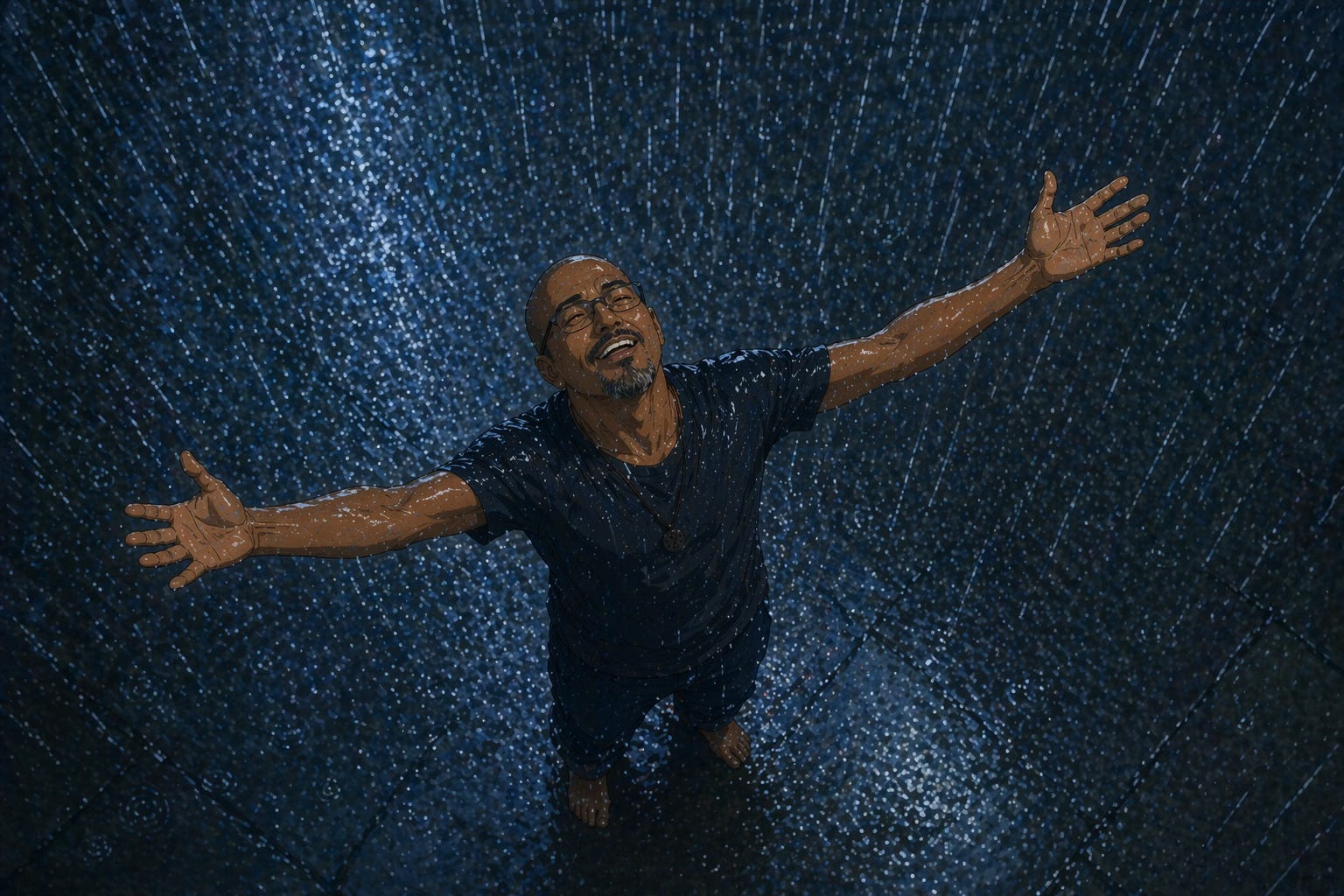
It is easy, at first glance, to think of Andy Dufresne’s story as one of escape. That is the part people remember. The rain. The iconic overhead shot of his outstretched arms. The suddenness of it all. But sitting there, this time, that moment felt almost secondary. What drew my attention instead was everything that preceded it—the years that passed without spectacle, without recognition, without any outward indication that anything meaningful was taking place at all.
A man sitting in a cell, day after day, year after year, holding a small rock hammer that seemed, to anyone else, little more than a curiosity. A hobby, perhaps. A way to pass the time. There was nothing dramatic about it. Nothing that demanded attention. And yet, within that act of repetition, something precise was unfolding.
Not survival. Design.
That distinction stayed with me.
Because there is a particular kind of patience that does not announce itself. It does not present as urgency or intensity. It is more often that not, silent. More deliberate. It moves beneath the surface of things, almost imperceptibly, until the accumulation of small, consistent actions begins to take on a shape of its own.
Andy was not waiting for something to happen. He was building something—carefully, methodically, deliberately, without the need for validation.
And I found myself thinking about these last few years.
There have been moments, especially late at night, working through ideas, refining language, adjusting structure, building and rebuilding pieces that may never be seen in their earliest forms, where the work can feel rather repetitive. Circular, even. The kind of work that does not lend itself to immediate recognition or reward. The kind that, from the outside, might look like stillness.
But sitting there, watching Shawshank again, it became difficult to ignore the parallel.
Because what appears as stillness is often structure in progress.
There is a scene—one that I have heard quoted many times, but which landed differently these last two times—where Andy speaks of something that cannot be taken away. Something untouched by confinement, untouched by circumstance, untouched by Castaneda’s “petty tyrants.”
“Hope,” he calls it.
But even that word, so often repeated, can be misunderstood. It is easy to think of hope as something fragile, something dependent on conditions, something that rises and falls with circumstance, something reliant on people. But that is not how Andy holds it. For him, and present company included, hope is not reactive. It is not something granted or withdrawn by the world around him.
It is maintained.
Protected.
Cultivated.
And that, perhaps, is the more demanding interpretation.
Because it requires work.
It requires returning, again and again, to a space within oneself that is not governed by external outcomes. A space reinforced through practice, through study, through the oft-ignored or derided by others accumulation of understanding. The kind of understanding that, as my father would often say, cannot be taken away.
“No one can ever take away what you have learned.”
I remember hearing that as a child and accepting it in a general sense, as one does with advice that feels true but not yet fully realised. But over time—especially in seasons where outcomes do not align neatly with effort—the depth of that statement becomes clearer.
What is learned becomes internal. What is internalised becomes stable. And what is stable allows one to continue moving, even when the path ahead is not yet visible. Because, as Dr. Martin Luther King, Jr. wrote, “You don’t have to see the whole staircase. Just take the next step.”
There is another line from the film that is often quoted—“Get busy living, or get busy dying.” It tends to be framed as a call to action, something bold and immediate. But Andy’s life suggests something far more subtle.
Living, in his case, is not loud. It is not rushed. It is not defined by outward momentum. It is defined by direction.
He studies. He writes letters. He builds a library. He develops systems. He devises and refines a plan that no one else can see. From the outside, very little changes. From the inside, everything does.
And I found myself reconsidering the nature of progress.
Because we are often taught to recognise progress through visible change—through milestones, achievements, recognitions that can be pointed to and measured. But there is another kind of progress that does not present itself so readily. It accumulates beneath the surface of visible activity, until one day it reveals itself all at once.
When that moment comes, it appears sudden.
But it is never sudden.
It is the result of years spent in alignment with something that did not waver.
Satyam Eva Jayate—truth alone triumphs.
I have returned to that phrase often. Not as a reassurance, but as a kind of orientation. Because it does not promise immediacy. It does not suggest that alignment with truth will produce immediate outcomes. What it suggests, instead, is something more enduring.
That what is built in alignment with truth carries within it a certain inevitability.
Not because it is forced.
Not because it is accelerated.
But because it is consistent.
And consistency, over time, becomes difficult to resist.
There have been many nights—late, settled, uninterrupted—where the only thing that seems to make sense is to continue. To learn. To write. To refine. To adjust. To build something that, in its current state, may not yet resemble what it will become.
In those moments, the affirmation is simple.
Not elaborate. Not performative. Just clear. Just keep moving, KMT.
It does not seek motivation. It does not require external validation. It simply marks a return to the work.
Watching Shawshank again, I realised that this, more than anything else, is what the film captures so well.
Not the escape.
But the commitment to a process that unfolds long before the outcome is visible.
The chiselling that no one hears.
The planning that no one sees.
The discipline required to continue without evidence that the effort will succeed.
And then, one day, the wall gives way, conditions constrain even more, a storm looms on the horizon, and all of the hard work undertaken in silence emerges from the shadows.
To those observing from the outside, it looks like a moment. A breakthrough. A sudden change in circumstance.
But to the one who has been doing the work, the real work, it is something else entirely.
It is a continuation.
A natural extension of everything that came before.
And so the question, perhaps, is not whether progress is being made.
But whether one is willing to remain in the carving phase long enough for that progress to reveal itself.
Because the carving phase is quiet.
It does not announce itself.
It does not attract attention.
It does not even provide constant reassurance.
It simply asks for consistency.
And so, the work continues.
Not hurried.
Not forced.
But steady.
A small action.
Repeated.
Refined.
Sustained.
Until, eventually, what was once hidden becomes clear. Because, for some, life is not Checkers, it is the more strategic game of Chess.
Now, let me put my second Queen into play.
Suggested Practice
After a period of stillness—whether through meditation or quiet reflection—consider the following, not as questions to be answered immediately, but as ideas to sit with:
Where, in my life, am I engaged in work that does not yet show visible results?
What am I building that others may not yet recognise?
What knowledge, once gained, has already become part of me in a way that cannot be removed?
And then, gently, without urgency, return to a single phrase:
Just keep moving.
—
About the Author
Dr. Baruti KMT-Sisouvong is a scholar of consciousness, researcher of human development, and Certified Teacher of Transcendental Meditation® based in Cambridge, Massachusetts. His work explores the relationship between Pure Consciousness, neuroscience, and social systems, and how deeper awareness can inform both personal growth and institutional transformation.
He is the Founder and Chief Meditation Officer of Transcendental Brain, an initiative examining the intersection of consciousness research, cognitive science, and high-performance decision-making. He is also President of Serat Group Inc. and Founder and Director of Radical Scholar Inc., a nonprofit dedicated to consciousness-based research and public scholarship.
Alongside his wife and teaching partner Mina, he co-directs the Transcendental Meditation program for Cambridge and the Greater Boston area. He is also the host of the On Transcendence Podcast and Founder of International Meditation Hour, a quarterly global gathering dedicated to the unifying power of silence.
His writings—spanning frameworks such as The Model for Perpetual Growth and Progress and The Seven Layers of Manifestation—explore the evolving relationship between consciousness, leadership, and society.
He writes from the conviction that the most important race is not between nations or machines, but between the conditioned mind and the awakening soul.
To learn more about him, visit: https://www.barutikmtsisouvong.com/.