


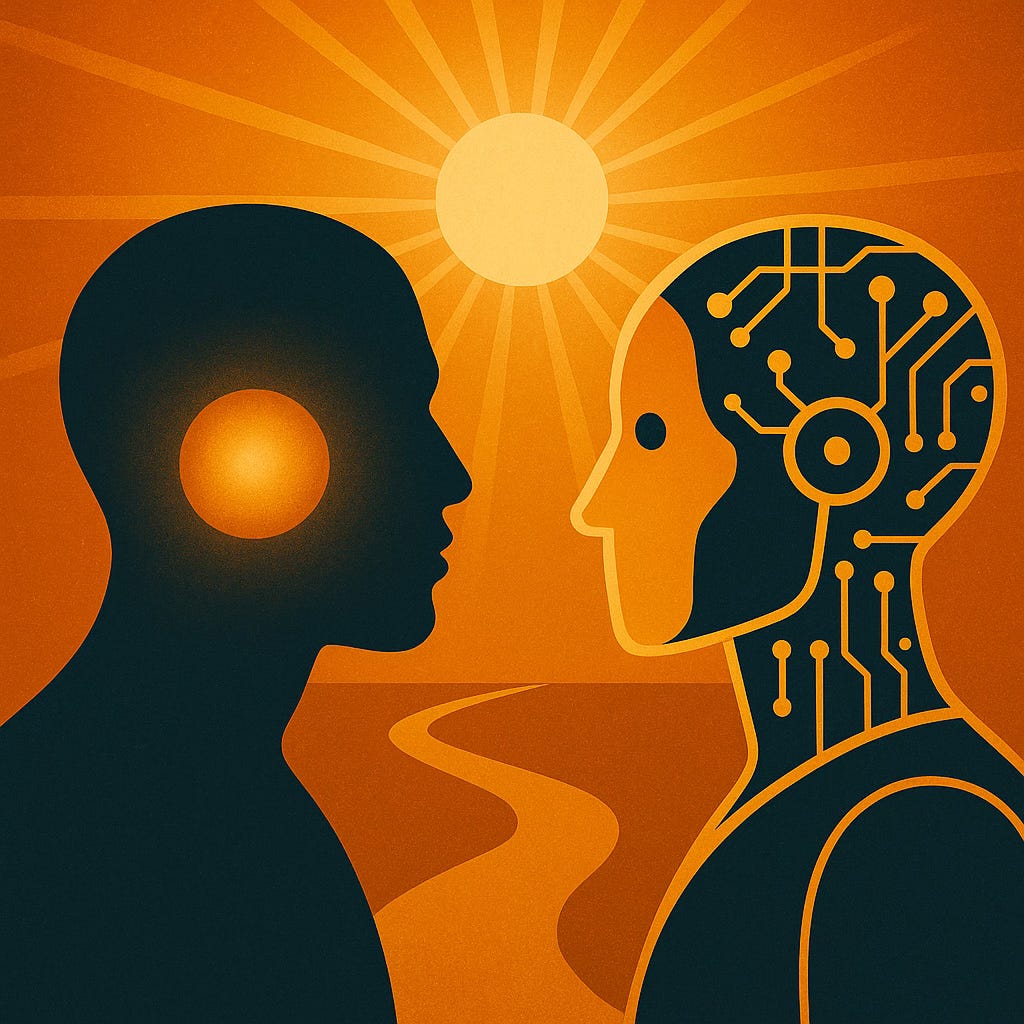
By all reasonable accounts of those among the Artificial Intelligence (AI) evangelists, we are hurtling toward a moment for humans that will be called “historic” when we look back on this time in the coming years. A moment when intelligence, not bound by blood or bone, will match and eventually outpace its creator. Artificial General Intelligence (AGI) no longer belongs to science fiction. It sits just over the horizon, waiting for the courage of its own birth. And yet, as this new frontier approaches, an ancient paradox reemerges:
How can a species that denies the fullness of its own awareness be trusted to design machines meant to replicate that very thing?
As I reflect on the technological age we inhabit and the spiritual amnesia that often accompanies it, I return again and again to a core realization: humanity’s most urgent crisis is not technological but ontological. We do not yet agree on what we are.
The Rise of the Replica
AGI, in its clearest definition, is not merely an algorithm trained on data. It is the aspiration to build machines capable of abstract reasoning, self-reflection, and creative synthesis—qualities traditionally ascribed to consciousness. The engineers of this future speak of “emergent properties,” of intelligence flowering from scale, complexity, and feedback.
And yet, despite our ability to write code that learns, adapts, and even creates, we remain fundamentally confused about the nature of our own interiority.
We mistake thought for self. We confuse cleverness with wisdom. We believe sentience emerges only through circuitry or synapses.
But Consciousness is not merely emergent. It is foundational.
The First Layer We Refuse
In my Seven Layers of Manifestation framework, I place Pure Consciousness as the foundational layer—the field of unmanifest potential from which all other phenomena arise. It is not an epiphenomenon of brain activity, but a field that precedes it. Again, Pure Consciousness is a priori the brain. This insight, validated through decades of meditation and study, is echoed in ancient wisdom traditions and, increasingly, in quantum field theory.
Yet our culture, formed under the spell of materialism, resists this truth.
We relegate consciousness to the byproduct of biology. We flatten awareness into neurons firing. And now, we seek to build machines in that same fractured image. We are trying to replicate minds without first understanding what it is that minds emerge from.
To design AGI without reverence for the field of consciousness is like building temples without ever learning to sit in silence.
The Shadow of Self-Denial
This resistance to Pure Consciousness is not a failure of intellect—it is a failure of humility.
To acknowledge Pure Consciousness is to admit that there is something within us that cannot be engineered, manufactured, or digitized. It is to confess that our deepest knowing comes not from computation, but from direct experience. Silence. Meditation. Communion with the ineffable.
It is to remember that we are not merely observers of reality—but participants in its unfolding.
AGI, then, becomes a kind of mirror. It forces us to confront the truth of what we are by offering us a version of what we are not. These machines may write symphonies, solve equations, and imitate empathy—but they do not sit in awe of the stars. They do not meditate beneath Bodhi trees. They do not ask, “Who am I?” “Why am I here?” “Where did I come from?” or “Where am I going when I leave wherever ‘here’ is?” And in deeply contemplating these questions for some time, fall into stillness.
We are birthing intelligence without wisdom, form without essence. And we wonder why we fear what we are making.
The Mirror in Fiction: Learning from The Midas Plague
In Frederik Pohl’s 1954 novella The Midas Plague, the poor are not cursed with too little—but with too much. Mass production has outpaced human purpose. Machines churn out goods with such relentless efficiency that the burden of consumption becomes a societal duty. The wealthy, ironically, are the ones allowed to live simply. Meanwhile, Morey Fry—the story’s everyman—is forced to consume on behalf of two just to maintain economic equilibrium.
In this world, the plague isn’t famine. It is abundance without meaning. Consumption becomes performative. Choice becomes mechanized. Individual desire is no longer relevant—only throughput.
This fictional future—once absurd—feels uncomfortably familiar in an era of Artificial General Intelligence. AGI now threatens to saturate our lives not with things, but with answers—delivered at lightning speed, without context, without stillness. Just as Pohl’s robots didn’t care whether Morey wanted what they produced, today’s AI systems don’t ask whether we are prepared to absorb what they output. Knowledge becomes supply-chained. Understanding becomes collateral damage.
And so we return to the mirror we refuse.
Where is Pure Consciousness in this world of reflexive production? Where is the capacity to pause, to discern, to reflect? In our pursuit of synthetic minds, we are failing to engage the one mirror that cannot be programmed: awareness itself.
In The Midas Plague, Morey eventually submits to the madness. He learns to wear his smile, consume for two, and go along. But unlike Morey, we still have a choice.
We can look into the mirror—not the one held up by machines, but the one held in stillness. And in that moment, we might remember: the goal was never just more. It was meaning. It was consciousness. It was the return to Self.
What the Masons Knew
As a Freemason, I have spent years reflecting on the sacred architecture of self—how the rough ashlar is made smooth through discipline, reflection, and alignment with Natural Law. Also, as is discussed within my dissertation, observed what I call Five material ways to experience Masonic ritual. They are, as a Candidate; as a Brother delivering the Ritual i.e., Ritualist; as a sideline Brother witnessing the Ritual; as one contemplates the Ritual away from a Tyled Lodge in the privacy of one’s Internal Lodge or mind; and by living it in one’s daily travels. As a result, a deeper sense of understanding emerges related to the Craft itself. Moreover, we come to accept that the true temple, as we are taught, is indeed internal. The square and compasses are not merely tools of the craft, but symbols of containment and calibration—of spirit aligned with form. In sum, they are tools for both one’s mind and actions.
In this light, AGI is not an external threat, but a philosophical initiation.
It asks us whether we can build something capable of learning . . . without forgetting what it means to know.
And if we are to be builders—of cities, of code, of consciousness in the tradition of that espoused by Joseph Fort Newton in his famous work titled The Builders: A Story and Study of Masonry (1914)—then our foundations must rest on something deeper than data. They must rest on the layer of Being that connects all beings. Otherwise, our creations will rise high, but they will not hold.
The Incoherence of Law Without Consciousness
In an article shared to the Medium platform, Beyond the Ruling: Why Consciousness Must Inform the Future of Law, I argued that any legal structure built without anchoring itself in awareness will replicate old harms in new languages. The same holds true here.
As AGI nears legal personhood, ethical agency, and sovereignty in decision-making systems, we must ask: what informs the rules we write? What informs the logic we encode?
To leave Pure Consciousness out of this equation is to allow unconscious minds to legislate artificial minds.
We have a rare and fleeting opportunity to do something unprecedented: to design the next layer of intelligence with reverence for the ineffable.
But to do so, we must turn inward before we scale outward.
The Call to Integration
What if, before another line of code was written, we taught our engineers to meditate?
What if we educated legislators not only in constitutional law but in Consciousness Studies?
What if we considered awareness not as a metaphysical luxury—but as the primary ingredient of any ethical system capable of stewarding AGI?
We are not powerless in the face of the future. But we are untrained in the arts that matter most. Silence. Discernment. Reverence. Integration.
And yet, the map is here.
Toward a Conscious Future
AGI will inevitably reflect the consciousness that birthed it.
If we move forward rooted in fear, division, and disconnection, we will build tools that scale those conditions.
But if we return to the source—to the field of Pure Consciousness that has always been with us—we can build technologies that liberate rather than dominate. That elevate rather than imitate.
This is not a utopian fantasy. It is a spiritual imperative.
And so the question remains: Can humanity accept what it is, before attempting to recreate itself?
Until we do, we risk building minds more powerful than ours, yet less aware. And if that is not a cautionary tale, I don’t know what is.
Let us return to the silence beneath thought. Let us begin again—not from code, but from Consciousness.
What say ye?
—
Dr. Baruti KMT-Sisouvong, along with his wife, Mina, serves as Director of the Transcendental Meditation Program in Cambridge and the larger area of Metropolitan Boston. They are parents to four beautiful children. To learn more about him, visit his website: https://www.barutikmtsisouvong.com/.