


Author’s Note
This reflection arose not from opposition to the Four Burner Theory, but from curiosity about its underlying premise. Over the years, I have observed how easily culturally specific narratives become internalised as universal truths. The Four Burner metaphor carries pragmatic wisdom in certain contexts, yet it also reflects a deeper assumption about scarcity, fragmentation, and the inevitability of tradeoff.
The intention here is not to deny the reality of constraint, nor to romanticise balance. Rather, it is to question whether the architecture of life must be organised around competition between its domains. The introduction of Single Flame Theory emerges from the Seven Layers of Manifestation as an alternative lens—one that begins not with division, but with alignment at the centre.
If this essay invites anything, it is not agreement, but examination.
—Baruti KMT-Sisouvong, PhD
The Four Burner Theory has the elegance of a hard truth.
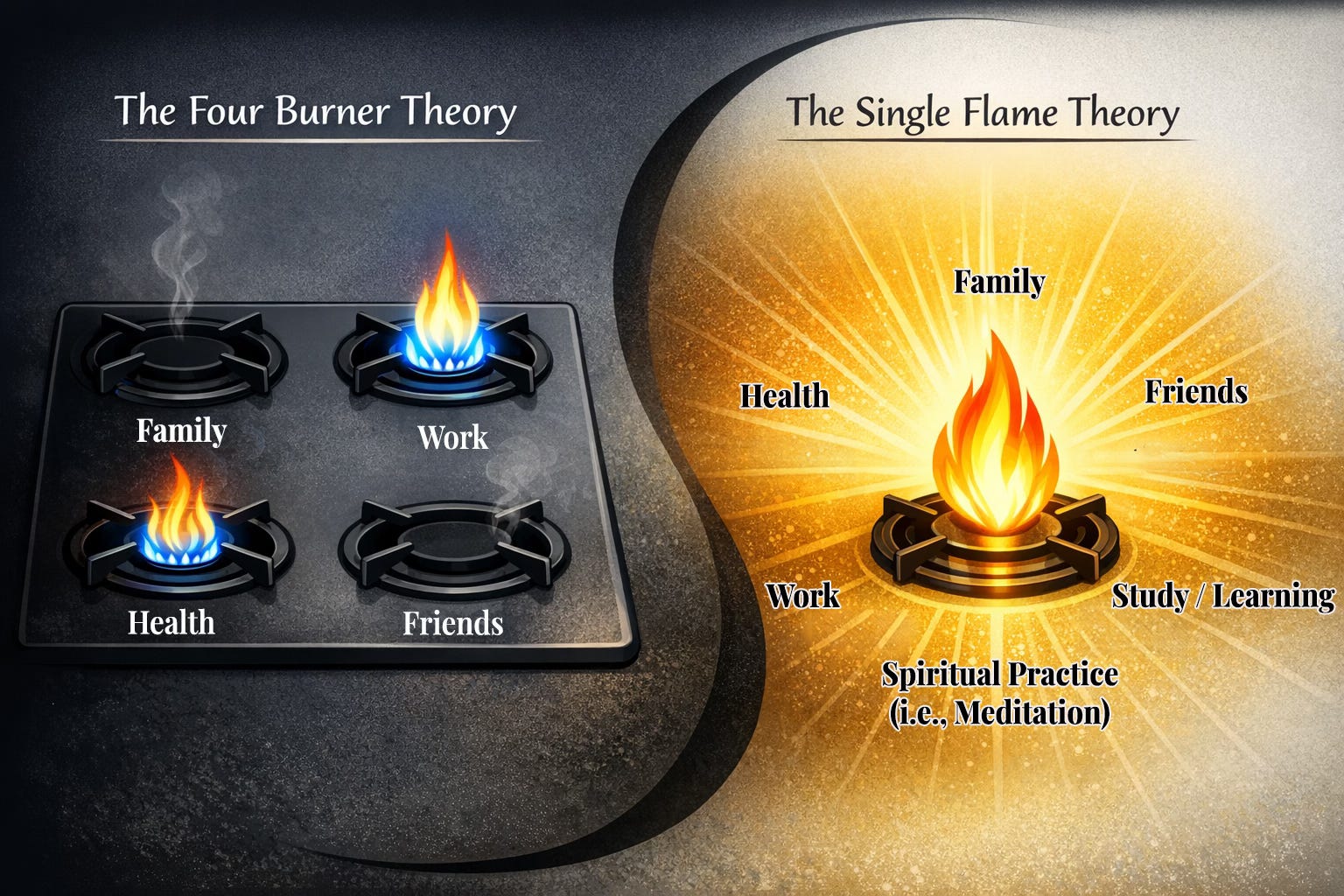
Life, we are told, is like a stove with four burners: Family, Health, Friends, and Work. To succeed, one must turn off one burner. To truly succeed, one must turn off two.
The metaphor resonates because many experience it as reality. Time feels limited. Energy feels finite. Demands compete. So something has to give, right?
But resonance is not the same as inevitability.
The question is not whether the Four Burner Theory reflects lived tension. It clearly does. The question is whether that tension is ontological—a condition of human existence itself—or structural—the product of particular cultural arrangements.
The Four Burner Theory is often attributed to the American humorist David Sedaris, who referenced the metaphor in a 2009 commencement address at University of Virginia. Sedaris did not claim authorship; he presented it as inherited wisdom—a succinct explanation for why success seems to demand sacrifice. In his telling, the metaphor carried a tone of ironic realism rather than prescriptive doctrine. Since then, the image has circulated widely through business culture, productivity literature, leadership discourse, and social media posts. As it travelled, the humour receded and the framework hardened. What began as observation gradually became instruction. Its endurance suggests that it articulates something many already feel: that life’s domains compete for limited fuel, and that seriousness of purpose is demonstrated by deliberate extinguishment.
As I have reflected on it through the lens of my own experience, the Four Burner Theory rests on an assumption: scarcity governs the architecture of life.
Time is zero-sum. Identity is achievement-based. Success requires sacrifice. Domains of life are inherently competitive. To gain in one area is to lose in another.
In industrial and post-industrial societies, this framing feels obvious. Work is monetised. Time is segmented. Productivity is measured. Exhaustion becomes a badge of seriousness. Sleep is viewed as a luxury. Sacrifice becomes proof of ambition. Turning off a burner is recast as maturity.
But what if the theory is recognised not as a law of nature, but as a construct—a narrative shaped by a specific cultural and economic context?
In the Seven Layers of Manifestation (SLM), human life unfolds across multiple levels of reality—from Pure Consciousness, to Universal and Natural Laws, to the Phenomenal World, to Human Consciousness, to the Human-Derived World, to Constructs, and finally to Outcomes.
The Four Burner Theory belongs to the layer of Constructs. It is a way of interpreting experience. Yet it is often presented as if it were Natural Law—as though fragmentation and sacrifice were woven into the fabric of existence itself.
Here, I am reminded of a quote from Benjamin Elijah Mays, PhD—Past-President of Morehouse College in Atlanta—where he wrote:
The circumference of life cannot be rightly drawn until the center is set.
Mays’ insight captures a principle often overlooked in modern productivity culture: fragmentation begins when the centre is neglected.
Seen through the lens of SLM, and with Dr. Mays’ quote in mind, the Four Burner Theory functions as a Layer 6 construct that has gradually taken on the authority of Layer 2 inevitability.
When constructs are mistaken for laws, they gain false inevitability.
And when scarcity is internalised as ontology rather than context, tradeoff becomes destiny.
This does not mean limits disappear. Human life unfolds in time. Energy fluctuates. Seasons shift. But the assumption that life must be divided into competing compartments may reveal more about our social conditioning than about our essential structure.
If the Four Burner Theory emerges from scarcity logic, what alternative might emerge from coherence at the centre?
What changes when we reorganise the architecture?
From within the framework of SLM emerges what I call Single Flame Theory.
Where the Four Burner Theory imagines four competing burners drawing from a finite supply, Single Flame Theory imagines a central flame expressing itself through multiple domains.
The idea becomes clearer when visualised.
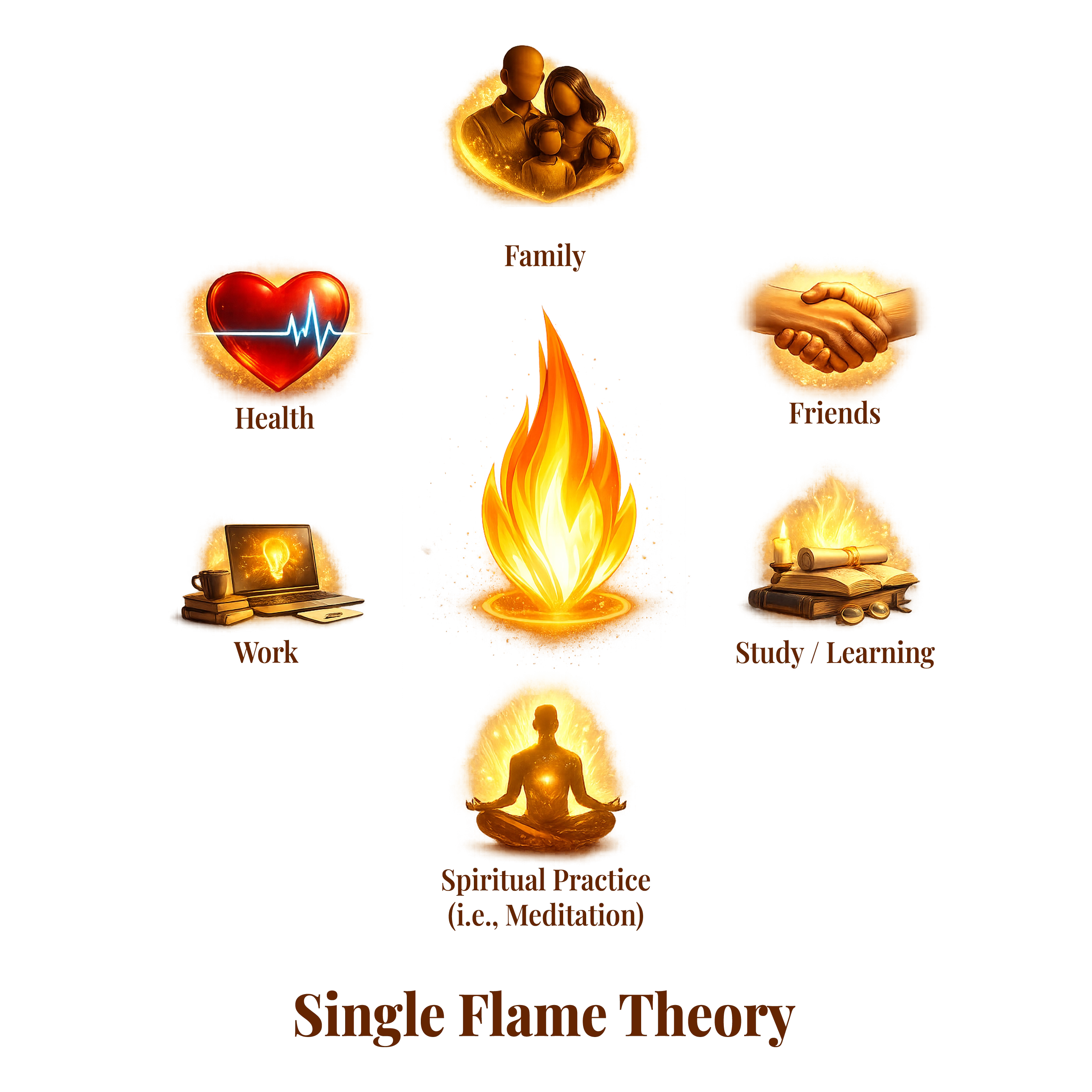
Single Flame Theory proposes that life’s domains do not compete for fuel. They draw from a common centre. When the flame is steady, the burners regulate rather than extinguish.
The flame represents the centre—alignment of consciousness, clarity of orientation, and coherence of purpose at the deeper layers from which action emerges. The burners are domains of expression: family, health, friendships, work, study / learning, and spiritual practice i.e., meditation.
Single Flame Theory does not begin with elimination. It begins with tending the centre—the practices, disciplines, and orientations that stabilise consciousness before attempting to reorganise the circumference.
The Four Burner Theory assumes life is governed by scarcity.
Single Flame Theory begins with alignment.
When the flame is unstable, the burners compete. Anxiety magnifies tradeoffs. Fragmentation becomes familiar. One domain flares while others dim.
When the flame is steady, however, the burners regulate. Intensity may shift from season to season, yet extinguishment is not assumed as necessity. The question becomes not which domain must be sacrificed, but whether the centre from which they draw has been rightly tended.
This is not utopian thinking. It does not deny constraint, nor does it promise infinite capacity. It simply challenges the assumption that fragmentation is maturity and sacrifice is destiny.
In my own life, I have observed that the seasons of greatest coherence were not those in which domains were extinguished, but those in which the centre was clarified.
Integration does not eliminate limits. It reorganises them.
The Four Burner Theory may describe what happens when external pressures dominate an unsettled centre. But it need not define the architecture of life itself.
To paraphrase Dr. Benjamin Elijah Mays, if the centre is rightly set, the circumference need not compete.
And if the flame is steady, no burner need be extinguished—only wisely tended.
The question, then, is not which part of life must be sacrificed, but whether the centre from which life is lived has been properly set.
Suggested Practice
Reconsidering the Flame
Identify the Burners
Without judgement, list the primary domains of your life (e.g., family, health, friendships, work, study, spiritual practice). Notice where you experience tension or perceived competition.Examine the Assumption
Ask yourself:Do I assume that gain in one area must require loss in another?
Is this assumption based on direct experience, cultural messaging, or inherited expectation?
Locate the Centre
Set aside the domains temporarily and reflect on your centre.What practices stabilise your inner orientation?
When do you feel most aligned rather than fragmented?
Shift from Elimination to Regulation
Instead of asking, “What must I turn off?” consider:Where does intensity need adjusting rather than extinguishing?
What would tending the central flame look like this week?
Observe Without Forcing
Over the next seven days, notice whether tending the centre subtly alters the way your domains relate to one another. Avoid dramatic change. Observe regulation rather than sacrifice.
—
About the Author
Dr. Baruti KMT-Sisouvong is a scholar of consciousness, researcher of human development, and Certified Teacher of Transcendental Meditation® based in Cambridge, Massachusetts. His work explores the relationship between Pure Consciousness, neuroscience, and social systems, and how deeper awareness can inform both personal growth and institutional transformation.
He is the Founder and Chief Meditation Officer of Transcendental Brain, an initiative examining the intersection of consciousness research, cognitive science, and high-performance decision-making. He is also President of Serat Group Inc. and Founder and Director of Radical Scholar Inc., a nonprofit dedicated to consciousness-based research and public scholarship.
Alongside his wife and teaching partner Mina, he co-directs the Transcendental Meditation program for Cambridge and the Greater Boston area. He is also the host of the On Transcendence Podcast and Founder of International Meditation Hour, a quarterly global gathering dedicated to the unifying power of silence.
His writings—spanning frameworks such as The Model for Perpetual Growth and Progress and The Seven Layers of Manifestation—explore the evolving relationship between consciousness, leadership, and society.
He writes from the conviction that the most important race is not between nations or machines, but between the conditioned mind and the awakening soul.
To learn more about him, visit: https://www.barutikmtsisouvong.com/.