


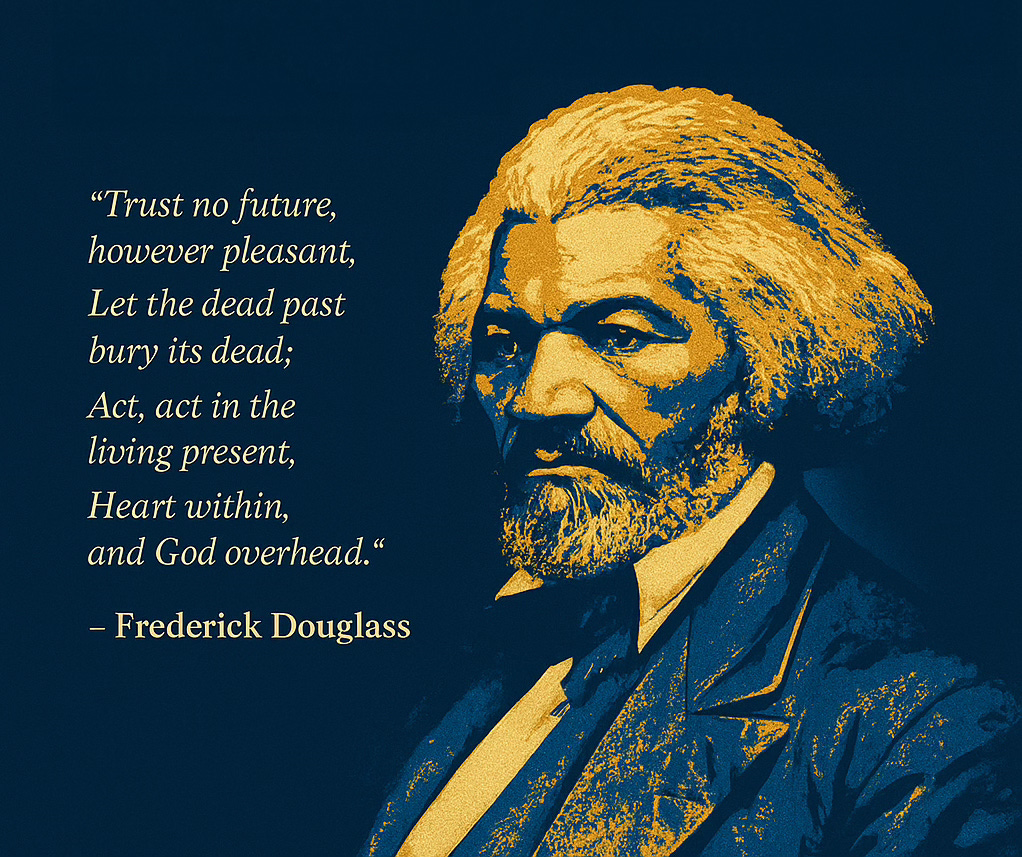
Yesterday, for the Fourth of July, I had the pleasure of participating in a public reading of Frederick Douglass’ famous speech What to the Slave Is the Fourth of July? as part of an effort by several scholars from across the country. To say it was a deeply contemplative experience would be putting it mildly. As a result, I thought to share a few of my reflections on this exceedingly relevant speech for our current historical moment in relation to my Seven Layers of Manifestation framework for your consideration.
Frederick Douglass’ words in the section titled “The Present” of his famed oration are often overlooked in favor of the fiery condemnations that follow. But for those of us who work at the intersection of consciousness and social structure, Douglass' reflections on time, legacy, and integrity serve as a meaningful meditation on the layers related to human manifestation. His words are a spiritual summons—not just a historical reckoning.
In my framework, the Seven Layers of Manifestation, we examine the nested fields through which reality takes form—from the unmanifest field of Pure Consciousness to the outcomes i.e. material expressions of collective human constructs. Douglass, knowingly or not, traced these layers in reverse. He began with the ethical vacuums of his day and peeled them back to reveal not just hypocrisy—but a systemic disconnection from the fundamental reality of Being.
What Douglass exposed is not unique to the 19th century. It is timeless. In every age, societies erect monuments and mythologies while ignoring the living pulse of the present moment—the ever-living now. They praise the forebears but forget the faith and force that made their forebears worthy of memory. Douglass understood this lapse as not just political failure, but a metaphysical one.
And so must we.
Layer One: Pure Consciousness and the Sacred Now
In my framework, the deepest layer is Pure Consciousness—the field of unbounded intelligence from which all things emerge. Douglass opens the section of his address titled The Present by pointing us to now as the only acceptable time in God’s eyes. This is not merely rhetorical; it is metaphysical. The present is the only place we encounter Being directly. It is the only time field in which transformation can occur.
“Act, act in the living present, Heart within, and God overhead.”
When we bypass this layer—when societies ignore the immediacy of the now and retreat into nostalgic idealization of the past or prognosticate too far into the future—they lose their spiritual anchor which is designed to moor them in the present. In so doing, they confuse heritage with holiness, memorialization with meaning. The invocation of founding fathers becomes a chant devoid of conscious action.
Layer Two: Universal and Natural Laws
Emerging from Pure Consciousness are Universal and Natural Laws—the organizing principles of life, evolution, and balance. Douglass’ challenge is not merely political. It is ontological. He is asking whether the Declaration of Independence, which claims to reflect natural rights and self-evident truths, actually aligns with the deeper natural law that governs existence.
“Are the great principles of political freedom and of natural justice... extended to us?”
The hypocrisy he identifies is not just moral—it is structural. America had declared itself a land of liberty while actively constructing systems to deny that liberty to millions—in particular those of African ancestry. This dissonance is not just an ethical failing. It is a violation of Natural Law itself.
When human-made structures conflict with Natural Law, they cannot endure. Their foundations are brittle. Their rituals become hollow. Their flags wave in the wind of self-deception. The problem isn’t simply legal—it’s cosmic.
Layer Three: The Phenomenal World
Next is the Phenomenal World, the material reality we encounter through the senses—land, labor, flesh, monuments, chains. In short, the world not made by human hands but the world into which humans are born and with which we are to collaborate for our continuance. Douglass names it with piercing clarity: Washington’s monument, “built up by the price of human blood,” stands as an emblem of collective dissonance. The material world, in this instance, contradicts the moral and spiritual world.
“Alas! That it should be so; yet so it is.”
This is a caution to our age as well. Technology, architecture, and progress cannot be mistaken for wisdom. The built environment must reflect inner coherence or it becomes a mirror of our fractures.
Layer Four: Human Consciousness
In the fourth layer, we reach Human Consciousness—our capacity for awareness, choice, and transformation. This layer if the fulcrum of the framework. Douglass stands here most fiercely. He does not just critique institutions; he challenges individuals to wake up.
“You live and must die, and you must do your work.”
This call is timeless. Each generation must evince consciousness through right action. We cannot inherit morality. We must embody it. The consciousness that built pyramids of justice in one era cannot be assumed—it must be cultivated anew among successive generations and must be facilitated consciously.
The highest spiritual teachings remind us that each human is a field of infinite potential. But when society trains us to suppress this awareness, to perform roles rather than awaken truths, we fall into forgetfulness. The present becomes a performance rather than a portal.
Layer Five: The Human-Derived World
The fifth layer is the Human-Derived World—the mental architectures we’ve constructed: economic systems, legal frameworks, ideologies. Douglass unmasks these constructs as often being fueled not by higher principles, but by the desire to conceal contradiction.
“Men seldom eulogize the wisdom and virtues of their fathers, but to excuse some folly or wickedness of their own.”
This insight is devastating. It reminds us that the human mind is capable of genius and deception. That systems can be designed to uphold dignity or deny it. And that many of the structures we take for granted today—borders, courts, currencies—are not immutable laws of nature but mental projections.
If they were designed once, they can be redesigned now. But only if we operate from deeper layers of awareness.
Layer Six: Collective Constructs
The sixth layer concerns Collective Constructs—those stories and systems sustained by shared belief. Douglass exposes the national myth of moral exceptionalism, not to destroy hope, but to purify it. He knew the danger of collective delusion: how an entire people could venerate freedom while legislating bondage.
This layer is the arena of public education, media, social norms—those invisible currents that either lift the soul or lull it to sleep. Today, we must ask: What constructs do we still cling to? What myths have calcified into obstacles to unity? What tombs are we still building while ignoring the living prophets among us?
Layer Seven: Outcomes i.e. Manifest Reality
Finally, the seventh layer: Outcomes i.e. Manifest Reality. The outer world reflects the inner. And when the deeper layers are ignored, this world becomes chaotic, inequitable, violent.
The systems we see failing today—whether ecological, economic, or political—are not the result of bad luck. They are the inevitable outcomes of misalignment. Of attempting to build without foundation. Of acting without awakening.
Douglass reminds us that the present must be infused with moral and metaphysical integrity. That the structures of the world must grow from conscious being, not unconscious inheritance.
Toward a Conscious Future
If we accept the reality that we are beings within a conscious universe, governed by laws we did not create, then our work is not just to change the world. It is to attune it.
We must build structures that serve life, not just profit. Laws that honor dignity, not just power. Economies that reflect balance, not just accumulation. And cultures that recognize spirit before status.
Douglass’ speech was not a lamentation. It was a map. A summons to reclaim the present as sacred. The Seven Layers of Manifestation offer a similar call: to return to consciousness as source. To build outward, from the innermost reality of who and what we are.
And what are we?
Not merely citizens.
Not merely consumers.
But expressions of a living cosmos, encoded with intelligence, wired for justice, and born to co-create.
“We have to do with the past only as we can make it useful to the present and to the future.”
So let us listen again—not only to Douglass, but to the layers within.
The work is now.
The field is Consciousness.
The call is ours.
Let’s get to work!
—
Dr. Baruti KMT-Sisouvong, along with his wife, Mina, serves as Director of the Transcendental Meditation Program in Cambridge and the larger area of Metropolitan Boston. They are parents to four beautiful children. To learn more about him, visit his website: https://www.barutikmtsisouvong.com/.