


Author’s Note
Some essays begin with a question. Others begin with an observation. This one began with a song.
During a morning asana practice, a handful of lyrics from Alicia Keys’ “Authors of Forever” settled into my awareness and remained there long after the session had ended. In particular, the line, “We’re here to make meaning of what happens in between,” prompted me to reflect not only on the meanings we assign to our experiences, but on the source from which those meanings arise.
As with much of my recent writing, this essay explores the relationship between consciousness, interpretation, and human flourishing. As always, my hope is not to provide definitive answers, but to invite a different line of inquiry—one that asks not only what meaning we are making, but from what level of awareness that meaning is being created.
After all, the stories we tell ourselves about life often shape the lives we ultimately live.
—Baruti KMT-Sisouvong
A few weeks ago, during my daily early-morning asana practice, a song began playing through the speakers.
I had heard it before, though perhaps not attentively. Like many songs that accompany movement, it initially occupied the background rather than the foreground of my awareness. Yet on this particular morning, a handful of lyrics pierced through the rhythm of the practice and settled firmly into my thoughts.
The song was Authors of Forever by Alicia Keys.
The lines that lingered were simple:
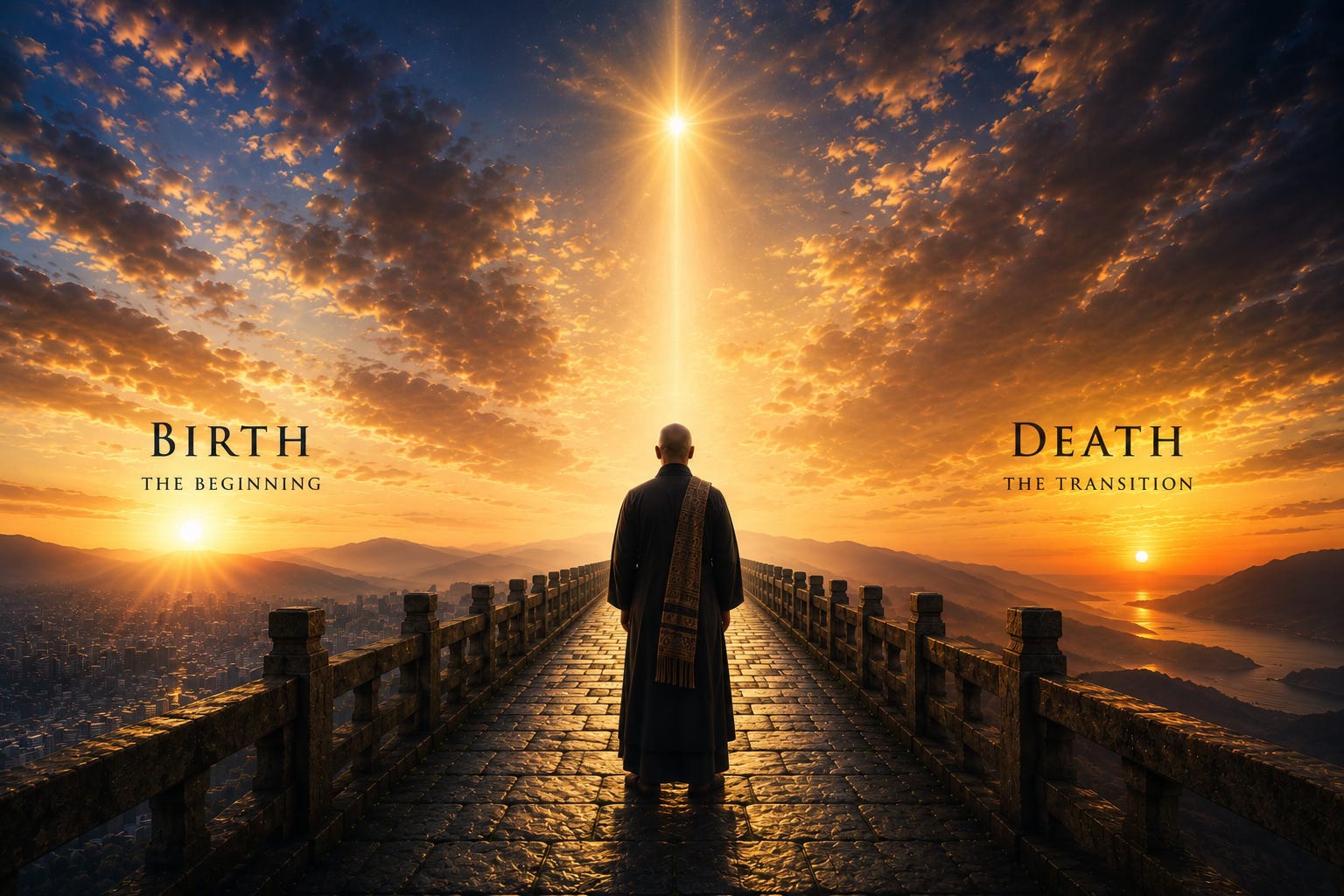
We are born on our own.
And we die on our own.
And we’re here to make meaning
Of what happens in between.
For reasons I could not immediately explain, the words remained with me long after the practice had ended.
Not because they were particularly complex. Quite the opposite.
They expressed, in a remarkably concise way, one of the central questions of human existence:
What are we doing here between birth and death?
As I reflected on the lyrics after the session, it became clear most of us spend our lives focused upon the events themselves. Concerns such as careers, relationships, accomplishments, disappointments, losses, victories, identities, obligations, material possessions, and all manner of social aspirations. Moving as it is from one circumstance to another. Often believing that the circumstances themselves are the primary story. Yet the lyric suggests something different.
Life happens. Meaning is made.
The distinction is admittedly subtle, yet insightful.
The same event can produce entirely different meanings depending upon the individual experiencing it.
One person encounters hardship and becomes bitter, success and becomes arrogant, or sees uncertainty and feels fear. Yet another encounters a like hardship and becomes compassionate, experiences success and becomes grateful, or sees the same uncertainty and perceives possibility.
The events remain the same. However, the meaning for the latter person changes. The question, then, is why.
Why do human beings derive such radically different interpretations from similar experiences?
Increasingly, I have come to believe the answer lies in orientation.
Not political or ideological orientation. But existential orientation—the place from which we are viewing reality itself.
Over the last three years, I have explored a framework I developed that has come to be known as the Seven Layers of Manifestation.
At its deepest level rests Pure Consciousness—the silent field of awareness from which all manner of phenomena emerge. For example, from there arise Universal and Natural Laws, followed by the Phenomenal World, Human Consciousness, the Human-Derived World, Constructs, and finally Outcomes.
Most people encounter life beginning at the level of constructs and outcomes and rarely question the assumptions they inherit. In many respects, we are born into the middle of a sentence already being spoken. We inherit ideas regarding race, class, religion, nationality, success, failure, intelligence, morality, gender, politics, and countless other categories. As a result, these constructs become lenses through which experience is interpreted.
Eventually those interpretations become reality.
Not because the constructs themselves are reality itself, but because they shape the meanings assigned to experience.
The consequence is that two individuals can inhabit the same world while living within entirely different realities.
One sees opportunity, abundance, and cooperation. Whereas another will conversely note oppression, scarcity, and threat respectively.
Neither is merely responding to the world. Each is responding to a particular orientation toward the world.
This distinction becomes increasingly important when discussing social change.
Much of contemporary discourse focuses upon changing outcomes. Others focus upon changing constructs. Still others seek to redesign institutions within the Human-Derived World.
All such efforts have value. Yet they often overlook a more fundamental question:
What level of consciousness is producing the interpretation in the first place?
The same reform viewed through fear produces one outcome; yet through wisdom a very different outcome is produced.
Should one view events or life circumstances through resentment, such becomes evidence of injustice. However, were one inclined instead to view such experiences via the lens of compassion, curiosity, and awareness, one’s orientation becomes one of healing, lessons learned, and thereby participates in a larger unfolding.
In my experience, the event does not determine the meaning. Rather, it is orientation that determines the meaning. And orientation itself emerges from consciousness.
This is why I increasingly suspect that many of humanity’s challenges are not merely problems of policy, economics, education, or technology. They are orientation problems.
We have become extraordinarily skilled at debating the contents of experience while neglecting the level of awareness through which experience is interpreted. As a result the lyric from Alicia Keys points directly toward this overlooked territory. In short, we are here to make meaning of what happens in between.
The question then is not whether we make meaning. We all do.
The real question is from where we are making it. Are we constructing meaning from fear, scarcity, separation, inherited constructs, or noise? Or are we seeking understanding, abundance, unity, direct experience, or stillness?
As I reflect on a quote I have cited and shared in print more times than I care to count, I believe the answer matters because meaning becomes action. The quote comes from Benjamin Elijah Mays, the great past-president of Morehouse College in Atlanta, and reads:
The circumference of life cannot be rightly drawn, until the center is set.
He did not say it could not be drawn—only that it could not be rightly drawn.
That single word, rightly, when applied in the context of the song, carries tremendous significance as it appears we have choices throughout our sojourn through this thing called life. And that as we continue to move along the path toward greater fulfillment, the best decisions we make will come from a center of calm and clarity to the benefit of not only ourselves but all with whom we come into contact. Because, as I have learned along the way, our actions, or lack thereof, becomes habit. Habit becomes character. Character becomes destiny.
Every life becomes, in part, the story generated by the meanings assigned to experience.
Perhaps this is why the song’s refrain feels so comforting.
It’s alright.
Not because suffering is unreal, injustice does not exist, nor that life unfolds exactly as we wish. But because existence itself contains opposites.
Light and shadow. Gain and loss. Beginning and ending. Love and sorrow.
The challenge, then is not eliminating one side of the equation; but rather is in learning to orient ourselves wisely within it.
Birth and our transition to the realm beyond are givens; yet the space between—the proverbial hyphen—remains open. And within that space each of us becomes an author.
Not merely of our stories. But of the meanings through which those stories are lived.
The question then is not whether we will make meaning; but at what level of awareness will we be doing the writing.
For me, delving within to the root of all allows me to not only transcend all but to serve all.
Will you meet me there?
Suggested Practice: Examining the Meaning-Maker
Set aside ten to fifteen minutes in a quiet place and reflect upon a significant event from your life—one that continues to influence how you see yourself or the world around you.
As you reflect, consider the following questions:
· What meaning have I assigned to this experience?
· How has that meaning influenced my actions, habits, relationships, or decisions?
· Is the meaning I assigned the only possible interpretation?
· What assumptions, beliefs, or inherited constructs may have shaped my understanding of the event?
· If I were to approach this experience from a place of greater stillness, compassion, curiosity, or awareness, how might its meaning change?
When finished, spend a few moments in silence.
Rather than focusing on the event itself, turn your attention toward the one interpreting the event.
In doing so, you may discover that transformation does not always begin by changing what happened.
Sometimes it begins by examining the consciousness from which meaning is being made.
—
About the Author
Dr. Baruti KMT-Sisouvong is a scholar of consciousness, researcher of human development, and Certified Teacher of Transcendental Meditation® based in Cambridge, Massachusetts. His work explores the relationship between Pure Consciousness, neuroscience, and social systems, and how deeper awareness can inform both personal growth and institutional transformation.
He is the Founder and Chief Meditation Officer of Transcendental Brain, an initiative examining the intersection of consciousness research, cognitive science, and high-performance decision-making. He is also President of Serat Group Inc. and Founder and Director of Radical Scholar Inc., a nonprofit dedicated to consciousness-based research and public scholarship.
Alongside his wife and teaching partner Mina, he co-directs the Transcendental Meditation program for Cambridge and the Greater Boston area. He is also the host of the On Transcendence Podcast and Founder of International Meditation Hour, a quarterly global gathering dedicated to the unifying power of silence.
His writings—spanning frameworks such as The Model for Perpetual Growth and Progress and The Seven Layers of Manifestation—explore the evolving relationship between consciousness, leadership, and society.
He writes from the conviction that the most important race is not between nations or machines, but between the conditioned mind and the awakening soul.
To learn more about him, visit: https://barutikmtsisouvong.com/.