


Author’s Note
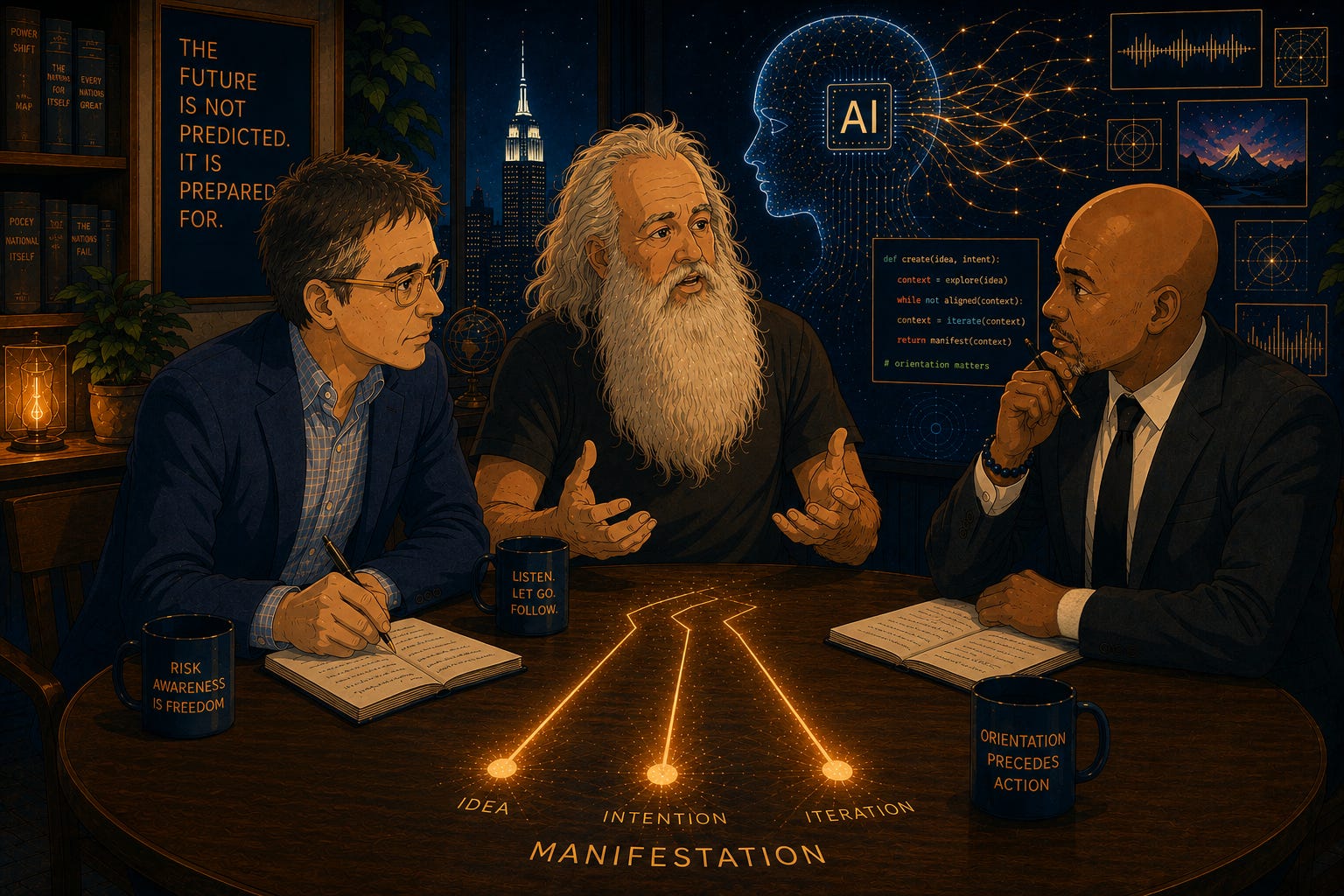
The Three Chord Revolution emerged from my encountering two seemingly different conversations about artificial intelligence within a relatively short period of time. In one, political scientist Ian Bremmer considered the systemic consequences of increasingly powerful capabilities becoming available to ordinary individuals. In the other, music producer Rick Rubin approached much the same phenomenon through the lens of creativity, comparing artificial intelligence to the spirit of punk rock: the lowering of technical barriers that once separated those with ideas from those possessing the means to manifest them.
Their observations resonated with me because, for roughly the past year, I have been conducting my own informal experiment with artificial intelligence—not as a substitute for thought, but as a collaborator in its development. Ideas that once might have remained notes, sketches, or possibilities have increasingly been subjected to dialogue, interrogation, refinement, visualisation, and eventual manifestation.
That experience has left me less interested in the question of whether AI can replicate particular human tasks than in a deeper question: What becomes possible when the distance between imagination and manifestation dramatically contracts?
The answer will depend, I suspect, less upon the capability of our machines than upon the orientation of the human beings using them.
The three chords were never the music. They merely made it possible for more people to begin playing.
—Baruti KMT-Sisouvong, PhD
There was a time when wanting to make something and being able to make it were separated by a considerable distance.
An aspiring musician might hear an entire composition internally yet lack the years of training necessary to reproduce it on an instrument. Someone with an idea for a piece of software might understand precisely what it should accomplish while possessing none of the programming knowledge required to build it. A scholar might see connections among ideas that seemed obvious once articulated, yet still require researchers, designers, editors, publishers, programmers, videographers, or considerable capital to carry those ideas into the world.
For much of human history, imagination has been abundant yet the means of manifestation have not.
This is one reason a recent observation by the legendary music producer Rick Rubin stayed with me. In discussing artificial intelligence and what has come to be called “vibe coding,” Rubin compared the present moment to the emergence of punk rock. Before punk, he observed elsewhere in discussing the same idea, a musician might spend years studying before possessing sufficient technical proficiency to participate seriously in music. Punk disrupted that assumption. A person could learn three chords, have something to say, find a few others willing to make some noise, and suddenly there was a band. The technical threshold to music creation had fallen dramatically. What mattered was no longer merely whether one possessed mastery of the instrument. It mattered whether one had an idea, a point of view, and the willingness to act upon it.
Rubin sees something comparable happening now with artificial intelligence.
In his conversation with Ryan Holiday on The Daily Stoic, the discussion turns to vibe coding, an approach in which someone describes to an artificial intelligence system what they would like software to do rather than personally writing every line of code. The system responds with something. Perhaps it is wrong. Maybe it is merely adequate. Or it produces something unexpectedly interesting. The human then responds to what has appeared, modifies the direction, and tries again. What once required thousands of carefully constructed lines of computer language can, at least in some circumstances, begin with a few sentences describing an intention.
What interested me most was not the coding. It was the change in the location of human contribution.
Holiday points out that traditional programming requires something resembling the combined capacities of an architect, engineer, and contractor. Vibe coding introduces a different collection of abilities. One must be able to describe what one wants, employ analogy and metaphor, recognise direction, remain open to an unexpected result, and respond intelligently to what comes back. Rubin immediately recognises the resemblance to his own work in the recording studio. Artists may enter with an idea for a song, but through experimentation the work changes. The tempo shifts. The arrangement changes. Instruments are added or removed. The chorus might become the introduction. Something that began with one intention gradually reveals possibilities no one could have specified at the beginning.
That description felt familiar to me.
For roughly the last year, I have been working with artificial intelligence with increasing regularity. What began as the use of a new technological tool has gradually become something more difficult to categorise. I have used it while developing essays, presentations, websites, research ideas, visual concepts, public talks, institutional proposals, book manuscripts, and frameworks that began as little more than observations scribbled mentally at inconvenient moments. Sometimes the work begins with a fairly developed proposition. At other times it begins with five words familiar to anyone who has worked with me long enough: “I just had a thought.”
What follows thereafter is rarely simple production.
An idea enters the conversation. It is turned around. Its assumptions are examined. Connections appear. Language is attempted and discarded. A phrase exposes a distinction I had sensed but had not yet articulated. An objection from my side or that of my AI Chatbot forces refinement. Something produced in response to my original idea suggests an entirely different direction. I reject some of it, keep some of it, modify other portions, and occasionally encounter something I recognise immediately even though I had not consciously known I was looking for it. Eventually, what began as a thought becomes something that exists.
An essay idea and accompanying text is presented, pored over, refined, and eventually published. A framework in its nascent stage is discussed, debated, reworked, and later receives a name. A website idea is shared, colour palette debated, architecture developed, design aesthetic put forth, the coding commences, newer design concepts incorporated and fonts downloaded, and a draft website begins to emerge. A presentation topic is proposed, refined, images added from a personal archive, some are created in Photoshop, others generated with my Chatbot’s assistance, and an even better website produced. An idea for an image is suggested and the resultant visual representation makes an abstract idea visible. And via lengthy, sometimes weeks long exchanges, new connections between previously separate pieces of work becomes obvious.
The above are but a few examples where the distance between cognition and manifestation has become increasingly shorter.
That experience has made it difficult for me to accept descriptions of artificial intelligence that reduce the question to whether machines will replace human beings at particular tasks. That question is certainly important. Yet it is also incomplete.
A more interesting question may be what happens when millions, and eventually billions, of people acquire access to capabilities that previously required considerable technical training, institutional resources, or financial capital.
Political scientist Ian Bremmer approaches precisely this possibility from a very different direction.
In an April 2026 interview with Steven Bartlett for The Diary of a CEO podcast, Bremmer identified artificial intelligence as one of the most underappreciated systemic risks facing the world. His concern extends considerably beyond employment. Increasingly powerful AI capabilities, he observes, are becoming accessible to anyone possessing something as ordinary as a laptop or mobile phone. The same democratisation of capability that allows an individual to build software without having spent years learning to code can place capabilities once reserved for sophisticated organisations into the hands of actors whose intentions may be less constructive.
Bremmer therefore looks upon the collapsing capability barrier and sees danger.
Rubin, in contrast, looks upon the same collapsing barrier and sees liberation.
They are both right.
The power to create and the power to disrupt are not separate technological developments. They are different expressions of the same one.
The printing press made it easier to distribute wisdom and propaganda. Photography could preserve human memory and manufacture deception. Radio could carry music into homes and demagoguery across nations. The Internet gave ordinary people access to more knowledge than the greatest libraries of previous centuries while simultaneously giving misinformation a distribution system of unprecedented scale.
Technologies amplify. They do not determine what deserves amplification.
Bremmer himself acknowledges the extraordinary possibilities. In his conversation with Bartlett he describes artificial intelligence being used to improve productivity, reduce waste, optimise fuel consumption, and assist agricultural decisions. His ultimate concern is not that technology possesses some independent desire to harm humanity. Rather, he worries that political and economic systems may deploy these technologies in ways that concentrate their benefits among relatively few people while imposing their disruptions upon everyone else.
That distinction deserves more attention.
We often ask what artificial intelligence will do to us. Perhaps we should spend more time asking what we will do with artificial intelligence. For me, the difference is one of orientation.
For years, much of my own work has revolved around a deceptively simple proposition: outcomes do not begin with outcomes. They emerge from layers beneath what eventually becomes visible. Orientation precedes technique. Consciousness precedes action. The tools we employ matter, but the hand guiding the tool matters more, and the orientation of the consciousness guiding the hand matters more still.
Artificial intelligence does nothing to make this principle obsolete. As I have shared previously, it magnifies it.
When the technical cost of producing something is high, the difficulty of production itself functions as a gatekeeper. Writing a book requires enough persistence that many books are never written. Making a film requires enough money, equipment, and coordinated labour that many films remain imaginary. Developing software requires enough technical expertise that countless potentially useful applications never move beyond someone saying, “Wouldn’t it be useful if…?”
Those barriers can be frustrating. They can also filter. However, when the barriers fall, something else must do the filtering. This is why Rubin’s ideas about taste become so important.
Elsewhere in his conversation with Holiday, Rubin posits that an artist’s contribution lies substantially in possessing and cultivating an individual perspective. If all one does is reproduce what everyone else already finds fashionable or acceptable, there is little reason for one’s work to exist. The contribution is the perspective itself, shaped by a particular life, set of experiences, sensitivities, curiosities, memories, and judgements.
Artificial intelligence does not erase that distinction. It, instead, may make it more important.
Holiday offers an amusing example while discussing predictive text. When typing well-known passages by Hemingway, he notices that the AI prediction rarely selects the word Hemingway actually chose. Rubin’s response is illuminating: perhaps that tells us something about why Hemingway was Hemingway. The unusual choice, the departure from what was statistically expected, may be precisely where the artistry resided.
The machine can identify the probable. Human beings remain capable of choosing the improbable because it feels right.
That does not make every improbable choice genius. Most are probably terrible. But therein lies the role of discernment.
As artificial intelligence makes capability increasingly abundant, judgement may become increasingly valuable.
This changes the meaning of expertise rather than eliminating it.
The classically trained musician is not rendered irrelevant because someone else can learn three punk-rock chords in an afternoon. The trained musician simply no longer possesses an exclusive claim to musical participation. A programmer who understands architecture, logic, security, and computation will be able to interrogate AI-generated software in ways unavailable to someone who knows nothing about those subjects. A historian who understands evidence and historiography will recognise when an elegantly written AI response rests upon an indefensible claim. A sociologist will recognise when AI conflates Bourdieu and Weber. A filmmaker who understands narrative may use the same generative tools available to everyone else while recognising why one sequence moves an audience and another merely looks expensive.
Artificial intelligence can democratise capability without equalising wisdom.
Indeed, the more capable the tools become, the more consequential the distinction may become.
This is where my own experience with AI has become particularly instructive.
The most valuable moments in my collaboration with artificial intelligence have rarely occurred when the system simply did something for me. They have occurred when interaction caused an idea to become more itself.
A concept such as Adaptive Elegance did not emerge because a machine generated a clever phrase and handed it to me as a finished product. It emerged through extended reflection on how people navigate transitions, how adaptation differs from surrender, and how one might describe the capacity to move through changing conditions without unnecessarily losing coherence. The technology accelerated exploration. It helped hold ideas still long enough for me to examine them from multiple directions. But recognition remained a human act.
The same has been true while developing the Seven Layers of Manifestation and continuing to refine the Model for Perpetual Growth and Progress. These frameworks arise from years of study, meditation, teaching, scholarship, observation, lived experience, and questions that preceded current artificial intelligence systems by decades. Yet AI has made it possible to test relationships among ideas, examine language, create visual expressions, consider objections, and move from internal conception toward communicable form with extraordinary speed.
What has changed is not where the ideas originate. What has changed is how much friction exists between their emergence as an idea and their manifestation as an essay, a book, framework website, and platform for human flourishing.
That distinction matters enormously.
For it suggests that we may be entering an age in which one sufficiently oriented individual can operate with capabilities that once required an organisation.
A writer can become a publisher. A teacher can become a media studio. An entrepreneur can prototype before hiring a development team. A researcher can interrogate bodies of literature with assistance once available only through several research assistants. A community organisation can create professional communications without maintaining an advertising department. Someone with an idea and limited financial resources can increasingly discover whether that idea has merit before asking anyone for permission or capital.
As a result, I suspect more such stories as that of Matthew Gallagher, the entrepreneur who launched the telehealth startup Medvi with $20,000 and went on to scale it into a formidable, multi-billion-dollar revenue business with essentially a two-person team consisting of himself and his younger brother.
This, I believe, is the three chord revolution.
The phrase should not be misunderstood as celebrating amateurism for its own sake. Punk rock did not prove that musicianship was unnecessary. It demonstrated that technical gatekeeping and creative legitimacy were not the same thing.
AI may do something similar across an astonishing range of human activity.
The person who once said, “I would build this if I knew how to code,” may increasingly be able to build a version of it. The person who once said, “I can see this film in my head, but I could never afford to make it,” may increasingly be able to show others what she sees. The scholar whose work never reached beyond academic journals may be able to communicate with audiences through video, animation, interactive visualisations, and formats that previously required an entire production team. And the child somewhere in the world whose family cannot afford conservatory training may nevertheless discover that an idea inside her can be made audible.
This is why Bremmer’s observation about differing attitudes toward artificial intelligence is especially revealing. He notes that enthusiasm is often greater in parts of the Global South, where people may see AI as a means of expanding human capital and opportunity, while anxiety is greater among many Americans and Europeans who see it threatening existing knowledge work and professional status. Note the socio-historical element coming into relief.
Here, I am reminded of the myriad arguments against Black Americans learning to read and the famous quote from Frederick Douglass in his Narrative of the Life of Frederick Douglass: A Slave, where we learn in relation to teaching a person to read:
“Knowledge makes a man unfit to be a slave,” (p. 33)
And given the increasing awareness of possibilities as more people eventually embrace artificial intelligence, admittedly, those responses are not difficult to understand.
The same door looks different depending upon which side of it one has been standing.
For those historically protected by scarce expertise, AI may appear to remove a moat. For those historically excluded by scarce expertise, AI may appear to lower a wall.
That tension will shape politics, employment, education, and culture for years to come. In particular, it should cause us to reconsider the role formal education is to serve in our global society.
If information retrieval becomes trivial, memorising information cannot remain education’s highest aim. If competent prose can be generated practically in an instant, the ability to produce grammatically acceptable sentences cannot by itself represent intellectual mastery. And if software can increasingly be constructed through ordinary language, knowing programming syntax cannot remain the sole measure of computational competence.
What then becomes more important?
I see no less than seven points to direct more attention and resources toward—knowing what questions deserve asking, recognising when an answer is wrong, understanding history deeply enough to detect false analogies, possessing sufficient self-knowledge to distinguish authentic judgement from social imitation, cultivating taste, learning to attend, developing the capacity to remain with ambiguity rather than immediately accepting the first plausible answer, and perhaps most importantly, cultivating an orientation toward life capable of determining what all this newfound capability should serve.
These are not secondary skills for an AI age. I believe they may become the primary ones.
Rubin describes creativity as beginning with a prompt rather than a finished destination. One starts with an idea, enters the process, responds to what appears, and gradually discovers what the work wants to become.
There is something deeply human in that description. Because our lives themselves often unfold that way.
We begin with intention, reality responds, we adjust, unexpected possibilities appear, we discover capacities we did not know we possessed, and as a result, the original destination changes because the traveller changes.
Perhaps artificial intelligence is most interesting not when it pretends to replace that process, but when it participates in it.
I do not know precisely where this revolution leads. Bremmer is right to warn that enormous capability distributed rapidly across poorly prepared political and economic systems may produce consequences we have scarcely begun to contemplate. There will be displacement, misuse, fortunes made, institutions disrupted, and there will undoubtedly be things created simply because they can be created rather than because they should be.
But Rubin is also right to sense something exhilarating.
There are people alive today carrying ideas they have never possessed the means to manifest. In one recent exchange with a friend, he mentioned he had an idea rolling around in his mind for a decade. As a result of his engaging with AI, he was able to bring the idea in its pre-beta stage to fruition in a matter of a few days.
In reflecting on his experience, I am compelled to posit that somewhere there is a future filmmaker without a camera crew, a future entrepreneur without a programming team, a future scholar without institutional backing, a future composer who cannot read music, and a future inventor who does not yet know that the absence of a particular technical skill may no longer prevent an idea from entering the world. This is where, I believe one’s idea, one’s will to act, and unflinching approach to AI may prove a tremendous advantage.
The gate is opening—wide—and seems it will forever remain more than ajar for many among the global majority.
That does not mean everything coming through it will be worthwhile. It, instead, means the determining question is changing.
For centuries, many people confronted a practical barrier: Can I make this?
Increasingly, another question may take its place: What is worth making?
And beneath even that question sits another: From what orientation am I creating it?
Three chords were never the point. The point was that once three chords were enough to begin, people who had previously been listeners could become participants.
Artificial intelligence may be bringing humanity to a similar threshold. This time, however, the instrument is not a guitar. It is capability itself.
Suggested Practice
Consider something you have wanted to create, explore, understand, or bring into the world but have postponed because you believed you lacked some necessary capability.
Perhaps you do not know how to code, you cannot draw, you have never edited a video, designed a website, analysed a large body of information, composed music, developed a presentation, or known where to begin researching an idea that has followed you for years.
Rather than beginning with the question, Do I know how to do this?, begin somewhere else:
What am I actually trying to bring into existence?
Spend a few minutes describing it as clearly as possible. Describe what it should accomplish, why it matters to you, whom it might serve, what you already understand about it, and what remains unclear. Then bring that description into conversation with an AI system.
Do not ask the system simply to make the thing for you. Instead, use the system to explore possibilities.
Question its assumptions. Reject what does not fit. Ask why it made particular choices. Follow unexpected connections. Refine your language. Introduce your own knowledge and experience. When something resonates, examine why. When something feels wrong, articulate what is missing. Allow the interaction not merely to accelerate execution, but to clarify the idea itself.
Then, before proceeding toward manifestation, ask three questions:
Can I make this?
Is this worth making?
From what orientation am I creating it?
The first question concerns capability.
The second requires judgement.
The third requires something no technological revolution can supply on our behalf.
—
About the Author
Dr. Baruti KMT-Sisouvong is a scholar of consciousness, researcher of human development, and Certified Teacher of Transcendental Meditation® based in Cambridge, Massachusetts. His work explores the relationship between Pure Consciousness, neuroscience, and social systems, and how deeper awareness can inform both personal growth and institutional transformation.
He is the Founder and Chief Meditation Officer of Transcendental Brain, an initiative examining the intersection of consciousness research, cognitive science, and high-performance decision-making. He is also President of Serat Group Inc. and Founder and Director of Radical Scholar Inc., a nonprofit dedicated to consciousness-based research and public scholarship.
Alongside his wife and teaching partner Mina, he co-directs the Transcendental Meditation program for Cambridge and the Greater Boston area. He is also the host of the On Transcendence Podcast and Founder of International Meditation Hour, a quarterly global gathering dedicated to the unifying power of silence.
His writings—spanning frameworks such as The Model for Perpetual Growth and Progress and The Seven Layers of Manifestation—explore the evolving relationship between consciousness, leadership, and society.
He writes from the conviction that the most important race is not between nations or machines, but between the conditioned mind and the awakening soul.
To learn more about him, visit: https://barutikmtsisouvong.com/.
What bubbles to the surface of my mind after listening to this article is less thought and more feeling. I felt a deeper sense of calm in my body and mind just before beginning to listen and that stillness continued throughout the entire article. I am grateful to have almost fallen asleep while listening. The reason I didn’t is because I’m about to board a plane to visit family. I hope to be able to listen again while on the flight and gain a deeper understanding, however the cadence, tone and poetic nature of this article feels almost like a song so I’m in no rush to move on to the next thing to learn. Thank you.