


Author’s Note
This essay emerged during a period of reflection—one of those moments where the mind, having settled post-meditation, allows a simple idea to surface with unusual clarity:
Whatever is for you cannot be kept from you.
At first glance, the statement may appear as a form of comfort, perhaps even naïveté. Yet, when held up against lived experience—against delay, resistance, and the often opaque behaviour of people and institutions—it begins to ask more of us than it reassures.
What does it mean to say something cannot be kept from you in a world where access is often mediated, opportunities are unevenly distributed, and outcomes do not always follow effort in any predictable way?
This essay does not offer a defence of passivity, nor does it attempt to reconcile injustice through abstraction. Rather, it explores the possibility that what we call obstruction may, at times, function as a form of redirection—one that gradually reshapes our capacity to arrive, sustain, and inhabit what we seek.
In this sense, the “unseen hand” is not presented as a mystical force acting upon our lives, but rather as a way of describing the subtle convergence that occurs when persistence, clarity, and structural readiness begin to align.
The reflections that follow are offered not as conclusions, but as invitations—to consider where resistance has clarified rather than diminished, and where the longer path has, in fact, proven to be the more complete one.
— Baruti KMT-Sisouvong, PhD
It arrived in the middle of the night, post meditation, when thoughts are neither fully formed nor fully absent:
Whatever is for you cannot be kept from you.
The statement felt true, yet immediately suspicious. Experience seems to argue otherwise. People lose opportunities. Institutions close ranks. Doors shut without explanation. Decisions are made in rooms one never enters. Outcomes that appear reasonable and deserved dissolve into delay, or vanish entirely.
If the sentence were literally true, obstruction would not exist.
Yet obstruction clearly does.
So the question is not whether the statement is correct, but what kind of correctness it might describe.
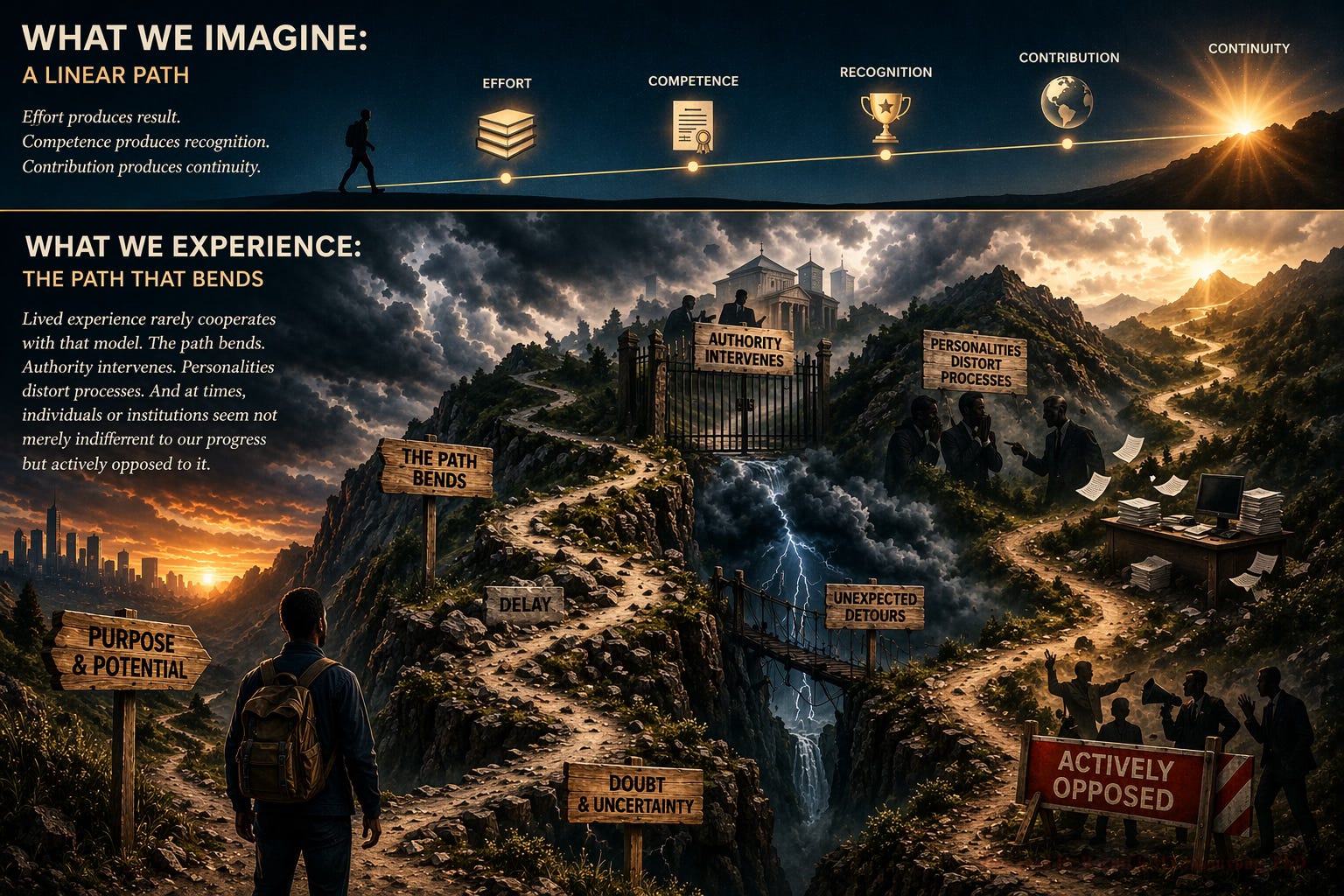
We are inclined to imagine our lives as linear: effort produces result, competence produces recognition, contribution produces continuity. But lived experience rarely cooperates with that model. The path bends. Authority intervenes. Personalities distort processes. And at times, individuals or institutions seem not merely indifferent to our progress but actively opposed to it.
Carlos Castaneda referred to such figures as petty tyrants—not grand villains, but people whose small assertions of control produce outsized effects in the lives of others. At first glance, they appear to block movement. They deny access, withhold support, or redirect outcomes for reasons that feel disproportionate to their authority.
It is tempting to interpret them as barriers standing between a person and a rightful future.
But another possibility emerges over time:
they do not actually stop the path—they interrupt a version of the path that depended on them.
The distinction matters.
What collapses in such moments is often not the destination, but the structure through which we expected to arrive there. The role, the channel, the alliance, the institutional permission—these dissolve. The apparent obstruction exposes an invisible dependency. Something in us assumed continuity through a particular arrangement, and that arrangement proved conditional.
The petty tyrant, then, does not merely oppose.
They reveal where we located our forward motion outside ourselves.
The experience remains humanly frustrating. It does not become morally admirable. Yet structurally it performs a different function: it forces a relocation of authority inward. One must now proceed without the mechanism that previously carried the movement.
The path does not end.
It becomes longer—and more distinctly our own.
With time, a curious pattern becomes noticeable. The original aim does not vanish. Instead, it reappears through altered circumstances. New people emerge. Different contexts open. Work continues, sometimes in a subtler form, sometimes with greater coherence than before. What felt like a termination reveals itself as a redirection.
The destination, it seems, was stable.
The traveller was not yet configured to inhabit it independently.
Nature rarely blocks; it reorganises.
What we call delay is often structural maturation—the interval, or liminal period, required for identity to stabilise around what it seeks. Had the earlier arrangement persisted, the outcome might have been attained but not sustained. The very support that promised arrival might have prevented integration.
The route lengthens until the person can stand within the result without leaning upon the conditions that first made it imaginable.
From within the experience, this feels like effort—persistence in uncertainty, repeated adjustment, calm continuation after enthusiasm fades. From a distance, however, it can look guided. Improbable convergences occur. Encounters arise at precise moments. Closed doors coincide with emerging alternatives. Timing acquires an uncanny quality.
Lao Tzu wrote, “Nature does not rush, yet everything gets accomplished.”
Blaise Pascal described his life as moved by an unseen hand.
Jay-Z commented during an interview with Kevin Hart, that some events are not happening to you but for you.
These statements appear mystical only if one assumes guidance and effort are opposites.
They may instead describe the same phenomenon from different vantage points.
From inside the life, one continues—choosing, correcting, enduring, learning, becoming.
From outside the life, a pattern becomes visible—alignment increasing until movement requires less force.
Perhaps the unseen hand is not pushing events into place.
Perhaps it is the name we give to the moment persistence becomes compatible with reality’s existing order.
We do not arrive because we were selected.
We arrive because we gradually become able to remain where we hoped to stand.
Such reflections should not be used to excuse conduct. People still act from insecurity, territoriality, or fear—whether of circumstance or of those they do not understand.. Institutions still preserve themselves at the expense of fairness. Recognising pattern does not absolve behaviour. Ethical responsibility belongs fully to those who exercise power, wisely or poorly.
Yet meaning may still be extracted without granting moral approval.
Opposition can reorganise capacity in ways support never could. It clarifies motives, strips unnecessary dependency, and reveals which desires persist when external reinforcement disappears. One discovers whether the aim was circumstantial or intrinsic.
In this sense, the circuitous path is not a detour away from fulfilment but the process by which fulfilment becomes inhabitable.
So the sentence from the night meditation returns, altered:
Whatever is for you cannot be kept from you
does not mean nothing will oppose you.
It means opposition cannot prevent what you become able to sustain.
What appears denied may only be premature.
What appears lost may have been conditional.
What remains through redirection begins to resemble destiny, though it was built through attention rather than granted by favour.
Perhaps Pascal’s unseen hand is simply the larger coherence revealed when we continue long enough for resonance to meet result.
And perhaps Nature does not rush because it waits for us to arrive not merely at our goals, but at the version of ourselves capable of living within them.
Suggested Practice
Tracing the Long Path
Set aside a few silent moments—whether after meditation or at the close of the day—and reflect on the following:
Recall a moment of obstruction.
Identify a time when something you sought did not unfold as expected—an opportunity delayed, withdrawn, or redirected.Examine the structure, not just the outcome.
Ask yourself:What was I relying on at that time (a person, institution, or specific pathway)?
In what way was my progress dependent on that structure?
Observe what changed in you.
Over time, consider:What capacities did I develop as a result of that disruption?
What became clearer about my intentions or direction?
Identify re-emergence.
Has the original aim appeared again—perhaps in a different form, context, or scale?
If so, how does your current ability to engage with it differ from before?
5. Sit with the central question:
Am I being blocked or am I being prepared to sustain something I could not yet hold?
Allow the question to remain open. There is no need to force an answer.
Close with a few moments of stillness, recognising that movement is not always visible—and that what is taking shape within may be as significant as any external result.
—
About the Author
Dr. Baruti KMT-Sisouvong is a scholar of consciousness, researcher of human development, and Certified Teacher of Transcendental Meditation® based in Cambridge, Massachusetts. His work explores the relationship between Pure Consciousness, neuroscience, and social systems, and how deeper awareness can inform both personal growth and institutional transformation.
He is the Founder and Chief Meditation Officer of Transcendental Brain, an initiative examining the intersection of consciousness research, cognitive science, and high-performance decision-making. He is also President of Serat Group Inc. and Founder and Director of Radical Scholar Inc., a nonprofit dedicated to consciousness-based research and public scholarship.
Alongside his wife and teaching partner Mina, he co-directs the Transcendental Meditation program for Cambridge and the Greater Boston area. He is also the host of the On Transcendence Podcast and Founder of International Meditation Hour, a quarterly global gathering dedicated to the unifying power of silence.
His writings—spanning frameworks such as The Model for Perpetual Growth and Progress and The Seven Layers of Manifestation—explore the evolving relationship between consciousness, leadership, and society.
He writes from the conviction that the most important race is not between nations or machines, but between the conditioned mind and the awakening soul.
To learn more about him, visit: https://www.barutikmtsisouvong.com/.