


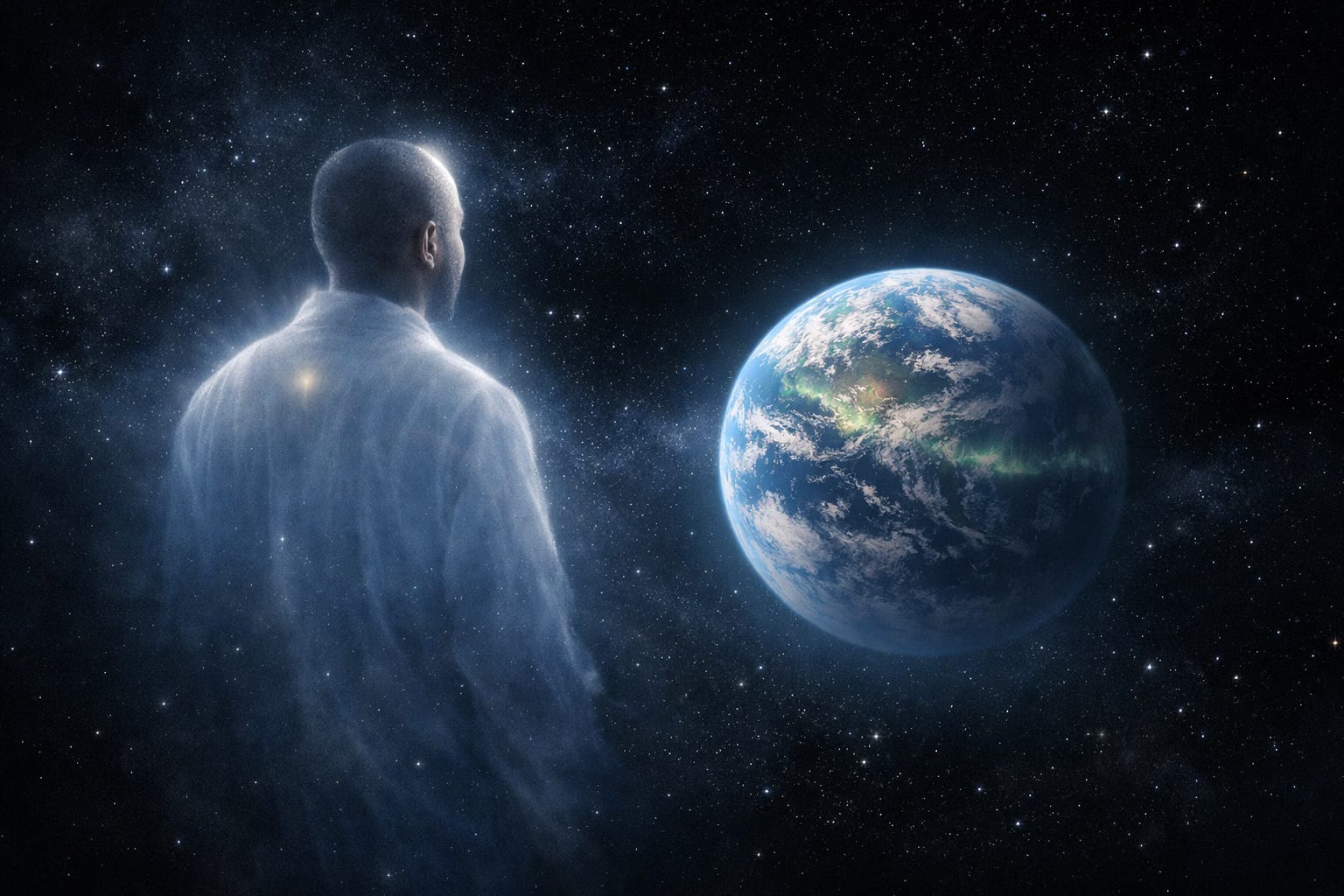
Author’s Note
This reflection was not planned.
It arrived in the early hours—unannounced, yet unmistakable—prompted both by an experience from the Fall of 1998 and by an image of Earth taken from beyond its immediate bounds. In that moment, what is often discussed in abstraction became visible in form: the relationship between what is fundamental and what is constructed.
What follows is not an argument, but an observation—one that invites reconsideration of where, and from what level, human life is governed.
—Baruti KMT-Sisouvong, PhD
At 4:44 in the morning, the world is settled enough to reveal itself.
Not as we typically experience it—through obligations, roles, and the steady movement of the day—but as it is when briefly released from interpretation.
It was in such a moment that the image reappeared.
I say “reappeared” as it was not the first time such a view had entered my field of awareness.
But first—a bit of backstory.
Having wended my way through one of my earlier initiations into a sacred Order during my time in Atlanta, one of the exercises guided us to ascend—gradually, deliberately—into the upper atmosphere, to experience the Earth in what many now refer to as “the overview effect.”
In practice, one moves methodically:
from the room…
beyond the building…
beyond the neighbourhood…
beyond the city…
beyond the country…
beyond the hemisphere…
and finally, beyond the planet itself.
Until one arrives at a vantage point from which the Earth can simply be observed.
In that moment, looking back on it now, I was struck by what was not there.
No borders.
Only the swirling whites of cloud systems…
the soft glow of auroras…
the deep blue of the oceans…
the verdant greens…
and the earth-toned expanses stretching across continents.
It was beautiful.
Then I turned.
Behind me was a depth of black so complete that the only comparison I have found, even now, is to that of transcending.
No sound.
Only awareness.
Again—it was beautiful.
In time, I was guided back—gradually—to my place of rest in my small flat in downtown Atlanta.
That experience, and the realisations it carried, have subsequently informed many of my decisions ever since.
I am fully aware that some reading this may regard such an experience with more than a slight degree of skepticism. And that is fair.
I can only offer this: it was real enough to register physiologically—
awe, tears, a sense of clarity… and a growing dismay at the divisions we so confidently maintain amongst our species.
It felt no less real than this moment of typing these lines.
And so, I accept whatever scrutiny may follow. It is what it is.
That experience, however, did not remain in the past.
It returned—unbidden—on the morning in question.
At 4:44 AM, having just emerged from meditation, I came across the photo from NASA astronaut, Reid Wiseman, capturing what will likely become a defining image of our time—Earth, viewed from the Orion spacecraft during the Artemis II mission. And we are all in it. Let that sink in.
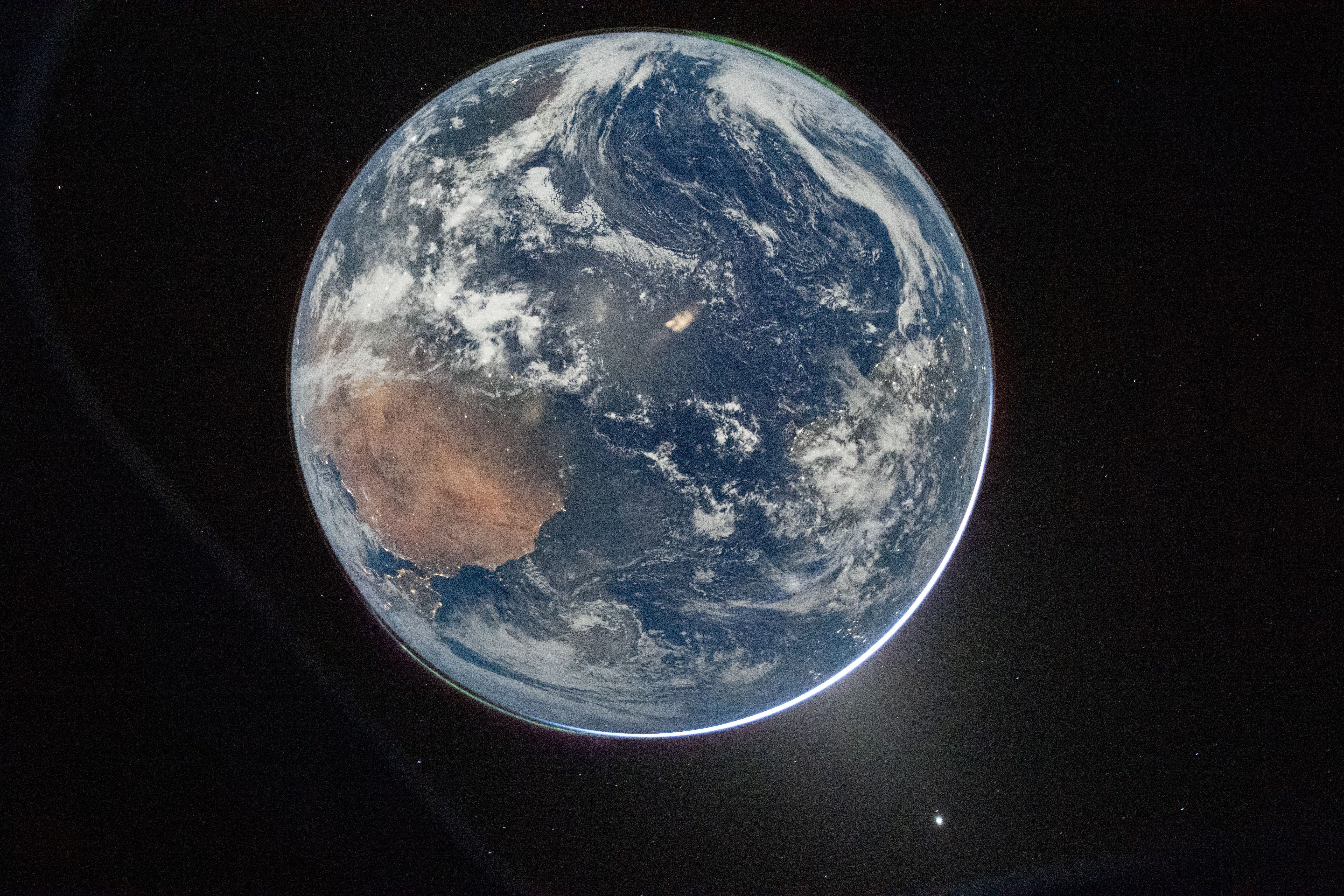
(As a Nikonian, I admit a not-too-subtle moment of satisfaction surfaced upon learning the image was captured using a Nikon D5. In our household, we are a Nikon family—with multiple cameras for Mina, the children, and myself—so it felt fitting that such a view was rendered through a familiar lens.)
And in an instant, the earlier experience and the present moment converged.
Earth—fully visible, self-contained, luminous—suspended in a vast, unbroken field. Auroras traced the upper atmosphere like silent currents of energy, while faint zodiacal light revealed the presence of a larger cosmic geometry in which this sphere, this “pale blue dot” merely participates.
As before, there were no borders.
No nations.
No economies.
No evidence of the systems to which so much of human life is given.
Only a planet.
Only movement.
Only law.
And in that instant, as was the case for me on that Fall night of 1998, something becomes difficult to ignore:
The vast majority of what governs human experience does not appear anywhere in the image.
This is not merely a personal observation.
Those who have physically occupied this vantage point have articulated something remarkably similar.
Artemis II Pilot, Victor Glover, speaking from aboard the Orion spacecraft, described Earth as an “oasis” in the vast expanse of space—a rare and life-sustaining presence within an otherwise inhospitable field.
In reflecting on this view, he emphasised not division, but shared existence—reminding those on Earth that regardless of belief, background, or identity, we inhabit the same fragile and extraordinary environment.
What is revealed from that vantage point is not ideology.
It is proportion.
And within that proportion, many of the distinctions we defend so vigorously begin to lose their coherence.
The view does not argue for unity.
It instead renders socially constructed division increasingly difficult to sustain.
The Misplaced Centre
Human beings, through necessity and ingenuity, have constructed elaborate systems to organise life.
Governments. Markets. Institutions. Social identities. Narratives of belonging and exclusion.
These are not without function. They coordinate action, provide continuity, and scaffold development.
But, when the planet is observed from this vantage point, it becomes clear they are not fundamental.
They belong not to the base of reality, but to its upper layers—to what, within the Seven Layers of Manifestation, would be recognised as:
Layer V: The Human-Derived World
Layer VI: Constructs
And herein lies the central tension:
We have learned to govern ourselves from the top of the structure rather than from its foundation.
Decisions that affect millions—sometimes billions—are made within systems that are themselves contingent, provisional, and often misaligned with the deeper laws that sustain life.
From within those systems, this can appear normal.
From beyond them, it appears unmistakably precarious.
What the Image Reveals
The photograph does not argue.
It does not critique.
It simply reveals.
Earth exists in accordance with laws that do not require human agreement:
Gravitational coherence
Atmospheric balance
Electromagnetic interaction
Cyclical rhythms of light and dark
These belong to:
Layer II: Universal and Natural Laws
And beneath even these—
Layer I: Pure Consciousness
—out of which the entire display inarguably emerges.
Human constructs do not generate these layers.
They depend upon them.
Yet, in practice, governance rarely reflects this hierarchy.
Instead, we attempt to impose order from within constructs that are themselves downstream of the very laws they often disregard.
The Origin of the Problem
It would be convenient to locate the source of human difficulty in external conditions.
In flawed leaders.
In unjust systems.
In historical inheritances.
But within the Seven Layers framework, the origin is more precise.
The issue then is not merely what we have built.
It is where we are building from.
When governance arises primarily from:
Fragmented perception (Layer IV: Human Consciousness in its contracted form)
Reinforced constructs (Layer VI)
—it produces outcomes (Layer VII) that reflect that fragmentation.
Conflict. Inequity. Environmental degradation. Misalignment between intention and result.
These are not random failures.
They are coherent outcomes of incoherent positioning.
A Different Possibility
And yet—the image does not suggest despair.
It suggests possibility. Tremendous possibility.
Because everything visible within the upper layers is, by definition, modifiable.
Constructs can be reimagined.
Systems can be redesigned.
Patterns can be interrupted.
But only if the point of reference shifts.
To govern from the deeper layers is not to abandon the world.
It is, in fact, to align action with what is already fundamentally true.
This means:
Recognising that human-created problems are, in fact, human-created
Accepting that they are therefore reversible
And understanding that sustainable change requires descending before acting
Governing From the Base
What might it mean to govern from the deepest layers?
Not in abstraction—but in lived practice.
It would begin with the stabilisation of Human Consciousness (Layer IV) through direct experience of its source.
Not as belief.
Not as philosophy.
But as a repeatable, physiological reality.
From there:
Decisions become less reactive, more coherent
Perception becomes less fragmented, more inclusive
Action becomes less compensatory, more aligned
Only then do constructs become what they were always meant to be:
Not authorities—but instruments.
Not determinants—but expressions.
The Lingering Responsibility
The image of Earth does not instruct us.
It does not tell us what to do.
But it does remove certain illusions.
It reveals that:
The divisions we defend are not visible at scale
The systems we uphold are not foundational
The problems we inherit are certainly not inevitable
And in so doing, it leaves us with a subtle but unmistakable responsibility:
To decide—from which layer we will consistently live.
Closing Reflection
Somewhere, beyond the atmosphere, a spacecraft continues its trajectory.
Inside, a human being looks out and captures an image.
That image returns to Earth.
And, in the early hours, another human being sees it—and pauses.
Not because the world has changed.
But because, for a moment—
it is seen evermore clearly.
Can you see it?
Suggested Practice
This morning—or at some point today—pause briefly and consider:
What aspects of my current concerns originate in constructs, rather than fundamentals?
Where might I be reacting from the surface, rather than responding from depth?
What would shift if I allowed my next decision to arise from a more settled state of awareness?
Then proceed—not by withdrawing from life—but by engaging it from a different level.
—
About the Author
Dr. Baruti KMT-Sisouvong is a scholar of consciousness, researcher of human development, and Certified Teacher of Transcendental Meditation® based in Cambridge, Massachusetts. His work explores the relationship between Pure Consciousness, neuroscience, and social systems, and how deeper awareness can inform both personal growth and institutional transformation.
He is the Founder and Chief Meditation Officer of Transcendental Brain, an initiative examining the intersection of consciousness research, cognitive science, and high-performance decision-making. He is also President of Serat Group Inc. and Founder and Director of Radical Scholar Inc., a nonprofit dedicated to consciousness-based research and public scholarship.
Alongside his wife and teaching partner Mina, he co-directs the Transcendental Meditation program for Cambridge and the Greater Boston area. He is also the host of the On Transcendence Podcast and Founder of International Meditation Hour, a quarterly global gathering dedicated to the unifying power of silence.
His writings—spanning frameworks such as The Model for Perpetual Growth and Progress and The Seven Layers of Manifestation—explore the evolving relationship between consciousness, leadership, and society.
He writes from the conviction that the most important race is not between nations or machines, but between the conditioned mind and the awakening soul.
To learn more about him, visit: https://www.barutikmtsisouvong.com.