


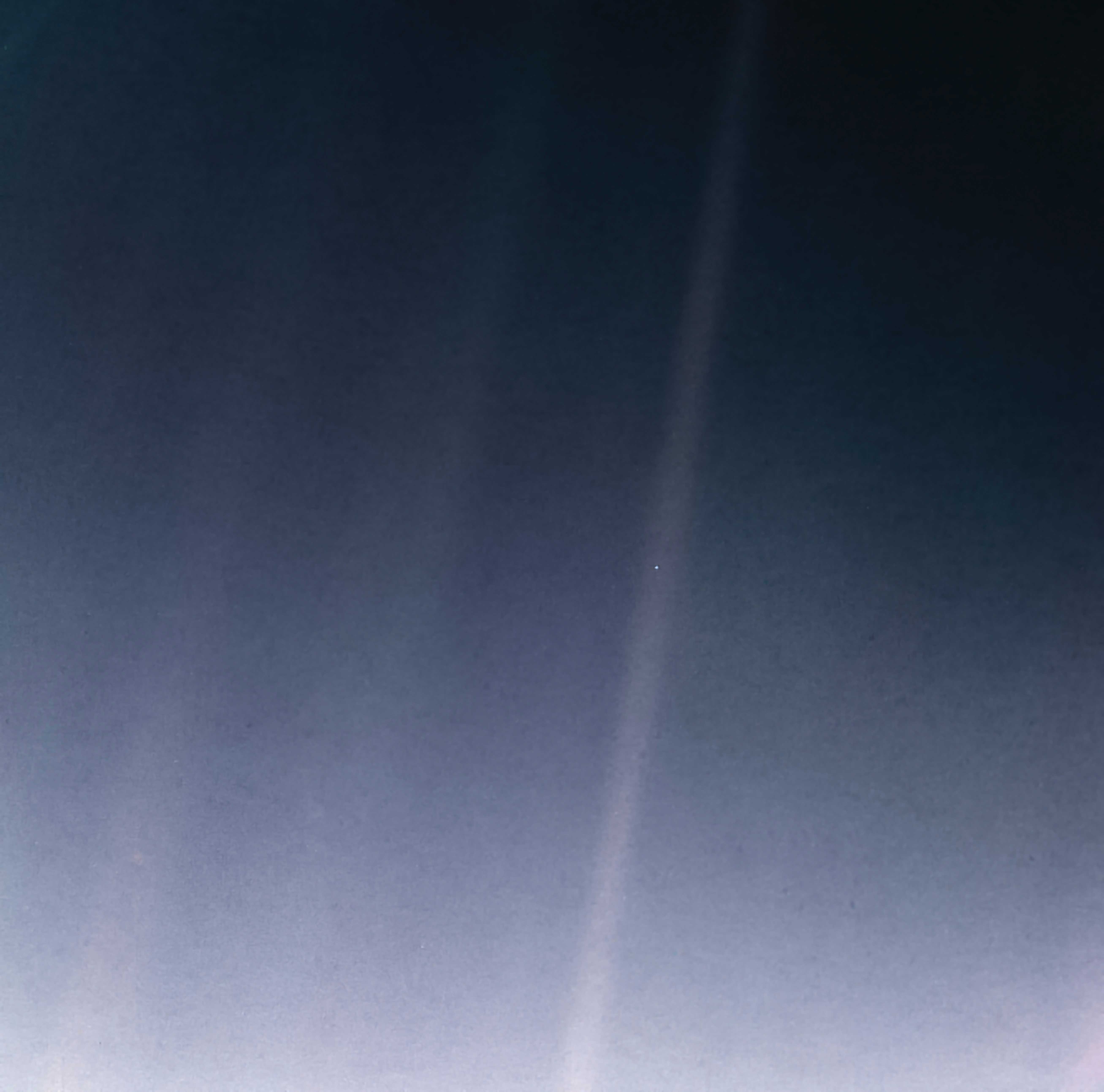
The Pale Blue Dot is a photograph of Earth taken 14 February 1990, by NASA’s Voyager 1 spacecraft at a distance of 3.7 billion miles (6 billion kilometers) from the Sun.
Source: NASA/JPL-Caltech
Author’s Note
I have long been fascinated by the relationship between the worlds human beings inherit and those we subsequently help to create. My training in history and sociology taught me to examine how institutions, identities, categories, and systems emerge through human activity and become embedded within societies. My later exploration of Consciousness added another dimension to that inquiry: if so much of our lived reality originates through human consciousness, what possibilities emerge when we become more conscious of the processes through which that reality is continually constructed?
The World-Builder grew from that question.
Carl Sagan’s reflection upon Voyager 1’s Pale Blue Dot has remained one of the most compelling invitations I know to reconsider the scale we assign to human distinctions. Seen from billions of miles away, the borders, institutions, identities, hierarchies, and conflicts that can appear enormous from the surface of Earth disappear entirely. Yet within that nearly imperceptible point of light exists the human mind—the very instrument capable of imagining those distinctions, constructing civilisations around them, sending a spacecraft billions of miles into space, and then asking it to turn around and photograph its creators.
The paradox continues to fascinate me.
This essay explores that paradox through the Seven Layers of Manifestation and through a question I increasingly believe deserves our attention: if human consciousness has participated in building so much of the world we presently inhabit, what might become possible if we understood the world-builder itself more fully?
Perhaps the next frontier of human development lies not solely in how much farther we can travel outward, nor solely in how deeply we can journey inward, but in what becomes possible when those two directions of exploration begin informing one another.
—Baruti KMT-Sisouvong, PhD
On 14 February 1990, a spacecraft travelling beyond Neptune turned its camera toward home.
Voyager 1 was approximately 3.7 billion miles from the Sun when it captured an image that would eventually become one of the most consequential portraits ever made of the human species. There are no faces in it, no families standing together, neither presidents nor kings were featured. No nations, religions, cultures, armies, universities, corporations, or borders. Upon first glance, there is barely an Earth.
Suspended within a scattered ray of sunlight is a tiny point of light occupying roughly a single pixel—Us.
Carl Sagan had advocated for the photograph years earlier. Its apparent insignificance was precisely the point. From such a distance, the world upon which virtually everything human beings have ever considered important had become almost indistinguishable from the vast darkness surrounding it.
I sometimes wonder what would happen if we could hold that perspective while going about our ordinary lives.
Somewhere within that pixel, human beings were loving, fighting, marrying, divorcing, worshipping, doubting, creating, destroying, raising children, and burying parents. They were organising themselves into nations, religions, political parties, distinct cultures, social classes, professions, and innumerable other categories. They were drawing boundaries across the surface of a planet upon which, from Voyager’s vantage point, no boundary could be seen at all. Here, I am reminded of the Berlin Conference which occurred from 1884-1885 where the African Continent was divided among fourteen nations. But I digress.
In that famous Voyager 1 photo, every human disagreement was occurring there—every war, border, racial classification, and every argument about who belonged and who did not. All of it, inside that pixel.
The more I study and reflect on being human and all that we create and our enormous potential, I find it useful, from time to time, to remember where we are by sitting with that famous photo. Not where we live in the ordinary sense; such as in either Cambridge or Boston, Massachusetts or the United States. Not even North America. I mean where we actually are—the Universe.
We inhabit a relatively small planet revolving around an otherwise unremarkable star in the Milky Way Galaxy, surrounded by a universe whose scale exceeds anything the human mind can comfortably imagine. We have become rather good at representing that immensity mathematically. We can calculate distances between stars, estimate the ages of galaxies, observe light that began travelling toward us billions of years before our species existed, and construct instruments capable of peering farther into the universe than any human being could have imagined only a few generations ago. Yet knowing these things and apprehending them are not quite the same.
Occasionally, when I look at an image of Earth suspended against the vast darkness of space, I try to hold the scale of it in mind. Somewhere on that small sphere are billions of human beings going about their lives. They are waking, sleeping, falling in love, grieving, raising children, caring for parents, creating businesses, attending schools, worshipping, doubting, building, destroying, cooperating, and competing. They speak thousands of languages and inhabit innumerable cultures. They organise themselves into nations, religions, political parties, social classes, professions, ethnic groups, distinct cultures, institutions, movements, and communities. They establish borders, currencies, issue passports and credentials, confer titles and status, construct hierarchies, make laws, wage wars, and sometimes kill one another over distinctions that are completely invisible from even a modest distance beyond the atmosphere.
From space, there are no lines separating Massachusetts from Rhode Island. There is simply Earth.
The observation is hardly new. Astronauts have described variations of it for decades. What continues to fascinate me, however, is what happens when that outward perspective is placed alongside an equally remarkable journey in the opposite direction. Instead of looking farther outward, look inward.
Inside every person moving across the surface of that tiny planet is a human brain performing an astonishing amount of work. Even as I sit here typing these words while Malcolm is in the kitchen with Mina as she prepares a meal for our family and Chloë, Emerson, and Tennyson are hatching some plan to build yet another fort in one of the rooms, mine is coordinating processes to which I am giving virtually no conscious attention. My heart continues beating, lungs continue breathing, and sensory information is being received and organised. Memories are being retrieved, language is being formed, fingers move across a keyboard in response to thoughts that, moments earlier, did not exist in precisely this arrangement. Somewhere within that activity, an idea becomes a sentence and a sentence becomes something another human mind may eventually encounter.
Meanwhile, I can direct that same brain toward contemplating the galaxy in which it exists. There is something almost breathtaking about that—the universe has produced a creature capable of contemplating the universe itself.
And that creature spends an extraordinary portion of its mental capacity thinking about the differences between itself and other members of its own species.
I have been thinking about that paradox lately.
My training in sociology taught me long ago that human beings do not simply encounter the world; we encounter a world already interpreted for us. We are born into societies whose categories precede our arrival. Before we possess the language necessary to question them, we begin learning what things mean. We learn that this patch of Earth belongs to one country and that patch belongs to another; that pieces of paper, metal, and increasingly digital entries possess different values; the meaning assigned to occupations, neighbourhoods, clothing, education, religion, skin colour, family names, and accents. And, sadly, we learn who is considered successful, respectable, dangerous, desirable, foreign, familiar, powerful, or marginal.
Most importantly, we rarely experience this early process as learning a particular interpretation of reality. Instead, we experience it simply as learning reality. That distinction has enormous consequences.
A child entering the world does not invent race, nationality, economic class, religious denomination or political identity. These categories are waiting. Their meanings have been constructed through generations of human interaction, institutionalised through law and custom, reinforced through families and communities, and transmitted through language, education, media, ritual, and ordinary social life. By the time we are old enough to examine them critically, many have become so deeply embedded in our perception that they appear less like human creations than features of nature itself.
Perhaps this is among socialisation’s most consequential achievements: it can make what human beings created appear to be what reality required.
That does not mean our differences are imaginary. Thankfully, human beings are wonderfully different. We possess different histories, cultures, languages, appearances, experiences, talents, temperaments, and ways of understanding the world. Nor does recognising the constructed nature of certain categories erase the consequences those categories have produced. A human-derived system can produce extraordinarily real suffering. Laws are human constructions, yet prisons are real. Money is a human construction, yet poverty can determine whether someone lives in a food desert being unable to eat fresh fruit and vegetables regularly. Borders are human constructions, yet crossing one without permission can alter the course of a life. Racial classifications are human-derived, yet centuries of organising societies around them have produced consequences that cannot simply be wished away by announcing that race is socially constructed. The distinction I am interested in is therefore not between what is real and what is unreal. It is, instead, between what is given and what is made.
That difference occupies an important place within what I describe as the Seven Layers of Manifestation.
Within that framework, I distinguish the Phenomenal World from Human Consciousness and the Human-Derived World that emerges through human activity. The latter contains the extraordinary structures our species has brought into existence: governments, markets, corporations, universities, technologies, religious institutions, legal systems, social hierarchies, and countless other arrangements through which we organise collective life. From these emerge constructs that influence how we understand ourselves and one another, eventually producing outcomes that can become so persistent that they appear inevitable. Yet the Human-Derived World remains precisely that—Human-derived.
And therein lies a possibility I do not think we contemplate nearly enough.
If human consciousness participated in constructing the physical and social worlds we inhabit, then human consciousness also possesses some capacity to reconstruct it.
This is not an argument for utopian thinking. Neither history nor sociology gives us much reason to believe that recognising a problem automatically produces agreement about its solution. Human beings possess competing interests. Power and resources matter. Institutions develop mechanisms for preserving themselves. People benefit differently from existing arrangements, and those who benefit substantially may have little incentive to redesign them. Even among people acting in good faith, deeply held values can lead to fundamentally different conclusions about what ought to be done.
Still, none of this eliminates the underlying capacity. It merely reveals the difficulty of exercising it.
I sometimes wonder how different our civilisation might become if a sufficiently large portion of humanity recognised not merely that the brain is the most powerful aspect of being human, but that our collective use of mind is continuously participating in the construction of lived reality.
Consider how much we already ask of this remarkable organ. The human brain simultaneously manages the body’s internal processes, interprets sensory experience, stores and retrieves memories, learns patterns, anticipates possibilities, creates language, navigates relationships, solves problems, and generates the subjective world through which each of us moves. With that same biological instrument, human beings have composed symphonies, formulated mathematics, written poetry, discovered medicines, constructed cities, mapped genomes, explored space, and developed machines capable of extending our cognitive reach. And yet the most remarkable thing about the brain may not be any single thing it has built.
It may be its capacity to imagine something that does not yet exist and then organise behaviour sufficiently to bring some version of that possibility into being.
Every human institution began, in some sense, there.
Before there was a university, someone had to imagine a durable community organised around learning. Before there was a democratic constitution, human beings had to imagine that political authority could be arranged differently. Before there was a spacecraft, someone had to conceive of leaving the planet while gravity continued insisting otherwise. And before any social order could become normal, it first had to become conceivable.
The Human-Derived World is filled with yesterday’s impossibilities.
Why, then, are we so quick to assume that its present arrangements constitute the limits of tomorrow?
Perhaps part of the answer is that humanity has become extraordinarily accomplished at studying what the mind has produced while remaining comparatively unfamiliar with the mind producing it.
We study economies, governments, technologies, institutions, and societies. We teach children how to navigate the systems they inherit. We prepare them to participate successfully in the Human-Derived World. We ask what they will become, where they will work, what they will earn, and what they will contribute. All of that has value.
But how often do we teach them to investigate the instrument through which every one of those activities will occur?
How often does education invite a young person to become genuinely curious about attention, awareness, thought, perception, emotion, and the relationship between inner experience and outward action? How much of our collective educational enterprise is devoted to understanding not merely the products of consciousness, but consciousness itself?
We have become remarkably sophisticated builders of worlds without becoming equally sophisticated students of the world-builder.
I believe that imbalance becomes increasingly consequential as the power of our technologies grows.
A stone tool amplifies the hand. A telescope amplifies sight. A computer amplifies calculation. Artificial intelligence increasingly amplifies aspects of cognition itself. Each technological advance expands what human intention can accomplish, which makes the quality of the intention guiding it increasingly important.
The more powerful the tool, the more consequential the consciousness holding it.
This is why I find myself returning to the relationship between our inner and outer development. Technological advancement alone cannot answer the question of what ought to be built. Intelligence alone cannot determine toward what purpose intelligence should be directed. And, sadly, a civilisation can become extraordinarily capable without becoming correspondingly wise.
Indeed, some of humanity’s most pressing problems are not evidence that we lack intelligence. They are evidence that extraordinary intelligence can be organised around competing identities, short-term incentives, and woefully fractured conceptions of collective interest.
Keen observers will note, we already possess enough intelligence to understand many of the problems confronting our species. We know that children should not starve, that preventable diseases should be prevented, and that ecosystems upon which human life depends cannot be degraded indefinitely. Moreover, we recognise the destructive potential of war, that education expands human possibility, and that humans possess extraordinary scientific, technological and organisational capabilities.
The difficulty is not always knowing what could be done. Often, it is organising ourselves sufficiently to do it. And that brings me back to difference.
Permit me to state, unequivocally, I have no desire for a world in which human beings become alike. Such a world would be impoverished beyond measure. Difference is not the problem. The natural world itself seems almost exuberant in its production of variation. Therefore, human culture should be no less so. For me, the question is whether difference must require division.
What might become possible if human beings could maintain strong cultural, philosophical, religious, national, and individual identities while simultaneously recognising that none of those identities exhausts what we are?
Perhaps disagreement could remain disagreement without requiring dehumanization, competition could occur without constructing an enemy, identity could provide belonging without requiring inferiority somewhere else, and we could finally learn to hold our distinctions as meaningful without mistaking them for the deepest level of reality.
Here, I am reminded of a familiar poem from Rumi, translated in what Coleman Barks referred to as “American free verse.” It reads:
Out beyond ideas of wrong doing and right doing,
there is a field.
I’ll meet you there.
When the soul lies down in that grass,
the world is too full to talk about.
Ideas, languages, even the phrase ‘each other’
doesn’t make any sense.
What has always interested me about the poem from the moment Dr. Barks shared and discussed it during my Connecting the Dots interview with him in 2007, is where it ultimately leads. Rumi does not merely imagine a place in which disagreement has been settled. He gestures toward a level of experience at which the conceptual boundaries ordinarily separating one person from another no longer carry their customary meaning.
Rumi arrives through mystical language at something I have been approaching through history, sociology, meditation, and the Seven Layers of Manifestation. That there are levels of reality at which our differences matter tremendously. And there are levels at which they do not exist in the forms we have constructed.
Perhaps wisdom consists partly in knowing the difference.
The more I contemplate this, the more I suspect that looking outward and looking inward can produce surprisingly similar effects.
Look far enough outward and the Human-Derived World begins to shrink. Borders disappear. Nations vanish. Buildings become invisible. Eventually even the planet itself becomes a point of light suspended within an incomprehensibly larger reality.
Look deeply enough inward and something analogous can occur. The noise of ordinary identity can become virtually nonexistent, titles recede, social categories loosen, and the accumulated narratives through which we ordinarily define ourselves may temporarily give way to something more fundamental: awareness itself.
In one direction lies the immensity of the universe. In the other lies the depth of Consciousness.
And somewhere between those two immensities sits the Human-Derived World, enormously consequential to us and yet astonishingly small within the larger order of things.
Perhaps our mistake has not been creating that world. Creating worlds is one of the things human beings do extraordinarily well. Perhaps our mistake has been in forgetting that we created it.
For once we forget, our creations begin to govern our imagination. What exists becomes what must exist. What has been inherited becomes what is possible. As a result, constructs become constraints, and the architecture of yesterday begins to establish the boundaries of tomorrow.
However, remembering restores something different. It restores agency.
Not absolute agency. We do not individually control history, institutions, economies, or other human beings. Nor can generations of accumulated consequences simply be redesigned through intention alone. But collective human arrangements remain susceptible to collective human action precisely because they are human arrangements.
We have revised them before. And we will revise them again.
The question is whether those revisions will emerge primarily from the same fractured consciousness that produced so many of our present difficulties, or from a deeper understanding of the instrument through which every human world is built.
And so I find myself returning to a question that feels increasingly important:
What might humanity build if we understood the builder as well as we understand what it has built?
I do not profess to know the answer. But I can imagine what might follow from taking the question seriously.
Perhaps we would devote considerably more attention to cultivating the inner capacities from which outer action emerges. Maybe education would concern itself not only with filling minds with information, but with helping human beings understand the minds receiving it. Possibly our institutions would become better at distinguishing human difference from human division. Conceivably we would become less susceptible to inherited categories that require an adversary in order to sustain an identity. And perhaps above all, some portion of the extraordinary cognitive capacity presently consumed by defending the boundaries between us could be redirected toward the problems confronting all of us.
Admittedly, there is no guarantee that greater understanding of mind will produce a harmonious civilisation. Human freedom precludes such certainty. But there is something strange about possessing an instrument of extraordinary possibility while remaining largely unaware of its capacities—and stranger still about allowing that instrument to remain captured by constructs of its own creation.
We are inhabitants of a small planet suspended within a vast universe. But we are also builders of worlds.
It seems to me, that the next great frontier is neither exclusively outward nor inward, but the relationship between the two: learning enough about the consciousness within us to become wiser about the world emerging from us.
We have already demonstrated that we can build extraordinary things. Yet, the more important question may now be whether we can become sufficiently conscious of the builder to choose, together, what deserves to be built next.
Suggested Practice: The View from the Dot
Set aside several uninterrupted minutes and look closely at Voyager 1’s Pale Blue Dot photograph.
Do not immediately intellectualise what you are seeing. First, find Earth. Allow yourself to recognise just how little of the photograph we occupy. Somewhere within that tiny point of light is every nation, every border, every institution, every social category, every human conflict, every person you love, everyone with whom you disagree, and virtually every circumstance that presently occupies your attention.
Now consider one distinction that has become especially important in how you understand yourself or someone else. It might involve nationality, race, religion, politics, profession, social status, education, institutional affiliation, or simply a disagreement that has become larger in your mind than the person with whom you disagree.
Look again at the photograph.
Ask yourself: From this distance, what remains?
The purpose is not to convince yourself that differences are meaningless. Difference is part of the extraordinary richness of human existence, and human-derived distinctions can produce very real consequences. Instead, notice what happens when those differences are placed within a larger frame.
Then close your eyes and reverse the direction of attention. Rather than travelling billions of miles outward, allow attention to settle inward. Notice thoughts appearing and disappearing. Notice the identities, categories, memories, and assumptions through which you ordinarily interpret experience. Without trying to eliminate any of them, consider that you are also the awareness within which they are being observed.
Remain there briefly.
Then bring these two perspectives together: the almost unimaginably large universe without and the extraordinary depth of experience within.
Somewhere between them lies the world human beings have made.
Before returning to your day, ask yourself:
What am I helping to build?
And then:
Does what I am building reflect the deepest understanding of myself and others available to me?
You need not arrive at an immediate answer. The practice is simply to remember that the world we inherit and the world we perpetuate need not always be the same world.
—
About the Author
Dr. Baruti KMT-Sisouvong is a scholar of consciousness, researcher of human development, and Certified Teacher of Transcendental Meditation® based in Cambridge, Massachusetts. His work explores the relationship between Pure Consciousness, neuroscience, and social systems, and how deeper awareness can inform both personal growth and institutional transformation.
He is the Founder and Chief Meditation Officer of Transcendental Brain, an initiative examining the intersection of consciousness research, cognitive science, and high-performance decision-making. He is also President of Serat Group Inc. and Founder and Director of Radical Scholar Inc., a nonprofit dedicated to consciousness-based research and public scholarship.
Alongside his wife and teaching partner Mina, he co-directs the Transcendental Meditation program for Cambridge and the Greater Boston area. He is also the host of the On Transcendence Podcast and Founder of International Meditation Hour, a quarterly global gathering dedicated to the unifying power of silence.
His writings—spanning frameworks such as The Model for Perpetual Growth and Progress and The Seven Layers of Manifestation—explore the evolving relationship between consciousness, leadership, and society.
He writes from the conviction that the most important race is not between nations or machines, but between the conditioned mind and the awakening soul.
To learn more about him, visit: https://barutikmtsisouvong.com/.