


Author’s Note
There are moments in life when one encounters a shift in conditions—be they subtle or overt—that alters the field upon which one has been successfully operating. What once moved freely encounters resistance. What once felt natural is constrained. In such moments, it is tempting to interpret the change as obstruction, or even injustice.
Yet, history offers a different lens. This essay explores the landscape, the player, institutions, and the import of remaining centered so as to innovate.
—Baruti KMT-Sisouvong, PhD
In 1967, the NCAA made a decision that, at the time, seemed both specific and curious: it banned dunking in college basketball.
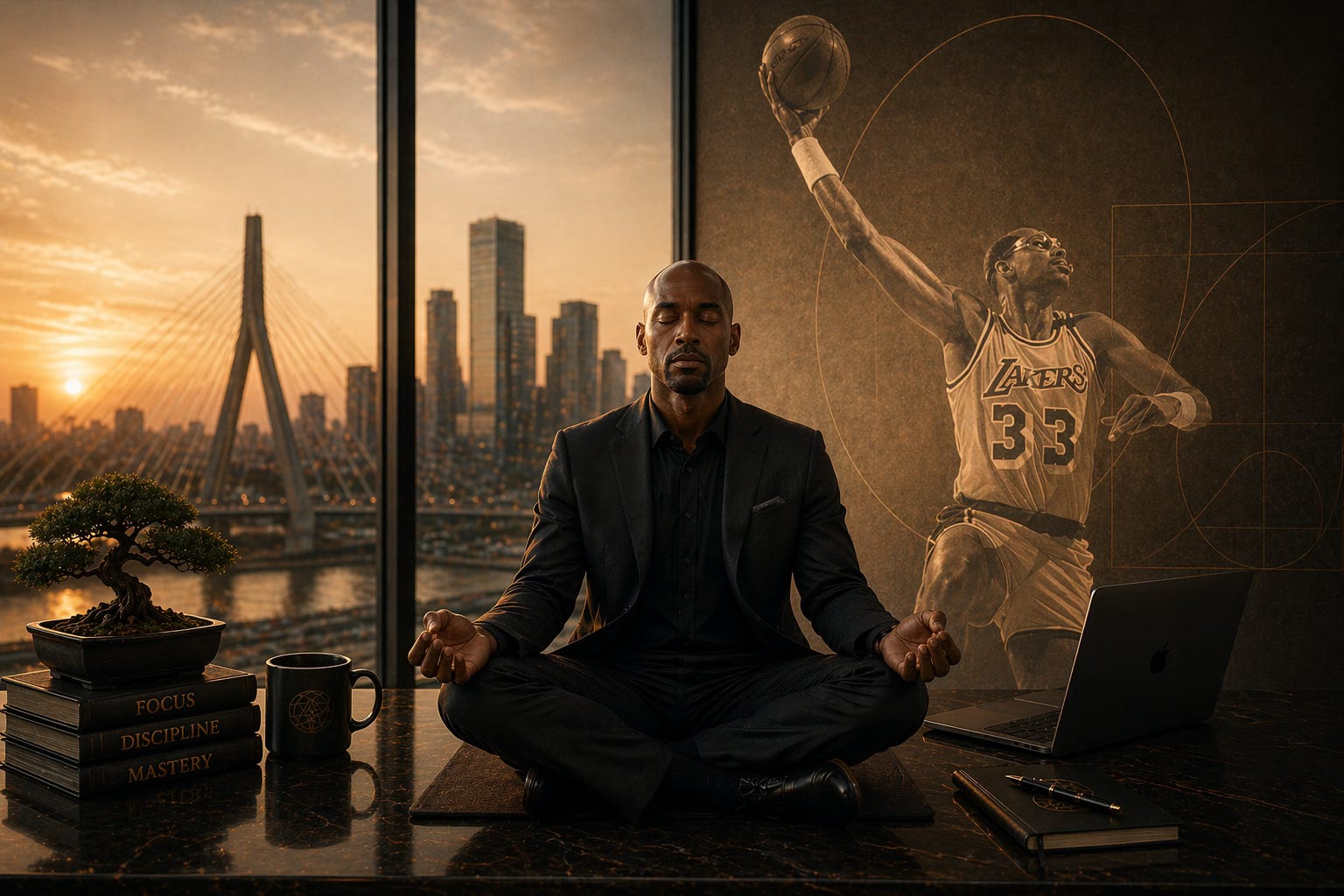
While the rule applied universally, its origin was widely understood. At the center of the conversation stood Kareem Abdul-Jabbar—then known as Lew Alcindor—a player whose physical presence and technical command had rendered the game, in certain respects and to some, unequal.
The dunk, for Alcindor, was not merely a display of athleticism. It was efficiency. Certainty. Finality.
And so, it was banned—from the beginning of the 1967 season with it finally being lifted in 1976—for nine seasons. Fans knew the ban was specific due to Alcindor’s dominance with the UCLA squad and for his efficacy with the dunk in particular.
The question, then, was simple: What does one do when the most direct expression of one’s ability is no longer permitted?
There are many ways to respond to constraint.
One may resist.
One may protest.
One may even quietly withdraw.
Alcindor did none of these.
Instead, he refined.
Deprived of the dunk, he turned his attention to a movement that, at the time, was far less celebrated—the hook shot. Not as a secondary option, but as a primary path. Not as a workaround, but as a solution.
Over time—through repetition, adjustment, and an unwavering commitment to precision—this movement evolved into what the world would come to know as the skyhook. Alcindor’s commitment to his craft was as a result of what scholar, Anders Ericsson would later refer to as deliberate practice—“the individualized training activities specially designed by a coach or teacher to improve specific aspects of an individual’s performance through repetition and successive refinement” (Ericsson & Lehmann, 1996, pp. 278–279). In Alcindor’s case, he undertook a path that came to define much of his success on the court.
The skyhook was not as loud as a dunk; nor as immediately dramatic.
But it was something else entirely. It was unguardable.
A Shift in Understanding
At first glance, the story appears to be one of adaptation. And, on one level, it is.
But at a deeper level, it reveals something more fundamental: Constraint does not, nor could it ever, eliminate excellence. It reveals its next form.
The removal of the dunk did not diminish Alcindor’s capacity. It redirected it.
What could no longer be expressed through force would now be expressed through precision. What could no longer rely on immediacy would now depend upon timing, angle, and control.
In this way, the constraint did not close a path. It revealed another—one that required greater refinement. And ultimately supplied an elegant solution.
The Inner Movement
There is a tendency to view such transformations as purely external—technical adjustments made in response to changing conditions. Yet, every external refinement begins with an internal shift. Just as everything is an echo of an idea. The idea is the rudder of the ship.
One must first perceive clearly that conditions have changed.
One must then interpret accurately so as to recognise that this newly imposed limitation is not the end of expression.
And finally, one must determine, conclusively, the answer to the most important question—What remains available?
This sequence—perception, interpretation, decision—is not incidental. It is foundational. It marks the difference between reaction and refinement. The difference between collapsing under pressure and standing tall so as to divine a solution.
For had Alcindor interpreted the ban as an endpoint, the story would have ended there.
Instead, he asked a different question—What cannot be taken away?
As in basketball, so, too, in business and life, one must ask and answer this key question so as to chart a new path forward.
From Power to Precision
The skyhook is often described as a shot. This is true, but incomplete.
It is, more accurately, the visible expression of a deeper process:
Footwork refined to create space
Timing calibrated to disrupt defence
Angles studied until they became intuitive
Repetition carried to the point of effortlessness
In this sense, the skyhook was not merely developed. After many hours of practice and refinement beyond the initial constraint, it was arrived at.
And once fully integrated, it required no force. Only execution. And it was on more than a few occasions, flawless.
Here, a subtle principle emerges.
When power is restricted, precision becomes the path.
All one need do is commit to the work and execute—ever bearing in mind, restraint is the luxury.
The Broader Pattern
Though this story unfolds on a basketball court, its structure is not confined to sport.
There are moments in professional life when operating conditions shift. Processes change. Assumptions are radically altered. What once flowed freely becomes constrained—not always through direct opposition, but through structural redesign.
In such moments, the initial impulse is often to restore what was lost.
But restoration is not always possible. Nor is it always necessary.
For the deeper question is not: Why has this been taken away? But rather: What is now required?
To answer this question is to move from resistance to refinement.
The Long Path of Mastery
Mastery does not reveal itself in moments of ease.
It reveals itself when the obvious path is removed.
When the familiar is no longer available, one is left with a choice: to either diminish, or to deepen.
Alcindor chose the latter.
And in so doing, he did not merely adapt to the game as it was.
He contributed to what it would become.
The skyhook did not arise in spite of constraint. It arose because of it.
Outcome and Influence
In time, Kareem Abdul-Jabbar would go on to become the NBA’s all-time leading scorer for decades, his skyhook serving as a defining feature of his career.
More importantly, it became a reference point.
A demonstration that refinement, carried far enough, does more than solve a problem.
It establishes a new standard.
What begins as a response to limitation may, if pursued with sufficient depth, become a contribution to the field itself.
Closing Reflection
Constraint will appear.
This is not a matter of speculation, but of experience.
The question is not whether one will encounter limitation, but how one will meet it.
For in that moment—subtly and often unobserved by most—something essential is decided.
Will one attempt to return to what was?
Or will one refine toward what is now possible?
The difference is not merely strategic.
It is developmental.
And in that difference lies the path—not only of adaptation, but of mastery. True and unquestionable mastery.
There are moments when systems, whether by design or limitation, restrict the most direct expression of one’s ability. These moments are often experienced as constraint—even injustice. Yet, when viewed through the proper lens, they reveal something else entirely: an invitation—not to retreat, but to refine.
The banning of the dunk did not diminish Kareem Abdul-Jabbar’s greatness; it compelled him to develop a form so precise, so efficient, so elegant, that it transcended the very limitation imposed upon him.
In this way, constraint becomes not an end, but a catalyst.
And within this catalytic moment, we find a living expression of the Model for Perpetual Growth and Progress.
So, despite external limitations, continue to plan your work—and work your plan. In the end, you may develop something that renders externally imposed constraints almost inconsequential.
Suggested Practice
Take a moment to reflect on a current or recent constraint in your own life.
What has changed in your operating conditions?
What initial interpretation did you assign to this change?
What, upon closer examination, remains available to you?
Now, consider:
If this constraint were not an endpoint, but an invitation to refinement—what might it be asking you to develop?
Sit with this question, not as an abstraction, but as a practical inquiry.
For the answer, as in all such cases, will not be found in what has been removed—but in what is now required.
—
About the Author
Dr. Baruti KMT-Sisouvong is a scholar of consciousness, researcher of human development, and Certified Teacher of Transcendental Meditation® based in Cambridge, Massachusetts. His work explores the relationship between Pure Consciousness, neuroscience, and social systems, and how deeper awareness can inform both personal growth and institutional transformation.
He is the Founder and Chief Meditation Officer of Transcendental Brain, an initiative examining the intersection of consciousness research, cognitive science, and high-performance decision-making. He is also President of Serat Group Inc. and Founder and Director of Radical Scholar Inc., a nonprofit dedicated to consciousness-based research and public scholarship.
Alongside his wife and teaching partner Mina, he co-directs the Transcendental Meditation program for Cambridge and the Greater Boston area. He is also the host of the On Transcendence Podcast and Founder of International Meditation Hour, a quarterly global gathering dedicated to the unifying power of silence.
His writings—spanning frameworks such as The Model for Perpetual Growth and Progress and The Seven Layers of Manifestation—explore the evolving relationship between consciousness, leadership, and society.
He writes from the conviction that the most important race is not between nations or machines, but between the conditioned mind and the awakening soul.
To learn more about him, visit: https://www.barutikmtsisouvong.com.