


Author’s Note
I first encountered George G. M. James’s Stolen Legacy in 1995, during a period of extraordinary intellectual and spiritual exploration in my life. That same period brought me into conversation with Dr. Théophile Obenga, introduced me to the work of Dr. Cheikh Anta Diop, and began my intellectual tutelage under the guidance of Dr. Asa G. Hilliard III. At the time, I could not have known how these encounters would contribute to questions I would continue exploring more than three decades later.
This essay is neither an attempt to resolve the longstanding controversy surrounding James’s central thesis nor an argument for replacing one historical orthodoxy with another. Rather, it is an exercise in intellectual genealogy: an attempt to look backwards and recognise some of the books, people, questions, and ideas that accompanied the development of my thinking.
What interests me most today about Stolen Legacy is not whether every historical proposition James advanced withstands contemporary scrutiny. It is that his discussion of the ten virtues presented me with an enduring proposition: perhaps knowledge asks something of the person who seeks it. Perhaps becoming capable of receiving, employing, and ultimately serving through knowledge is itself part of the journey.
Only decades later would I develop the Model for Perpetual Growth and Progress. I do not regard James’s virtues as its source. But returning to them now, I can recognise an early resonance with questions that would eventually become central to my work: What must the knower become? How does knowledge refine thought and action? And how might that refinement ultimately become service?
Sometimes an old book tells us as much about the journey of its reader as it does about the ideas of its author.
—Baruti KMT-Sisouvong, PhD
In October 1995, I found myself travelling through a moment that I did not yet understand would remain with me for the rest of my life.
I was one year into my full-time schedule as an undergraduate student at Georgia State University. I had travelled from Atlanta to Temple University for a summit during the weekend of the Million Man March as hosted by renowned African American Studies scholar and Founder of Temple’s Doctoral program in African American Studies—Dr. Molefi Kete Asante. While there, and after speaking with Dr. Asante, I had the opportunity to meet Dr. Théophile Obenga, the Congolese scholar whose work on African history, language, and Ancient Kemet had developed alongside that of the Senegalese scholar Dr. Cheikh Anta Diop. We had a wonderful conversation about his work and that of Diop.
On our return journey to Atlanta in a university passenger van, Nature supplied an almost improbable coda. We encountered the Washington, D.C., traffic associated with the Million Man March. Somewhere between Philadelphia, Washington, and Atlanta, I was carrying home questions about African history, civilisation, knowledge, identity, and human possibility while hundreds of thousands of people of African descent were converging upon the nation’s capital amid a different, but not entirely unrelated, conversation about responsibility, purpose, and collective possibility. I could not have known then how long some of those questions would remain with me.
Around that same period, I met another scholar whose influence upon my development would become far more personal: Dr. Asa G. Hilliard III aka “Baba.” Dr. Hilliard invited me to apply to participate in his Ancient Kemet Study Tour during the spring and summer of 1996, ahead of the Atlanta Olympic Games. The possibility of Kemet was consequently changing for me. It was no longer simply a civilisation encountered through photographs, books, competing histories, and scholarly arguments. I was being invited to consider encountering the land, temples, monuments, and surviving record directly, under the guidance of someone who had devoted much of his scholarly life to understanding African history on its own terms.
At that time, my long-held love of reading was quickly becoming and encounter with knowledge that would later, although unknown at the time, serve as the foundation for both relationship and the possibility of direct experience of the material under study.
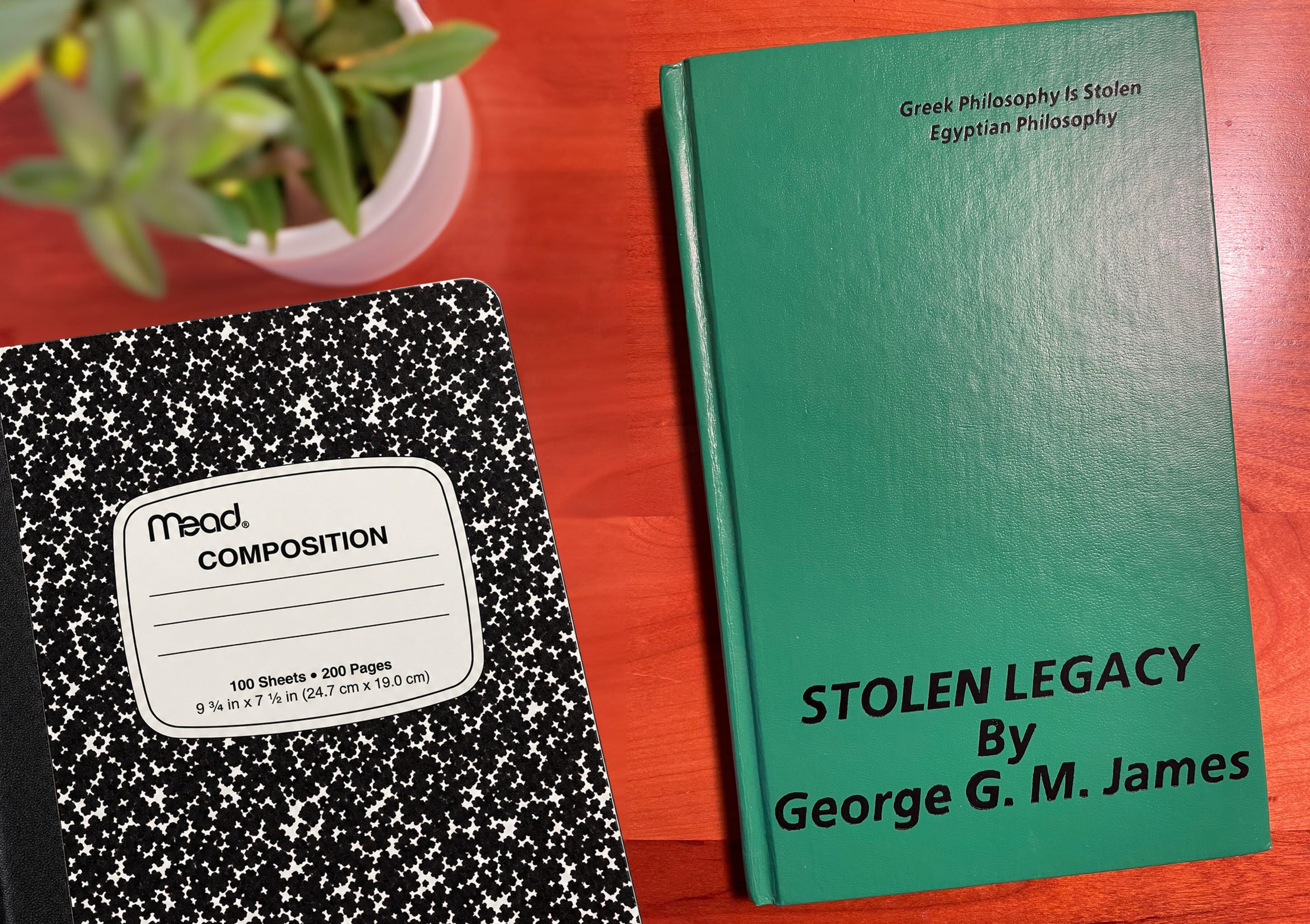
Somewhere within that period of intellectual formation I came into contact with a softcover book with an Egyptian sarcophagus adorned in gold and lapis on the cover—a later copy I secured of the same work came in the form of a green hardcover version—that remains in my library today: George G. M. James’s Stolen Legacy.
I first read James’s book sometime in 1995. Published in 1954, Stolen Legacy advances an audacious thesis. James argues not merely that Ancient Egyptian civilisation influenced Greek thought, but that what subsequently became known as Greek philosophy was substantially derived from an Egyptian Mystery System and later attributed to Greek thinkers. James himself states the proposition without ambiguity, describing Greek philosophy as a misnomer and identifying the Egyptian Mysteries as its antecedent. It is also a thesis that has generated considerable controversy among historians.
There are good reasons for treating some of James’s historical claims critically. His chronology, sources, assertions concerning particular Greek philosophers, and accounts of the transmission of Egyptian knowledge have all been challenged. Some of the specific mechanisms by which he says appropriation occurred are considerably more difficult to sustain than the broader proposition that Egyptian and Greek intellectual worlds were not isolated from one another.
For me, those distinctions matter.
To acknowledge evidence of Egyptian influence upon Greece is not necessarily to demonstrate James’s stronger claim that Greek philosophy was “stolen” wholesale from Egypt. Conversely, identifying weaknesses in James’s thesis does not establish that Egypt contributed nothing to Greek intellectual development. The historical landscape is considerably more interesting than either extreme.
Ancient Kemet (KMT) had already existed for millennia before the period ordinarily associated with classical Greek philosophy. By the time figures such as Thales, Pythagoras, Herodotus, Socrates, Plato, and Aristotle appeared, Egyptians had long developed systems of writing, monumental architecture, mathematics, medicine, religious thought, state administration, astronomy, and elaborate conceptions concerning humanity, divinity, death, order, and the cosmos.
The chronology alone does not establish intellectual transmission. It does, however, correct an image of Egypt as some peripheral civilisation standing in the shadow of Greece.
The Greeks themselves further complicate that picture.
Herodotus, writing in the fifth century BCE, devoted much of Book II of his Histories to Egypt. His account must be read critically, as all ancient sources must, but he repeatedly describes Egyptian customs, priests, religious practices, and forms of knowledge. More importantly for the question of transmission, Herodotus sometimes explicitly identifies practices he observed among Greeks as having Egyptian antecedents. In one striking passage, he describes certain rites called Orphic and Bacchic as actually Egyptian and Pythagorean; elsewhere he credits Egyptians with discoveries subsequently used by Greek poets.
That does not prove Stolen Legacy.
It does, however, make the proposition that Greece and Egypt existed as hermetically sealed intellectual worlds exceedingly difficult to maintain.
For me, the more responsible questions therefore become: What travelled between both civilisations? Through whom? During which periods? In what directions? And to what extent were ideas encountered elsewhere subsequently transformed into recognisably Greek intellectual traditions?
Yet another question shadows the above historical questions: Why has the place of Ancient Egypt within African history proved so consequential?
Egypt is in Africa. That geographical fact should require no ideological commitment whatsoever. Ancient Egypt also endured for thousands of years at a crossroads connecting the Nile Valley, Nubia and other parts of Africa with the Levant and the Mediterranean. The Nile itself flows from south to north, carrying waters from deep within the African continent toward the Mediterranean. As anthropology and archaeology repeatedly demonstrate, river systems have long served as corridors of human settlement, exchange, and migration. In the case of the Nile Valley, this means that movements of people, culture, goods, and knowledge connected Egypt not merely with the Mediterranean world to its north and the Levant to its northeast, but profoundly with African populations and civilisations to its south and west.
Mind you, all of this was occurring millennia before the Berlin Conference of 1884–1885 imposed European colonial boundaries upon much of the African continent. Projecting those comparatively recent political divisions backwards into antiquity can obscure rather than illuminate the human geography of the Nile Valley. Moreover, Ancient Egypt’s population cannot responsibly be compressed into contemporary American racial categories and projected as unchanged across several millennia.
But acknowledging such complexity should not require removing Egypt from Africa.
This becomes especially important when we remember the intellectual environment in which scholars such as James, Diop, Obenga, and later Hilliard were working. Claims about African intellectual and civilisational inferiority did not exist merely as private prejudices. They appeared in scholarship, educational systems, popular histories, racial theories, and colonial justifications. Generations of people could therefore encounter a story of civilisation whose implied trajectory ran from Greece through Rome and Europe into the modern West, while Africa appeared largely outside the lineage except as primitive precursor, colonial subject, or recipient of civilisation from elsewhere.
Kemet complicated that story.
Here stood one of humanity’s great ancient civilisations—on the African continent, flourishing millennia before classical Athens.
This was part of the intellectual terrain into which Cheikh Anta Diop stepped. Like James, Diop published one of his most consequential works in 1954. But Diop approached questions surrounding Ancient Egypt through multiple forms of evidence, including history, linguistics, anthropology, and physical investigation. One of his most controversial experiments involved melanin.
In a 1973 paper on the pigmentation of Ancient Egyptians, Diop reported examining thin sections of skin taken from Egyptian mummies preserved at the Musée de l’Homme in Paris. His object was to determine whether melanin remained detectable in mummified tissue and whether pigmentation might therefore provide empirical evidence relevant to debates concerning the Ancient Egyptian population. He reported that the epidermis could remain sufficiently preserved for such examination. He also sought samples from royal mummies—including Thutmose III, Seti I, and Ramesses II—but reported that the samples he had requested from Cairo had not arrived.
There was something important in Diop’s methodological impulse: if the bodies themselves could provide evidence, examine the bodies. Diop’s position was to ask the empirical question, test what can be tested, and allow evidence to participate in a debate too often dominated by assumptions. Assumptions that carried an imperialist or imperialist-adjacent mindset.
The larger questions surrounding the population of Ancient Egypt eventually became the subject of an important UNESCO symposium held in Cairo from 28 January through 3 February 1974. Diop and Obenga participated alongside other scholars in debates concerning the peopling of Ancient Egypt, linguistic relationships, physical anthropology, archaeology, and the relationship of Egypt to other African populations. The proceedings record disagreement rather than some tidy scholarly consensus, which is precisely why they remain interesting.
More than twenty years later, I found myself standing at Temple University talking with Obenga about precisely this intellectual lineage.
I appreciate the significance of that encounter more today than I possibly could have then.
Yet for all the historical questions raised by Stolen Legacy, something rather different became the portion of James’s book that remained most useful to me—the ten virtues.
James presents a set of disciplines associated with preparation for initiation into the Egyptian Mystery System. However one adjudicates his claims concerning their precise historical provenance, the virtues themselves struck me as worthy companions for the journey I was already travelling. They are:
Control of thought.
Control of action.
Steadfastness of purpose.
Identity with spiritual life.
Evidence of having a mission in life.
Evidence of a call to spiritual orders.
Freedom from resentment.
Confidence in the power of the master.
Confidence in one’s own ability.
Readiness for initiation.
By 1995, those propositions encountered fertile ground.
Two years earlier, in 1993, my understanding of human possibility had undergone a fundamental shift through an experience of Pure Consciousness. My study of Three Magic Words had become another companion to the interior journey unfolding during those years. I did not possess the language or conceptual frameworks that I would develop decades later. While I had been initiated into the Rosicrucian Order, AMORC a few years later in 1998, I had not yet learned Transcendental Meditation. I had not been made a Freemason. I had not become a Certified Teacher of TM. I had not undertaken doctoral study. The Seven Layers of Manifestation did not exist. Neither did the Model for Perpetual Growth and Progress.
But I had already begun asking some of the questions from which those later developments would emerge.
What is a human being capable of becoming? What is the relationship between consciousness and conduct? What is knowledge for? And what does greater knowledge require of the person who receives it?
James’s first two virtues—control of thought and control of action—suggested an ordering that remains important to me today. For those familiar with either my written works or have heard me speak, you re well aware of one of my central propositions: Every action is preceded by a thought. No matter how subtle the thought. Therefore, what we repeatedly entertain within consciousness influences what we subsequently produce through behaviour. To refine action without attending to the thinking from which action proceeds is therefore to begin downstream when attention is best directed upstream or rather within.
Steadfastness of purpose added another dimension. It is one thing to know where one wishes to go. It is another to maintain one’s orientation when circumstances become difficult, distractions multiply, or immediate results fail to appear. What I would later describe in the MPGP as intentional refinement requires precisely this capacity to keep one’s eyes on the prize while continuing to refine thought and action in relation to it.
The next virtues moved from discipline toward identity and vocation. Identity with spiritual life, evidence of having a mission in life, and evidence of a call to spiritual orders spoke directly to questions already stirring within me. The experience of 1993 had made spiritual life something more than an intellectual subject. It had become an experiential proposition. Over time, attraction to initiatic traditions would likewise become more than idle curiosity about esoteric knowledge. Such traditions suggested that knowledge might require preparation, discipline, guidance, and ultimately responsibility.
Freedom from resentment proved equally significant.
The Stoics would later provide another language through which to understand this principle: distinguish what lies within one’s control from what does not, and invest one’s attention accordingly. Freedom from resentment does not require pretending that injustice did not occur, nor does it demand reconciliation with those who caused harm. It asks something more difficult: whether another person’s conduct will be permitted to become the organising principle of one’s own consciousness. I believe this to be a key component for the development of a robust mental constitution due to personal observations that resentment can imprison the injured person within an event that has already occurred. However, freedom of thought, akin to that as proposed by Kierkegaard, restores agency.
Then came two virtues whose relationship I appreciate much more fully today: confidence in the power of the master and confidence in one’s own ability.
The first requires humility—the recognition that someone may possess knowledge, experience, or vision that one does not yet possess. The second requires development. A worthy guide should not produce permanent dependency. Guidance should assist the seeker in developing competence. So, trust the guide but become capable.
My conversations today concerning confidence frequently return to this same principle. Confidence worthy of the name is not merely something one declares. Competence provides its foundation. Through study, practice, correction, repetition, and demonstrated capability, one gradually develops legitimate reasons to trust oneself.
Finally comes readiness for initiation. And, be aware, readiness is different from desire.
One may desire deeper knowledge without yet possessing the capacity to employ it wisely. Initiation, considered developmentally, therefore becomes more than access to concealed information. It marks a threshold at which the seeker has demonstrated sufficient preparation to enter another stage of knowledge, practice, responsibility, and ultimately service.
Only in returning to these virtues more than thirty years later have I noticed how closely some of the questions they raised resemble those that eventually informed my own Model for Perpetual Growth and Progress.
I do not mean that I derived the MPGP from George G. M. James. Far from it. Intellectual genealogies are rarely so tidy. We encounter hundreds of books, teachers, experiences, conversations, successes, failures, insights, and questions across a lifetime. Their contributions mingle within us until attempting to isolate a single source becomes nearly impossible. But ideas can also be seeds.
Sometimes they enter consciousness years before the conditions exist for them to germinate.
In reviewing the ten virtues as discussed by James all these years later, the MPGP asks something remarkably close to the developmental question I encountered in those virtues, but develops the proposition into a general model of human development. Knowledge alone does not produce mastery. There must be a seeker; the seeker must acquire tools; those tools must be intentionally employed to refine the thinking and actions of the user; through refinement, capability becomes service; repeated practice produces mastery; and mastery generates outcomes—which themselves become the conditions for continued growth. Hence perpetual growth and progress.
Seen from this perspective, the ten virtues were never particularly valuable to me because they constituted another list of moral commandments. They described an architecture of becoming.
Govern thought so that action may increasingly reflect right orientation. Develop sufficient steadfastness to remain aligned with purpose. Allow spiritual life to become lived identity rather than abstraction. Discover mission. Recognise the call toward deeper knowledge. Become increasingly free from the gravitational pull of resentment. Learn from those capable of guiding you. Develop sufficient competence to trust your own cultivated ability. And demonstrate through the life you live that you are ready for what comes next.
Curiously, this also suggests something about how we might read contested books such as that of George G.M. James.
Control of thought cannot mean believing whatever confirms the worldview we already prefer. If it means anything, it must include the discipline to subject congenial ideas to the same scrutiny we apply to ideas we dislike.
I need not defend every historical claim in Stolen Legacy to acknowledge what the book contributed to my development.
Neither must James be reduced to his errors if indeed errors are found.
Diop’s questions can remain consequential even where his terminology or methods require revision.
Herodotus can preserve evidence of Greek perceptions of Egypt without every statement in his account being historically accurate.
Obenga can challenge inherited assumptions without being made infallible.
Hilliard can teach us to reconsider how Africa has been represented, be it within text or visually as with the Mercator map of 1569, thereby dislodging notions of Eurocentric centrality and thus alleged superiority over nations and contributive peoples far older along the human timeline.
The purpose of scholarship is not to exchange one orthodoxy for another. It is to see more clearly.
Perhaps that is what I find most interesting when I look today at the copy of Stolen Legacy that has accompanied me since 1995 as well as the green hardcover I was blessed to obtain from an unremembered bookstore during my many travels.
The undergraduate student who first opened it could not have known where the questions it raised would travel. He could not have known that a conversation with Théophile Obenga would still be remembered three decades later, or what the invitation from Baba would come to represent. He could not have anticipated learning Transcendental Meditation, becoming a Rosicrucian, Freemason, Certified TM Teacher, to undertaking doctoral research, or eventually developing models concerned explicitly with consciousness, knowledge, human development, and the relationship between what we know and what we produce.
He certainly could not have known that thirty-one years later he would return to those ten virtues and recognise something familiar.
Sometimes we return to an old book to discover whether we still agree with its author. And at other times we return and discover something considerably more interesting: what became of the person who first read it.
The central thesis of Stolen Legacy remains contested. The historiographical questions concerning Ancient Kemet, Greece, Africa, and the transmission of ancient knowledge deserve continued investigation wherever the evidence leads. But that is no longer the only legacy of James’s book that interests me.
In 1995, I thought I was encountering an argument about where knowledge came from. Perhaps, instead, what I carried away was an early question about what the person seeking knowledge must become.
Control your thought. Control your action. Remain steadfast in purpose. Discover what your life is for. Become increasingly free of resentment. Learn from those capable of guiding you. Develop confidence grounded in growing competence. And when deeper knowledge presents itself, show yourself ready—not merely to possess it, but to act upon it.
Thirty-one years later, I can see something I could not have seen then—perhaps Stolen Legacy left me more than an argument about the origins of philosophy. Maybe, just maybe, it left me an early map of becoming. One I continue contemplating even on this very day.
Suggested Practice
Select a book, teacher, conversation, or experience that influenced you at least ten years ago.
Return to it—not initially to determine whether you still agree with it, but to encounter again the person you were when it first entered your life.
Ask yourself:
What did I see in this then? What questions did it awaken? Which ideas did I eventually abandon or revise? Which survived? And can I recognise anything in the person I have since become that may have begun, however quietly, with that encounter?
Then consider one additional question:
What idea am I carrying today whose significance I may not understand for another ten, twenty, or thirty years?
Do not force an answer.
The purpose of the exercise is not to construct a tidy intellectual genealogy. Human development rarely works that way. It is simply to become more conscious of the seeds we encounter—and of the responsibility we bear for deciding which ones we continue to cultivate.
—
About the Author
Dr. Baruti KMT-Sisouvong is a scholar of consciousness, researcher of human development, and Certified Teacher of Transcendental Meditation® based in Cambridge, Massachusetts. His work explores the relationship between Pure Consciousness, neuroscience, and social systems, and how deeper awareness can inform both personal growth and institutional transformation.
He is the Founder and Chief Meditation Officer of Transcendental Brain, an initiative examining the intersection of consciousness research, cognitive science, and high-performance decision-making. He is also President of Serat Group Inc. and Founder and Director of Radical Scholar Inc., a nonprofit dedicated to consciousness-based research and public scholarship.
Alongside his wife and teaching partner Mina, he co-directs the Transcendental Meditation program for Cambridge and the Greater Boston area. He is also the host of the On Transcendence Podcast and Founder of International Meditation Hour, a quarterly global gathering dedicated to the unifying power of silence.
His writings—spanning frameworks such as The Model for Perpetual Growth and Progress and The Seven Layers of Manifestation—explore the evolving relationship between consciousness, leadership, and society.
He writes from the conviction that the most important race is not between nations or machines, but between the conditioned mind and the awakening soul.
To learn more about him, visit: https://barutikmtsisouvong.com/.