


Author’s Note
This reflection emerged in the silent interval between the end of meditation and a return to activity—the space in which thought has not yet fully taken hold, yet awareness is present. In that interval, certain observations do not arrive as arguments, but as recognitions.
—Baruti KMT-Sisouvong, PhD
There is a simple sequence that governs much of human life, though we rarely pause long enough to examine it directly.
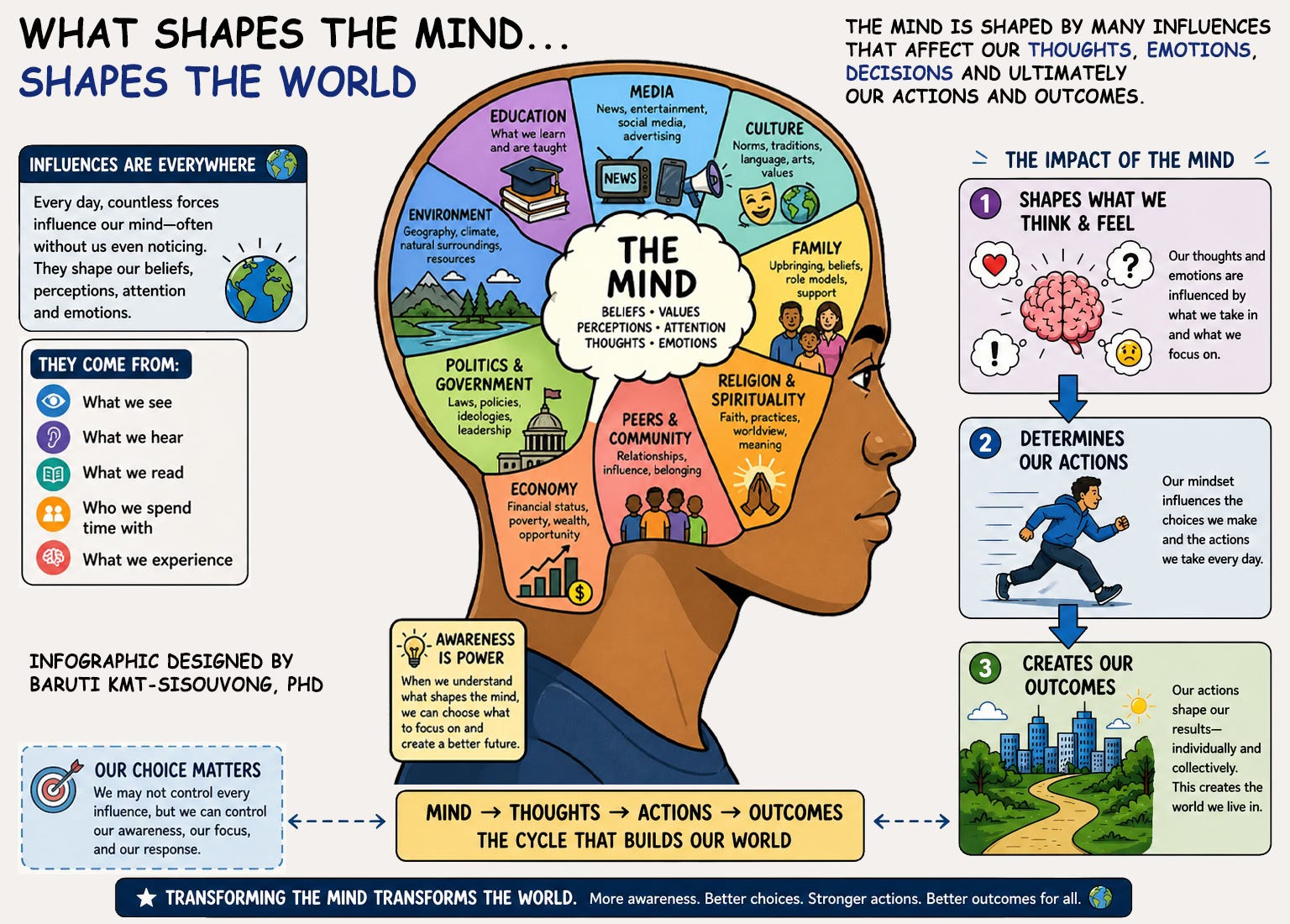
Mind gives rise to thought. Thought gives rise to action. And action gives rise to the world we collectively inhabit—the Human-Derived World.
This is not an abstraction reserved for philosophy. It is observable. Every institution, every policy, every structure—whether beneficial or harmful—began as an idea held within the field of human consciousness and then acted upon. The world we see is, in no small measure, the echo of thought made manifest.
And yet, for all the attention we give to outcomes, we seldom examine the origin point with equal seriousness.
If the human-derived world is built through thought and action, then the quality of that world is inseparable from the quality of mind from which it emerges. This introduces a subtle but consequential insight: to influence the world, one must—directly or indirectly—influence the mind.
This need not be framed in conspiratorial terms. It is simply structural. And occurs as we are born into said structure mid-sentence and are rarely, if ever, taught to critically analyse the world about us. Rather, most of us are actively encouraged via friends, family, culture, religion, media of all stripes, to keep our heads down and do not attempt to colour outside the socially acceptable lines; or there will be consequences.
Where attention goes, energy flows. Where energy flows, patterns begin to form. And where patterns stabilise, systems emerge. In this way, the shaping of attention becomes, over time, the shaping of reality itself.
To recognise this is to begin seeing the modern environment in a slightly different light.
We now live within conditions that place unprecedented demands on attention. Information is continuous. Stimulus is constant. Emotional intensity is not only present but often amplified. Under such conditions, the mind tends toward fragmentation. Attention shifts rapidly. Reaction frequently precedes reflection. Narratives are adopted before they are critically examined.
This is not a moral failing. Quite the contrary. It is a predictable response to sustained exposure to high-stimulation environments.
Yet the implications are significant. A fragmented mind does not build coherent systems. It builds reactive ones.
From here, a subtler question begins to take shape beneath the surface of things.
If mind shapes the world, and the environment increasingly shapes the mind, then what is the relationship between the two?
It is not necessary to assume deliberate manipulation to recognise a pattern. Systems that depend on attention will evolve to capture it. Systems that capture attention will, over time, shape perception. And perception, in turn, shapes action.
What emerges then is a feedback loop—one that can either stabilise or destabilise collective life depending on the quality of awareness within it.
At this point, one might be tempted to conclude that the solution lies in making more people aware of the “power of mind.” While admittedly a noble goal, awareness alone proves insufficient.
Without stability, awareness can distort. It may inflate the sense of individual control. It may fragment into competing subjective realities. It may, in some cases, amplify confusion rather than resolve it.
The question, then, is not merely one of knowledge, but of development.
What is required is not the rapid dissemination of an idea, but the gradual cultivation of a certain kind of mind—one that is less reactive, more stable, capable of sustained attention, and aligned, insofar as possible, with the underlying natural order below what I call the Phenomenal World. That substrate consists of Universal and Natural Laws that emerge from Pure Consciousness.
Such a mind does not merely think differently. It perceives differently.
And from that shift in perception, from the surface diversity to that of fundamental unity, action begins to change—not through force, but through clarity.
Seen in this light, the transformation of the world does not begin at the level of policy or institution, though these remain important. It begins at the level of experience.
When enough individuals come to experience the mind as something that can be refined, to recognise attention as a fundamentally formative force, and to act from a place of greater coherence, the structures that emerge begin, gradually, to reflect that newly acquired and actively cultivated coherence.
This process is neither immediate nor dramatic. But it is durable.
At present, many are often inclined to frame the central question outwardly: Who is shaping the world?
But a more precise question may be: What is shaping the mind from which the world is being built?
And more personally still: What is shaping mine?
Suggested Practice
Set aside 10–15 minutes today.
Not to analyse or solve, but simply to observe.
Where does your attention move when it is not directed?
What captures it most easily?
What stabilises it?
Do not attempt to control the mind. Simply notice its tendencies.
Clarity begins there.
—
About the Author
Dr. Baruti KMT-Sisouvong is a scholar of consciousness, researcher of human development, and Certified Teacher of Transcendental Meditation® based in Cambridge, Massachusetts. His work explores the relationship between Pure Consciousness, neuroscience, and social systems, and how deeper awareness can inform both personal growth and institutional transformation.
He is the Founder and Chief Meditation Officer of Transcendental Brain, an initiative examining the intersection of consciousness research, cognitive science, and high-performance decision-making. He is also President of Serat Group Inc. and Founder and Director of Radical Scholar Inc., a nonprofit dedicated to consciousness-based research and public scholarship.
Alongside his wife and teaching partner Mina, he co-directs the Transcendental Meditation program for Cambridge and the Greater Boston area. He is also the host of the On Transcendence Podcast and Founder of International Meditation Hour, a quarterly global gathering dedicated to the unifying power of silence.
His writings—spanning frameworks such as The Model for Perpetual Growth and Progress and The Seven Layers of Manifestation—explore the evolving relationship between consciousness, leadership, and society.
He writes from the conviction that the most important race is not between nations or machines, but between the conditioned mind and the awakening soul.
To learn more about him, visit: https://www.barutikmtsisouvong.com.