



Author’s Note
This essay reflects on a form of influence that is often overlooked. We tend to remember the people and books that changed what we think, but less frequently notice those that changed how we speak about what we know.
In revisiting early encounters with communicators such as Drs. Asa G. Hilliard, III, Charles S. Finch, III, Lawrence Edward Carter, Sr, Jacqueline Rouse, Wayne Dyer, and a host of others, I found that their lasting impact was not confined to agreement or disagreement with particular claims. Rather, they demonstrated a method: begin with recognition, then introduce interpretation. The listener first locates themselves in experience before being asked to adopt language.
Many years later, I recognised that much of my own teaching had, throughout the years, inherited this structure. The essay therefore is not a tribute so much as an acknowledgment of pedagogical lineage—the way one’s voice forms gradually through regular exposure, consistent study, and repeated attempts to communicate interior realities without reducing them.
Understanding matures privately. Communication matures relationally.
This piece concerns the latter.
—Baruti KMT-Sisouvong, PhD
Long before I understood what I would one day teach and speak about, I was being taught how teaching sounds.
At the time I did not recognise it as instruction. Nothing in my early encounters announced itself as formative. They appeared as books picked up out of curiosity, televised talks watched late in the evening, class instruction at both the undergrad and graduate level, public lectures attended without expectation that they would echo years later inside classrooms and auditoriums. Only in retrospect do certain moments gather weight, revealing themselves less as isolated exposures and more as a gradual shaping of voice.
In 1993, a book recommendation reached me—Three Magic Words. I approached it without a framework for where such ideas belonged. It did not fit neatly into religion, philosophy, or science as I then understood them. Yet it opened a cognitive door: the possibility that reality might be more unified than our categories suggested. At the time, I did not possess the language to defend or articulate what I sensed while reading it. I only recognised that it rearranged how questions appeared in my mind. It did not answer my questions; it changed the form of the questions themselves. To learn more about that experience, you may read about it here.
University education then provided structure. Concepts were examined historically, arguments organised, claims evaluated. I learned how knowledge is defended, how ideas are positioned within traditions, and how reasoning travels through evidence. But academic training, while clarifying thought, does not automatically teach how insight becomes receivable to a listener. It refines precision; it does not always cultivate transmission.
That lesson came from a different classroom.
In the early years of my studies, I encountered the public presentations of Dr. Wayne Dyer and others. I did not initially approach them as teachers whose content I was meant to adopt. Instead, they demonstrated something subtler: a way of speaking about interior life that neither demanded belief nor sacrificed seriousness. Their talks moved without hurry. They entered through experience rather than assertion. They allowed audiences to recognise before asking them to agree.
Watching Dr. Wayne Dyer’s public broadcasts—particularly his PBS presentations—I noticed a peculiar effect. The listener was never argued into agreement. Understanding was arranged so that it appeared already present. Stories preceded concepts. Familiar situations replaced abstract terminology. The audience discovered rather than received.
Only later did I recognise this as pedagogy.
Others, in complementary fashion, moved fluidly across domains often held apart—science, philosophy, spirituality, psychology. Agreement with every conclusion mattered less than observing the method. They demonstrated how ideas could travel across interpretive boundaries without forcing premature resolution. Listeners could enter from multiple intellectual locations and still feel addressed. Dr. Asa Grant Hilliard, III was a master at this.
In one instance that comes to mind, I was invited to sit on a plenary panel for the Association for the Study of Classical African Civilizations (ASCAC). In Spring 2005 and the panel was to discuss the recent French-to-English translation from Joseph Antenor Firman of his work titled De l’égalité des races humaines: Anthropologie Positive (1885)—Equality of the Human Races: Positivist Anthropology—as it was of keen interest to both scholars and thinkers alike as it was the first time the book was available in English. Given the role of the plenary is to establish the tone of the conference for the weekend, my nervousness was on overdrive.
After weeks of both study and preparation for my talk, Dr. Hilliard said to me, “Given your study of Firmin’s work and preparation for the panel, even if your voice cracks and you feel nervous, begin to speak and the knowledge will take over. Your preparation will make it possible.” And he was correct. I began to speak—and the knowledge took over. We received a standing ovation at the conclusion. And according to conference organizers, that had never happened with an opening plenary in the history of the organization.
That lesson, and many others, from Baba—“…even if your voice cracks and you feel nervous, begin to speak and the knowledge will take over. Your preparation will make it possible”—continues to serve me well to this very day.
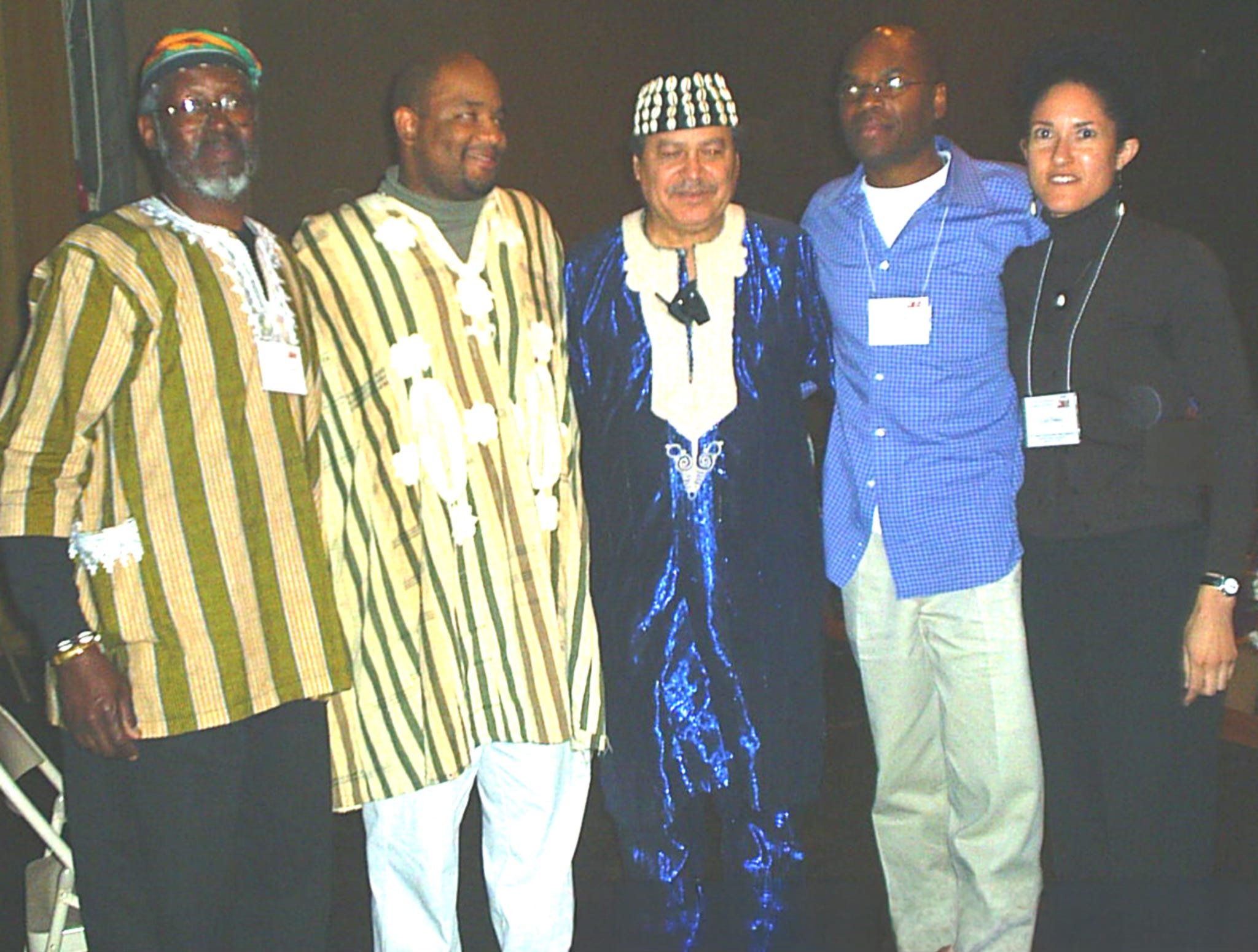
From L-R: Dr. Kobi Kambon, Kenyatta Bush, Dr. Asa G. Hilliard, III, Me, and Dr. Layli Maparyan—Current President of University of Liberia, Monrovia.
Together, both the lessons from Drs. Hilliard and Dyer, as but two examples, revealed something I had not yet articulated: ideas concerning the historical contributions of Blacks—be they within the United States or the Diaspora—as well as that of consciousness and human potential are not rejected primarily because they are complex, but because they are often introduced without regard for how understanding unfolds in the listener.
I began to notice that when I spoke in academic mode, audiences evaluated. When I spoke in experiential language, audiences recognised.
The difference was not dilution of content. It was sequence.
Years later, when presenting introductory lectures on Transcendental Meditation, participating in university panels, or speaking in community forums, I found myself unconsciously employing patterns first absorbed from those early exposures. Begin with lived experience. Allow the listener to locate themselves. Introduce terminology only after recognition occurs. Let conclusions feel discovered rather than delivered.
What appeared spontaneous was in fact inherited method.
This realisation did not diminish the role of scholarship in my life. Rather, it clarified its function. Study provided accuracy. Encounter provided accessibility. One guarded truth from error; the other protected it from distance.
In time I came to see that intellectual formation is rarely confined to a single lineage. Books shape our thinking. Teachers shape our discipline. But communicators shape our capacity to meet other minds without friction. They teach not what to think, but how thought travels between people.
I eventually recognised that many audiences were not resisting ideas about consciousness. They were resisting unfamiliar modes of entry. When the entry changed, resistance often dissolved without argument. The listener did not feel persuaded. They felt reminded.
It was then I understood why certain early influences had remained with me long after specific details faded. They had taught me a principle: understanding precedes agreement. If recognition occurs first, debate becomes unnecessary.
Years later, I encountered a line from T. S. Eliot that articulated this experience with precision:
We shall not cease from exploration,
And the end of all our exploring
Will be to arrive where we started
And know the place for the first time.
The line does not describe discovery as acquisition but as return—a revisiting made possible by a changed capacity to see. The ideas that once felt distant become obvious not because they altered, but because our language for them matured.
Looking back, the path from an unexpected book in 1993, through formal education, to observing communicators capable of bridging inner and outer worlds did not simply accumulate knowledge. It cultivated voice. Not a voice as personal expression, but as a medium in which understanding can travel without distortion.
One learns what is true through study.
One learns how truth can be heard through encounter.
Only after both occur does teaching begin.
And when it does, it often feels less like presenting something new and more like guiding others to recognise what they have quietly known—arriving, together, where we began, and knowing it for the first time.
Suggested Practice
Noticing How You Were Taught to Understand
Take a few minutes and reflect on a person, book, or experience that shaped not merely your opinions, but the way you explain ideas to others.
Ask yourself:
When I try to help someone understand something important, what do I do first—define, argue, or illustrate?
Did I learn this approach consciously, or did I absorb it from someone whose explanations felt unusually clear?
How might my communication change if I began from shared experience rather than explanation?
Write briefly about an idea you care about, but describe it only through everyday examples. Avoid specialised terminology. Notice whether understanding feels easier to convey.
The aim is to observe that communication is often inherited before it is chosen.
—
About the Author
Dr. Baruti KMT-Sisouvong is a scholar of consciousness, researcher of human development, and Certified Teacher of Transcendental Meditation® based in Cambridge, Massachusetts. His work explores the relationship between Pure Consciousness, neuroscience, and social systems, and how deeper awareness can inform both personal growth and institutional transformation.
He is the Founder and Chief Meditation Officer of Transcendental Brain, an initiative examining the intersection of consciousness research, cognitive science, and high-performance decision-making. He is also President of Serat Group Inc. and Founder and Director of Radical Scholar Inc., a nonprofit dedicated to consciousness-based research and public scholarship.
Alongside his wife and teaching partner Mina, he co-directs the Transcendental Meditation program for Cambridge and the Greater Boston area. He is also the host of the On Transcendence Podcast and Founder of International Meditation Hour, a quarterly global gathering dedicated to the unifying power of silence.
His writings—spanning frameworks such as The Model for Perpetual Growth and Progress and The Seven Layers of Manifestation—explore the evolving relationship between consciousness, leadership, and society.
He writes from the conviction that the most important race is not between nations or machines, but between the conditioned mind and the awakening soul.
To learn more about him, visit: https://barutikmtsisouvong.com.