



Author’s Note
This essay emerged unexpectedly from a convergence of reflection, memory, institutional transition, family dynamics, and a small book encountered nearly two decades ago that somehow refused to leave my consciousness.
In many ways, the piece became less about manifestation and more about coherence: the silent, often painful process through which vision reorganizes relationships, institutions, and one’s understanding of who is genuinely aligned with the journey ahead.
If this essay resonates with you, perhaps you too are navigating a season in which old structures are dissolving while new forms of alignment gradually emerge.
If so, continue walking.
Clarity often arrives after contraction.
— Baruti KMT-Sisouvong, PhD
Nearly twenty years ago, I visited Athens, Georgia for a few days and while visiting a local bookstore, came across a small book with a deceptively simple title: Your Invisible Power. The book itself, authored by a mentee of Thomas Troward—Genevieve Behrend—was physically unremarkable. Thin. Plain. Easy to overlook on a shelf crowded with louder promises and more polished presentations. Yet, somehow, it drew me in. As a result, I pulled the thin volume from the shelf, took a seat, and began to read. I read the book in that sitting and purchased it. The lessons have remained with me all these years later—even if, at times, I find myself not strictly adhering to them.
At the time, I was still trying to understand the relationship between thought, consciousness, intention, and the strange unfolding architecture of human life. Like many who encounter the broader lineage of the New Thought tradition through figures such as Thomas Troward, I found myself simultaneously intrigued and cautious. There were ideas present that resonated deeply, alongside others that occasionally drifted too close to magical thinking or the seductive simplicity of believing one could merely “think” their way into reality.
Still, something enduring lived beneath the surface of the book’s central premise. Not wishful thinking or fantasy. Rather, the notion that sustained orientation of mind and consciousness possesses consequences. That what one consistently holds inwardly begins, over time, to shape perception, relationship, action, opportunity, resilience, and ultimately the trajectory of one’s life.
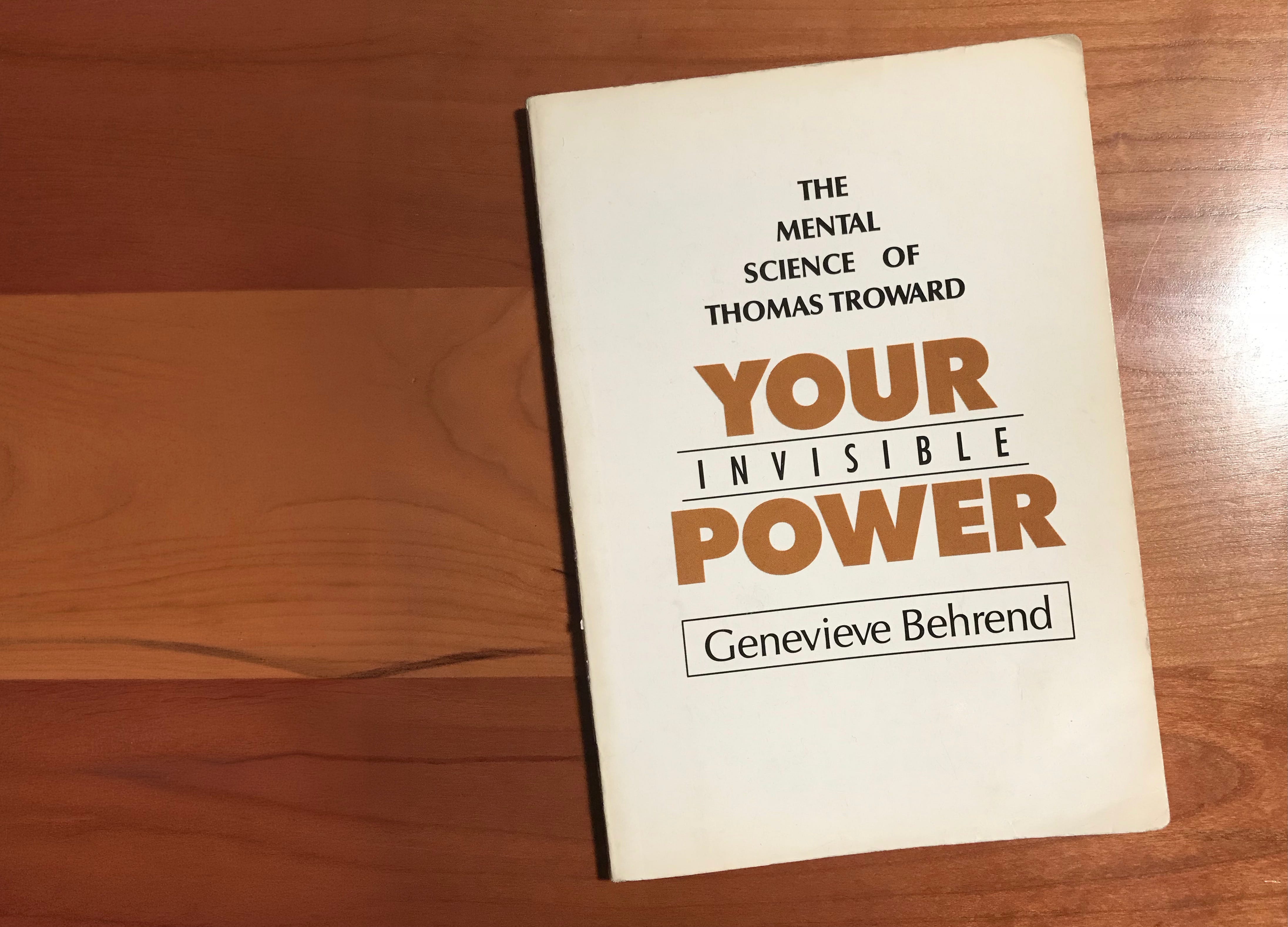
Two decades later, I now understand the matter somewhat differently.
The invisible power is not merely the capacity to envision a future.
It is the capacity to remain internally coherent while one’s relationships, institutions, and social ecosystems reorganize around that vision.
That realization, admittedly, is far less romantic—and far lonelier.
Over the last two and a half years, my family and I have navigated a prolonged period of contraction. Financial strain. Institutional instability. Shifting organizational structures. Silence where one expected support. Distance where one expected continuity. Alongside these realities existed the subtle psychological challenge of attempting to continue building, writing, teaching, researching, parenting, and envisioning while portions of one’s external world appeared to narrow simultaneously.
During such moments, one learns a great deal about the invisible architecture of relationship.
One also learns how deeply human it is to want to bring others along.
There is a generous instinct within many vision-oriented people that whispers:
“Surely if they understand what is emerging, they too will see it.”
“Surely if the invitation is extended carefully enough, thoughtfully enough, lovingly enough, they will walk beside us into the next phase.”
Yet, in my experience, life rarely unfolds so neatly.
Recently, I found myself contemplating whether to share a developing initiative document with members of my family. The document itself represents the gradual emergence of what has become an interconnected ecosystem involving consciousness studies, public scholarship, meditation, neuroscience, civic engagement, media, institutional dialogue, and long-term human development initiatives.
On the surface, the impulse felt reasonable. Even loving. If something meaningful is emerging, should those closest to us not at least be given the opportunity to participate?
But beneath the question rested another realization: an opportunity extended is not the same thing as an opportunity accepted.
That distinction matters.
Some time ago, I sent messages attempting to reconnect. One responded warmly. The others did not respond at all. At first, part of me continued carrying the subtle emotional burden of wondering whether I should “try harder,” explain more clearly, or somehow create conditions under which everyone could remain connected to the evolving journey.
Then I remembered something Michelle Obama once discussed regarding transition, growth, and public life. She spoke candidly about the reality that, as one evolves into larger responsibilities and more visible forms of stewardship, some people simply “are not ready for the climb.” When I first encountered that sentiment years ago, I remember finding it somewhat harsh.
I no longer do.
Not because I have become cynical. Nor because I believe human beings are disposable. Quite the contrary. Rather, I now understand that growth is not merely additive. It is also selective.
Not everyone possesses the disposition, emotional maturity, energetic alignment, or long-term orientation necessary for every phase of becoming.
Similarly, I recall the discussions surrounding Barack Obama as he entered the Presidency, and the phrase that circulated around him: “No new friends.” He sought to protect his mental energy as well as that of those whom he knew were equipped for the journey ahead.
At the time, many interpreted the statement either socially or politically. Yet, from my perspective, beneath it existed a deeper understanding: one’s visibility, mission, and responsibility to the emerging work fundamentally reorganizes relationships in big and small ways.
The moment one begins carrying something larger than oneself, discernment becomes necessary.
Not because one becomes “better” than others; but because stewardship requires coherence.
This, I suspect, is among the more painful dimensions of adulthood that few discuss honestly. We are often taught to imagine growth as a universal procession where everyone we love walks beside us indefinitely. Yet experience reveals something different. Some relationships deepen. Others fade. Some people surprise us with their presence, with their absence, and occasionally, entirely new alignments emerge from directions we never anticipated. Here, I am reminded of something I learned from Iyanla Vanzant during a talk of hers I attended in Atlanta:
People come into your life for a reason, season, or lifetime.
Over the past several weeks, as the broader initiative has continued to clarify itself, I have experienced precisely this phenomenon. New conversations have emerged with scholars, philanthropically minded individuals, institutional figures, civic leaders, contemplative practitioners, and strategic thinkers. People have begun engaging not merely with isolated projects, but with the deeper architecture connecting them.
Interestingly, many of these individuals were not the people I initially imagined would resonate most deeply with the work.
And perhaps that is part of the lesson.
Vision does not merely reveal the future. It reveals relational alignment.
The invisible power discussed by Behrend now strikes me as less concerned with “manifesting” outcomes than with sustaining inner clarity long enough for authentic structures to emerge around one’s deepest orientation. In this sense, consciousness does not merely shape external reality through mystical causation. Instead, it shapes reality through attention, endurance, coherence, discernment, and the subtle but consequential decisions regarding where one places one’s time, energy, trust, and relational investment.
Recently, while volunteering during a session with the Urban League, I found myself reflecting upon how meditation and consciousness-based practices might be presented meaningfully to communities navigating stress, instability, fragmentation, and the broader loneliness epidemic increasingly discussed by figures such as Scott Galloway. At that moment, something became unexpectedly clear to me:
the work was never solely about meditation instruction. It was about coherence—human, relational, civic, and inner.
As external fragmentation increases, coherence becomes increasingly important. As a result, something I learned a couple of years ago surfaced and speaks to the import of presenting this knowledge and technique to people who will view it as an asset versus as an accessory. The former is certainly in great need now.
And perhaps that is why the last two and a half years unfolded as they did.
Contraction has a way of clarifying architecture.
When resources shrink, illusions often disappear alongside them. One begins seeing more clearly—who truly resonates, what genuinely matters, which structures possess integrity, and, perhaps most importantly, which relationships can sustain the weight of evolution.
This does not eliminate grief. Some distances still ache more than a little. Unexpected silences still carry emotional weight. Yet maturity increasingly requires accepting that not everyone is meant to accompany us into every phase of becoming. And that is okay.
In reflecting on it in this moment, perhaps that acceptance is itself a form of invisible power.
Not a form of domination, manifestation rhetoric, or the fantasy of controlling outcomes.
But the silent strength required to continue walking coherently toward an emerging future even as one’s relational landscape reorganizes around the journey.
In the end, I suspect the deeper lesson is this: We cannot force resonance.
We can only extend invitation, remain internally aligned, and allow life to reveal who is genuinely prepared to walk beside the vision as it unfolds.
And as I am coming to understand it, acceptance of that realisation matters most.
So, continue moving forward and allow the people and resources who are aligned with and will aid in bringing the vision to fruition to, as Maharishi was wont to say in relation to financial resources “Come from where ever it is.”
Suggested Practice
Mapping Resonance
Take 15–20 minutes with a journal or sheet of paper and reflect silently upon the following questions:
Which relationships in my life consistently deepen my sense of coherence, clarity, and groundedness?
Which relationships leave me chronically fragmented, diminished, or emotionally exhausted?
Where am I attempting to force resonance rather than allowing alignment to reveal itself naturally?
What opportunities, visions, or callings am I hesitant to fully embrace out of fear that others may not come with me?
What might change if I stopped viewing discernment as rejection and began viewing it as stewardship?
After reflecting, sit in silence, with eyes closed for several minutes without attempting to “solve” anything.
Simply observe what thoughts, emotions, or insights emerge.
Sometimes clarity arrives not through force, but through stillness.
—
About the Author
Dr. Baruti KMT-Sisouvong is a scholar of consciousness, researcher of human development, and Certified Teacher of Transcendental Meditation® based in Cambridge, Massachusetts. His work explores the relationship between Pure Consciousness, neuroscience, and social systems, and how deeper awareness can inform both personal growth and institutional transformation.
He is the Founder and Chief Meditation Officer of Transcendental Brain, an initiative examining the intersection of consciousness research, cognitive science, and high-performance decision-making. He is also President of Serat Group Inc. and Founder and Director of Radical Scholar Inc., a nonprofit dedicated to consciousness-based research and public scholarship.
Alongside his wife and teaching partner Mina, he co-directs the Transcendental Meditation program for Cambridge and the Greater Boston area. He is also the host of the On Transcendence Podcast and Founder of International Meditation Hour, a quarterly global gathering dedicated to the unifying power of silence.
His writings—spanning frameworks such as The Model for Perpetual Growth and Progress and The Seven Layers of Manifestation—explore the evolving relationship between consciousness, leadership, and society.
He writes from the conviction that the most important race is not between nations or machines, but between the conditioned mind and the awakening soul.
To learn more about him, visit: https://barutikmtsisouvong.com/.