


Author’s Note
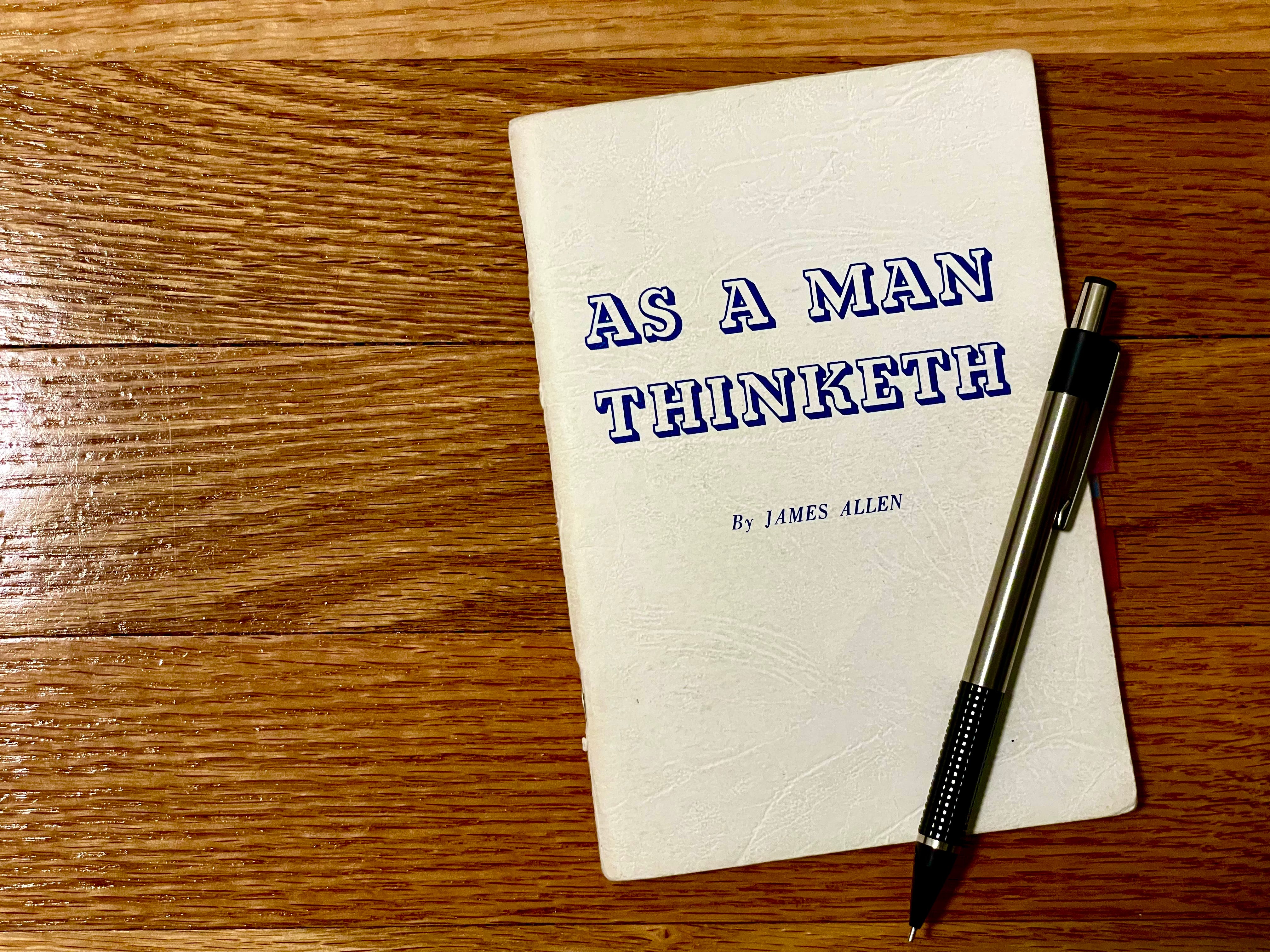
In 1903, the British writer James Allen published a small book titled As a Man Thinketh. Its central insight was simple yet enduring: our thoughts shape our character, and our character shapes our lives.
For many readers, Allen’s work has served as a meaningful guide to self-reflection. Yet as I revisited the text recently, reading several pages each evening with my family before retiring for the night, another thought began to unfold.
Allen spoke primarily of the individual mind.
But individuals do not begin life as isolated thinkers.
Long before we form our own conclusions about the world, we inherit a mental environment—one shaped by the families into which we are born. In that sense, the deeper truth may be this:
Before a man thinketh, a family thinketh.
This essay explores that inheritance.
Just as families pass down physical traits through generations, they also transmit patterns of thought—beliefs about work, love, faith, money, possibility, and limitation. These mental inheritances often travel silently across generations, shaping how each new member of the family lineage interprets life itself.
To understand consciousness at the level of society or civilization, we must first understand the place where consciousness is most intimately formed:
the family.
This essay is an attempt to understand just that.
—Baruti KMT-Sisouvong, PhD
For several evenings over the course of about a month, our family settled into a small post-dinner ritual.
Before the house settled for the night and just after dinner dishes were cleaned, we read a few pages from As a Man Thinketh. The book itself is small—barely more than a pamphlet—but its sentences carry the kind of clarity that invites reflection long after the page is read.
Allen famously wrote:
A man is literally what he thinks, his character being the complete sum of all his thoughts.
As we read those words aloud at the start of the book, the simplicity of the idea seemed almost disarming. Of course our thoughts shape our lives. Anyone who has spent even a moment observing the mind can see how a single belief can alter an entire day.
Yet sitting there together, another realization slowly appeared.
If thoughts shape the individual, then the environment in which those thoughts first arise must also matter.
And the first environment of thought is not the school or the workplace.
It is the home.
The First School of Consciousness
Before a child learns language, they learn atmosphere.
They absorb tone before vocabulary. They recognize tension before explanation. They sense joy before understanding its cause.
The emotional climate of the household becomes the first environment in which consciousness begins to orient itself.
While reading Allen’s reflections on character and thought each evening, I found myself thinking about how those patterns begin long before a person ever opens a philosophical book.
A child does not first encounter ideas about life through philosophy.
They encounter them through family conversation.
They hear how adults speak about work, about other people, about success, about finances, about hardship. They observe how conflict unfolds and how reconciliation happens—or does not happen. They watch how adults interpret events: whether setbacks are seen as catastrophe or as challenge. Whether the home is chaotic or, as Mina and I consciously seek to cultivate our space, a sanctuary.
Over time, these observations form the earliest architecture of thought.
The child may not yet possess the vocabulary to explain what they are learning, but the lessons are absorbed nonetheless.
In this way, it may be rightly said the family becomes the first school of consciousness.
The Invisible Curriculum
One evening, after reading a passage in which Allen compared the mind to a garden—where thoughts are the seeds that eventually become character—I found myself reflecting on two lessons I have learned along my journey—how for the first half of our lives we create our habits; for the second half, our habits create us; and how gardens are rarely planted only once.
Both are cultivated repeatedly.
In much the same way, families cultivate mental environments through countless small moments: conversations at dinner, reactions to unexpected news, stories told about the past, expectations spoken or unspoken about the future.
These moments form what might be called the invisible curriculum of the household.
No syllabus announces it. No formal lesson introduces it.
Yet its influence can be lasting.
Children learn what the world is supposed to be like long before they consciously examine those beliefs. They learn whether the future is something to approach with curiosity or with caution. They learn what success looks like and what failure means. On that final point, one of our favourite quotes comes from Henry Ford, where he commented:
“Failure is the opportunity to begin again more intelligently.”
Because these lessons arrive gradually and are often forgotten as time passes for young minds, and if consciously executed by the parents or guardians, they often become mental heirlooms that serve the developing mind of a child well into young adulthood and beyond.
The inherited map becomes indistinguishable from the territory.
The Architecture of Belief
Every family carries a set of underlying assumptions about life.
Some families cultivate intellectual curiosity. Books fill the home, questions are encouraged, and exploration is welcomed. In such households, children may grow up assuming that learning is both natural and joyful.
Other families may emphasize stability and survival. Practical concerns dominate daily conversation. Work becomes the central organising principle of life. In such environments, children may grow up viewing the world primarily through the lens of security and responsibility.
Neither orientation is inherently superior to the other. Each arises from the historical experiences of the members who comprise the foundation of the family itself.
Generations shaped by migration, hardship, or instability often develop mental frameworks designed to protect against uncertainty. Other families, shaped by different circumstances, may transmit expectations that emphasise expansion and exploration.
Over time, these frameworks become what we might call the “architecture of belief."
They determine what futures seem imaginable and which possibilities appear out of reach. Here I find myself reflecting on a passage where Allen writes:
He who has conquered doubt and fear has conquered failure.
In response to that passage, I pencilled the following reflection into the margin late one night.
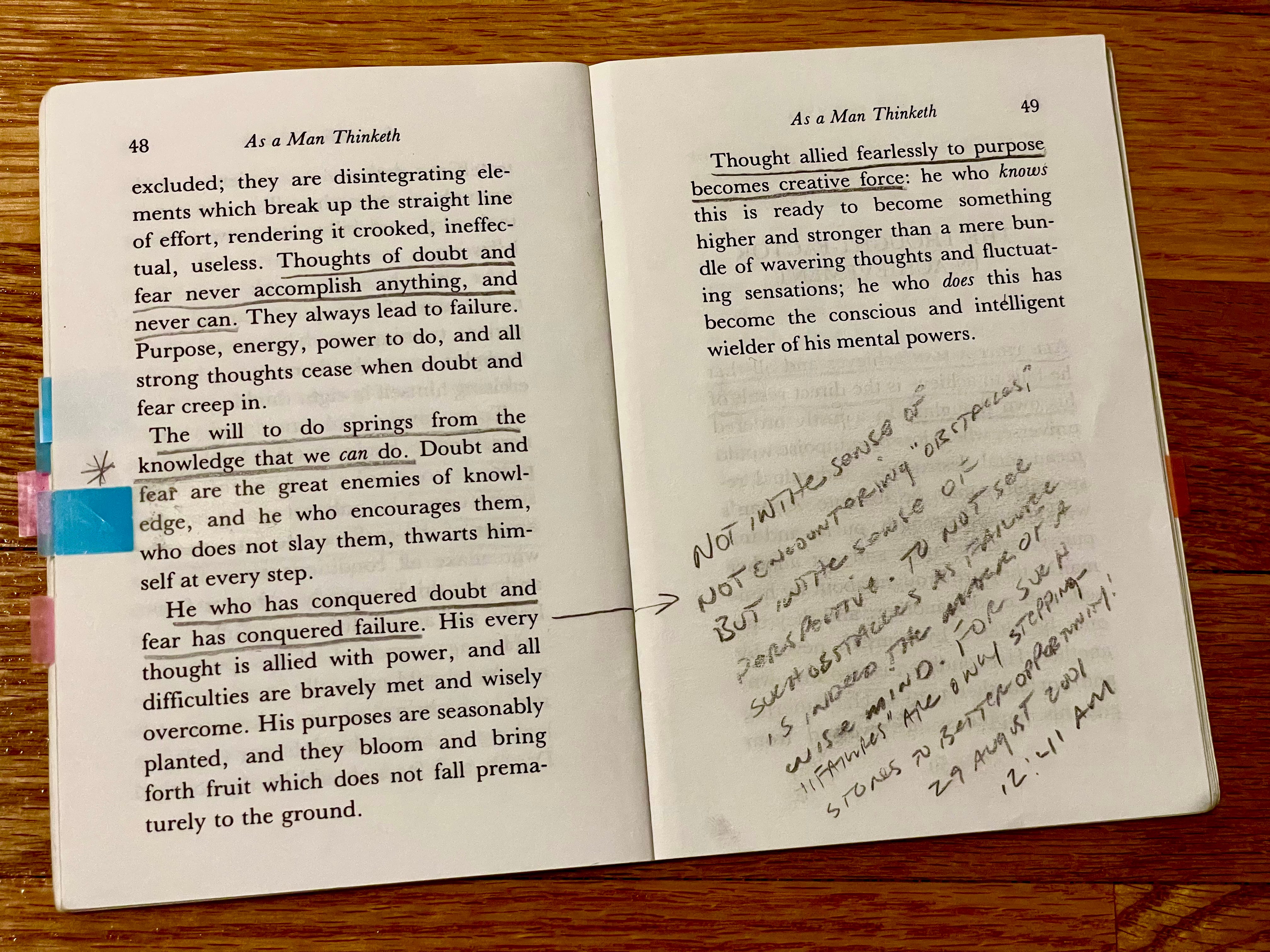
Not in the sense of not encountering ‘obstacles,’ but in the sense of perspective. To not see such obstacles as failure is indeed the mark of a wise mind. For such ‘failures’ are only steppingstones to better opportunity.
(Dated 29 August 2001, 12:41 AM.)
Looking at the note now, however, I cannot help but notice something else: the handwriting itself.
In those years, my penmanship was far less disciplined than it is today. For a period of time I even set aside deliberate practice—working through stacks of legal pads simply to refine how I wrote on the page. It may seem like a small matter, but the contrast between the hurried script in that margin and the steadier hand I now possess reminds me of something of considerable import.
Growth does not occur only in the grand ideas we entertain.
It also appears in the small disciplines we choose to cultivate along the way.
In that sense, the handwriting itself becomes a kind of archaeological trace—evidence that the person who first wrote those words and the one reflecting on them now are connected, yet not entirely the same.
When Inheritance Becomes Awareness
As our evening readings continued, I noticed something familiar—something that echoed those late-night reflections many years ago.
Allen’s sentences have a natural way of inviting the reader to pause. They ask us to observe the mind directly rather than merely pass over the words.
During these moments of pause, conversations would begin to unfold around our table. Chloë and Emerson—the “Bigs,” as we call them—seemed to enjoy these exchanges, even at their young ages.
It was a meaningful reminder that reflection itself can be inherited. In a contemplative environment, even young minds begin to sense that thought is something that can be examined rather than simply accepted.
Those pauses revealed something subtle yet powerful: many of the thoughts we carry feel familiar not because they are necessarily true, but because they have been repeated.
Repeated by parents. Repeated by relatives. Repeated by the stories families tell about themselves.
At some point, many people experience a moment of recognition.
A thought arises, and instead of accepting it automatically, they examine it.
Where did this idea come from?
Why does a certain fear feel so familiar? Why does a particular possibility feel strangely unreachable?
Moments like these mark the beginning of awareness.
The inherited patterns of thought that once appeared as unquestionable reality begin to reveal themselves as interpretations.
And once an interpretation is recognized as inherited, it can also be reconsidered.
The Responsibility of Awareness
Awareness introduces a new question.
If we inherit patterns of thought from the past—and from our parents or guardians in particular—what will we consciously pass forward to the future?
Each generation stands at a crossroads between inheritance and intention. We receive certain ways of interpreting the world, yet we also possess the capacity to refine them.
Families shaped by fear can gradually become families that cultivate courage. Households accustomed to silence can become places where difficult conversations are welcomed.
Change rarely happens instantly. Beliefs formed across decades—or even centuries—carry emotional weight. Yet awareness creates the space in which transformation becomes possible. Here we turn again to Allen, who writes:
All that a man achieves and all that he fails to achieve is the direct result of his own thoughts.
As I reflect on this passage, I cannot help but wonder how it is that so few people seem to grasp that the human-derived world—with its constructs and outcomes—is itself a product of the human mind. It is as though human society has sufficiently clouded the eye of inner knowing for so many that few ever move beyond the proverbial cave.
Many will pass into the great beyond having never awakened the latent potential within them to envision—and help bring about—a better lived reality, not only for themselves but also for those whose lives they touch.
This, I believe, is one of the great failings of modern society: it encourages the unawakened mind to remain in a kind of perpetual slumber, unaware of the possibility of personal and collective transformation.
Imagine what an environment consciously oriented toward personal transformation might bring about for the species. Imagine further what might unfold within familial networks—both immediate and extended. For when transformation takes root within a family, its effects ripple outward into society, carrying with them the possibility of lasting change for the species writ large.
The Larger Context of Consciousness
Seen from a broader perspective, the inheritance of mind is part of a much larger movement.
In the previous essay—Consciousness is the Only Real Game in the Universe: A Story Across Traditions—I explored how cultures across the world—from ancient African cosmologies to Vedic philosophy and modern physics—have repeatedly returned to the same insight: consciousness is primary.
Families represent the most intimate expression of that principle.
Within the household, consciousness learns to interpret itself through relationships, expectations, and shared narratives. Each generation inherits a particular configuration of thought, and each generation modifies it in subtle ways.
In this sense, the family becomes one of the places where the human-derived world is inarguably constructed.
Closing Reflection
On the final evening of our reading, we closed the small volume of As a Man Thinketh and sat in relative silence for a moment.
Allen had written about the power of individual thought.
Yet the deeper realization, at least for me, was this: thought rarely begins alone.
It begins in conversation, in atmosphere, in the shared mental environments of the families into which we are born.
Families shape the earliest contours of our thinking, but consciousness itself remains larger than any inheritance.
The same awareness that absorbs patterns can also observe them. It can question them, refine them, and choose which ones deserve to be carried forward.
The inheritance of mind is therefore not merely something we receive.
It is something we continually rewrite.
And in so doing, we help ensure that the next generation inherits not only our circumstances, but our growing awareness of the freedom to shape them.
For if it is true that a man becomes what he thinks, it may be equally true that a family becomes what it repeatedly believes—and a civilization becomes what its families teach their children to imagine.
Suggested Practice: Observing the Inheritance
Journal Prompts
What beliefs about success, work, or relationships did you inherit from your family?
Which of these beliefs continue to serve you well today?
Which beliefs might be ready for reconsideration or renewal?
Practical Exercise
During a conversation with family this week, notice not only what is said but the assumptions beneath it. Observe how certain patterns of thought appear automatically in familiar contexts.
Ask yourself: Is this belief something I consciously choose to carry forward?
—
About the Author
Dr. Baruti KMT-Sisouvong is a scholar of consciousness, researcher of human development, and Certified Teacher of Transcendental Meditation® based in Cambridge, Massachusetts. His work explores the relationship between Pure Consciousness, neuroscience, and social systems, and how deeper awareness can inform both personal growth and institutional transformation.
He is the Founder and Chief Meditation Officer of Transcendental Brain, an initiative examining the intersection of consciousness research, cognitive science, and high-performance decision-making. He is also President of Serat Group Inc. and Founder and Director of Radical Scholar Inc., a nonprofit dedicated to consciousness-based research and public scholarship.
Alongside his wife and teaching partner Mina, he co-directs the Transcendental Meditation program for Cambridge and the Greater Boston area. He is also the host of the On Transcendence Podcast and Founder of International Meditation Hour, a quarterly global gathering dedicated to the unifying power of silence.
His writings—spanning frameworks such as The Model for Perpetual Growth and Progress and The Seven Layers of Manifestation—explore the evolving relationship between consciousness, leadership, and society.
He writes from the conviction that the most important race is not between nations or machines, but between the conditioned mind and the awakening soul.
To learn more about him, visit: https://www.barutikmtsisouvong.com/.