


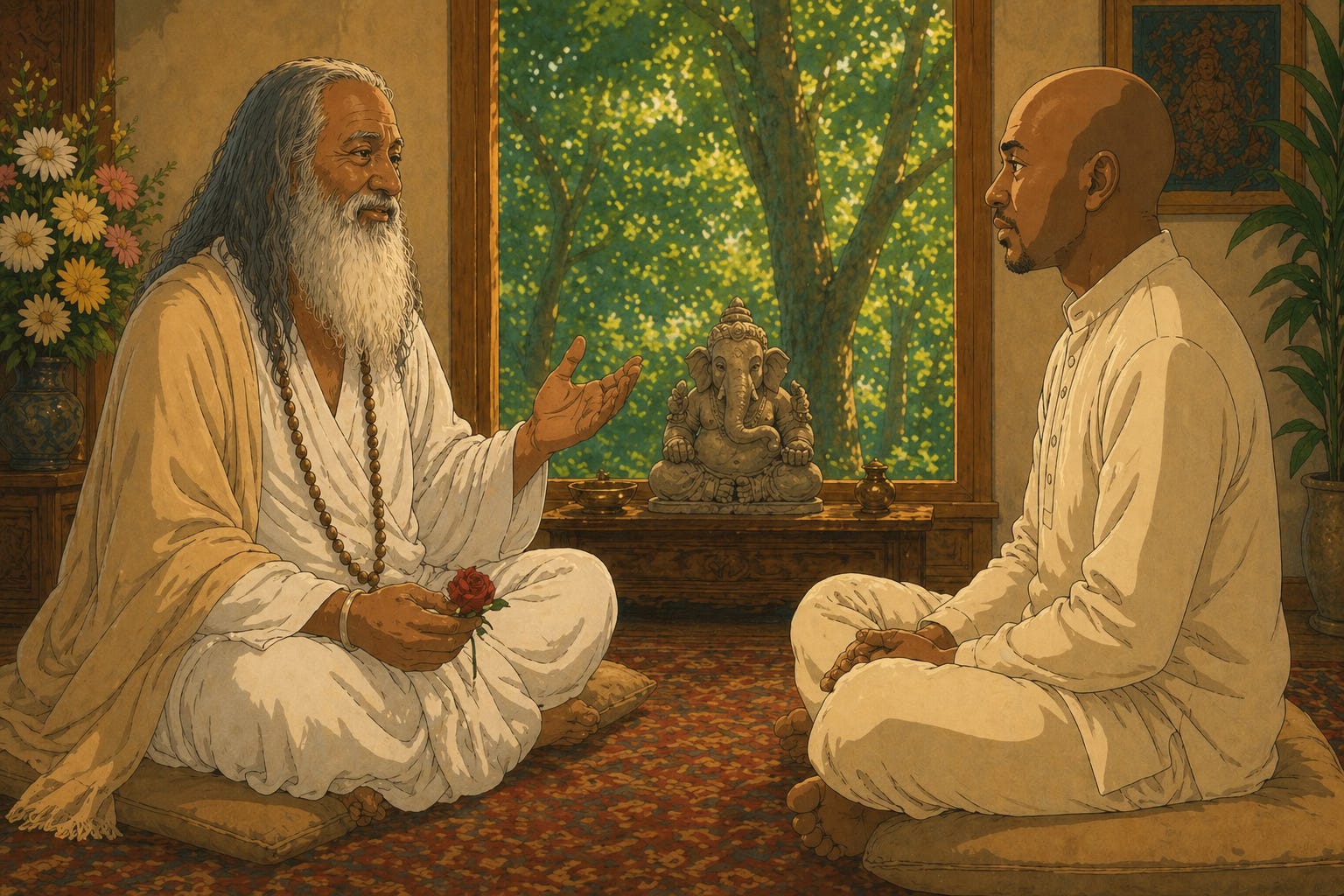
The accompanying image is inspired, in part, by a series of dream experiences that unfolded over a number of years, beginning in the fall of 2008 and continuing through my time on the Transcendental Meditation Teacher Training Course (2012–2013). In these dreams, conversations with Maharishi arose not as instruction, but as recognition—exchanges that suggested knowledge is not only transmitted outwardly, but also encountered inwardly. While those experiences remain largely private, they have informed the spirit in which this work, and my larger body of work, is offered.
Author’s Note
In recent years, meditation has moved from the margins to the mainstream. What was once considered esoteric has now entered boardrooms, classrooms, and clinical settings. Yet with this increased visibility has come a certain diffusion of meaning—an abundance of techniques, interpretations, and expectations, often leaving the curious uncertain of where to begin. This essay offers a brief account of Transcendental Meditation®: where it comes from, how it entered the modern world, and why it continues to be practiced by individuals seeking clarity, stability, improved health, and a more coherent experience of life.
—Baruti KMT-Sisouvong, PhD
The Modern Condition
We live in an age defined not simply by activity, but by acceleration. Information moves at a pace that outstrips our capacity to assimilate it. Demands accumulate across domains—personal, professional, social—without clear boundaries between them. Even rest, for many, has been absorbed into the logic of productivity, becoming something to optimise rather than something to experience and incorporate as a norm.
Amid this, a seemingly simple question begins to arise. It does not announce itself loudly, nor does it demand immediate resolution. Rather, it lingers at the edges of awareness:
Is there a reliable way for the mind to settle—naturally, without effort or strain?
This question, though it may feel contemporary, is not new. It has accompanied human beings across centuries and, based on available evidence, all traditions, emerging wherever there has been the desire not merely to act, but to understand the source from which action arises.
To learn more about the journey of Consciousness through time and traditions, consider reading my essay titled Consciousness is the Only Real Game in the Universe: A Story Across Traditions.
An Ancient Lineage
Long before the language of neuroscience or psychology emerged, and in the wake of the historical disruption and loss of many formal repositories of knowledge across parts of the African continent due to colonialism—though much of this knowledge endured through resilient oral traditions—there remained a body of knowledge concerned with the nature of consciousness itself. Preserved within the Vedic tradition of India, this knowledge approached the mind not as something to be disciplined into silence, but as something capable of transcending activity altogether.
In this view, meditation was neither concentration nor contemplation. It did not require the practitioner to hold the mind steady or direct it toward a particular object. Instead, it recognised a natural tendency within the mind—a movement toward subtler, more refined levels of awareness. When allowed to follow this tendency without interference, the mind could settle into a state of deep, silent wakefulness.
This was not presented as philosophy alone. It was offered as a repeatable experience, accessible through proper instruction.
A Teacher and a Transition
In the mid-twentieth century, Maharishi Mahesh Yogi undertook the task of bringing this knowledge into a world undergoing rapid transformation. His contribution was not to construct a new system, but to articulate and teach a technique—simple, systematic, and precise—that would allow individuals to access this deeper level of awareness without withdrawing from the demands of contemporary life.
In so doing, he reframed meditation from something reserved for monastic or ascetic contexts into something that could be practiced within ordinary routines—that of a householder. The emphasis was not on belief, nor on adherence to a particular worldview, but on direct experience. One did not need to adopt a new identity in order to practice. One needed only to learn.
Crossing into the Modern World
Beginning in the late 1950s, and gaining momentum through the decades that followed, Transcendental Meditation began to spread across Europe and North America. It entered universities, research institutions, and private homes, carried not by doctrine but by demonstration. Those who learned the technique often found it sufficiently compelling to share with others, and in this way its reach expanded.
People came to the practice from different directions. Some were drawn by its growing cultural visibility of the day, the widely viewed television interviews conducted with Maharishi himself, the possibility of reducing stress, others by a desire for greater clarity of thought, and still others by a more general sense that something essential had been obscured within the pace of modern living. What they encountered was not complexity, but simplicity—a technique that could be practiced without strain and integrated without disruption.
From Experience to Evidence
As the practice gained visibility, it also attracted the attention of researchers. Over time, studies began to examine the physiological and neurological effects associated with Transcendental Meditation—among the earliest widely recognised being the work of Robert Keith Wallace in 1970. Dr. Wallace would later serve as president of Maharishi International University. What emerged was a pattern that, while described in contemporary scientific language, echoed the experiential accounts that had preceded it.
During the practice, the body was observed to enter a state of deep rest, often more pronounced than that achieved during ordinary relaxation. At the same time, the mind remained quietly alert. This combination—restful physiology alongside wakeful awareness—suggested a mode of functioning distinct from waking, dreaming, and sleep activity.
Further inquiry explored changes in patterns of brain activity, indicators of stress, and aspects of cognitive performance. While the specifics of these findings continue to be refined, the underlying principle remains straightforward:
When the mind is allowed to settle in a natural way, the system as a whole tends toward greater coherence.
The Nature of the Practice
In a landscape now populated by a wide range of meditative approaches, Transcendental Meditation remains distinctive in its effortlessness. It does not ask the practitioner to concentrate, to monitor the mind, or to control the flow of thoughts. Instead, it provides a means by which the mind can move inward, guided by its own inherent tendencies.
Practiced for twenty minutes, twice each day, it becomes less an activity to be performed and more a process that unfolds. For many, this quality of effortlessness removes the uncertainty that often accompanies attempts at meditation. There is nothing to force, and nothing to sustain. One simply begins as instructed by a Certified Teacher, and the process takes care of itself.
A Practice in Lived Experience
In Cambridge and throughout Greater Boston, I have had the opportunity to work with individuals whose lives are shaped by a wide range of responsibilities and aspirations. Some arrive with clear intentions, others with only a sense that something within their experience could be different—better even.
What becomes apparent over time is not a dramatic transformation imposed from the outside, but a gradual shift in how life is lived from within. The effort that once accompanied thinking begins to ease. Decisions are made with greater clarity. The sense of being pulled in multiple directions simultaneously gives way, at times, to a more unified experience.
These changes are not the result of striving. They arise as a consequence of allowing the mind to access a level of rest that is often overlooked, yet deeply restorative. Here, I am reminded of a phrase shared by Maharishi that the experience, over time, occurs as “a gradual click.” Such develops as a result of regular practice. And when we factor in what we have learned about the brain and is myriad processes, we now know that “experience changes the brain.”
As we consciously undertake an experience such as learning Transcendental Meditation, we are consciously training our brains to experience, stabilize, and deliver on the quietude cultivated within for not only ourselves but all with whom we come into contact.
An Open Invitation
The history of Transcendental Meditation is not confined to its origins, nor to the period of its introduction to the modern world. It continues in the experiences of those who practice it, each bringing their own context and discovering, in their own way, what it offers.
For those who have considered whether such a practice might have a place in their lives, there is no requirement to decide in advance. The process begins simply: by learning, by experiencing, and by allowing that experience to inform what follows.
And as to the question of when one might begin, there is a solid argument to be made for now.
Suggested Reflection
There are moments in each day when the accumulation of activity becomes noticeable, even if only briefly. Rather than attempting to resolve this through further effort, it may be worth considering what it would mean to introduce a space in which nothing is required of the mind at all. Not control, not focus, not redirection—only the opportunity to settle. To sit in meditation.
What might emerge from such a space is not imposed. It reveals itself.
Closing Note
For those interested in exploring this further, introductory talks are offered regularly in Cambridge and online. These sessions provide an opportunity to learn more about the practice, to ask questions, and to determine—without pressure—whether it is something worth experiencing directly.
Locally: https://tm.org/cambridge
Nationally: https://tm.org
—
About the Author
Dr. Baruti KMT-Sisouvong is a scholar of consciousness, researcher of human development, and Certified Teacher of Transcendental Meditation® based in Cambridge, Massachusetts. His work explores the relationship between Pure Consciousness, neuroscience, and social systems, and how deeper awareness can inform both personal growth and institutional transformation.
He is the Founder and Chief Meditation Officer of Transcendental Brain, an initiative examining the intersection of consciousness research, cognitive science, and high-performance decision-making. He is also President of Serat Group Inc. and Founder and Director of Radical Scholar Inc., a nonprofit dedicated to consciousness-based research and public scholarship.
Alongside his wife and teaching partner Mina, he co-directs the Transcendental Meditation program for Cambridge and the Greater Boston area. He is also the host of the On Transcendence Podcast and Founder of International Meditation Hour, a quarterly global gathering dedicated to the unifying power of silence.
His writings—spanning frameworks such as The Model for Perpetual Growth and Progress and The Seven Layers of Manifestation—explore the evolving relationship between consciousness, leadership, and society.
He writes from the conviction that the most important race is not between nations or machines, but between the conditioned mind and the awakening soul.
To learn more about him, visit: https://barutikmtsisouvong.com/.