


Author’s Note
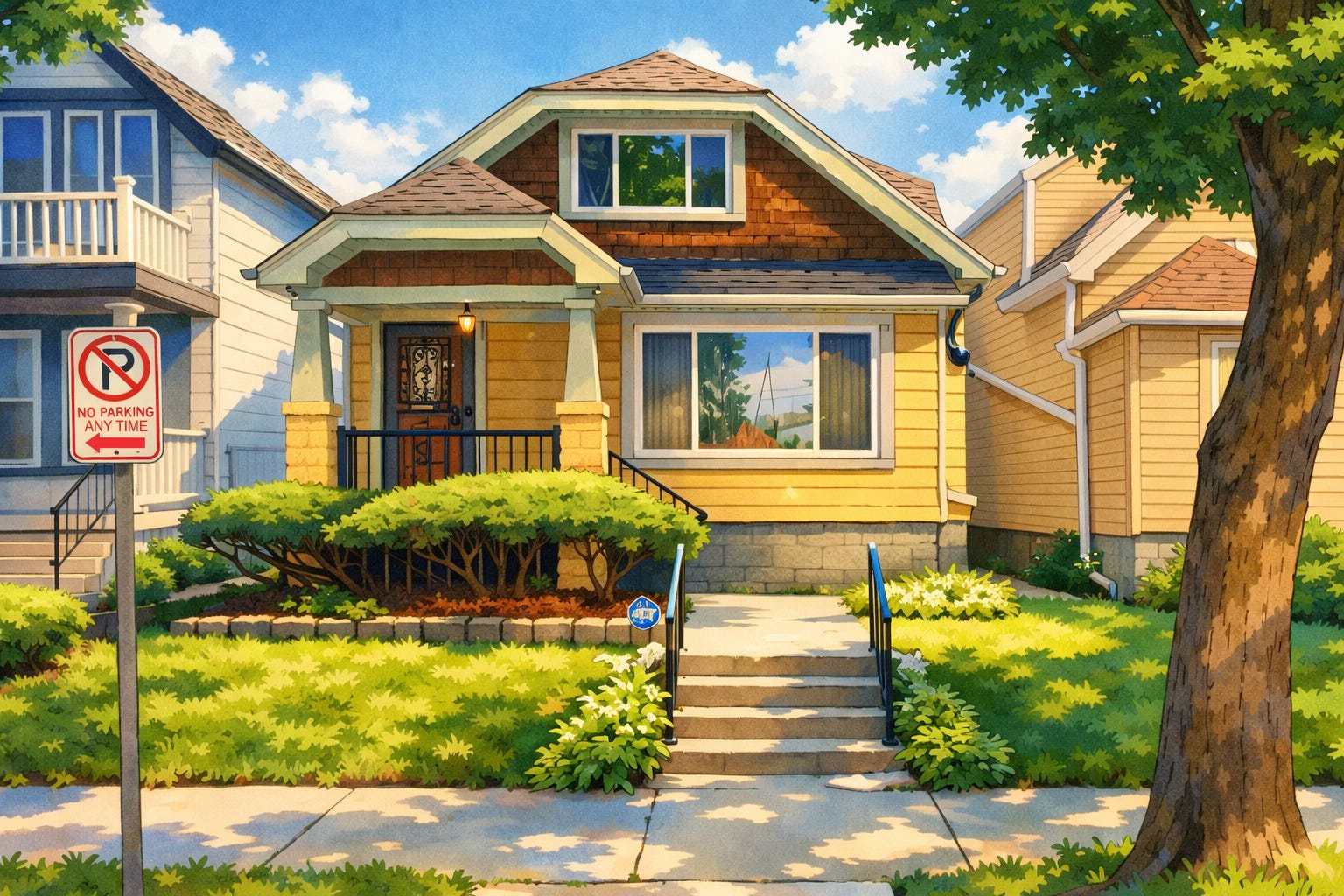
The image accompanying this essay is a stylised rendering of my childhood home. I include it neither as nostalgia nor as biography for its own sake, but as a visual threshold—an invitation to consider the structures that quietly shape us long before we are conscious of choice.
Homes, like caves, are not merely places. They are formative architectures of perception. They shelter us, orient us, and—if we are inattentive—can come to define the limits of what we believe is possible. To revisit such a structure later in life is not an act of regression, but of discernment.
The dream explored in this essay has returned to me periodically over many years. Each time, I am older. Each time, the house is both the same and subtly altered. I am not trapped within it, nor am I fleeing it. I am preparing to leave.
That posture matters.
What follows is not an argument for departure, nor a rejection of origins. It is instead a reflection on maturation: on the long, often quiet preparation required to move from inheritance to authorship; from conditioned belonging to conscious participation; from dwelling within a structure to understanding it well enough to step beyond it.
Readers are invited to hold their own “houses” lightly as they read—those early frameworks of identity, belief, and meaning that once served as shelter and may now be asking to be re-examined. Nothing here requires abandonment. Only radical honesty.
The door, as it turns out, has always been there.
There is a dream that returns periodically—not with urgency, but with patience.
In it, I am no longer a child. I am an adult, fully aware of myself as such, standing once again inside my childhood home. At times I find myself in my old bedroom on the second floor. At other moments, I am in the kitchen, preparing a meal or cleaning. Still other times, I am in the lower-level rec room, reading or listening to music. In the most recent iteration of the dream, the rooms remain familiar, though time has subtly altered their feel.
I am not hiding.
I am not lost.
I am preparing to leave.
What makes the dream unusual is not its content, but its persistence. It has appeared intermittently over many years—perhaps only once or twice annually—yet always with the same essential orientation: presence, recognition, readiness. The psyche does not rush me out. It invites me to take stock.
Understood through a Jungian lens, this dream does not announce crisis. It announces individuation in progress.
The House as Psychic Architecture
Across cultures and depth-psychological traditions, the house is a remarkably consistent symbol of the psyche itself. A childhood home, in particular, represents the first architecture of consciousness: the structure of assumptions, habits, loyalties, fears, and permissions inherited before choice was fully available.
To be inside such a house as an adult is not regression.
It is review.
What matters most in this recurring dream—especially in its present form—is that I am neither trapped within the house nor fleeing it. I am preparing. This distinction signals a mature relationship to one’s origins: neither repudiation nor captivity, but discernment.
This is the posture required when one begins to move consciously through the Seven Layers of Manifestation.
The Seven Layers, Revisited Through the Dream
The dream functions less like a narrative and more like a periodic alignment check, returning at moments when one layer of experience has stabilised and the conditions for the next are quietly forming.
At the level of the Phenomenal World (Layer III), the house first appears as simple facticity. It is the physical environment one inhabits: rooms, floors, routines, and sensory familiarity. The house is not yet symbolic. It is simply where life happens.
As awareness develops within Human Consciousness (Layer IV), the relationship to the house begins to change. Reflection emerges. Memory, affect, and perception reorganise. One notices that the house feels different now—not because it has changed, but because consciousness has. Questions arise quietly: Why does this space feel smaller? Why does it no longer mirror who I am becoming?
With further maturation, the dream crosses into the Human-Derived World (Layer V). Here, the house is recognised as formative. It shaped identity, habits, expectations, and roles. Crucially, this is where authorship begins to emerge. The house is no longer mistaken for the world itself, but understood as a world—one constructed through human meaning, inheritance, and participation.
By the time the dream reaches its current form—myself preparing to leave—the psyche is no longer negotiating mere perception or identity, but engaging the deeper recognition that such houses are not singular. At the level of Constructs (Layer VI), the dream reveals its broader significance. One sees that many others still live inside similar houses: shared systems of belief, social agreements, institutional norms, and inherited assumptions that once served a purpose but were never meant to be permanent dwellings.
To echo something I learned long ago, The past is a place for learning… not living. The same may be said of the structures that nurtured us early on in our development.
It is at this threshold—between recognising constructs and loosening their hold—that teachers, elders-in-the-making, and symbolic custodians emerge. Not as saviours, but as living evidence that departure is possible without denial, rupture, or contempt.
From here, the movement toward Outcomes (Non-Local Influence—Layer VII) becomes inevitable. Leaving the house alters the field. Others sense permission before they can articulate why. The dream need not appear as often—not because it is resolved, but because its influence has begun to operate beyond the individual psyche.
The Long Preparation: Why Departure Is Never Immediate
What is often omitted in popular retellings of inner transformation—whether psychological or philosophical—is the time required outside the familiar structure before one can speak clearly about it.
Preparation is not delay.
It is reorganisation.
The psyche must recalibrate perception, language, and responsibility before departure becomes sustainable. To leave too quickly is to risk carrying the house intact within oneself, recreating it elsewhere under a different name.
The dream honours this necessity. It does not dramatise escape. It affirms readiness.
The Cave and the House: A Shared Archetype
This is where the dream aligns unmistakably with Plato’s Allegory of the Cave.
In Plato’s account, the prisoner who turns toward the light does not immediately return to liberate others. There is a necessary—and often overlooked—interval of disorientation, adjustment, and solitary refinement. The eyes must learn to see differently. The mind must learn to think without shadows as its primary reference. An earlier essay, From Shadow to Stone: Awakening, Return, and Inner Refinement, explores this experience in greater depth.
The childhood home and the cave are parallel structures:
Both are enclosed systems of meaning
Both are mistaken for reality by those born within them
Both require time, courage, and humility to outgrow
Crucially, neither is destroyed. The cave remains. The house stands. What changes is the relationship to them.
Those who return too soon—or without integration—are often misunderstood or rejected, not because they are wrong, but because their vision has shifted beyond the shared frame. Too often, such a return proves painful for the one who has “left” when encountering those who, for varied reasons, remain within the cave—both physically and mentally.
The dream understands this. It prepares rather than propels.
Why This Dream Appears in Teachers and Elders-in-the-Making
This motif is extraordinarily common among:
Teachers
Initiators
Elders
Philosophical custodians
Consciousness translators
Why?
Because such individuals must do three things simultaneously:
Remember the house accurately
Leave it consciously
Return symbolically without re-entering it
Most people manage only one or two.
This dream reflects all three capacities developing together.
Reflecting on this pattern through a Jungian lens, I am struck by how Pure Consciousness seems to encode within each of us the seeds and conditions for eventual growth and flourishing. It is as though such transitions are universal—undertaken by all who choose the path of teachers, initiators, elders, philosophical custodians, and consciousness translators.
If this is so, then the task before us is clear: to become aware enough, brave enough, and sufficiently aligned in intent to move forward as Nature itself demands.
Suggested Practice: A Guided Meditation on Leaving Inherited Structures
(This meditation may be read silently or spoken aloud.)
Layer I – Pure Consciousness
Begin by settling into stillness.
Before memory, before story, before any sense of “house,” allow awareness to rest in itself. There is nothing to solve here, nothing to leave. This is the ground from which all experience arises—the silent field that precedes structure.
Layer II – Universal and Natural Laws
From this stillness, sense the quiet intelligence that governs growth and change. Notice how life moves toward balance, adaptation, and renewal without force. Leaving is not rebellion here; it is obedience to a deeper order. Growth follows law, not impulse.
Layer III – Phenomenal World
Now allow an image of the house to appear—not as symbol yet, but as place. Walls, rooms, light, texture. This is the environment as it once was: the physical world in which life unfolded. There is no judgment here. The house simply exists.
Layer IV – Human Consciousness
Notice your awareness within the house. Thoughts, memories, emotions arise. Perception shifts. You may sense familiarity, comfort, or subtle tension. This is consciousness recognising experience—no longer absorbed, but observing.
Layer V – Human-Derived World (Identity)
Here, the house becomes formative.
You recognise how it shaped roles, habits, expectations, and identity. This is where authorship begins to stir. The psyche realises: this structure helped make me—but it does not define all I can become.
Layer VI – Constructs (Social Agreement)
The frame widens.
You see that this house is not unique. Many live within similar structures—systems of belief, norms, and inherited agreements that once served a purpose but were never meant to be permanent dwellings. Recall: the past is a place for learning, not living. The same is true of the structures that once sheltered us.
Layer VII – Outcomes (Non-Local Influence)
Now, without effort, allow the sense of leaving to occur—without departure, without rupture. Simply by seeing clearly, the field shifts. Others may feel permission without knowing why. The lesson moves beyond you. Remain here briefly, letting influence unfold naturally.
When ready, return—not to the house, but to the present moment—bringing with you clarity, steadiness, and quiet resolve.
Now, go live the lesson.
Suggested Practice (Companion): Journal Prompts by Layer
Layer I – Pure Consciousness
Before structure, before story
Prompt:
When I set aside roles, memories, and expectations—even briefly—what remains aware?
How does my sense of self change when I rest in that awareness without trying to define it?
Layer II – Universal and Natural Laws
Growth, rhythm, and lawful change
Prompt:
Where in my life do I sense a natural movement toward growth or release that does not require force?
In what ways might my current transition be less a personal decision and more an expression of a deeper order?
Layer III – Phenomenal World
Place, environment, and lived reality
Prompt:
What environments—physical or situational—have most shaped my early sense of what life “is”?
When I picture these places now, what do I notice without interpreting or judging them?
Layer IV – Human Consciousness
Perception, memory, and meaning
Prompt:
How has my perception of these early environments changed over time?
What emotions, memories, or insights arise when I observe them from my present standpoint?
Layer V – Human-Derived World (Identity)
Roles, habits, and authorship
Prompt:
Which aspects of my identity were shaped by the structures that once housed me?
Where do I sense the possibility of authorship—of choosing who I am becoming rather than inheriting who I was expected to be?
Layer VI – Constructs (Social Agreement)
Norms, systems, and shared assumptions
Prompt:
What beliefs, norms, or agreements did I once accept as “just the way things are”?
Which of these still serve me—and which feel like structures I have outgrown but not yet fully named?
(You may wish to reflect on this phrase: The past is a place for learning, not living.)
Layer VII – Outcomes (Non-Local Influence)
Field effects and quiet transmission
Prompt:
How might my own clarity—or willingness to step beyond inherited structures—affect others without my needing to persuade or instruct them?
Where do I sense influence already unfolding simply through how I live?
—
About the Author
Dr. Baruti KMT-Sisouvong is a consciousness scholar, executive coach, and Certified Teacher of Transcendental Meditation® based in Cambridge, Massachusetts. His work—spanning The Model for Perpetual Growth and Progress and The Seven Layers of Manifestation—explores how Pure Consciousness, neuroscience, and social-systems transformation intersect in the evolution of both the individual and society.
He is the Founder and Director of Radical Scholar Inc., a nonprofit organization dedicated to consciousness-based research and public scholarship, and President of Serat Group Inc., the parent company of Transcendental Brain, a consulting and educational platform bringing consciousness science into leadership and institutional development. He also serves as Host of the On Transcendence Podcast.
Alongside his wife, Mina, he co-directs the Cambridge and Metropolitan Boston TM Program and serves as Host and Founder of International Meditation Hour (IMH), a quarterly global gathering dedicated to the unifying power of silence.
He writes from the conviction that the most important race is not between nations or machines, but between the conditioned mind and the awakening soul.
To learn more about him, visit: https://www.barutikmtsisouvong.com/.