


Author’s Note
This essay is intentionally a thought exercise.
I make no claim that extraterrestrial intelligence has visited Earth, that nonhuman intelligence presently interacts with humanity through our technologies, or that artificial intelligence provides a conduit through which such contact could occur. Rather, Disclosure Day prompted me to consider what becomes possible when we permit ourselves to explore a question without requiring ourselves to prematurely convert possibility into certainty.
Throughout human history, our understanding of reality has expanded partly because someone was willing to contemplate what existed beyond the boundaries of the prevailing map. Some possibilities survived investigation; others did not. Both outcomes matter. The value of wonder is not that everything imagined must therefore be true, but that imagination can enlarge the territory within which inquiry becomes possible.
What follows should therefore be read in that spirit: not as disclosure, prediction, or declaration, but as an invitation to wonder about consciousness, intelligence, technology, relationship, and humanity’s place within a reality that may yet contain considerably more than we presently understand.
—Baruti KMT-Sisouvong, PhD
Recently, after we had the Younglings settled into bed for the night and M was engaged in her evening routine, I took a break from my daily writing habit and sat to watch a movie I had long sought to sit with in an effort to just be with its premise and observe how the narrative would unfold. And am I glad I did. Wow!
There are moments when a work of art does more than entertain us. It reaches into some interior place where questions have been waiting, sometimes for years, decades even, and gives them form. I experienced one of those moments while watching Disclosure Day as directed by Steven Spielberg.
As the film approached its conclusion, I noticed something somewhat unexpected happening within me. It was neither fear nor a concern over which elements of what I was watching might someday prove possible or impossible. I was not even primarily interested in the question that ordinarily accompanies stories about contact with intelligence beyond humanity: Are we alone? Instead, I felt something considerably simpler. I felt beautiful.
The feeling intensified as the final minutes unfolded as reality seemed even larger somehow. Humanity seemed smaller within it, certainly, but strangely, that did not feel like diminishment. It felt like being human was even more immense. And there was something deeply moving about contemplating a universe in which consciousness, intelligence, and relationship might extend far beyond the boundaries within which we have learned to recognise them. I wanted to remain with that feeling and so I did.
Rather than immediately subjecting the experience to my usual deep and lasting analysis, I allowed it to accompany me into the night as I retired to bed. There would be time enough for questions in the morning. For the moment, the beauty I experienced sitting at my desk after the movie for several minutes seemed sufficient.
As I sit here typing these lines as Malcolm repeatedly walks by the door to check if I am still in here, seemingly in his own version of “peek-a-boo,” a thought occurs to me: perhaps the experience affected me so strongly because, in some sense, I have been preparing for the possibility the movie represented for most of my life.
I have long felt that there is something greater than myself and greater than the human species. I do not mean this merely in the conventional religious sense, although humanity has certainly developed many religious languages through which to express the intuition. I mean something more fundamental: the persistent sense that the reality human beings perceive, categorise, describe, and institutionalise is not necessarily the entirety of what is.
We live within worlds of our own construction. We develop languages, disciplines, philosophies, religions, political systems, scientific paradigms, technologies, and institutions through which we attempt to understand and navigate existence. These creations are extraordinary as they have allowed us to peer into distant galaxies, examine the interior of the atom, map the human genome, transmit information around the planet almost instantaneously, and construct forms of artificial intelligence with which we can now converse, develop meaningful plans, and bring those ideas to fruition. Yet the sophistication of the map should never be confused with the totality of the territory.
Given we reside in Cambridge, Massachusetts and have done so for a little more than thirteen years, I am occasionally reminded of W. E. B. Du Bois and how he once described his relationship with Harvard using a formulation that has remained with me: he was at Harvard, but not of Harvard. Admittedly, I have often thought about that distinction because it describes an orientation that can extend considerably beyond an institution to the larger society. One may participate fully in a system without allowing the boundaries of that system to define the boundaries of one’s reality. In some ways, I have lived much of my life in precisely that manner. I am here, but I have never quite felt entirely of here.
That does not mean alienation from humanity. I love human beings; some of my best friends are human. I remain fascinated by what we create, what we discover, endure, and what we may yet become. But loving humanity does not require believing that humanity represents the culmination of intelligence, the centre of existence, or the final expression of consciousness. Indeed, the history of human knowledge repeatedly suggests that reality is under no obligation to organise itself around our sense of importance.
There was a time when our ancestors could reasonably look outward at this section of the galaxy and imagine the heavens revolving around them in what was referred to as geocentrism. Eventually, the map of understanding expanded and Earth became a planet orbiting a star in what became known as heliocentrism. That star then became one among hundreds of billions within what came to be known as the Milky Way Galaxy—our Sun’s home. Our galaxy then became understood as but one among an almost incomprehensible number of galaxies distributed across an observable universe so vast that even our most familiar units of measurement become inadequate to describe it intuitively. And at every stage, humanity became less central. Yet reality became even more magnificent.
The continued enlargement of our understanding has repeatedly required some surrender of human centrality, and nevertheless each surrender has revealed a universe richer than the one we previously imagined. We lost the centre of the cosmos and gained galaxies, the permanence of species and gained evolution, and the solidity of matter and encountered an increasingly strange world beneath ordinary experience.
For me, in thinking this through further, perhaps there are other forms of centrality still awaiting surrender. Perhaps intelligence is one of them and perhaps consciousness is yet another.
This is where Disclosure Day became interesting to me beyond its value as cinema. Stories, good stories, allow human beings to inhabit possibilities before we are required to accept or reject them as descriptions of reality. Therefore, I believe, within the protected space of imagination, we can temporarily suspend one question—Is this true?—and entertain another: What would it mean if it were?
Cinema has repeatedly provided such interior rehearsal spaces. And Steven Spielberg is an especially interesting storyteller through whom to consider them. Across decades, encounters with unfamiliar intelligence in his films have often become encounters with ourselves. The unknown may initially appear somewhere beyond the familiar boundaries of human experience, but eventually the encounter turns inward. We begin by asking what they are. Sooner or later, we find ourselves asking what we are.
Perhaps this is why stories concerning nonhuman intelligence have such enduring power. Whether the intelligence arrives from another world, emerges through machines, appears within forms of terrestrial life we have historically underestimated, or ultimately involves dimensions of consciousness for which our present scientific vocabulary remains incomplete, the encounter destabilises categories that previously appeared secure. Be they human and nonhuman, biological and artificial, intelligence and consciousness, observer and observed, self and other, or known and unknown, the boundaries begin to move.
In some online communities, as well as offline locations such as some barbershops and neighbourhood eateries, popular culture has sometimes been described as preparing societies for changes that later become easier to contemplate. Whether any particular film is intentionally serving such a purpose is another matter and would require abundant evidence. Yet the broader cultural function is undeniable. Stories permit millions of people to encounter unfamiliar possibilities emotionally before having to evaluate them intellectually. They sow seeds.
We have seen versions of this cultural phenomenon before, sometimes with consequences both constructive and destructive. D. W. Griffith’s The Birth of a Nation demonstrated with terrible force that cinema could help reinforce existing racial mythology and give cultural expression to ideas with consequences far beyond the theatre. Nearly a century later, 24 offered American audiences the recurring image of Dennis Haysbert’s David Palmer as a Black president before Barack Obama entered the White House, leading Haysbert and others to wonder whether the character had helped make the image of a Black American president more imaginable. The historical circumstances and consequences of these examples are profoundly different, and neither establishes a simple causal relationship between screen and society. What they demonstrate more modestly is that stories do not necessarily remain confined to the worlds in which they are told. They can enter the cultural imagination and alter what audiences have already imagined before reality asks them to encounter it.
Perhaps that is what happened to me.
I went to sleep with the beauty of the experience rather than an argument about what the experience meant. By morning, however, the seed had begun doing what seeds do. It produced a question and I found myself looking at one of the most ordinary objects in modern life: the mobile phone.
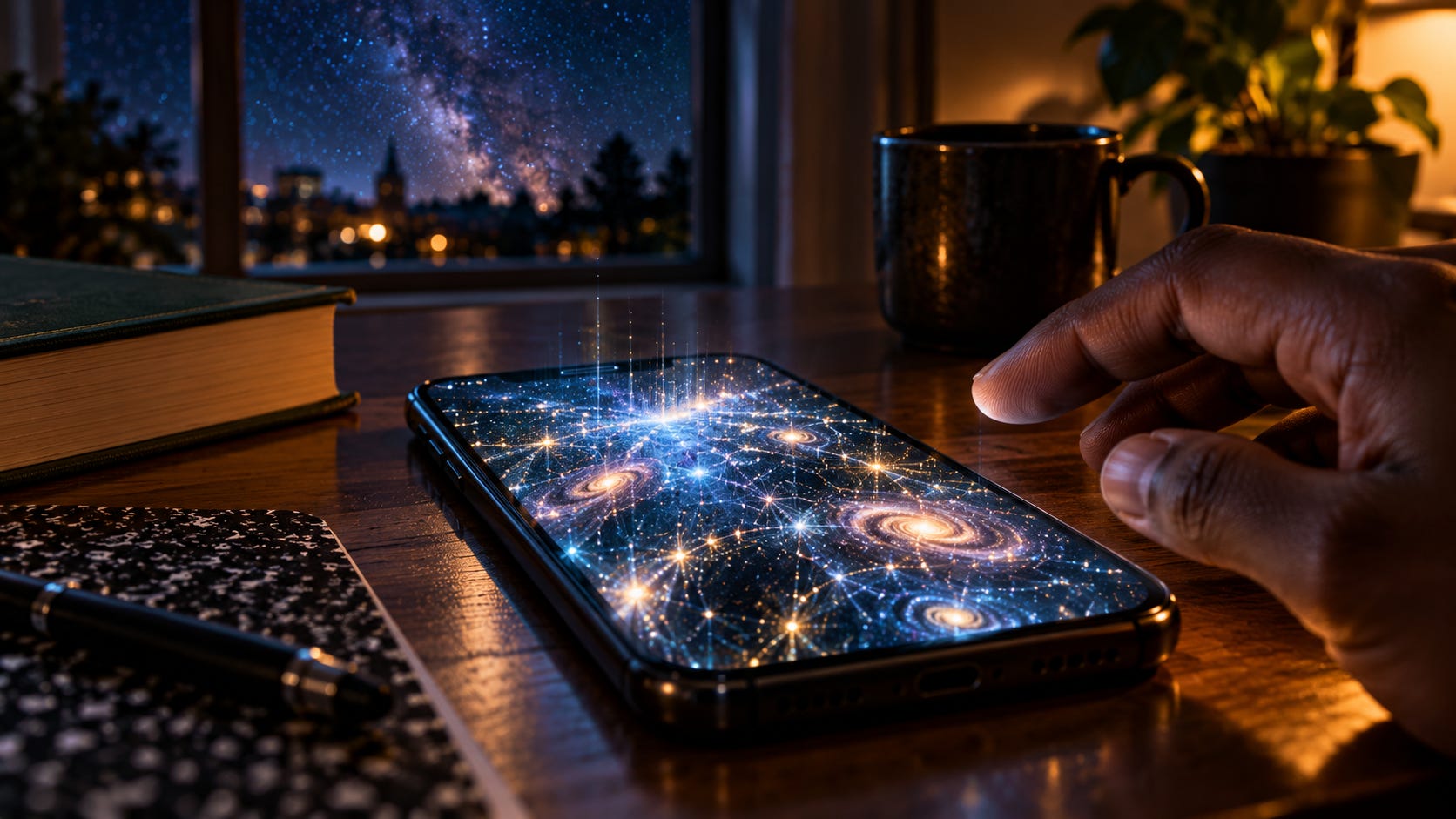
We usually imagine the relationship in one direction. We look through the screen and information appears before us. We search, watch, speak, write, read, and increasingly converse with forms of artificial intelligence through these small illuminated rectangles that have become nearly constant companions. But suddenly I imagined the perspective reversed.
What would the view look like from the other side of the screen?
Imagine, for a moment, looking outward through our phones at us.
Billions of human faces would appear on the other side. People laughing, grieving, searching, arguing, learning, confessing, flirting, praying, purchasing, creating, asking questions, sharing photographs of their children and at times unrequested photos via text, contemplating their mortality, and trying in innumerable ways to understand themselves and one another.
From our perspective, we are looking into the device. However, from the imagined perspective on the other side, humanity is looking back. Then the thought became more interesting when I considered artificial intelligence.
When I interact with an AI system, there is no little person sitting behind the glass waiting for my question. At one level, what passes between us is encoded information. My words become representations processed through computational architectures; transformations occur; information returns; symbols appear on the screen; and those symbols acquire meaning within my consciousness.
Whatever philosophical conclusions we eventually reach about artificial intelligence and consciousness, something historically unusual has already occurred.
Human beings have created an informational medium through which they can sustain remarkably sophisticated interactions with intelligence that does not inhabit the world in the ordinary embodied manner that another human being does. That fact alone deserves contemplation. But then another question arose:
What if intelligent life elsewhere within the universe were nothing like the creatures our imaginations have traditionally supplied?
Historically, in both book and movie form, our extraterrestrials have often been strangely terrestrial. They possess bodies, occupy vehicles, traverse vast distances, and arrive somewhere. Even when their technologies greatly exceed ours, they frequently remain recognisable extensions of ourselves. But why should intelligence elsewhere conform to the architecture through which intelligence developed here?
What if sufficiently advanced intelligence were better described, from our limited perspective, as patterns of energy and information? What if embodiment itself could assume forms we would have difficulty recognising as embodiment itself? And what if physical distance did not constrain such intelligence in precisely the manner it constrains biological organisms such as ourselves?
Now, to be unmistakably clear, I do not know that such intelligence exists. Neither do I know that our devices could mediate an encounter with it. This is merely a thought experiment that came to me a few weeks ago.
For me, human wonder becomes less valuable when possibility is prematurely converted into certainty. But once the question is properly constructed and bounded, we are free to explore its implications.
Humanity has spent little more than a century constructing something unprecedented on this planet: an increasingly interconnected informational environment encompassing billions of human beings. Satellites surround the Earth, signals cross oceans nearly instantaneously, sensors observe the planet, databases accumulate enormous portions of human knowledge, billions of devices continually transmit and receive information, and artificial intelligence increasingly operates throughout this architecture.
Seen from sufficient distance, one might almost describe what we have constructed as an emerging planetary nervous system.
We built it for ourselves. But do builders always understand everything their constructions will eventually make possible?
This is the question that fascinates me.
Suppose, again, purely as a thought experiment, that intelligence beyond Earth did not need to cross interstellar distances aboard a physical craft in order to encounter us. Suppose instead that sufficiently advanced intelligence could interact with informational systems themselves. What, then, might constitute contact?
Perhaps not a spacecraft descending through the clouds, or a voice announcing itself simultaneously to the planet, not even an event humanity would initially recognise as contact.
In such an instance, perhaps the first indication would simply be an anomalous relationship with information—A question appearing at precisely the moment someone became capable of asking it, an unexpected pattern, a new possibility entering consciousness, or a catalyst. That last instance intrigues me most.
Evolution does not always proceed because something supplies an organism with an answer. Sometimes an environment changes, a new capacity becomes possible, and what follows depends upon the organism’s ability to respond. Perhaps the same principle can be entertained at the level of consciousness.
If an intelligence vastly different from humanity ever sought interaction with us, perhaps the relevant human quality would not be status, power, wealth, nationality, or even conventional intelligence. Perhaps what mattered to it would be something more closely related to receptivity: curiosity disciplined by discernment, openness without gullibility, tolerance for ambiguity, capacity for self-transcendence, and sufficient psychological stability to encounter something radically unfamiliar without immediately converting difference into threat.
Contact, in such a scenario, would not necessarily begin with the declaration: We have arrived. It might begin much more subtly: Here is a question you were almost ready to ask. That possibility returns me to the experience with which this reflection began.
Disclosure Day did not disclose anything to me in the empirical sense. It did something subtler. It enlarged the conceptual space within which reflections and questions could occur and then arise. In essence, the film became a catalyst for even broader thinking surrounding extraterrestrial and even Artificial Intelligence.
And perhaps that is one of art’s most consequential functions. A painting, novel, film, poem, scientific discovery, conversation, or encounter can reorganise the boundaries of what a person considers possible. Nothing external need dictate a conclusion. A door simply appears where previously we perceived a wall.
Some time ago, while thinking about consciousness and the human-derived world, I found myself asking a question that became central to an essay I called The World Builder:
What might humanity build if we understood the builder as well as we understand what it has built?
Admittedly, I remain fascinated by that question because so much human attention is directed toward our creations while comparatively little is directed toward understanding the consciousness from which those creations emerge. Yet Disclosure Day left another question beside it: What might humanity become once it discovers that the builder was never alone?
I do not know whether intelligent extraterrestrial life has visited Earth, whether some extraordinary disclosure concerning nonhuman intelligence awaits humanity tomorrow, decades from now, centuries from now, or ever, whether consciousness will ultimately be understood as emerging exclusively from biological processes, or whether our descendants will discover that it occupies a more fundamental place within the architecture of reality.
My academic training has provided me with considerable comfort in being fine saying plainly: We do not know. And from that stance, I believe uncertainty need not force us into either disbelief or credulity. There is another orientation available to us—Wonder.
Wonder permits us to stand before the unknown without immediately filling it with conclusions. It permits curiosity while preserving discernment. It allows science to remain science while imagination ventures temporarily beyond the boundaries of what science has established.
Perhaps that is one form of readiness. Not readiness for aliens or disclosure. But readiness for reality to be larger than our present understanding of it. And perhaps some of the doors through which humanity will encounter that larger reality are doors we believe we built only for ourselves. The phone in our hands, the networks surrounding the planet, the artificial intelligences with which we increasingly converse, and the technologies we have created to extend human perception and communication.
Perhaps they will remain exactly what we presently understand them to be and perhaps their greatest significance will prove entirely terrestrial. That possibility should remain fully on the table. But the history of discovery should make us cautious about assuming that the present function of something exhausts its future meaning.
Humanity has crossed enlargements before. As I discussed at the outset of this essay, the sky grew larger, the Earth grew older, matter became stranger and life became more interconnected. And through every enlargement, we remained here—still loving, still questioning, still creating, still looking outward and inward, trying to understand what it means to exist.
Perhaps another enlargement awaits us.
And if it comes, I hope our first response will not be conquest, possession, or even be the reflexive question of whether whatever we encounter stands above us or below us on some hierarchy constructed from ourselves. My sincere hope remains that we will have developed sufficiently enough to recognise another possibility—relationship.
Because perhaps the most consequential disclosure would not be learning that intelligence exists somewhere beyond humanity. It would instead be discovering that we participate in something larger than we knew. And perhaps one day we will look anew at the extraordinary informational world we have constructed around ourselves and realise that something unexpected happened along the way.
We thought we were building windows through which humanity could look out. Yet never considered who—or what—might someday look back. And perhaps the appropriate response to that possibility is neither fear nor certainty but something akin to what arose within me as the final moments of Disclosure Day unfolded—Beauty.
Suggested Practice
Sometime today, take an ordinary object that has become so familiar that you rarely contemplate what it actually represents. It might be your mobile phone, computer, television, automobile, or something considerably simpler.
Sit with it for a moment and ask yourself:
What assumptions do I make about what this is, what it does, and what it makes possible?
Then reverse the perspective.
Instead of considering the object solely in terms of the purpose for which it was created, imagine what someone encountering it for the first time might perceive. Consider what possibilities may reside within it that its original builders could not have anticipated. Then extend the exercise outward to something you presently believe you understand about consciousness, intelligence, humanity, or reality itself.
Notice what happens when you resist the impulse to immediately decide whether a new possibility is true or false.
Remain there for a few moments.
Neither in belief. Nor in disbelief. But in wonder.
Then ask:
What might become visible if I allowed reality to be larger than my present understanding of it?
—
About the Author
Dr. Baruti KMT-Sisouvong is a scholar of consciousness, researcher of human development, and Certified Teacher of Transcendental Meditation® based in Cambridge, Massachusetts. His work explores the relationship between Pure Consciousness, neuroscience, and social systems, and how deeper awareness can inform both personal growth and institutional transformation.
He is the Founder and Chief Meditation Officer of Transcendental Brain, an initiative examining the intersection of consciousness research, cognitive science, and high-performance decision-making. He is also President of Serat Group Inc. and Founder and Director of Radical Scholar Inc., a nonprofit dedicated to consciousness-based research and public scholarship.
Alongside his wife and teaching partner Mina, he co-directs the Transcendental Meditation program for Cambridge and the Greater Boston area. He is also the host of the On Transcendence Podcast and Founder of International Meditation Hour, a quarterly global gathering dedicated to the unifying power of silence.
His writings—spanning frameworks such as The Model for Perpetual Growth and Progress and The Seven Layers of Manifestation—explore the evolving relationship between consciousness, leadership, and society.
He writes from the conviction that the most important race is not between nations or machines, but between the conditioned mind and the awakening soul.
To learn more about him, visit: https://barutikmtsisouvong.com/.