


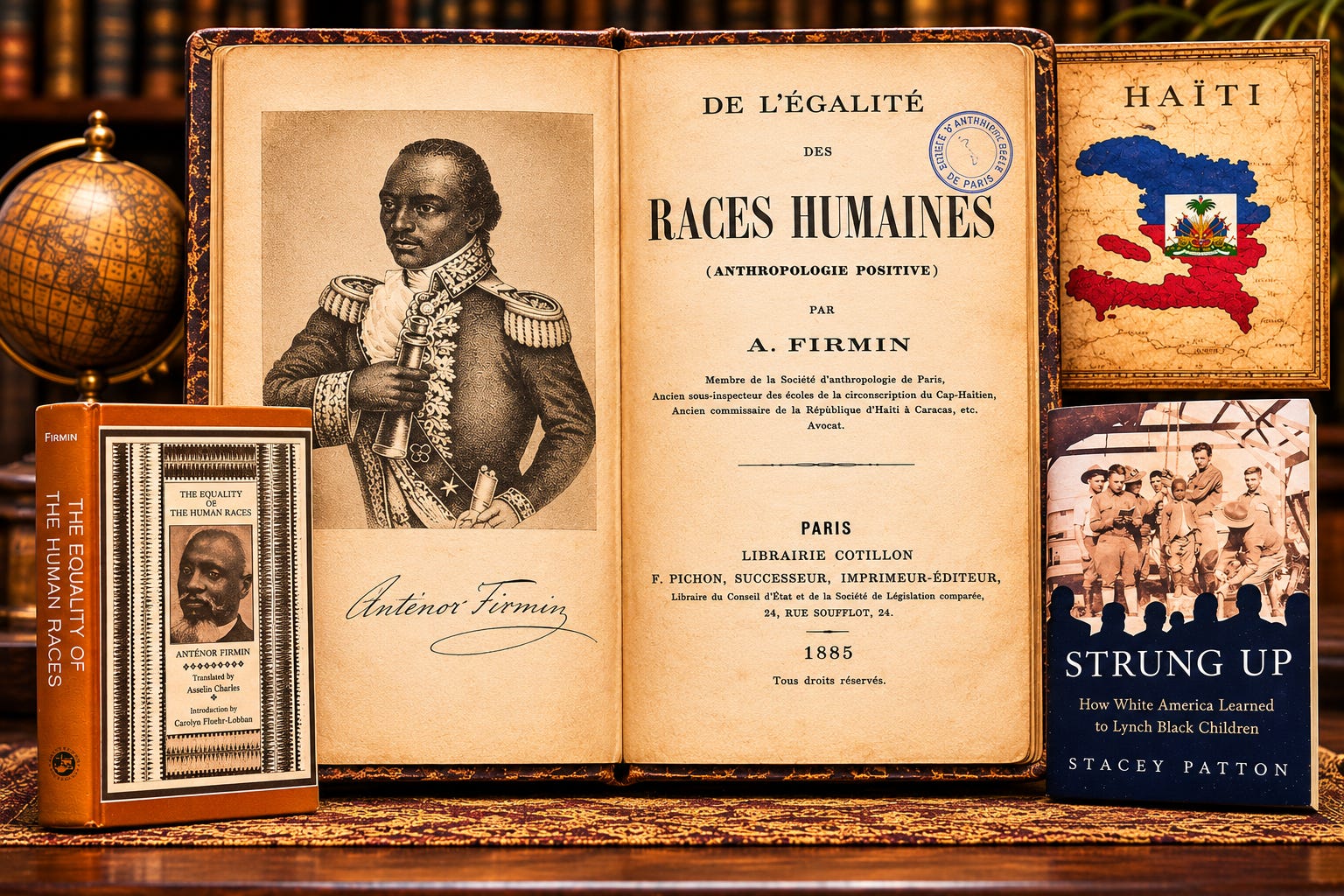
Author’s Note
This essay emerged from my reading of Dr. Stacey Patton’s Strung Up: How White America Learned to Lynch Black Children, which prompted me to reconsider a question that has occupied my thinking for more than two decades: What happens when the authority to examine humanity is exercised by institutions whose own assumptions and conduct remain insufficiently examined?
My engagement with Joseph Anténor Firmin’s The Equality of the Human Races began in 2005 when my then professor and mentor, Dr. Asa G. Hilliard, III, brought the book to class and said, with his usual wide grin, “Man! Have I got a book for you!” That introduction continued through subsequent scholarship, an interview with Dr. Carolyn Fluehr-Lobban in 2007, and a presentation at the National Council for Black Studies (NCBS) in 2008. Returning to Firmin through the lens of Dr. Patton’s work has provided an opportunity to revisit these earlier enquiries in light of my developing philosophical framework, the Seven Layers of Manifestation.
The interpretations offered here are my own. They are intended neither to collapse the distinct historical contributions of Dr. Patton and Firmin nor to attribute my contemporary philosophical framework to either scholar. Rather, I hope to place their work in conversation while considering how the constructs through which we understand humanity can obscure the deeper relationships that connect us.
—Baruti KMT-Sisouvong, PhD
There is something deeply revealing about the questions a society chooses to ask, particularly when those questions concern the nature, capacities, and worth of some human beings. Questions are rarely innocent of the assumptions that produce them. They emerge from particular historical circumstances, reflect prevailing understandings of the world, and often carry within them conclusions that have yet to be subjected to meaningful examination. When such questions become the foundation of scientific enquiry, they may acquire an authority that obscures rather than illuminates the assumptions upon which they rest. What begins as an enquiry into human differences can become an elaborate justification for treating those differences as evidence of human inequality.
I was reminded of this while reading Dr. Stacey Patton’s Strung Up: How White America Learned to Lynch Black Children. In a particularly arresting passage, Dr. Patton directs attention toward the histories of violence, punishment, and domination that European societies carried into the colonial world. Her argument invites us to consider that the practices through which African and Indigenous peoples would subsequently be subjected to extraordinary brutality did not emerge from an historical vacuum. Rather, they developed within societies that had long employed coercion, rigid hierarchies, religious authority, and corporal punishment as instruments of social organisation. The forms, targets, and locations of domination changed, but important elements of its underlying logic had long been established in Europe.
What makes this observation especially consequential is the direction in which it turns our attention. Much of the historical literature surrounding racial oppression necessarily examines the experiences of those who were enslaved, colonised, dispossessed, and subjected to institutionalised violence. Such scholarship is admittedly indispensable, not least because the experiences of marginalised peoples have so frequently been excluded from the historical record. Yet Dr. Patton’s analysis raises another question, one that receives comparatively less attention in popular understandings of these histories: What were the historical and social conditions that enabled those exercising domination to regard their conduct as legitimate, necessary, and even virtuous?
For me, this question becomes particularly important when we consider the intellectual history of scientific racism. For generations, European scholars devoted considerable energy to measuring, classifying, and comparing human populations, frequently proceeding from the assumption that differences in physical appearance corresponded to differences in intelligence, morality, and civilisational capacity. People of African ancestry became prominent objects of this enquiry with their bodies and cultures subjected to increasingly elaborate systems of classification. Yet the societies conducting these investigations were simultaneously participating in slavery, colonial conquest, territorial dispossession, and the systematic extraction of human and material resources. However, for me, the contradiction deserves closer examination. Because those who claimed the authority to determine the intellectual and moral capacities of other populations were rarely subjected to an equivalent investigation of the assumptions and institutions that enabled their own conduct. The colonised were examined as problems requiring explanation, while the colonisers occupied the position of supposedly objective observers. In this arrangement, the consequences of domination could be presented as evidence of the inferiority of those who experienced it, while the conduct of those responsible remained largely insulated from comparable scrutiny. The gaze of science, in other words, was not merely directed toward particular populations. It was directed away from others.
When Classification Becomes Justification
The nineteenth century offers a particularly revealing illustration of this relationship between knowledge and power. As European imperial expansion accelerated, scientific disciplines concerned with human origins, physical variation, and cultural development increasingly became entangled with claims about racial hierarchy. Anthropometry, craniometry, and related methods were employed to establish purported relationships between anatomical characteristics and intellectual capacities. The scientific legitimacy claimed for these practices gave an appearance of objectivity to propositions that frequently reflected the social prejudices and political interests of their practitioners. And among the most influential expressions of the false notion of racial hierarchy was Arthur de Gobineau’s Essay on the Inequality of the Human Races, published between 1853 and 1855. Gobineau’s work advanced an interpretation of human history in which racial differences were treated as fundamental determinants of civilisational development. Although his arguments were neither universally accepted nor representative of every European scholar, they nonetheless contributed to an intellectual environment in which racial inequality could be presented as a scientific proposition rather than recognised as a historically contingent ideology.
The implications of Gobineau’s thesis extended far beyond academic debate. When a population is defined as inherently less capable of intellectual, political, or moral development, its subjugation can be reframed as an expression of natural hierarchy. Colonial conquest may then be represented as the introduction of civilisation, economic extraction as the productive use of supposedly neglected resources, and political domination as the necessary supervision of peoples presumed incapable of governing themselves. The violence required to maintain such arrangements becomes easier to rationalise when those subjected to it have already been positioned outside the boundaries of equal human consideration.
This relationship between racial ideology and imperial power was especially visible during the period surrounding the Berlin Conference of 1884–1885. Convened under the leadership of German Chancellor Otto von Bismarck, the conference brought European powers together to establish diplomatic rules governing aspects of colonial expansion and territorial claims on the continent of Africa. Notably, African peoples were not represented in the negotiations that would help shape the conditions under which European powers asserted authority over their territories. Although the conference did not itself draw all the borders of colonial Africa, it became an important milestone in the larger process commonly described as the Scramble for Africa.
The ambitions driving this expansion were complex, involving economic competition, strategic interests, international rivalries, and the pursuit of political influence. Scientific racism may not have been the sole cause of European imperialism. Nevertheless, the intellectual construction of African inferiority provided a powerful means of legitimising domination. It allowed European powers to present their expanding control over African societies as consistent with a purported hierarchy of human development. In reflecting on all I have learned over the years about the period, what remains striking is the asymmetry of the arrangement. European governments could negotiate the conditions under which African territories would be claimed, while European intellectuals debated the alleged deficiencies of the populations whose political independence was being undermined. The capacity to dominate was interpreted as evidence of superiority, while the condition of being dominated was increasingly presented as evidence of inferiority.
The possibility that the entire arrangement revealed more about the assumptions, interests, and conduct of the colonising societies than about the intrinsic capacities of African peoples was seldom permitted to become the organising question.
Anténor Firmin and the Intellectual Challenge of 1885
It was against this historical background that Joseph Anténor Firmin, the Haitian scholar, diplomat, and anthropologist, published De l’égalité des races humaines (Anthropologie positive) in 1885. The coincidence of dates is extraordinary. At the very moment European powers were formalising important mechanisms of colonial expansion in Africa, Firmin was producing a systematic intellectual challenge to the racial assumptions that helped legitimise the broader imperial enterprise.
Firmin’s intervention was remarkable not simply because he rejected claims of African inferiority, but because he challenged the intellectual foundations upon which such claims rested. A member of the Société d’Anthropologie de Paris, he was familiar with the methods and arguments employed by prominent European anthropologists. Rather than responding solely through moral indignation, he engaged the evidence, examined the methods of classification, and questioned the reasoning through which anatomical differences were transformed into claims of intellectual and moral inequality.
His work demonstrated that the scientific apparatus surrounding racial hierarchy was neither as objective nor as conclusive as its proponents maintained. The measurements and classifications that appeared to establish natural divisions among human populations were frequently dependent upon assumptions that had not themselves been adequately examined. In challenging these assumptions, Firmin exposed the possibility that what was being presented as scientific knowledge was, in significant measure, the formalisation of existing prejudice.
My own encounter with Firmin began in the winter of 2005, when I first read The Equality of the Human Races. What initially captured my attention was the intellectual breadth of his scholarship and the extraordinary historical circumstances under which it had been produced. Here was a Haitian scholar writing in nineteenth-century Paris, confronting some of the most influential racial theories of his time, and doing so with a command of history, philosophy, anthropology, and the sciences that challenged the very stereotypes his contemporaries sought to defend. Yet as I continued studying the work, I became increasingly interested in something beyond Firmin’s rebuttal of scientific racism. His argument seemed to contain a second movement, one that became more apparent as I examined the relationship between his scientific critique and his closing reflections on human solidarity.
This interpretation formed the basis of my presentation at the National Council for Black Studies (NCBS) in Atlanta on 21 March 2008, titled Let the Circle Be Unbroken: An Exploration of Anténor Firmin and the Spiritual Component of Human Solidarity. My argument was that Firmin’s work should not be understood exclusively as a refutation of racial inequality. Beneath its scientific and historical arguments, I perceived a broader philosophical proposition concerning the nature of humanity and the relationships that bind human beings together into a common mass that should therefore seek to work together for in so doing our unified strength becomes evident.
This reading was informed by my earlier engagement with the scholarship of Dr. Carolyn Fluehr-Lobban, whose efforts, together with those of Haitian scholar and translator Asselin Charles, helped restore Firmin’s work to a wider English-speaking audience. My interview with Dr. Fluehr-Lobban for Connecting the Dots in December 2007 formed part of a continuing effort to understand not only Firmin’s intellectual contribution but also the circumstances surrounding the marginalisation and eventual recovery of his scholarship. Because the history of that recovery raises questions of its own. Consider this: Why did arguments that reinforced racial hierarchy acquire enduring institutional authority, while a systematic critique of those arguments as executed by Firmin struggle to obtain equivalent recognition?
As I have observed, it seems intellectual traditions are shaped not only by the quality of arguments but also by the institutions that preserve, circulate, translate, and legitimise particular forms of knowledge and the people who produce that knowledge. The history of a discipline is therefore never simply the history of ideas that proved persuasive. It is also a history of which ideas were permitted to circulate, whose contributions were recognised, and which intellectual challenges were left at the margins of history. This is why I believe Firmin’s recovery is an invitation for us to reconsider not merely the conclusions of nineteenth-century anthropology but the processes through which its accepted history was constructed.
Turning the Gaze Toward the Coloniser
Returning to Dr. Patton’s work, we encounter a complementary but distinct line of enquiry. Where Firmin challenged the purported scientific foundations of racial hierarchy, Dr. Patton invites us to examine the historical formation of the practices through which domination became normalised. I believe her argument is especially valuable because it complicates the assumption that racial violence can be adequately understood by examining only the prejudices directed toward its largely Black and brown victims. The European societies that participated in colonial expansion had themselves been shaped by histories of coercion, class hierarchy, religious persecution, and institutionalised punishment. These histories did not make colonial violence inevitable, nor did every individual exposed to them reproduce the same patterns of behaviour. They did, however, provide existing repertoires of authority, discipline, and social control that could be adapted to new circumstances.
The distinction is important. To investigate the historical conditions that helped produce domination is not to excuse those who practised it. Far from it. Nor is it to suggest that the experiences of European populations under earlier systems of oppression were equivalent to the racialised systems subsequently imposed upon African and Indigenous peoples through colonisation. The historical circumstances, structures of power, and consequences differed in substantial ways. What deserves examination is the possibility that practices already normalised within one social environment could be redirected, intensified, and reorganised within another.
This perspective also invites us to distinguish between the transmission of trauma and the transmission of institutions, beliefs, and learned behaviour. Although contemporary discussions sometimes invoke epigenetic inheritance to explain the persistence of historical trauma, the evidence for the multigenerational biological transmission of complex human experiences remains compelling even if not settled. The social transmission of practices, however, can be examined through more directly observable mechanisms, including familial relationships, education, religious instruction, legal institutions, political authority, and cultural expectations. Because through these mechanisms, domination can become embedded within a society’s understanding of what constitutes proper conduct. Obedience may be associated with virtue, punishment with moral correction, and hierarchy with the preservation of some preferred order. When such associations become sufficiently established, individuals may reproduce them without recognising the historical assumptions from which they emerged. This is among the most unsettling implications of Dr. Patton’s argument. Because a society need not understand itself as cruel to maintain otherwise cruel institutions. Indeed, some of the most enduring forms of domination have been sustained by people who regarded their actions as morally justified.
Scientific racism contributed to this process by providing a language through which existing arrangements of power could be represented as expressions of natural difference. Its function was not merely to describe the world, but to make particular forms of inequality appear inevitable. And once that transformation occurs, attention can be redirected toward the supposed deficiencies of those who have been marginalised. Their economic circumstances, educational opportunities, political institutions, and social conditions become subjects of investigation, while the historical forces that helped produce those circumstances recede from view. The result is a severely distorted understanding of causation. Conditions produced or intensified by domination are then interpreted as evidence that domination was necessary in the first place.
The Constructs We Mistake for Reality
This relationship between human-created classifications and the consequences they produce connects directly with a philosophical framework I have been developing into the book manuscript titled the Seven Layers of Manifestation.
The framework examines manifestation through seven interrelated layers, ascending from Pure Consciousness through Universal and Natural Laws, the Phenomenal World, Human Consciousness, the Human-Derived World, Constructs, and Outcomes. Its purpose is not to replace historical or scientific investigation, but to clarify the relationships among the deeper conditions of existence, human experience, and the systems human beings create. Within this framework, racial hierarchy offers an especially revealing example of the relationship between Constructs and Outcomes. Racial classifications are human-derived conceptual arrangements that acquire significance through social agreement, institutional reinforcement, and the exercise of power. Although observable physical variation exists among human populations, the assignment of inherent intellectual or moral superiority to socially defined racial categories is not a discovery of natural law. It is a human construction. And when such constructs become embedded within legal systems, economic institutions, educational practices, and political arrangements, they produce consequences that may persist across generations. Those consequences can then be interpreted as confirmation of the original classifications, creating a self-reinforcing relationship between belief and material circumstance.
A society constructs a hierarchy, organises its institutions around that hierarchy, and subsequently points to the resulting inequalities as evidence that the hierarchy reflects reality. The error therefore is not simply that the original classification was mistaken. It is instead that the consequences of human decisions have been confused with the operation of Natural Law.
The Seven Layers of Manifestation provides a way of distinguishing these domains. Constructs occupy a different explanatory position from the more fundamental principles governing existence. Their influence may be extensive, and their consequences devastating, but neither their longevity nor their institutional authority establishes their correspondence with the deeper nature of reality. This distinction is particularly relevant to scientific racism. Because its practitioners frequently treated socially constructed hierarchies as though they were discovering immutable biological truths. Yet the authority of a construct, however widely accepted, cannot transform it into a Natural Law. Despite the best efforts of those engaging in scientific racism.
To recognise this is to begin the process of clarification. It requires examining not only the conclusions produced by a system of thought but also the assumptions through which those conclusions became possible. And this brings us to what I regard as one of the most insightful dimensions of Firmin’s contribution.
Firmin’s Movement Further Upstream
Toward the conclusion of The Equality of the Human Races, Firmin’s argument undergoes what I interpret as a significant philosophical movement. Having devoted considerable attention to challenging racial classifications and demonstrating the intellectual and moral capacities shared across human populations, he begins to articulate a conception of humanity that reaches beyond the categories he has spent the book examining.
In his closing reflections, Firmin describes humanity as connected through an invisible relationship, one that transcends differences of colour, geography, and social circumstance. He presents human solidarity not merely as an ethical preference but as a condition through which the development and flourishing of humanity become possible. His understanding of equality consequently moves beyond the rejection of racial hierarchy toward an affirmation of a deeper relationship among human beings. This was the dimension of Firmin’s work that captured my attention when Dr. Hilliard brought the book to class and my attention in 2005, when I participated in the Opening Plenary for Association for the Study of Classical African Civilisations (ASCAC) in 2005, when I interviewed Dr. Carolyn Fleuhr-Lobban for Connecting the Dots in 2007, and when I sat on a panel during the National Council of Black Studies (NCBS) panel in 2008, and it remains especially compelling today. In Firmin’s own words:
In the universal alliance of peoples and races, certainly there are, and always will be, advanced groups and backward ones. The same state of things which prevails on a small scale within each nation must naturally prevail as well on the larger scale of the community of nations. But instead of being divided into superior and inferior races, the human community will be divided into civilized nations and savage and barbarian peoples. Among the civilized nations themselves, some are first rate, others low ranking, and still many others intermediate. In other words, each national community can be studied, evaluated, and deemed endowed with a superior or inferior civilization depending on its level of sociological development compared to a certain ideal of the civilized state. There will be no question of race, for the word implies a biological and natural fatality which has no correlation with the degree of ability observable among the different human communities spread around the globe. It is no news to anyone today that there are countless Negroes who are much more civilized, intelligent, and educated than most Caucasians. There are even more striking examples among the Mongolian race. Is it not an abuse of language, therefore to speak of superior races and inferior races? Such an abuse of language has unfortunately fathered the most harmful ideas, to which both ignorant masses and trained scientists sacrifice daily their intelligence or common sense. Thus slowly and imperceptibly arises the greatest obstacle to the development of a sense of human solidarity, the most effective stimulus of progress and prosperity for our species. We must act against this obstacle which has become an established prejudice.
My wish is that this book will enlighten minds, inspire a sense of justice in all, and compel one and all to face reality. Perhaps European scientists, who are still convinced of the superiority of their race, will stop, think, and realize that they have been the victims of an illusion. The current state of the world, the myths and legends which had shaped their thought as children, the traditions that they had continuously fed their intelligence, everything necessarily led them to a doctrine, a set of beliefs, which appearances seem to justify. But can they persevere in a proven error without renouncing the exercise of reason, the greatest endowment of humanity? Will prejudice, the belief that a more or less white complexion is a sign of superiority, remain forever in the best minds despite the facts which prove its falseness? This cannot be, for reason shall always prevail. When they see the facts, as in a mirror, what their own intelligence had been whispering to them, they will think again. I have no doubt that they will hasten to reject all those ideas which are inconsistent with the moral and intellectual temper of our century.
Returning to the truth, they will realize that human beings everywhere are endowed with the same qualities and defects, without distinction based on colour or anatomical shape. The races are equal; they are all capable of rising to the most noble virtues, of reaching the highest intellectual development; they are equally capable of falling into a state of total degradation. Throughout all the struggles that have afflicted, and still afflict, the existence of the entire species, one mysterious fact signals itself to our attention. It is the fact that an invisible chain links all the members of humanity in a common circle. It seems that in order to prosper and grow human beings must take an interest in one another’s progress and happiness and cultivate those altruistic sentiments which are the greatest achievements of the human heart and mind.
The doctrine of the equality of the human races, which consecrates these rational ideas, thus becomes a regenerative doctrine, an eminently salutary doctrine of the harmonious development of the species. Ultimately, it evokes for us the most beautiful thought uttered by a great genius, ‘Every man is a man.’ And the sweetest divine instruction, ‘love one another’. ” (Firmin/Fluehr-Lobban, 1885/2000, pp. 450-451).
Read through the Seven Layers of Manifestation, Firmin appears to be moving beyond the Constructs through which humanity has been divided and the Outcomes through which those divisions have been maintained. His closing reflections invite consideration of something further upstream, toward Human Consciousness and, potentially, the more fundamental principles represented by Universal and Natural Laws and Pure Consciousness. To be clear, this is an interpretive proposition rather than a claim that Firmin, in 1884-1885, explicitly articulated the metaphysical framework I developed in 2023. His writings emerged from a different intellectual and historical context, and his precise understanding of the relationship between spirituality, reason, and human nature deserves to be examined on its own terms. Nevertheless, the movement within his argument is striking. And having demonstrated the inadequacy of racial classifications, Firmin does not simply propose a more equitable arrangement among existing categories. Instead, he appears to invite readers to reconsider the deeper reality of human existence that those categories have obscured. For me, the distinction is consequential.
If equality depends exclusively upon the recognition granted by social institutions, then it remains vulnerable to the changing preferences of those institutions. If, however, equality reflects something fundamental about human existence, as I propose with the Seven Layers of Manifestation, then the role of institutions is not to confer human worth but to recognise and organise themselves in accordance with a worth that precedes them. And from this perspective, the recognition of human equality becomes an act of clarification rather than acquisition. Because humanity does not become fundamentally equal because a legislature passes a law, a scientific association revises its classifications, or a society adopts a more inclusive understanding of citizenship. Such developments may represent essential forms of social and political progress, but they do not create the underlying humanity whose equality they recognise.
The philosophical question becomes whether the divisions through which societies have organised themselves reveal the deepest nature of human existence or merely the historically contingent arrangements through which human beings have learned to perceive one another.
Firmin’s closing paragraphs suggests the latter.
His invocation of a common human bond also challenges the tendency to interpret human development exclusively through competition and hierarchy. Rather than treating the advancement of one population as dependent upon the subordination of another, he presents mutual concern and collective flourishing as central to humanity’s progress. And there is a considerable difference between a conception of civilisation measured by the capacity to dominate and one measured by the capacity to recognise and support the development of others.
The former depends upon hierarchy for its justification. The latter invites us to consider whether our deepest possibilities emerge through relationships that transcend it.
What the Gaze Reveals
Placed in conversation, Dr. Stacey Patton and Joseph Anténor Firmin illuminate different dimensions of the same enduring problem.
Dr. Patton encourages us to investigate the historical conditions through which domination became normalised, directing attention toward the formation of the institutions and behaviours that made racialised violence possible. Firmin challenges the intellectual classifications through which such domination could be represented as consistent with nature, while ultimately offering a conception of human solidarity that reaches beyond those classifications.
Their respective contributions should not be collapsed into a single argument. Dr. Patton’s historical investigation and Firmin’s scientific and philosophical intervention address different questions, employ different methods, and emerge from different circumstances. For me, their value lies partly in the productive tension between them. One directs our attention toward the historical formation of destructive human arrangements. The other invites us to reconsider the deeper understanding of humanity that might enable us to transcend those arrangements. Together, they also expose the limitations of an enquiry that examines marginalised populations without adequately investigating the systems responsible for their marginalisation.
When a society devotes its intellectual resources to explaining the supposed deficiencies of those it has subordinated, while neglecting the assumptions and institutions through which subordination occurs, the resulting knowledge is necessarily incomplete. The apparent objectivity of the investigation conceals an asymmetry in the questions being asked. And this problem is not confined to the nineteenth century. Contemporary discussions of educational achievement, economic inequality, social mobility, criminal justice, and political development can reproduce similar patterns when the conditions experienced by marginalised populations are examined without sufficient attention to the historical and institutional arrangements that shape those conditions.
The challenge then is not to abandon the study of disparities or to deny the importance of examining their immediate causes. It is to resist treating their existence as evidence of intrinsic deficiency while leaving the systems that produce and reproduce them outside the boundaries of investigation. Additionally, there is also a danger in merely reversing the direction of racial judgement. The purpose of examining the conduct of colonising societies should not be to replace one doctrine of inherent racial inferiority with another. Such a reversal would preserve the very conceptual error that Firmin sought to dismantle. Instead, the more demanding task is to investigate how human beings, operating within particular historical conditions, construct systems that permit them to deny the humanity of others while continuing to regard themselves as moral, rational, and civilised. That investigation requires attention to history, institutions, ideology, social conditioning, and the relationship between knowledge and power. It also requires the intellectual humility to recognise that the categories through which we interpret the world may themselves be products of the conditions we are attempting to understand.
Perhaps this is why Firmin’s closing reflections remain so important. His scientific critique exposed the inadequacy of racial hierarchy, but his philosophical vision pointed toward something that could not be established through measurement alone. He recognised that the future of humanity depended not simply upon correcting erroneous classifications but upon cultivating an understanding of human relationships capable of overcoming the divisions those classifications had sustained.
Nearly two decades after my first encounter with his work, I find myself returning to this possibility with renewed appreciation. Dr. Patton’s investigation has brought another dimension of the problem into focus, reminding me that the history of racial domination cannot be adequately understood without examining the societies and institutions through which domination was organised, rationalised, and ultimately transmitted.
Yet Firmin reminds us that understanding how division arose is not necessarily the same as understanding what lies beyond it. The first enquiry helps explain the conditions through which human beings came to mistake domination for civilisation. The second invites us to reconsider the nature of the humanity that such domination obscured. Both are necessary.
For if the history of scientific racism teaches us anything, it is that the authority to classify those being “othered,” must never be confused with the possession of a deeper understanding of human existence. The instruments of observation may become increasingly sophisticated while the assumptions guiding their use remain categorically mistaken. The question, then, is not simply whether we have learned to examine humanity more accurately. It is instead whether we have learned to examine the gaze through which humanity is observed. And perhaps, beyond that examination, lies a still more fundamental possibility: that the deepest understanding of our shared existence will emerge not from perfecting the categories through which we divide ourselves, but from recognising what those categories have prevented us from seeing.
The task before us is therefore both historical and philosophical. We must understand the conditions that produced domination while remaining willing to question the constructs through which its consequences continue to be interpreted. We must recover the intellectual contributions that challenged those constructs, even when the institutions of their time failed to recognise their significance. And we must remain open to the possibility that the most important truths about humanity are not those we create through classification, but those we clarify by looking beyond it.
Perhaps Firmin’s enduring invitation is precisely this: to recognise that the circle of humanity was never broken by the categories through which we learned to divide it. What became fractured was our understanding of the relationship that had always existed.
As for me, the work of clarification continues.
Care to join me?
Suggested Practice: Examining the Gaze
During the coming week, consider an account of human difference or inequality that you encounter in a news report, public discussion, institutional policy, or everyday conversation. Rather than immediately accepting the explanation offered, examine the assumptions underlying the questions being asked.
Who is being examined, classified, or evaluated? Who occupies the position of observer, and what assumptions inform that position? Are the circumstances being described understood as evidence of inherent characteristics, or is sufficient attention given to the historical, social, and institutional conditions that helped produce them?
Then consider what might change if the enquiry were directed toward the systems and assumptions shaping those circumstances rather than exclusively toward the people experiencing them.
The purpose is not to exchange one judgement for another, but to cultivate greater clarity concerning the relationship between what we observe, how we interpret it, and what we may have overlooked.
The invitation is simple: Before accepting the conclusions of an enquiry, examine the gaze through which its questions were formed.
—
About the Author
Dr. Baruti KMT-Sisouvong is a consciousness scholar, researcher of human development, and Certified Teacher of Transcendental Meditation® based in Cambridge, Massachusetts. His work explores the relationships among Pure Consciousness, neuroscience, human development, and social systems, with particular attention to how expanded awareness can inform individual and collective transformation.
He is Founder and Chief Meditation Officer of Transcendental Brain, President of Serat Group Inc., and Founder of Radical Scholar Inc.. Alongside his wife, Mina, he co-directs the Transcendental Meditation programme for Cambridge and Greater Boston. He also hosts the On Transcendence Podcast and founded International Meditation Hour.
Learn more at barutikmtsisouvong.com.