


Published to honour the first anniversary of a year-long commitment to weekly essays exploring consciousness, society, and human flourishing.
Author’s Note
This essay marks one year since I began publishing On Transcendence on a consistent weekly basis. During that time, the writing has become less an exercise in expressing opinions than an ongoing practice of refining orientation.
Returning to Frederick Douglass felt especially appropriate for this milestone. His invitation to use the past in service of the present has accompanied much of my thinking throughout the past year. While the ideas presented here reflect the evolution of my own work—particularly the development of the Seven Layers of Manifestation—they are also an expression of gratitude to those thinkers whose insights continue to illuminate the path long after they have departed.
If this essay accomplishes anything, I hope it encourages us to look beyond the immediate manifestations of our time and toward the deeper sources from which they arise. For it is there, I increasingly believe, that lasting personal and social transformation begins.
—Baruti KMT-Sisouvong, PhD
One year ago this weekend, I published an essay entitled The Present as Portal. It reflected upon one of Frederick Douglass’ most enduring observations—that while we often regard history as something behind us, its true value lies in what it enables us to perceive about the present. As Douglass himself remarked, “We have to do with the past only as we can make it useful to the present and to the future.”
At the time, and for many years since I initially encountered his well-regarded speech, I found myself captivated all over again by the elegance of that insight. History, I suggested, ought not be treated as a museum of settled facts or an archive of grievances, but as a living conversation through which each generation comes to understand itself. The past was not merely something to remember. It was something through which to see—clearly.
A year later, after publishing on average at least two essays each week without interruption, I find myself returning to that same idea—not because the original essay was incomplete, but because I have changed.
The intervening months have been marked by countless hours of reading, writing, interviewing, teaching, editing, and reflecting. They have also witnessed the rapid emergence of artificial intelligence as perhaps the most significant intellectual development of our age. Alongside these experiences, another framework has gradually taken on increased meaning and relevance in my own work: what I have come to describe as the Seven Layers of Manifestation. Together, these developments have altered not merely the conclusions I draw but the questions I ask.
And so, much as Douglass revisited the promises of the American experiment through the realities of his own day, I find myself revisiting one of my earliest published essays via this platform through the realities of ours.
The anniversary offers an opportunity not merely to look back, but to look again.
Frederick Douglass’ address, What to the Slave Is the Fourth of July?, is commonly remembered as one of the greatest indictments of American hypocrisy ever delivered. Such a characterization is deserved. Standing before an audience gathered to celebrate liberty, Douglass confronted the uncomfortable contradiction between the nation’s soaring declarations of freedom and the lived reality of millions held in bondage.
His words were neither polite nor conciliatory. They were intended to awaken.
Yet to understand the speech solely as a denunciation of slavery is, I believe, to overlook its more enduring contribution. Beneath its moral force lies a philosophical inquiry that remains startlingly relevant:
How can a society sincerely proclaim one set of ideals while simultaneously producing outcomes that directly contradict them?
That question extends well beyond nineteenth-century America.
It reaches into every civilisation that has ever mistaken its institutions for its principles, its rhetoric for its reality, or its achievements for its wisdom.
To effectively answer that question, one must look beneath the visible. Outcomes rarely arise in isolation. They emerge from institutions. Institutions emerge from cultures. Cultures emerge from collective assumptions. Assumptions emerge from human consciousness itself. Whether consciously or not, Douglass was inviting his audience to descend through these successive layers in search of causes rather than merely symptoms.
Douglass was not merely exposing inconsistency. He was diagnosing disorientation.
He refused to allow his audience to remain fixated upon the final manifestations of injustice. Instead, he continually redirected their attention toward the principles from which those manifestations arose. In contemporary language of the Seven Layers of Manifestation, he was asking America to move beyond its outcomes and social constructs toward the deeper orientations from which both inevitably emerged.
This distinction matters.
Many critiques begin with visible outcomes. Others probe the social systems that produce those outcomes. Douglass certainly addressed both; and handily so. Yet beneath his critique lay an implicit recognition that societies do not accidentally become unjust. Their institutions, laws, customs, economies, and political arrangements emerge from deeper assumptions regarding human nature, value, and reality itself.
The contradiction he identified was therefore not simply political. It was ontological.
A nation cannot consistently produce justice while remaining fundamentally misaligned with the principles from which justice arises.
This understanding has become increasingly important to me over the past year as I have continued developing the book manuscript for The Seven Layers of Manifestation: Consciousness, Creation, and the future of Being.
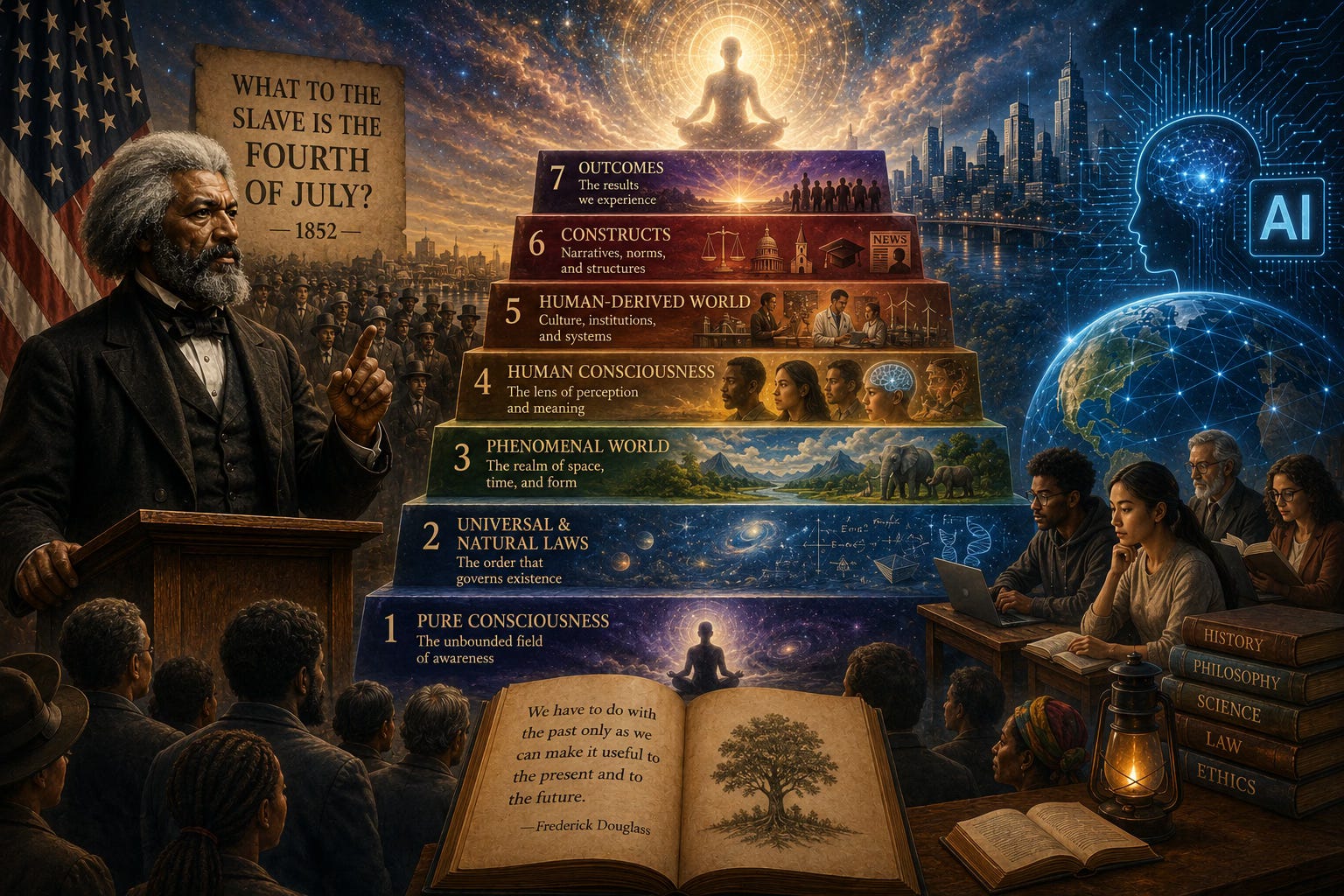
The Seven Layers of Manifestation offers one possible vocabulary for describing the movement Douglass was already making. Rather than beginning with visible outcomes, the framework begins with the deepest source from which those outcomes inevitably emerge.
At its foundation rests Pure Consciousness—the unbounded field of awareness from which experience itself arises. From this ground emerge the Universal and Natural Laws that govern existence. These unfold within the Phenomenal World, become interpreted through Human Consciousness, and are ultimately expressed through the Human-Derived World. Over time, they crystallise into the cultures, institutions, technologies, economies, and systems of governance we create, eventually solidifying into the social Constructs whose cumulative effects become the observable Outcomes we so often mistake for reality itself.
Douglass’ genius was that he refused to confuse the final layer with the first.
Most attempts at reform begin near the surface.
We observe inequality and seek to revise policy. We encounter violence and strengthen enforcement. We witness educational decline and redesign curricula.
Each effort may prove valuable. Yet they often resemble pruning branches while leaving the roots untouched.
Douglass understood this intuitively.
His speech did not simply call for better legislation. It demanded a more honest relationship with truth itself. That distinction has become increasingly significant in our own time.
For perhaps the first time in human history, knowledge itself is becoming radically democratised.
The emergence of artificial intelligence represents far more than another technological innovation. It signals an irreversible shift in humanity’s relationship to information. Questions that once required years of specialised study can now be explored within moments. Philosophical traditions separated by continents may be examined side by side. Legal precedents, scientific literature, historical documents, sacred texts, and competing interpretations have become available to an ever-expanding portion of humanity.
This development is difficult to overstate.
For centuries, access to knowledge has been mediated by geography, wealth, institutional affiliation, and social privilege. Libraries required proximity. Universities required admission. Mentors required circumstance. Expertise often remained concentrated within relatively small communities with strict barriers to entry.
Artificial intelligence alters this landscape.
It does not eliminate expertise, nor should it. It does, however, lower the threshold for meaningful inquiry.
In this respect, I believe, Artificial Intelligence functions as one of history’s great equalisers.
Yet what AI equalises is not consciousness itself. It equalises access within the Human-Derived World. It accelerates our interaction with knowledge, institutions, languages, histories, and the social constructs accumulated across centuries. It dramatically reshapes the upper layers of the Seven Layers of Manifestation while leaving the deepest layers untouched.
Such occurs not because it makes every individual equally knowledgeable. Still less because it makes every individual equally wise. Rather, because it grants unprecedented access to humanity’s accumulated intellectual inheritance. Simply stated, the democratization of the internet, ubiquity of information, and the advance of Artificial Intelligence is nothing short of miraculous in what it means for the human species writ-large.
A curious teenager in Nairobi, a retired machinist in Alabama, a contemplative monk in Bhutan, and a university student in Cambridge may now ask remarkably similar questions and receive remarkably sophisticated points of departure from which to continue their own investigations.
This is extraordinary. It is also deeply unsettling.
For if ignorance becomes increasingly difficult to claim, another question inevitably moves to the foreground:
What, then, explains our choices?
The answer cannot be found within information alone. Information may alter what we know. It does not necessarily transform the consciousness from which knowing proceeds. Two individuals may possess identical facts while arriving at entirely different conclusions because they remain oriented by different assumptions regarding reality, value, and purpose. The deeper layers continue governing the higher ones.
Here, for me, the significance of Douglass returns with renewed clarity.
His audience could not plead ignorance. The brutality of slavery was already visible. The principles articulated within the Declaration of Independence were already known. The contradiction between the two required neither additional evidence nor superior reasoning.
It required the willingness to see.
Artificial intelligence presents humanity with a remarkably similar moment.
Its greatest contribution may ultimately prove not to be the answers it generates but the excuses it deftly removes.
When access to knowledge becomes commonplace, orientation assumes an even greater importance.
The challenge before us then is no longer merely acquiring information. It is cultivating the consciousness capable of employing information wisely.
Knowledge has always been a tool. Wisdom, however, remains an orientation.
This distinction may prove decisive for the century presently unfolding, as every technological revolution expands human capability. Few expand human character.
Printing multiplied books. Electricity extended industry. The internet connected minds. Artificial intelligence amplifies cognition itself.
Yet none of these developments determines the purposes toward which they are directed.
The same instrument capable of illuminating truth may also magnify confusion, while fostering dialogue may deepen division, and amid solving extraordinary problems may create entirely new ones if guided by insufficient wisdom.
Technology amplifies orientation. It does not replace it.
It amplifies whatever already resides within the deeper layers of human consciousness. Where wisdom is present, technology extends wisdom. Where confusion prevails, technology extends confusion. The instrument remains neutral; orientation determines its expression.
This, I believe, is where Douglass continues to speak across the centuries. His challenge was never confined to one nation or one historical moment. Instead, it was directed toward every generation tempted to confuse advancement with awakening.
The future will not be determined solely by the sophistication of our machines, the complexity of our institutions, nor the abundance of our information. It will be determined by the depth of consciousness from which these are developed and employed.
Perhaps this is the deeper meaning of treating the present as a portal: the past does not imprison us. Nor does it absolve us. Instead, it invites us to recognise recurring patterns that shape every civilisation.
Frederick Douglass recognised one such pattern in 1852. Artificial intelligence reveals another in 2026. Both point toward the same enduring question:
Once knowledge is within reach, what remains to guide the hand that uses it?
That question cannot be answered by technology, nor can it be legislated into existence, and it most certainly cannot be delegated to machines, institutions, or experts.
It must ultimately be answered within the field of consciousness itself.
There, as always, the Human-Derived world and our collective future begins.
Frederick Douglass understood that the work of justice begins long before legislation and long after celebration. It begins with orientation. As a result, artificial intelligence may prove to be the greatest equaliser of knowledge humanity has yet produced. Yet knowledge has never been civilisation’s scarcest resource. Orientation has.
Perhaps that is why the present remains a portal. Not because it permits us to escape the past, but because it reveals the deeper currents that continue flowing beneath every age.
The challenge before us, then, is neither to fear technology nor to worship it. It is to cultivate the depth of consciousness from which technology, institutions, cultures, and societies inevitably emerge.
For when we learn to begin at the deepest layer rather than the most visible one, we may finally discover that history has not merely been teaching us what happened.
It has been patiently teaching us where to begin.
Suggested Practice
Set aside fifteen minutes in a quiet place.
Think of one challenge facing your family, organisation, community, or society.
Rather than asking, How do we fix the outcome?, ask yourself:
What social construct is producing this outcome?
What aspects of the human-derived world sustain that construct?
What assumptions within human consciousness continue giving it life?
Which Universal and Natural Laws does it appear to honour—or violate?
How might greater rootedness in Pure Consciousness alter the way I perceive both the problem and its possible solutions?
Resist the urge to answer immediately.
Instead, notice how the questions themselves begin shifting your attention from symptoms toward causes.
Sometimes the most meaningful transformation begins not with changing the world, but with changing where we choose to begin our inquiry.
—
About the Author
Dr. Baruti KMT-Sisouvong is a scholar of consciousness, researcher of human development, and Certified Teacher of Transcendental Meditation® based in Cambridge, Massachusetts. His work explores the relationship between Pure Consciousness, neuroscience, and social systems, and how deeper awareness can inform both personal growth and institutional transformation.
He is the Founder and Chief Meditation Officer of Transcendental Brain, an initiative examining the intersection of consciousness research, cognitive science, and high-performance decision-making. He is also President of Serat Group Inc. and Founder and Director of Radical Scholar Inc., a nonprofit dedicated to consciousness-based research and public scholarship.
Alongside his wife and teaching partner Mina, he co-directs the Transcendental Meditation program for Cambridge and the Greater Boston area. He is also the host of the On Transcendence Podcast and Founder of International Meditation Hour, a quarterly global gathering dedicated to the unifying power of silence.
His writings—spanning frameworks such as The Model for Perpetual Growth and Progress and The Seven Layers of Manifestation—explore the evolving relationship between consciousness, leadership, and society.
He writes from the conviction that the most important race is not between nations or machines, but between the conditioned mind and the awakening soul.
To learn more about him, visit: https://barutikmtsisouvong.com/.
This is quite an interesting article in my opinion.
The conditions that were set before the questions were asked toward the end were a quiet gem which actually answered a previous question I asked you about orientation.
The first instruction was to set aside 15 minutes in a quiet place.
When I decided to do this, I did Maharishi Yoga Asanas since I already did my morning TM. It usually takes about 35 minutes for me to complete the asanas, including a 5 minute easy breathing practice.
As I was completing the asanas, I noticed that it was a long time since I had been relatively alone in a relatively quiet place. It seemed to me that it was simply another lucky coincidence and I continued to do the asanas while wondering to myself about the second condition.
“Think of one challenge facing your family, organisation, community, or society.”
I thought and thought and while doing the asanas there was nothing which immediately bubbled up to the surface about family, organization, community, or society.
What did bubble up to the surface was the growing realization that I was content while alone in a relatively quiet place. Very content. This realization reminded me that my current paradigm is that the world is as I am. I don’t mean that in an exact way. It’s more like an orientation type of way to see the world, family or society or my environment. Essentially, I must first establish where I am before I look to where I’m going. The same can be said in a slightly different way; I must first establish when I am before I look to when I’m going. If I imagine myself as a point in endless space that would be very disorienting and mathematically incredibly complex. So I simplified by using a different question which seems in line with this article;
“How am I doing now, relative to how I was doing roughly 1 year ago?”
I used two points of when I was to create a rough map of my own orientation. How am I doing now relative to how I was doing roughly a year ago? Better. More content. I was content a year ago. I’m now somehow more content.
I will shift into a slight tangent to move towards the focus of the second condition, which was to
think of one challenge. A fish in an ocean is content. A fish on land? Most of time, not so much. If I am more content now than I was a year ago, when I was already content a year ago, it seems to me that I am a fish who has found a better environment to live in.
This is in line with what I feel is my nature. I’m constantly challenging myself to be better while simultaneously remaining very content through, what I feel is my consistent practice of transcendental meditation (TM).
If my environment is supporting me, I would have to say that my environment feels supported by me in some way. I’ll simplify my environment and use one person. My fiancée. She has been very supportive to me. The challenge that I think she faces is my constant growth. As I’m writing this, I just paused and asked her what challenge she is facing rather than just speculating. She said it was, “Accepting painful emotions”
I didn’t expect to write so much so I will take a break before answering the questions. Like I said before. Great questions. Even better conditions that you helped me set before asking the questions. Thank you.
P.S. Agape by Nicholas Britell
Thank you, Dr. Beruti for another wonderful, thought provoking article.