


Author’s Note
There are moments in life when one realizes that perseverance is not merely an act of force, but an act of alignment.
Not alignment with circumstance—for circumstance often shifts without warning—but alignment with something deeper: an interior steadiness that refuses collapse even while standing amid uncertainty.
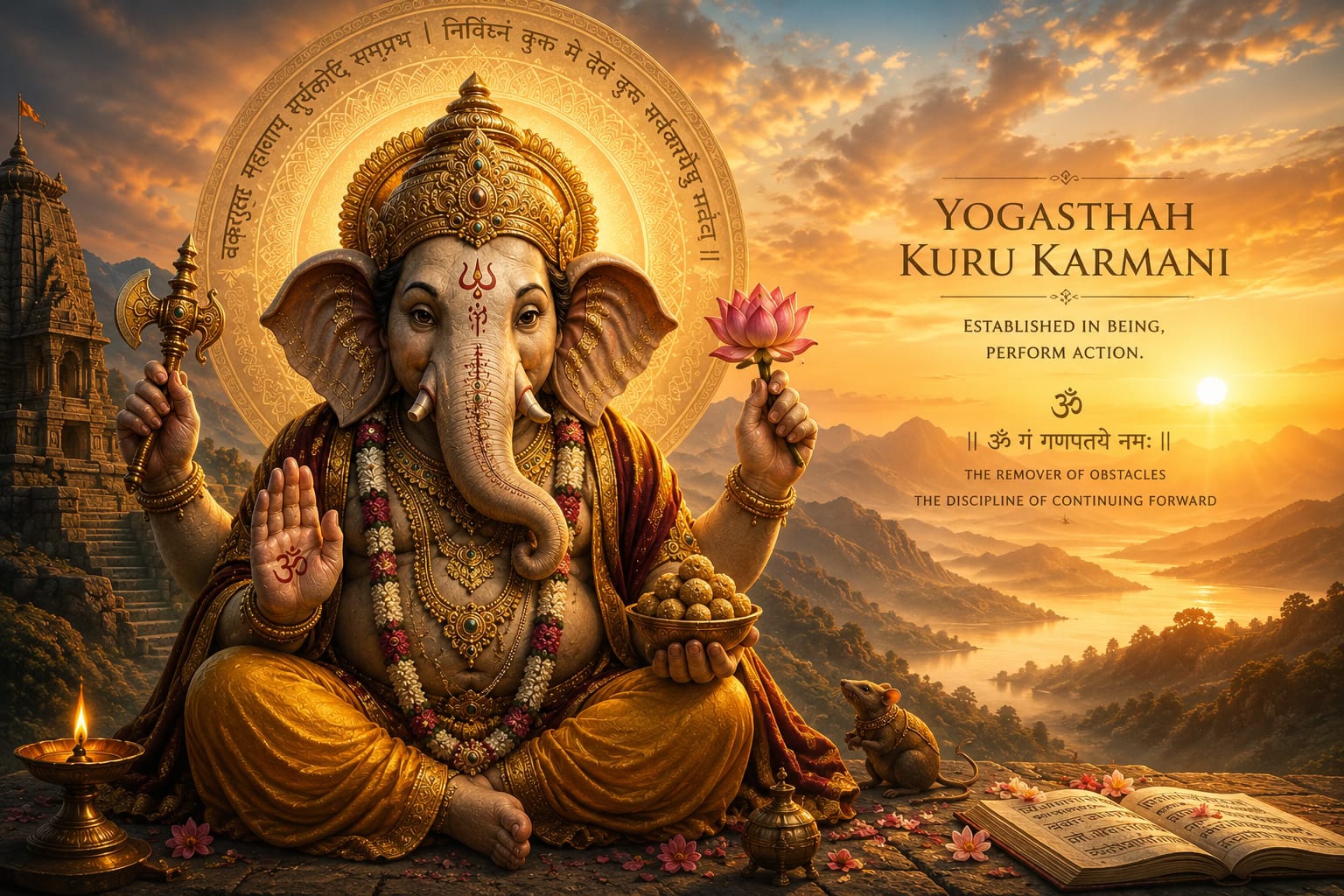
Recently, our family navigated a difficult and emotionally charged housing situation. It would have been easy to surrender to frustration, resentment, fear, or exhaustion. And yet, in the midst of that turbulence, an image surfaced during a meditation: Ganesha—the ancient figure so often associated with the removal of obstacles, wisdom, groundedness, and forward movement.
What struck me was not merely the symbolism itself, but the timing.
It arrived not as escapism, nor as fantasy, but as a reminder.
A reminder that difficulties are not always immediately removed from the path. Sometimes, they are navigated. Other times, endured. And further along the path at other moments, transformed through the cultivation of consciousness itself.
This reflection emerges from that space.
As for the Sanskrit subtitle, Yogastha Kuru Karmani, it is a timeless teaching from the Bhagavad Gita (Chapter 2, Verse 48).
—Baruti KMT-Sisouvong, PhD
Across centuries, cultures, and traditions, human beings have sought symbols capable of helping them endure the difficult passages of life.
Among the most enduring of these symbols is Ganesha—the elephant-headed deity widely revered throughout the Vedic tradition as the remover of obstacles, patron of wisdom, guardian of beginnings, and embodiment of steady perseverance.
For many in the modern world, Ganesha appears first as image: a serene figure with an elephant’s head, broad ears, calm eyes, and rounded form seated in composure amid apparent contradiction. Yet symbols that endure across generations rarely survive because of aesthetics alone. They survive because they carry psychological, philosophical, and spiritual utility.
And perhaps nowhere is that utility more evident than during periods of uncertainty.
There are seasons in life when the ground beneath one’s feet seems unstable—when plans collapse unexpectedly, when financial strain presses inward, when misunderstandings emerge, when doors close, and when one’s responsibilities toward family and future feel almost impossibly heavy.
During such moments, the mind often oscillates between fear and exhaustion.
One begins asking:
How much longer can this continue?
How many more obstacles remain?
And, at what point does one finally arrive at some semblance of stability?
Yet, as I have come to understand it, the symbolism of Ganesha offers another possibility entirely.
Not the fantasy of a life without obstacles. But the cultivation of a consciousness capable of moving through them. I have come to understand this process as a kind of spiritual weatherproofing.
Why the Elephant Matters
Whenever one observes an elephant, several characteristics become evident:
The elephant is not a frantic creature. It does not rush about impulsively through its tasks. As one continues observing the elephant, one notices that its movements are articulated with grounded force, memory, awareness, and deliberate presence—thereby conveying an astonishing degree of grace for such a large land mammal.
This symbolism matters deeply.
Modern society frequently glorifies acceleration. We celebrate speed, reaction, disruption, immediacy, and visible conquest. But life’s most difficult passages rarely respond well to frantic movement. Panic narrows perception. Fear compresses cognition. Emotional overload clouds judgment.
In contrast, the elephant symbolizes steadiness under pressure.
Large enough to move barriers, sensitive enough to navigate complexity, and sufficiently strong enough to continue despite resistance.
Even the large ears associated with Ganesha hold symbolic significance. They suggest the necessity of listening deeply—not merely to external noise, but to subtler forms of knowing that emerge when the mind settles.
And this, by virtue of direct experience, is where meditation becomes deeply relevant.
Meditation and the Recovery of Inner Space
One of the great misconceptions surrounding meditation is the belief that it exists merely for relaxation. In my experience and after now a solid eighteen years of twice daily practice of Transcendental Meditation® (TM), it does not.
Relaxation may indeed occur, but the deeper value of meditation lies elsewhere.
Meditation creates interior space between stimulus and reaction; thereby allowing a potential reaction to be transmuted into a response. And this matters tremendously.
As a result of consistent practice, TM allows the nervous system to recover from continual overload and, thereby, permits the mind to settle beneath surface turbulence. It introduces, cultivates, and strengthens one’s access to forms of intuition, clarity, resilience, and adaptive intelligence that are often inaccessible when one remains trapped in chronic stress activation. And in difficult circumstances, this matters enormously.
When individuals are overwhelmed, they frequently make decisions from contraction rather than coherence. In my talks, I often share we make our best decisions when we have clarity; yet our worst decisions when we lack clarity. With lack of clarity, fear narrows possibility, anxiety distorts time, and the resultant fatigue weakens discernment.
Meditation interrupts this cycle.
Not by magically removing external difficulty, but by altering one’s relationship to it.
Think of it this way, a settled mind can perceive options hidden from an agitated one. As a result, when the nervous system is rested, one can endure challenges that overwhelm an exhausted system. And when one is anchored internally, one can continue moving forward even while uncertainty remains unresolved.
This is not passivity. It is disciplined interior stabilization.
And increasingly, neuroscience supports what contemplative traditions have long understood: practices that allow the brain and nervous system to access deeper states of rest and integration often improve emotional regulation, cognitive flexibility, resilience, and long-term well-being.
Ancient symbolism and modern science, in this regard, begin converging toward the same insight:
Inner order influences outer navigation.
Obstacles Are Not Always Signs to Stop
This may be one of the hardest lessons adulthood teaches.
Many people unconsciously assume that resistance means failure—that obstacles indicate one has taken the wrong path. But history rarely supports this conclusion.
Nearly every meaningful undertaking encounters periods of contraction, uncertainty, misunderstanding, exhaustion, or instability.
Families endure difficult transitions.
Communities face disruption.
Institutions evolve imperfectly.
Visionaries encounter skepticism.
Builders encounter delays.
Dreams encounter resistance.
The presence of difficulty alone does not determine the value of the path.
Sometimes the obstacle is not a wall. In truth, it is training that, if accepted, reveals capacities one did not know one possessed. I often think of the experience as Nature forcing one to refine. One may either do so willingly, or one may do so kicking and screaming.
Because, if one has a worthy goal into which one must grow, the old self and its ways of thinking must be forever surrendered so as to embrace the new way of thinking, being, doing, and becoming.
In my experience, it seems Nature is asking—Will you continue?
And if one’s response is in the affirmative, moving forward must not be done recklessly or blindly. It must be done consciously.
Therefore, the symbolism of Ganesha reminds us that wisdom is not merely intellectual brilliance. It is also endurance with awareness coupled with the ability to remain internally composed while reality reorganizes itself around you. Here, I am reminded of one of my favourite quotes from Dr. Benjamin Elijah Mays—Past President of Morehouse College—where he penned:
The circumference of life cannot be rightly drawn until the center is set.
I believe that center is us—more specifically, our interior landscape.
Provided said center is calm, the world about us, eventually, comes to reflect the same. In so doing, it may be argued that one’s interior landscape—or mind—is the greatest alchemist of all.
The Spiritual Importance of Continuing Forward
There is dignity in continuing.
Not in performative optimism, denial, or in pretending difficulty does not exist. Because, unequivocally stated, it does.
But in continuing nonetheless.
To continue caring for one’s family, creating, teaching, serving, building, meditating, and perhaps most importantly, believing that one’s current circumstances do not represent the totality of one’s future.
This form of perseverance is spiritual in nature because it resists fragmentation.
It declares that external turbulence will not fully determine internal orientation.
And perhaps this is why symbols like Ganesha continue resonating across generations. They speak to something archetypal within human experience: the recognition that life inevitably presents obstacles, and that human flourishing depends not merely upon avoiding them, but upon developing the consciousness necessary to move through them wisely and with dignity.
The obstacle remover, then, may not always remove the obstacle itself.
Sometimes, echoing Dr. Mays, the deeper removal is internal. Be it panic, paralysis, despair, or the socialized belief that difficulty means defeat. All of these must be removed.
In so doing, the storm abates and movement becomes possible again.
Continuing Forward
On the morning in question, during meditation, the image of Ganesha surfaced unexpectedly.
Not dramatically. It just appeared in my awareness.
And perhaps that lack of a dramatic appearance was itself the lesson.
Because transformation rarely arrives only through thunderous revelation. Often, it arrives through subtle reminders encountered precisely when one needs them most.
Breathe.
Steady yourself.
Continue.
Not because the path is easy. But because movement itself is sacred, consciousness matters, your presence matters, your family matters, and because the future is still being shaped by the choices you make today.
Alongside the surfacing of Ganesha that morning, I recognized something that had become a constant companion since the Fall of 2013 and now accompanied me throughout the entire ordeal:
the still center had never moved.
While circumstances shifted repeatedly, plans changed, pressures intensified and receded, and the external environment required continual navigation, beneath all of it remained a subtle steadiness—a quiet interior continuity that neither panicked nor collapsed. It was the experience I wrote about in the essay titled The Unstruck Sound: On Hearing the Ever-Present Hum of Consciousness.
Throughout, the last two and a half years, the mind responded to circumstance, the body experienced fatigue, and my emotions rose and fell. But the still center remained.
As a result, I am compelled to close with the following:
Perhaps this is why contemplative traditions speak of an underlying sound, hum, or resonance beneath ordinary mental activity—not because life becomes silent, but because one eventually discovers that silence and movement can coexist.
And perhaps this is the deeper lesson:
sometimes the most powerful spiritual act is neither conquest nor certainty, but the disciplined decision to remain centered and continue forward.
So, center yourself and just keep moving!
Suggested Reflection
Take several minutes today to sit silently without devices, conversation, or distraction.
Reflect upon a current obstacle in your life—not merely the external circumstance, but your internal relationship to it.
Ask yourself gently:
What part of this situation is asking me to grow stronger, steadier, or clearer?
Where has fear narrowed my perception?
What would continuing forward look like if I moved from grounded awareness rather than anxiety?
What practices help restore my inner equilibrium when life becomes turbulent?
Then, before rising, take one slow breath and silently affirm:
“I will continue forward with steadiness, clarity, and awareness.”
Closing Note
For those interested in exploring meditation further, introductory talks on Transcendental Meditation® are offered regularly in Cambridge and online. These sessions provide an opportunity to learn more about the practice, to ask questions, and to determine—without pressure—whether it is something worth experiencing directly.
Locally: https://tm.org/cambridge
Nationally: https://tm.org
—
About the Author
Dr. Baruti KMT-Sisouvong is a scholar of consciousness, researcher of human development, and Certified Teacher of Transcendental Meditation® based in Cambridge, Massachusetts. His work explores the relationship between Pure Consciousness, neuroscience, and social systems, and how deeper awareness can inform both personal growth and institutional transformation.
He is the Founder and Chief Meditation Officer of Transcendental Brain, an initiative examining the intersection of consciousness research, cognitive science, and high-performance decision-making. He is also President of Serat Group Inc. and Founder and Director of Radical Scholar Inc., a nonprofit dedicated to consciousness-based research and public scholarship.
Alongside his wife and teaching partner Mina, he co-directs the Transcendental Meditation program for Cambridge and the Greater Boston area. He is also the host of the On Transcendence Podcast and Founder of International Meditation Hour, a quarterly global gathering dedicated to the unifying power of silence.
His writings—spanning frameworks such as The Model for Perpetual Growth and Progress and The Seven Layers of Manifestation—explore the evolving relationship between consciousness, leadership, and society.
He writes from the conviction that the most important race is not between nations or machines, but between the conditioned mind and the awakening soul.
To learn more about him, visit: https://barutikmtsisouvong.com/.