


Author’s Note
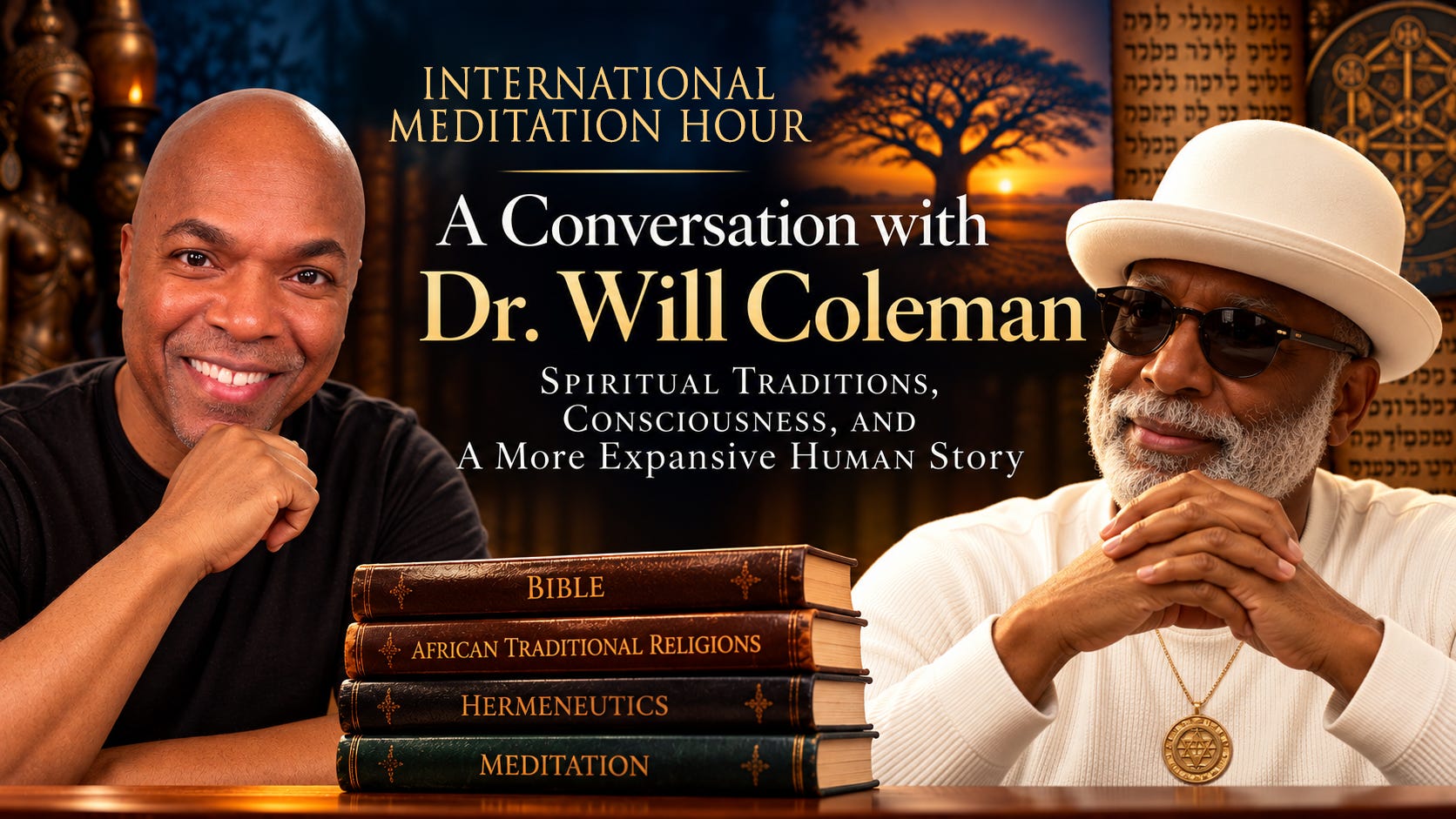
This essay emerged from an extraordinary conversation with Dr. Will Coleman during the recent installation of International Meditation Hour. What was intended to be an hour-long exploration of consciousness, spiritual traditions, and contemplative practice developed into a considerably longer exchange encompassing ancestral intelligence, institutional authority, artificial intelligence, and the responsibilities accompanying human development.
Given our nearly two decades of friendship and intellectual engagement, the conversation held particular significance for me and was not entirely unexpected. Because it provided an opportunity not merely to revisit ideas encountered during my earlier studies with Doc, but to consider how those ideas have evolved through subsequent experiences and the passage of time.
The accompanying recording preserves the fullness of that exchange, including the spontaneous turns that made it especially meaningful. I encourage readers to experience the conversation itself, as the reflections offered here represent but a miniscule portion of the territory we explored.
I also extend my sincere appreciation to Dr. WIll Coleman for his enduring generosity, friendship, and willingness to share his wisdom with our International Meditation Hour community.
—Baruti KMT-Sisouvong, PhD
For my recent International Meditation Hour, I sat down for what was intended to be an hour-long conversation with someone whose influence on my intellectual and spiritual development reaches back nearly two decades. Will Coleman, PhD, aka “Doc” a retired professor of theology and world religions at the Interdenominational Theological Center in Atlanta, Georgia, had graciously agreed to join us for the quarterly International Meditation Hour. I had prepared questions, organised the discussion around several broad themes, and anticipated an engaging exploration of consciousness, contemplative practice, and the relationship between spiritual traditions. However, what I had not anticipated was becoming so absorbed in our exchange that I forgot to begin recording. A remedy easily corrected at the conclusion.
In reflecting on the experience, there is something wonderfully appropriate about that oversight. We had gathered to consider the relationship between knowledge and experience, only for the experience itself to take precedence over the machinery intended to preserve it. The conversation was already underway, ideas were unfolding, and the distinction between preparation and participation had effectively disappeared.
By the time we concluded, we had travelled considerably beyond the customary hour. The expressions of appreciation appearing throughout the gathering suggested that those joining us were as engaged in the unfolding exchange as we were. What emerged was not simply an interview with a distinguished scholar, but a conversation about the inheritance of wisdom, the boundaries we construct around knowledge, and the possibilities that become available when we recognise ourselves as participants in a much longer human story within an unfolding universe.
My relationship with Doc began before I departed Atlanta in 2008 to resume graduate studies in Fairfield, Iowa. During those earlier years, I had the privilege of studying with him through courses exploring the Bible and meditation, Qabala, philosophy, and contemplative practice. Our conversations introduced me to ways of approaching spiritual traditions that did not require abandoning intellectual rigour in favour of personal experience, or sacrificing direct experience to satisfy the demands of institutional orthodoxy.
Over the intervening years, our paths continued to intersect. Doc remained a source of encouragement throughout my doctoral studies and was present for my dissertation defence in September 2023. Consequently, our discussion was not merely an opportunity to revisit ideas encountered long ago. It was an occasion to examine what those ideas had become through years of study, practice, questioning, and living with one of the most significant insights to emerge from our discussion concerning the very nature of spiritual development.
Dr. Coleman’s intellectual journey has taken him through Christianity, African traditional religions, Hoodoo, Qabala, Rosicrucianism, Freemasonry, and other philosophical and contemplative traditions. From the outside, such a journey might appear to involve moving from one system of belief to another, accumulating affiliations or combining ideas that belong to otherwise separate traditions. Yet Doc’s account suggested something considerably more integrated. In discussing his trajectory, it became evident that for him, encountering another tradition need not constitute a rejection of what came before. The practices, languages, and interpretations may differ, but the person engaging them remains part of a continuous process of development. Each encounter becomes an opportunity to deepen understanding, examine inherited assumptions, and discover possibilities that may not have been visible from within a single interpretive framework. Which, for me, raises an important question:
When we encounter wisdom expressed through different spiritual traditions, are we discovering fundamentally different truths, or are we encountering different cultural expressions of something more universal?
The distinction matters because human beings have a remarkable tendency to confuse the structures through which knowledge is communicated with the knowledge itself. Something I explored in a recent essay titled The Steward and the Destination. Because, institutions preserve teachings, establish methods of transmission, and create communities of practice. These functions can be enormously valuable. Yet the same institutions can become invested in maintaining boundaries that were originally intended to support understanding rather than constrain it. Consider this: a tradition may provide a language for describing experience without possessing exclusive authority over the experience being described. Its symbols and practices may illuminate particular dimensions of human life while remaining historically and culturally situated. Recognising this does not require us to declare every spiritual claim equivalent or every practice interchangeable. It asks us, instead, to distinguish carefully between what is experienced, how that experience is interpreted, and the institutional arrangements that subsequently emerge around those interpretations. And in his usual manner, Dr. Coleman’s reflections repeatedly returned to the importance of this distinction.
Perhaps nowhere was it expressed more beautifully than in his observation that meditation should not be an event but a rhythm.
He recalled his mother’s devotional life, describing how prayer permeated her ordinary activities rather than remaining confined to designated religious occasions. His father’s involvement in the church likewise shaped the rhythms of family life. What Doc inherited was therefore not simply a collection of teachings about spiritual practice. He, instead, inherited an example of what it might mean for practice to become inseparable from living. Admittedly, I found this especially meaningful because meditation has occupied a central place in my own life for many years. Although different contemplative traditions employ different techniques and may produce distinguishable experiences, there remains a broader question concerning the relationship between practice and the life of the practitioner. What happens when the benefits of a contemplative discipline begin to inform how we think, respond, decide, relate to others, and participate in the world?
In my own observations of fellow Meditators, I have arrived at an understanding that the significance of meditation cannot be reduced to the time spent practising it. Its contribution must also be considered in relation to what becomes possible beyond the period of practice. Additionally, and from this perspective, spiritual development is not necessarily measured by the number of traditions one has studied, the complexity of one’s vocabulary, or the accumulation of extraordinary experiences. It may be revealed more meaningfully in the increasing coherence between understanding and action. An understanding that allowed for our discussion to more easily move toward another form of continuity, one that challenges the modern tendency to regard individual achievement as something fundamentally self-contained.
To provide a bit of context, during my dissertation defence, Doc offered a reflection concerning my grandfather, who, like Dr. Coleman, was also a Prince Hall Mason. He observed that I had been able to pursue intellectual and educational opportunities that my grandfather had desired and possessed the capacity to undertake, but that the social conditions of his lifetime had not permitted him to realise. In that moment, Doc’s interpretation was that my grandfather had, in a meaningful sense, participated in the achievement alongside me. When we revisited that moment during our discussion for International Meditation Hour, he challenged the language I had used to distinguish what we inherit from our ancestors from what we discover through our own experiences. His response was characteristically direct. He urged me to reconsider the assumption that discovery belongs exclusively to the individual: “You are your ancestral bones now,” he declared. Admittedly, the statement will invite deep and prolonged reflection on several levels among many. And in that vein, consider this: biologically, our existence depends upon an unbroken succession of lives extending far beyond anything we can personally remember. Historically, the circumstances within which we act have been shaped by the decisions, sacrifices, struggles, achievements, and limitations of those who preceded us. Culturally, we inherit languages, practices, institutions, and ways of interpreting the world that were already developing long before our arrival.
And with but a modicum of reflection at the start of one’s interior excursion, it becomes evident that Doc approaches this continuity through an explicitly ancestral and spiritual understanding of human existence. Others may interpret the same relationships through history, sociology, psychology, or intergenerational development. These approaches need not be collapsed into a single explanation for us to recognise the importance of the question they share: how much of what we call our own achievement has been made possible by lives other than our own?
To be clear, the doctorate bears my name—Abiona Irungu Baruti KMT-Sisouvong—yet the conditions that made its completion possible did not originate with me. And such a recognition does not diminish individual effort. Instead, it places that effort within a wider field of relationships and responsibilities. We remain accountable for what we choose to do, yet our choices are exercised within possibilities that others helped create. In turn, what we accomplish may expand the possibilities available to those who follow. Doc then carried this understanding further by asking what kind of ancestors we intend to become.
It is a question that transforms ancestry from an exclusively retrospective concern into a prospective responsibility. Remembering those who came before us becomes inseparable from considering the role we are playing during our time here and what we are preparing to leave behind. Our decisions, institutions, intellectual contributions, and everyday conduct are not simply expressions of who we are today. They may become part of the inheritance through which future generations encounter their own possibilities. The conversation then travelled into territory that some might regard as distant from ancestral wisdom: artificial intelligence. Yet the transition was remarkably natural.
Dr. Coleman observed that knowledge has historically functioned as a form of property. “Knowledge is real estate,” he said, repeating the phrase to be certain listeners would take note of its significance; a rhetorical device he keeps within his intellectual quiver for effective use when needed. For those who pay close attention, the metaphor is striking because it directs attention away from technology as a collection of machines and toward knowledge as a source of social power. Across history, access to specialised learning has frequently been governed by institutions, credentials, wealth, geography, and inherited privilege. And when we factor in the reality of history, that the largess of the human species, until relatively recent, was “functionally illiterate,” it becomes clear that the capacity to acquire, interpret, and apply knowledge has therefore never been distributed independently of the structures through which societies organise opportunity. Perhaps for the first time in human history, Artificial Intelligence introduces the possibility of changing some of those arrangements.
In our exchange, I returned to questions raised in my earlier essay, The Three Chord Revolution, particularly the implications of AI for people and communities whose access to intellectual and technological resources has historically been constrained. If capabilities once concentrated within privileged institutions become increasingly accessible, the consequences may extend well beyond improvements in productivity. It is conceivable that they may alter who can participate in the production of knowledge, who can develop sophisticated ideas, and who possesses the means to translate those ideas into practical outcomes.
This does not mean that technological access automatically eliminates inequality. The infrastructures supporting AI remain embedded in economic, political, and institutional relationships. Access alone cannot guarantee sound judgement, intellectual independence, or equitable outcomes. Nevertheless, the potential redistribution of certain capabilities raises questions that established institutions cannot indefinitely avoid. And as we continued our discussion, Doc approached these developments with a striking sense of possibility. Rather than encouraging his students to retreat from emerging technologies, he described inviting them to imagine the knowledge and skills they might require in 2050 and then use AI to help construct a path from the present toward that imagined future.
The underlying principle was not technological enthusiasm for its own sake. It was the importance of recognising that emerging conditions can be engaged deliberately rather than merely endured. Here, the relationship between ancestral intelligence and artificial intelligence became particularly interesting. Because one concerns the accumulated inheritance of human experience, interpreted through the lives and traditions that precede us. While the other involves computational systems capable of identifying patterns, generating responses, and making increasingly sophisticated forms of knowledge accessible. They are not equivalent, nor should their differences be overlooked. Yet both invite us to reconsider the assumption that intelligence is adequately understood when confined to the isolated individual. In thinking it through, it becomes increasingly clear that what matters, ultimately, is how we engage the resources available to us and what we choose to bring into being through that engagement.
For me, and arguably Dr. Coleman, the same question applies to spiritual traditions, educational institutions, and the technologies now entering nearly every dimension of human life. Are we using these structures to enlarge the possibilities of human development, or have we become so invested in preserving their existing arrangements that we mistake their continuity for the fulfilment of their purpose? I have increasingly come to regard this distinction as essential. Because institutions can be valuable stewards of knowledge without being its ultimate source as I discuss in the above linked essay titled The Steward and the Destination. Teachers can illuminate possibilities without becoming the final authority over a student’s development. Technologies can extend human capabilities without relieving us of responsibility for the ends toward which those capabilities are directed. And wisdom, however inherited, must ultimately find expression in the lives we lead.
As our International Meditation Hour continued well beyond its anticipated conclusion, I found myself reflecting on the unusual privilege of returning to a conversation that had begun many years earlier. The eager, attentive person who once sat in Dr. Coleman’s classroom in Atlanta had travelled through experiences that neither of us could have fully anticipated. Yet there we were, still questioning, learning, and discovering new dimensions of subjects that had occupied our attention for decades. And for me, perhaps that is among the most important lessons of the session. Because the value of a teacher is not exhausted by the knowledge communicated during instruction. It may become increasingly apparent through the independent development of those who have studied with them. Nor is the significance of a student confined to what they learn. I believe it extends to what they eventually contribute, how they reinterpret their inheritance, and the conditions they create for others.
Our conversation did not produce a final theory of consciousness, resolve the differences among spiritual traditions, or establish a definitive account of the relationship between ancestral and artificial intelligence. Nor was that its purpose. Instead, it demonstrated the value of remaining available to enquiry while recognising that understanding is never entirely detached from the lives through which it develops.
Admittedly, I began the afternoon expecting to conduct an interview. Yet what unfolded was a reminder that some of the most meaningful conversations are not those after which we arrive at predetermined conclusions, but those during which the participants create the conditions for something neither could have produced alone.
The recording eventually began. The questions were asked and the customary hour came and went yet the conversation continued. And in retrospect, I am grateful that it did.
For the wisdom we inherit is not merely something to preserve. It is something to examine, embody, develop, and carry forward. And, for me, and perhaps you, the work of becoming continues unabated.
Suggested Practice: The Inheritance We Become
Set aside a few moments in silence to consider the people, experiences, and circumstances that have made your present life possible. Begin with someone whose influence has been particularly meaningful—a parent, grandparent, teacher, mentor, or another individual whose contributions helped shape your understanding of yourself and the world.
Reflect upon what you received from this person, recognising that an inheritance need not be material or even consciously transmitted. It may take the form of an opportunity, an example, a question, a sacrifice, or a possibility that someone else helped bring within your reach.
Now consider how that inheritance has developed through your own experiences. What have you preserved, reconsidered, and/or transformed into something that did not previously exist?
Finally, turn your attention toward those who will follow you, whether they are members of your family, colleagues, students, or individuals you may never meet. Ask yourself: What am I creating, cultivating, or making possible today that might become part of someone else’s inheritance tomorrow?
Allow the question to accompany you throughout the day. And where an opportunity presents itself, translate your reflection into one deliberate action that contributes to the conditions you would wish others to inherit.
The purpose is not merely to remember those who came before us, but to recognise that we are already participating in the creation of what comes next. So, create wisely.
—
About the Author
Dr. Baruti KMT-Sisouvong is a scholar of consciousness, researcher of human development, and Certified Teacher of Transcendental Meditation® based in Cambridge, Massachusetts. His work explores the relationship between Pure Consciousness, neuroscience, and social systems, and how deeper awareness can inform both personal growth and institutional transformation.
He is the Founder and Chief Meditation Officer of Transcendental Brain, an initiative examining the intersection of consciousness research, cognitive science, and high-performance decision-making. He is also President of Serat Group Inc. and Founder and Director of Radical Scholar Inc., a nonprofit dedicated to consciousness-based research and public scholarship.
Alongside his wife and teaching partner Mina, he co-directs the Transcendental Meditation program for Cambridge and the Greater Boston area. He is also the host of the On Transcendence Podcast and Founder of International Meditation Hour, a quarterly global gathering dedicated to the unifying power of silence.
His writings—spanning frameworks such as The Model for Perpetual Growth and Progress and The Seven Layers of Manifestation—explore the evolving relationship between consciousness, leadership, and society.
He writes from the conviction that the most important race is not between nations or machines, but between the conditioned mind and the awakening soul.
To learn more about him, visit: https://barutikmtsisouvong.com/.
That was an amazing conversation!! What the doctor ordered (the pun is intended :-) I am so happy I saw the announcement just in time! Thank you for that.