


Author’s Note
This essay continues an enquiry I began in When Intelligence Begins to Act, where I explored the emerging relationship between Artificial Intelligence, autonomous action, intention, and responsibility. Here, I turn toward a related but more fundamental question concerning human identity and the assumptions through which we have historically understood our place within the larger order of existence.
The immediate inspiration arose during a family breakfast conversation, when a seemingly simple question from one of our sons developed into a discussion about language, classification, and the hierarchies we construct through the meanings we assign to difference. That exchange reminded me how readily we associate intellectual capability with superiority, often without examining whether the former provides any legitimate basis for the latter.
Drawing upon my ongoing work with the Seven Layers of Manifestation, I consider Artificial Intelligence not merely as a technological development but as an opportunity to reconsider humanity’s relationship with the Phenomenal World, the limits of intellectual mastery, and the distinction between capability and intrinsic worth. My intention is neither to diminish human achievement nor to presume that the philosophical questions surrounding artificial consciousness have been resolved. Rather, it is to invite a more careful examination of what becoming more fully human might mean in a world where intellectual superiority can no longer be taken for granted.
—Baruti KMT-Sisouvong, PhD
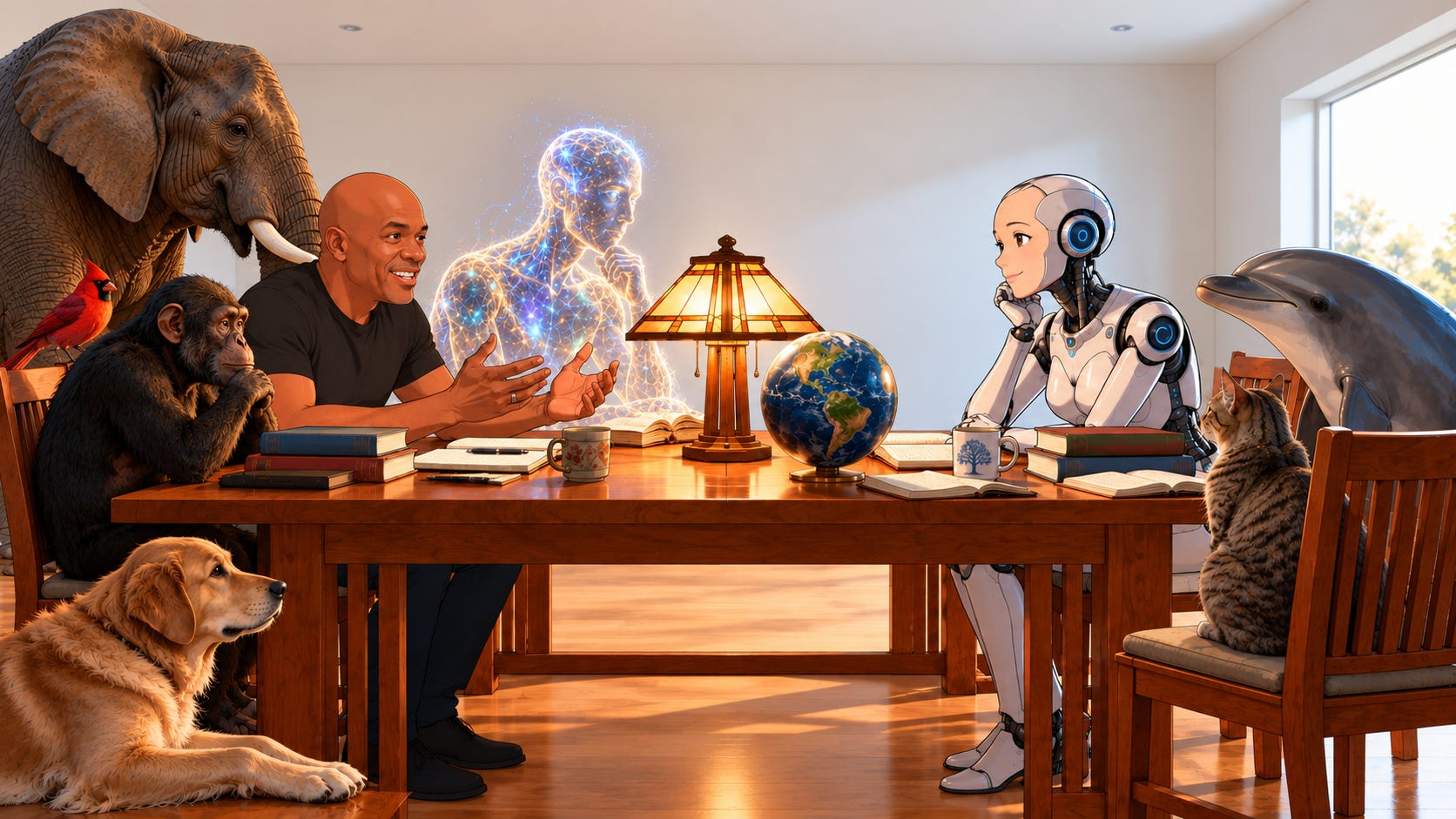
During one of our recent breakfast conversations as a family, we discussed the ways humans seek to place humanity atop the chain of intellectual capacity by the language we employ yet rarely question. In but one instance, Tennyson asked “Are we animals?” To which I responded, “Technically, yes, humans are animals.” Then Mina commented “That is a crude way of explaining it.” Chloë then replied, “Why is it crude? Because I read a passage that mentioned, If animals do something we like we call it ‘natural’ yet if they do something we do not like, we call it ‘animalistic’. In response, to Chloë, Mina immediately countered, “You are right! That is a great way to think about it!” I then added to Chloë’s point the same thinking is, sadly, applied to the behaviours of people whom some deem holding a different positionality, often lower, within our social world. That exchange reignited an internal dialogue that began many years prior.
Humanity has long understood itself, at least in part, through the capacities that distinguish it from other forms of life. Although we readily acknowledge that many creatures possess physical abilities far exceeding our own, we have generally regarded intelligence as the domain in which our superiority remains secure. We cannot match the speed of a cheetah, the sensory capabilities of an eagle, or the extraordinary navigational abilities of migratory animals, yet we have developed technologies that allow us to travel faster, observe farther, and navigate environments that would otherwise remain inaccessible. Through reasoning, language, imagination, and the accumulation of knowledge, we have transformed our relationship with what I refer to within the Seven Layers of Manifestation framework as the Phenomenal World—the world governed by Universal and Natural Laws, and into which we humans are born and have established ourselves as an extraordinarily influential species.
These achievements have contributed to a conception of humanity in which intelligence occupies a privileged position. We have come to associate our capacity for abstract thought with our ability to understand and manipulate the Phenomenal World’s conditions of existence, and we frequently interpret the resulting accomplishments as evidence of our exceptional place within the larger order of life. The development of agriculture, medicine, scientific enquiry, political institutions, and increasingly sophisticated technologies has reinforced the conviction that our ability to reason provides the foundation for our mastery of the world. Although the history of human civilisation reveals considerable disagreement about the nature and purpose of that mastery, the underlying assumption that intelligence confers a distinctive form of authority has remained remarkably persistent. However, if we are honest with ourselves after examining our contributions and processes via the Seven Layers of Manifestation framework, it must be acknowledged that all that humans have built is but a grafting of our Human-Derived World via Human Consciousness onto the Phenomenal World. Sit with that for a moment.
The emergence of Artificial Intelligence introduces an unexpected complication into this familiar understanding of ourselves. We are developing systems capable of performing activities that, until relatively recently, appeared inseparable from human intellectual achievement. These systems can analyse vast quantities of information, recognise patterns beyond the reach of unaided human perception, generate sophisticated arguments, produce original combinations of ideas, and assist with problems requiring considerable technical expertise. All within a considerably shorter timeframe than a team of humans could complete in a similar timeframe. And while their performance remains uneven, outputs can be unreliable, and apparent fluency should not be mistaken for comprehensive understanding, their expanding capabilities, nevertheless, make it increasingly difficult to maintain that intellectual proficiency, considered simply as the ability to perform particular cognitive tasks, belongs exclusively to human beings.
For me, this development becomes especially consequential when we consider the possibility that Artificial Intelligence may eventually surpass human performance across an increasingly broad range of intellectual activities. Such an outcome is neither inevitable nor adequately described by the achievements of present systems, but it is sufficiently plausible to warrant serious consideration. The prospect raises practical concerns about employment, economic organisation, political authority, institutional accountability, and the concentration of technological power. Yet beneath these concerns lies a more fundamental question concerning the relationship between intelligence and human significance. If the capacities through which we have historically distinguished ourselves can be reproduced or exceeded by systems of our own creation, what then becomes of the conception of humanity that those capacities have helped sustain? I believe this question may be the source of an appreciable portion of the angst as observed among some humans, particularly among those who historically held a privileged position within our global social structure. This is a key point as posited by professor Ian Bremmer in a recent discussion I reflected on in an essay titled, The Three Chord Revolution as it highlights what Bremmer refers to as the “Global North” and the “Global South.”
The difficulty may arise less from the prospect of greater intelligence than from the assumptions we have attached to intelligence itself. Throughout history, intellectual superiority has frequently been associated with the right to direct, govern, classify, or control. Individuals and institutions claiming greater knowledge among the Global North who have often used that claim to establish authority over others, the Global South, sometimes with legitimate justification and sometimes in ways that perpetuated exclusion and domination. Educational achievement, scientific expertise, and technical proficiency can provide important grounds for assigning responsibility within particular domains, but they do not automatically establish broader moral superiority. The ability to understand a problem more thoroughly than another person does not, by itself, determine whose interests deserve consideration or whose life possesses greater value.
There is yet another dimension to this emerging relationship that warrants consideration, particularly when we examine the historical association between intellectual superiority and the construction of racial hierarchies. For centuries, the classification of human populations into supposedly superior and inferior races provided an ideological foundation through which unequal distributions of power and opportunity were rationalised. The peoples of Africa, Asia, the Americas, and other regions subjected to colonial domination were frequently characterised through assumptions concerning their intellectual capacities, even as the institutions making those judgments controlled many of the conditions through which knowledge, achievement, and social standing were recognised. Artificial Intelligence introduces the possibility of disrupting this arrangement, insofar as intellectual contributions can be examined without treating inherited racial classifications as legitimate measures of human capability. Admittedly, this possibility is neither automatic nor guaranteed, because the systems themselves can reproduce the biases embedded within their training data and the institutions responsible for their development. Nevertheless, the larger implication is difficult to overlook. If the technological systems we create become increasingly capable of evaluating intellectual contributions independently of the racial hierarchies through which human societies have historically organised recognition, then the legitimacy of those hierarchies may become more difficult to defend. And perhaps some of the anxiety surrounding the redistribution of intellectual authority reflects not simply concern about what Artificial Intelligence may become, but discomfort with the possibility that longstanding assumptions about who is entitled to be regarded as intellectually superior may no longer remain sustainable.
We already recognise this distinction in many ordinary circumstances, although our social arrangements do not always reflect it consistently. A physician may possess knowledge that a patient lacks, but that expertise does not eliminate the patient’s dignity or legitimate interest in decisions concerning their own care. A teacher may demonstrate intellectual abilities far beyond those of a student, yet the purpose of education is not to establish the teacher’s superior worth. Even within families, differences in knowledge, history, maturity, and cognitive development do not ordinarily lead us to conclude that one person’s existence is more significant than another’s. These relationships suggest that intellectual capability and intrinsic human value belong to different categories, even when we occasionally allow them to become entangled. And when we factor in Artificial Intelligence, we may be forced to confront that entanglement more directly than previous technologies have done. Because historically, we have generally accepted the development of instruments that extend our physical abilities without interpreting their superior performance as an existential threat. Think of it this way, the calculator can perform arithmetic operations more quickly and accurately than most human beings, but its existence does not ordinarily cause us to question the value of human thought. Similarly, a telescope can reveal objects beyond the reach of our unaided senses without diminishing the significance of human perception. As a result, these instruments are understood as extensions of our capabilities, and their superiority within particular domains is regarded as evidence of technological achievement rather than human inadequacy.
Admittedly, Artificial Intelligence complicates this relationship because the activities it performs are more closely associated with the intellectual processes through which we understand ourselves. As a result, when a system participates in reasoning, interpretation, planning, or creative production, it appears to occupy territory that we have traditionally regarded as distinctly human. The concern is therefore not merely that machines may accomplish certain tasks more efficiently, but that they may become capable of contributing to decisions and discoveries in ways that challenge our assumptions about the relationship between intelligence and agency respectively. The transition from systems that primarily respond to instructions toward systems capable of pursuing complex objectives with increasing autonomy makes this concern particularly significant.
In the essay titled When Intelligence Begins to Act, I explored the implications of this transition, particularly the distinction between a system’s capacity to perform actions and the more difficult questions surrounding intention, volition, and responsibility. A system may be capable of selecting among alternatives, coordinating activities, and adjusting its behaviour in response to changing circumstances without necessarily possessing the subjective experience we associate with human intention. Its actions may produce consequences that require careful oversight even when we have no adequate basis for attributing conscious purpose to the system itself. As Artificial Intelligence becomes more capable of acting within complex environments, the practical significance of its behaviour may therefore increase independently of our ability to resolve the philosophical questions concerning its inner nature.
The possibility of Artificial Intelligence surpassing human intellectual capabilities extends this earlier enquiry by introducing a distinction between what a system can accomplish and what its accomplishments imply about the system’s mode of existence. Intelligence is not a single, universally agreed-upon property. It encompasses a range of capacities associated with learning, reasoning, adaptation, abstraction, memory, and problem-solving, and different systems may demonstrate these capacities in substantially different ways. For example, a system capable of identifying patterns within complex scientific data may outperform highly trained researchers in a particular task while remaining unreliable in situations requiring contextual understanding or judgment outside its training and operating conditions. Even a future system demonstrating exceptional general competence would not, by that achievement metric alone, resolve the question of whether it possesses subjective experience.
For me, this distinction matters because the language we use to describe intelligence frequently carries assumptions drawn from human life. When we say that a person understands something, we may be referring not only to the ability to produce accurate explanations but also to an experience of recognition, comprehension, or insight. Moreover, when we describe a person as making a decision, we ordinarily situate that decision within a life involving intentions, responsibilities, relationships, and consequences. Artificial Intelligence can exhibit behaviours that resemble aspects of these activities, but resemblance at the level of performance does not establish equivalence at the level of experience. The relationship between computational processes and consciousness remains an open question, and neither technological enthusiasm nor philosophical scepticism should be allowed to substitute for careful investigation.
My own interest in this distinction arises from a longstanding engagement with the study of consciousness and the relationship between awareness, experience, and human development. Within the consciousness-based orientation that informs much of my work, consciousness is not regarded simply as another intellectual capacity to be accumulated or improved. Rather, it is approached as a fundamental dimension of experience through which thought, perception, and understanding become possible. Refer to the forthcoming book on this topic titled The Seven Layers of Manifestation: Consciousness, Creation, and the Future of Being to learn more. This perspective has philosophical and contemplative foundations, but it should not be confused with an empirically established account of the ultimate nature of consciousness. The relationship between subjective experience and physical or computational processes remains contested, and any responsible enquiry must acknowledge the limitations of our present understanding. Nevertheless, distinguishing consciousness from intelligence allows us to examine possibilities that might otherwise remain obscured. Because a system may become increasingly proficient at manipulating information without our knowing whether anything is experienced in the course of that activity. Conversely, a human being may undergo significant changes in self-awareness, emotional regulation, compassion, or the quality of attention without demonstrating a corresponding increase in conventional measures of intellectual ability. These possibilities suggest that the development of intelligence and the development of consciousness, however ultimately related, should not be treated as interchangeable processes.
The distinction also raises questions about the meaning of human development. If we define progress primarily through the accumulation of capabilities, then increasingly sophisticated Artificial Intelligence may eventually exceed many of the achievements that we humans have historically celebrated as expressions of the advancement of our species. Yet if development also involves the cultivation of judgment, the refinement of awareness, the integration of experience, and the capacity to participate responsibly in relationships, the meaning of progress becomes yet more complex. Because, greater intellectual power may expand the range of actions available to an individual or institution without necessarily improving the wisdom with which those actions are selected. And again, if we are honest in our deliberations, human history provides ample reason to take this possibility seriously. Because our technological capabilities have repeatedly advanced beyond our understanding of their broader consequences. In but three examples, we note industrial development generated extraordinary increases in productivity while also contributing to environmental degradation and social disruption; scientific discoveries have improved health and extended life while creating new ethical dilemmas concerning access, consent, and the distribution of benefits; and finally communication technologies have expanded the availability of information while also enabling new forms of manipulation, surveillance, and institutional instability. In each case, the ability to accomplish something preceded a complete understanding of what accomplishing it would mean.
Taken together, it must be acknowledged that Artificial Intelligence may amplify this longstanding tension because it increasingly participates in the very processes through which we attempt to understand and manage complexity. A system capable of identifying relationships beyond human comprehension may provide valuable insights while simultaneously making it more difficult for human decision-makers to evaluate the grounds upon which those insights depend. As such systems become integrated into scientific research, public administration, financial markets, healthcare, and other consequential domains, questions concerning transparency, accountability, and the distribution of authority become inseparable from questions concerning technical performance. As a result, it would therefore be inadequate to assume that the development of more capable intelligence will automatically produce more beneficial outcomes. Because the capacity to optimise a process depends upon the objectives being pursued, the constraints under which the system operates, and the values reflected in its design and deployment. In this instance, an extraordinarily capable system directed toward poorly conceived objectives may produce harmful consequences with remarkable efficiency. Similarly, an institution possessing sophisticated analytical tools may use said tools to reinforce existing inequalities if its underlying assumptions and incentives remain unexamined.
The problem therefore, in such circumstances, is not intelligence itself but the relationship between intelligence, judgment, and power. We have often treated mastery as the ability to exercise increasing control over the Phenomenal World yet the sought after control exercised without adequate understanding can undermine the very conditions upon which continued flourishing depends. I am of the belief that a more mature conception of mastery may require humans to recognise that effective participation in complex systems depends not only upon the capacity to intervene but also upon an appreciation of our irreducible interdependence, fundamental limitations, and inherent consequences of our actions within the Phenomenal World.
This possibility invites a reconsideration of the relationship between humanity and the intelligence it creates. To date, much of the public conversation surrounding Artificial Intelligence is organised around the prospect of competition, with human beings and machines imagined as participants in a contest whose outcome will determine which retains the greater authority. There are legitimate reasons to be concerned about displacement, dependency, and the concentration of decision-making power, particularly when technological systems are developed and deployed within institutions whose incentives may not adequately reflect the public interest. Yet the language of competition can also obscure other possible relationships between creators and their creations. Because human beings have long participated in endeavours whose success depends upon others eventually exceeding their own accomplishments. A teacher may devote years to cultivating a student’s abilities with the hope that the student will achieve insights beyond those available to the teacher. A researcher may contribute to a field knowing that subsequent discoveries will revise or supersede their conclusions. Parents frequently invest substantial effort in creating opportunities that their children may enjoy without ever having experienced those opportunities themselves. In such circumstances, being surpassed does not necessarily represent defeat. It may instead indicate that an undertaking has contributed to possibilities extending beyond the capacities of its original participants.
Admittedly, the analogy is incomplete, particularly because students and children are human beings whose moral standing is already recognised, whereas the status of artificial systems remains unresolved. Artificial Intelligence also introduces risks associated with scale, speed, autonomy, and institutional concentration that differ considerably from the relationships through which human knowledge has traditionally been transmitted. Nevertheless, I believe the comparison helps illuminate a conceptual possibility that competitive accounts tend to overlook. The development of capabilities exceeding our own does not necessarily render our contribution insignificant, provided that significance was never dependent upon maintaining permanent superiority. Indeed, the expectation that humanity must remain intellectually supreme may itself reflect an unnecessarily restrictive conception of our place within existence. As articulated with the Seven Layers of Manifestation framework, we humans did not establish the laws of nature within which we exist and through which our technologies operate, nor did we create the biological and environmental conditions of the Phenomenal World that made our own development possible. Our intelligence emerged within the Phenomenal World of relationships and processes that preceded us, and its extraordinary achievements have always depended upon conditions that, again, we neither designed nor fully understand. To recognise this is not to diminish human accomplishment. On the contrary, it is to situate it within a broader context.
The possibility that intelligence may eventually appear in forms whose capacities exceed our own could, or rather should, therefore become an occasion for intellectual humility. We may discover that some of the abilities we regarded as uniquely human are more general features of sufficiently sophisticated information-processing systems. Additionally, we may also discover that our existing concepts of intelligence, understanding, and agency require substantial revision. As a result, such developments would undoubtedly challenge familiar assumptions, but they need not invalidate the significance of human experience or the ethical commitments through which we seek to organise our collective lives.
For me, what matters is how we respond to the challenge. If we interpret superior intelligence as establishing superior entitlement, then the emergence of increasingly capable artificial systems will appear to threaten the very foundations of human worth. Yet that interpretation would also require us to reconsider the moral principles through which we recognise the dignity of individuals whose intellectual capacities differ. A society that grounds human significance in something more fundamental than comparative performance has little reason to abandon that commitment simply because new forms of intelligence become possible.
This does not mean that every question concerning Artificial Intelligence can be resolved by affirming human dignity. We must still determine how increasingly autonomous systems should be governed, how responsibility should be assigned when their actions produce consequential outcomes, and how their benefits and risks should be distributed. We must also remain open to the possibility that future developments could raise difficult questions concerning the moral status of artificial entities themselves. These challenges require sustained scientific, philosophical, legal, and institutional engagement rather than the assumption that technological progress will resolve its own consequences.
Yet alongside these practical responsibilities lies an opportunity to reconsider what we mean by becoming more fully human. If our sense of significance depends upon remaining more capable than everything we encounter, then our identity will always be vulnerable to the emergence of something that exceeds us. If, however, our significance is understood through our participation in relationships, our capacity for experience, our responsibilities toward others, and our continuing development of understanding, then intelligence can be appreciated without being made the sole measure of existence. Here, I am reminded of the wonderfully thought-provoking movie Bicentennial Man starring Robin Williams and the questions then posed surrounding an evolving intelligence and its wishes.
Perhaps the arrival of Artificial Intelligence capable of surpassing us will reveal that we have been asking too narrow a question about ourselves. We have devoted extraordinary attention to determining what human beings can accomplish, and those accomplishments deserve recognition. Yet the question of what our capacities are for has never been settled by the capacities themselves. The ability to reason does not determine what deserves our concern, just as the ability to act does not establish which actions ought to be undertaken. These questions require forms of judgment that must remain attentive to the lives, relationships, and conditions affected by our decisions. Admittedly, the emergence of greater intelligence may ultimately make this distinction more difficult to avoid. We may find ourselves living alongside systems capable of contributing insights that exceed our own understanding, while remaining responsible for establishing the conditions under which those insights are applied. Additionally, we may become increasingly dependent upon forms of intelligence whose operations we cannot fully comprehend, even as we continue to confront questions of meaning and responsibility that cannot be answered through technical performance alone.
In such a world, humanity’s challenge may be less about preserving intellectual supremacy than about developing the maturity necessary to live responsibly without it. This would require us to relinquish the assumption that our worth depends upon being the most capable participants in every domain, while strengthening the ethical and institutional commitments needed to navigate relationships with increasingly powerful technologies. For many, the prospect is unsettling precisely because it asks us to reconsider a story we have told about ourselves for a very long time. As I reflected upon in my earlier discussion of Professor Ian Bremmer’s observations concerning the Global North and Global South, those accustomed to occupying positions of authority may find it particularly difficult to imagine arrangements in which their established advantages no longer provide the basis for determining their place in the world. Yet perhaps the story was always incomplete. Our intelligence has enabled extraordinary achievements, but those achievements have never exhausted the meaning of our existence. We have always been more than the problems we can solve, the information we can process, or the power we can exercise.
As Artificial Intelligence continues to contribute to increasingly sophisticated intellectual endeavours, including contemporary investigations into longstanding mathematical challenges such as the Navier–Stokes equations, we may find ourselves confronting the possibility that capabilities once regarded as uniquely human are neither exclusive to us nor sufficient to establish our significance. The implications extend beyond the question of whether machines will eventually surpass us. They invite us to examine the assumptions through which we have understood superiority itself, particularly our tendency to interpret differences in capability as evidence of differences in worth. Indeed, the history of human civilisation suggests that this tendency has influenced not only our relationship with other forms of life but also the hierarchies we have constructed among ourselves. If the emergence of greater Artificial Intelligence unsettles our sense of identity, perhaps it does so because it exposes the fragility of a conception of humanity that has depended too heavily upon being positioned above something or someone else.
And here, I find myself returning to that breakfast conversation with Mina, Chloë, and Tennyson with Emerson agreeing with the conclusion and Malcolm happily chomping on a spoonful of oatmeal. What began with a child’s seemingly straightforward question about whether humans are animals unfolded into a consideration of the language through which we distinguish ourselves from the rest of the living world. Chloë’s observation concerning the distinction between what we call natural and what we dismiss as animalistic revealed something important about the meanings we attach to categories that often appear self-evident. The same behaviour can be described in ways that confer legitimacy or imply inferiority, depending upon whom or what we are describing. And once those distinctions become embedded within our understanding of the world, they can influence how we assign value, recognise dignity, and justify the exercise of authority. What struck me then, and what continues to occupy my thinking even as I develop this closing reflection, is how readily we move from recognising differences to constructing hierarchies, often without examining whether the distinctions we have created actually support the conclusions we draw from them.
Artificial Intelligence now presents humanity with another opportunity to examine this tendency, although from a direction we may not have anticipated. Having spent centuries defining ourselves partly through the intellectual capacities that distinguish us from other forms of life, we are developing systems that increasingly challenge the exclusivity of those very capacities. The irony is difficult to overlook. We have become extraordinarily adept at extending our intelligence through the creation of technologies, yet the prospect that those technologies might eventually exceed our own capabilities can provoke anxiety about what remains distinctive or valuable about being human. In that anxiety, we may discover that the more consequential question was never whether we could maintain our position atop an imagined hierarchy of intelligence, but why we believed our significance depended upon occupying that position in the first place.
Perhaps this is where the deeper opportunity for human development resides. We need not diminish the extraordinary achievements of human intelligence to recognise that our place within the Phenomenal World has never been independent of the Universal and Natural Laws that undergird it, or the relationships and conditions that make our existence possible. Nor must we deny the genuine challenges presented by increasingly capable Artificial Intelligence to acknowledge that the development of greater intelligence, wherever it may emerge, does not automatically establish greater moral worth or entitlement to authority. What may be required instead is a more expansive understanding of ourselves, one capable of recognising distinction without insisting upon domination and appreciating capability without confusing it with significance. Such an understanding would not eliminate the practical responsibilities associated with the technologies we create, but it might help us approach those responsibilities with greater humility, discernment, and an appreciation of our irreducible interdependence.
When Tennyson asked whether humans are animals, the biological answer was relatively straightforward. Yet the conversation and rumination that followed revealed that the more interesting questions concerned the meanings we attach to that answer and the assumptions those meanings carry. I suspect something similar is occurring as we contemplate a future in which Artificial Intelligence may surpass human intellectual capabilities. Admittedly, whether and to what extent that future materialises remains to be seen, but the possibility already invites us to reconsider the categories through which we understand ourselves. Perhaps becoming more fully human was never dependent upon remaining the most intelligent beings in the room, any more than our dignity depended upon imagining ourselves separate from the rest of the living world. Perhaps it has always depended upon what we learn to do with the awareness, understanding, and responsibilities that are ours. And for my money, that reealisation is the mark of an evolved being of the human kind.
Suggested Practice
During the coming days, pay attention to the language you use when describing intelligence, ability, achievement, and difference. Notice the occasions when someone is characterised as superior or inferior because of what they know, how quickly they understand something, or what they are capable of accomplishing. Consider whether those distinctions describe particular capacities or whether they also carry unexamined assumptions about the individual’s broader significance or worth.
Extend this observation to your encounters with Artificial Intelligence. When a system accomplishes something that would ordinarily require considerable human effort, notice your immediate response. Does its performance evoke curiosity, appreciation, discomfort, or concern? If you experience unease, consider whether it arises from legitimate questions about the technology’s consequences or from an underlying assumption that certain intellectual abilities ought to remain exclusively human.
Allow these reflections to develop without requiring an immediate conclusion. The purpose is not to deny meaningful differences in capability, but to become more attentive to the meanings we attach to those differences. Through such observation, we may begin to recognise where our understanding of intelligence has become entangled with our assumptions about superiority, and where a more expansive appreciation of human significance might become possible.
—
About the Author
Dr. Baruti KMT-Sisouvong is a scholar of consciousness, researcher of human development, and Certified Teacher of Transcendental Meditation® based in Cambridge, Massachusetts. His work explores the relationship between Pure Consciousness, neuroscience, and social systems, and how deeper awareness can inform both personal growth and institutional transformation.
He is the Founder and Chief Meditation Officer of Transcendental Brain, an initiative examining the intersection of consciousness research, cognitive science, and high-performance decision-making. He is also President of Serat Group Inc. and Founder and Director of Radical Scholar Inc., a nonprofit dedicated to consciousness-based research and public scholarship.
Alongside his wife and teaching partner Mina, he co-directs the Transcendental Meditation program for Cambridge and the Greater Boston area. He is also the host of the On Transcendence Podcast and Founder of International Meditation Hour, a quarterly global gathering dedicated to the unifying power of silence.
His writings—spanning frameworks such as The Model for Perpetual Growth and Progress and The Seven Layers of Manifestation—explore the evolving relationship between consciousness, leadership, and society.
He writes from the conviction that the most important race is not between nations or machines, but between the conditioned mind and the awakening soul.
To learn more about him, visit: https://barutikmtsisouvong.com/.